
Translated material
Spectator, rise!
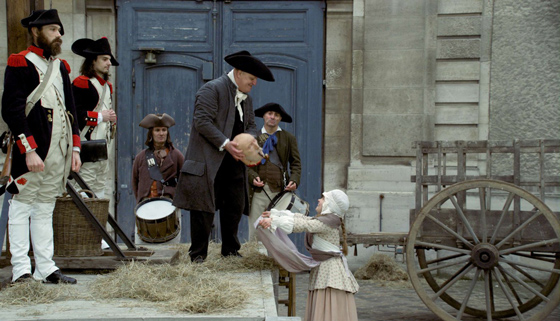
The executioner, slinging his finger, checks the severity of the guillotine. On a wooden cart is taken a criminal in a wig and with a pipe in his teeth. The accusation is read: the revolutionary tribunal accuses Baron Balthazar of criminal correspondence. The audience - all women with knitting in their hands and in caps on their heads - yells joyfully and rejoice. The sentenced is asked to remove the phone from the mouth, but it shakes his head negatively. Five seconds later, the executioner holds Balthazar's head (with an unchanged pipe, but how). One of the spectators, under the envious glances of others, takes a bloodied skull into his hem, and then carefully puts in a basket for sewing.
In the new picture of Otar Ioseliani, as many as two prologues. The first is historical, revolutionary. The second is modern, military. True, do not understand exactly what war is in Georgia. But the soldiers who have their hands on the elbow in the blood, they rob, tear off the rings from the fingers, rape the old women, kill women and children. In a minute of rest, one of the punishers (in appearance is quite non -Russian) puts on a cassock and baptizes all the soldiers in the river.
As always in Joseliani's films, funny here goes by the arm with gloomy. However, at the beginning of the Winter Song, the gloomy transforms is already completely terrible-despite the fact that in a peaceful moment when tanks with looted mattresses on the barrels leave the screen, the soldiers surround the piano and listen to the sad elegy.
 © Cinema Prestige
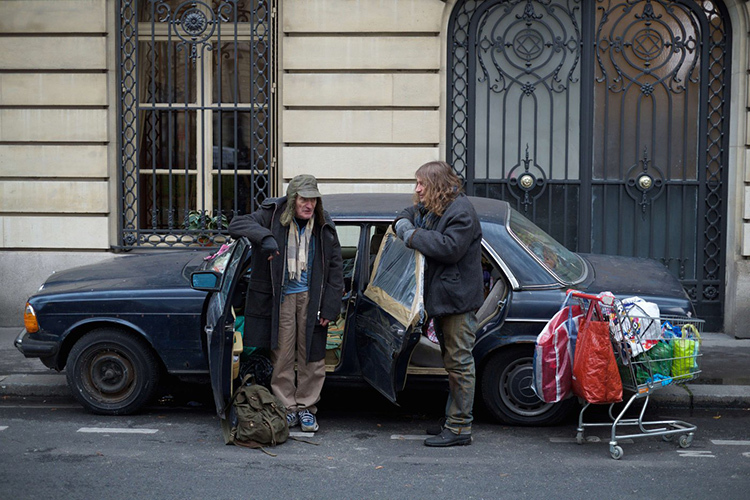
Absurdist humor has always been the key technique of Joseliani (especially the Paris period), as well as obvious sympathies to a variety of proletarian-Levo chantrape. In the main one - "Paris" - there are plenty of parts of the film of these types. A group of schoolgirls on videos terrorizes the city, stealing wallets in the crowd and tearing the hats. Young pockets are leaded by small crime - in appearance an ordinary near -thawed Milyaga. Having fallen in love with the violinist, he asks for a cultural council from two bourgeois - how to get a beauty? They advise you to condemn Beethoven and especially the "ode to joy."
If you list all the jokes and the Gags of the Winter Song, there will not be enough for an hour and a half (the film lasts two). Bushing away from the slate of Keaton’s bastering and using the universe of the surreal satire of Jacques Tati, Ioseliani shoots his, very recognizable cinema: a minimum of dialogues, dumb cinema, conflict of the bourgeoisie and the proletariat and classical music as an acceptable background for a cheerful anarchy. But in the “Winter Song” there is also a funny innovation - this is an amazingly set choreography of the city performance. It is impossible to literally keep track of everything that is happening in the frame. Rollers are stealing, the rally is striking, the police screws the protesters and immediately fleeing the guy with an ax. Joseliani in the Winter Song is more close to the theory - more precisely, the practice of the absence - the central conflict of Raul Ruis. Ruis, being a terrible movieman, from childhood, brought up on Category B films, all his life tried to show that cinema can be built without the main conflict that encourages the main character to action. “For example, two people are fighting on the street. Nearby, the child eats poisoned ice cream. Against this background, someone constantly shoots from the window along the passers-by, but no one even turns his head. In the corner, the artist is trying to capture this picture on canvas, while a pocket thief steals his wallet, and in the shadow of the building, embraced by the tongues of the flame, the dog eats the brain of a drunkard spread out on the ground. In the distance, numerous explosions framed the blood-red sunset. Such a scene is not of interest from the point of view of the theory of the central conflict until we call her “Vacations in Sarajevo” and we will divide all the characters into two warring camps ”(cit. According to the book “ Poetics of Cinema ” ). Exactly the same unthinkable mess is happening in the Winter Song. But if Ruis fought with the very existence of a central conflict, then Joseliani is trying to extract a positive, similar parable from his complex choreography.
 © Cinema Prestige
Joseliani (recognition made in one of the interviews in Locarno) hates money. Following this logic of an unrestraining, playing the meager role of Mathieu Amalric, glorifies the old Hibar with ancient royal outlets, and then happily drinks tea on the terrace. And every character striving for profit, on the contrary, will eventually be punished in one way or another. This also applies to a bald nouveau riche, who practically does not go out of his expensive cabinet (after leaving the street and looking at the beauty passing by, he falls into the sewer ditch), and a soldier from the second, “military”, a prologue who has grown the ring from the victims, and in the third, “Parisian”, part of the police officer (dies from the crazy bullet). And the unpretentious commander in chief of the Roller Banda (arrested). According to the optimistic laws of Joseliani, the truth and retaliation triumphs in the finale.
Nevertheless, it seems that with the age of Joseliani expanded the register of Bunyele's absurdity of his own films, connecting truly tragic and cruel realism (“Georgian” prologue) with ironic surrealism. Black humor became even darker, somewhere the thoughtful romantic poetry of earlier films, which, what to hide, acted in a luster. But in the “Winter Song”, the crazy symphony of life troubles is organized not only epic, but simply exciting. To fall asleep on the “Winter Song” will no longer be possible.