
Translated material
Der Spiegel: Germany proclaimed the end of the G7 Plus Russia format
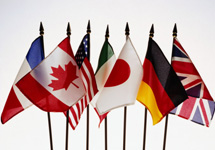
Russia will never be able to join the international format of the Great Seven as an eighth participant in negotiations, according to the department of the Federal Chancellor of Germany. This is stated in the article in the issue of Der Spiegel magazine, which will be released on May 1, the German Wave reports .
According to representatives of the department, at the moment, nothing indicates that Moscow will fulfill the conditions for its return to the circle of leading industrial states. In addition, Washington actively prevents the revival of the “large eight” format. “The G8 format is dead,” the article claims.
In early March 2014, the leaders of the seven leading countries of the world in a joint statement with the leaders of the European Union condemned Russia's invasion of Ukraine and announced that they canceled preparations for the June G8 summit in Sochi . "Russia's actions in Ukraine ... violate the principles and values on which the G7 and G8 are based," the statement said.
In June 2014, the leaders of the G7 participants, instead of a summit in Sochi , held a meeting in Brussels without the participation of Russian President Vladimir Putin . According to the results of the summit, they announced their readiness to impose economic sanctions against Russia in the event of a destabilization of the situation in Ukraine.
In June 2015, the Chancellor of Germany Angela Merkel said that Russia's participation in the G7 summit is currently unthinkable . "The G7 is a group of states united by values such as democracy and the rule of law. Our principles also include protecting the norms of international law and the inviolability of borders, since this is the basis of our world order. And the Russian annexation of Crimea is a violation of international law," Merkel emphasized.
At the same time, Merkel emphasized the interest in further cooperation with Moscow. According to her, without this it is impossible to settle a number of conflicts, including in Syria. Therefore, Merkel maintains regular contact with Putin. The Chancellor expressed satisfaction by the fact that in any case, contacts with Russia are successfully developing within the framework of the Big Twenty, where, according to her, a very good working atmosphere was established.
Canadian Prime Minister Stephen Harper also stated that Russia should not return to the G7. “I do not think that Russia under Vladimir Putin will be one of the G7. The point,” Harper said. “Canada will very much object to Putin sitting down at this table again. Consissus is required to return Russia, but this consensus simply will not happen.”
Shortly before this, the deputy head of the Russian Foreign Ministry, Sergei Ryabkov, said that Russia in the G7 "does not beg." According to him, now Moscow has much more interest in other formats, such as BRICS and Twenty. “Frankly, we do not beg,” said Ryabkov. “First of all, for the reason that Russia did not leave the“ eight ”, but this is his colleagues in the“ eight ”from the Russian chairmanship last year. This is their own sovereign decision, we do not encroach on someone else's sovereignty, it would probably be possible to influence it, having indicated our interest, but we have no interest that we have this interest.”