
Translated material
Earthquakes and volcanoes
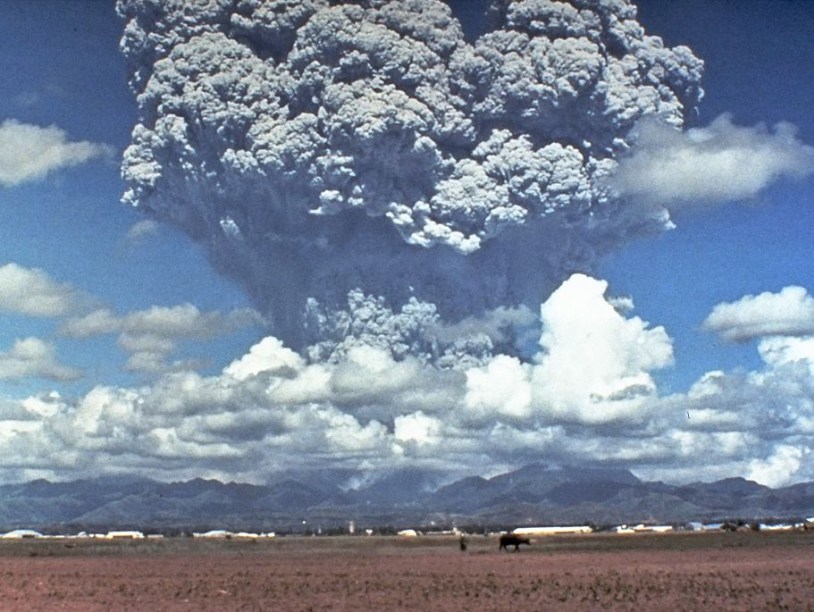
On April 14, an earthquake of magnitude 6.2 occurred on the Japanese island of Kyusu. And two days later, pillars of smoke over the ASO volcano, which is 42 kilometers from the epicenter of the earthquake, were seen. Are these two events related? The authors of the new study came to the conclusion that the ability of earthquakes to cause volcanic eruptions at a considerable distance from the epicenter really exists.
Disputes between scientists regarding this problem have been lasting a long time. The connection of earthquakes and eruptions of volcanoes is well known, but she is not doubted when these catastrophic events occur in one place, since both are associated with the boundaries of tectonic plates. The ability of earthquakes to act on volcanoes at a distance is not so universally recognized.
But Charles Darwin also expressed a hypothesis that the Chilean earthquake of 1835, which destroyed the cities of the concept of concept and Talcauano, also caused the eruption of the Osorno volcano, which Darwin observed a month later. “Judging by the phenomena of a close and complex connection between the lifting and erupping forces that showed throughout this chain,” Darwin wrote, “we can confidently conclude that those forces that slowly or in small jumps will raise the continents, and those that make the volcanic substances pour out of the open craters are identical” (the translation of S. L. Sobol).
In 1990, an earthquake of magnitude 7.7 occurred in the Philippines. After some time, more than 100 kilometers from its epicenter, the eruption of the Pinatubo volcano began. In 2009, David Pyle and his colleagues from Oxford University showed on the basis of many years of data that the number of eruptions in Chilean volcanoes increases within a year after any earthquakes of magnitude 8 or higher.
Scientists have proposed several hypotheses explaining the distant action of earthquakes on volcanoes. According to one assumption, seismic waves reduce the density of magma, making the eruption more likely. According to others, after the earthquakes, the number of gas bubbles in magma increases, which entails an increase in the pressure of magma and increases the risk of eruption. However, no one was able to fully explain why specific volcanoes react to earthquakes, on which the time interval between the earthquake and eruption, which can be from several days to a month, depends, and, finally, what determines the power of the volcano reaction: from tiny gas emissions to a full -scale eruption. Most often, according to David Pyle, volcanologists believed that the communication potential between the earthquake and the volcano is determined by the state of the volcano before the earthquake and the degree of saturation of the magma gas.
Photo: Wikimedia Commons
Now a new model of the remote action of earthquakes has been proposed, in which the cause of volcanic eruptions is called the oscillatory movement of the “carbonated” magma. This type of movement ( Sloshing , in Russian terminology "splashing") is well studied by hydrodynamics, in its section, where fluid movements in the container and surface phenomena in this liquid are considered. The study of splashing liquids is necessary for many tasks of technology, for example, when constructing tankers and cars transporting liquids in tanks, or in metallurgical production.
Atsuko Namiki from the University of Hiroshima drew attention to the destruction of oil storages that arose due to fluctuations in oil during earthquakes. He suggested that volcanoes following earthquakes can also have a similar nature. In order to confirm this hypothesis, Asuko Namiki and her colleagues from the German Center for Earth Sciences in Potsdam conducted an experiment with a “magmatic camera”. They used a rectangular reservoir installed on the vibration stand. The role of magma was played by thick glucose syrup, and pieces of irregular shape plastic imitated rock crystals formed in magma.
For splashing, magma should have a surface and space for moving, so that this process can only occur in a partially filled tank, which can be the Magmatic Canal of the volcano, which is associated with the surface. Also, the occurrence of the oscillatory movements of the magma is affected by the presence of solid fragments, which should not be too many. However, splashing can occur in completely filled tanks - “magmatic chambers” if they have different density in the magma in them. Volcanologists believe that in many cases a layer of lighter magma, in which there are many gas bubbles, lies above a layer of denser magma. In this situation, the lower layer can make oscillatory movements, displacing lighter magma into other chambers.
The researchers in their experiment considered three possible situations: an open chamber with one layer of liquid, an open chamber with a foamed liquid and a closed chamber with two -layer contents, where the gas saturated with gas was located above the dense liquid. For each of the three options, they carried out a series of tests, changing the density and viscosity of the “magma”, the amount of solid fragments, the volume of the gas fraction, the frequency and amplitude of vibrations. Each vibration test lasted 10 minutes.
They found several interesting effects. As scientists suggested, a significant increase in fluctuations in the fluid occurred when the frequency of vibrations approached the resonant frequency of this fluid. In a foamed layer, this deforms gas bubbles, destroys their walls, forcing to unite. As a result of this, the foam is destroyed. Subtle layers of foam with large gas bubbles turned out to be especially susceptible to this. In real volcanoes, according to researchers, the release of hot gases from the destroyed foamed magma in a closed tank can increase heat transfer to surrounding rocks, as well as increase the pressure of the magma and even cause eruption.
In addition, in the case of two -layer magma, the upper foamed layer will not only collapse, but also transfer part of the gas bubbles and solid fragments down into a denser magma. This increases the share of gas in the lower layer, which can lead to a slow increase in the pressure of the magma and, ultimately, increase volcanic activity, leading to eruption after some time.
Atsuko Namiki and her colleagues calculated the conditions that can lead to the destruction of a foamed layer in real magma. According to their calculations, for volcanic, the vent of 0.5 meters needs low -frequency seismic waves. This helps to explain why only large earthquakes are noticed in the fact that they cause volcanic activity. According to Namiki, for the magma in the typical channel of the volcano of the three -meter width, the earthquake of magnitude from 7.5 will cause splashing the magma and destruction of the foam at a distance of up to 100 kilometers. Also, larger, up to a kilometer in width, magmatic chambers located under the volcanoes can resonate with seismic waves if the dense layer of magma fills them to a certain level.
David Pyle, commenting on the results of the study, called them very intriguing and separately noticed that they are verified. The volcanoes, the eruptions of which were caused by the oscillatory movements of the magma, will erupt rocks containing chemical and structural evidence that they are formed in a mixture of foamed and denser magma. If such volcanic products are found, this will become a confirmation of the proposed model.
The article by Asuko Namiki and her colleagues is published in the Journal of Volcanology and Geothermal Research.