
Translated material
"Because I am good." Black Easter 1993
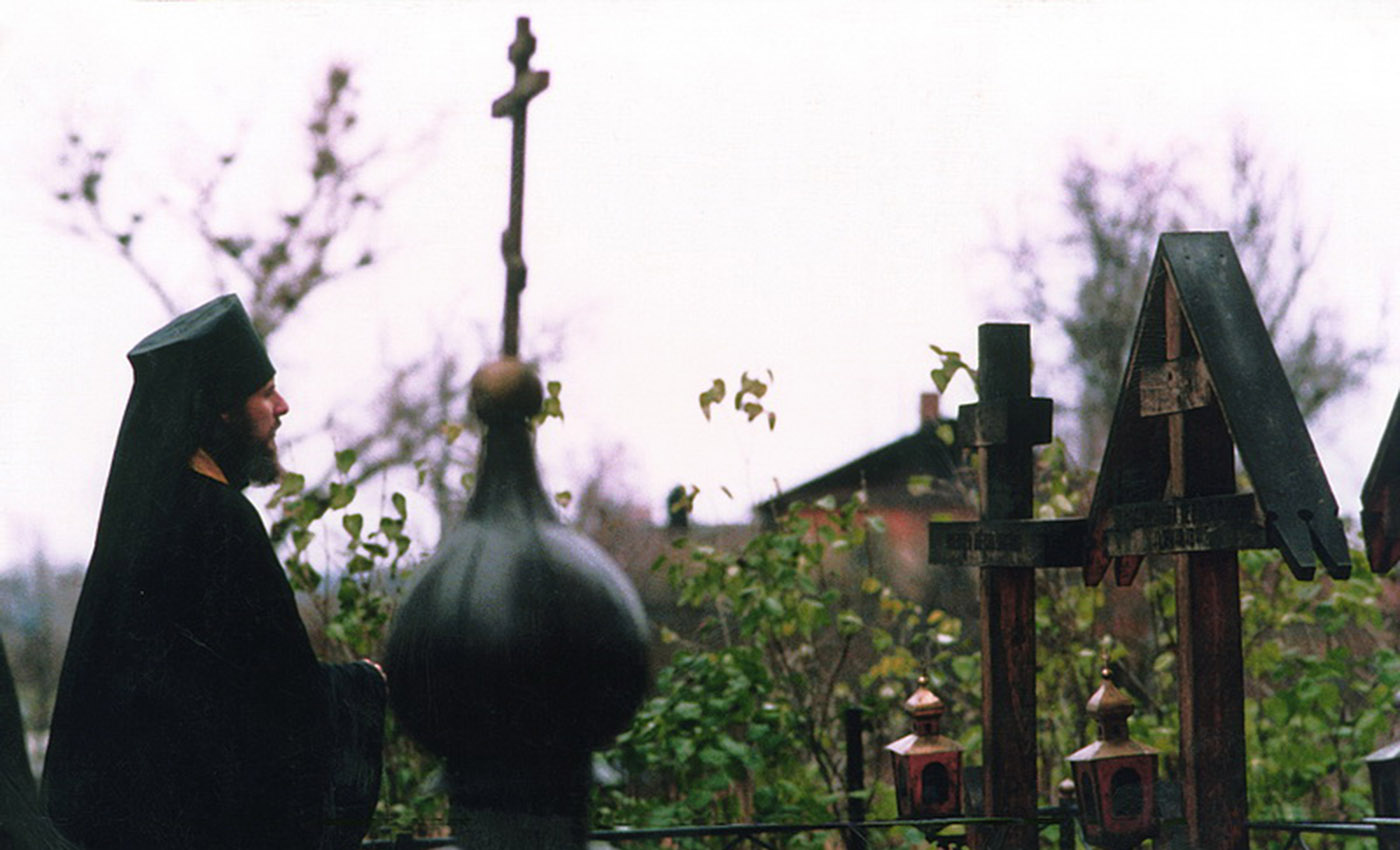
Hieromonk Vasily (Roslyakov) in front of the graves of the Optina elders
Murder on Easter. How Nikolai Averin from the Kozelsky district wanted to take revenge on God for his illness, but instead gave parachurch conspiracy theorists the most convincing evidence of an occult conspiracy against Orthodoxy.
The buildings of the Holy Vvedensky Stavropegic Monastery, better known as Optina Monastery, were transferred to the jurisdiction of the Russian Orthodox Church in November 1987. Soon, pilgrims from all over Russia flocked to the monastery returned to the church in the Kaluga region: the church-going Orthodox were attracted by the glory of the Optina elder Ambrose of Optina (1812-1891), who was canonized the following year, the intelligentsia - by the name of Dostoevsky, who sought consolation here after the death of his three-year-old son Alyosha and brought out the Monk Ambrose in The Brothers Karamazov under the name of Zosima, informal youth were captivated by Optina’s casual mention in one of the first big interviews of the then iconic Boris Grebenshchikov.
In July 1988, when the brethren of the monastery, in addition to the abbot, numbered only two hieromonks, two hierodeacons and four novices, the first liturgy was celebrated here, which was remembered by eyewitnesses as “such a wave of grace that strangers, like relatives, rushed to hug each other.” In those years, in the monastery, which had not yet been rebuilt after decades of neglect (under Soviet rule, there was a vocational school where machine operators were trained), an atmosphere of exaltation reigned: pilgrims call it “a land of wonders,” and, returning home, they willingly share stories about the special grace of this place and the miracles and signs surrounding it.
It is becoming fashionable to go here - despite the spartan conditions in the monastery building reserved for guests, the almost army discipline and the frightening severity of the Optina confessors. Under the guidance of monks, pilgrims perform “obediences”: they work to restore the monastery walls, make furniture, carry water, prepare firewood, and work in the kitchen. “At that time, there were teenagers living at the monastery - one of those who in our time are called “hippies”, but in the old days they were called “tramps.” Orphans, half-orphans, from the age of 8-12 they wandered from den to den, where the child was given drugs and a syringe instead of milk. And they clung to the monastery not yet out of an excess of faith, but rather out of that instinct by which freezing sparrows huddle in the cold to warm housing. In Optina they were called that - our “sparrows”,” the writer Nina Pavlova described the community of young volunteer “workers” that had formed around the monastery.
Residents of the surrounding villages, however, treated the clergy who returned to these places differently. One day in the early 1990s, a noticeable black inscription “MONKS ARE DOGS ****** [harloty]” appeared on the wall of the monastery from afar, but it is unknown who exactly left it.
The idyll in Optina was unexpectedly interrupted in April 1993, on Easter, when a triple murder was committed in the monastery.
Vasily, Trofim and Ferapont
A graduate of the journalism department of Moscow State University, Muscovite Igor Roslyakov came to Optina Pustyn in the year when the restoration of the monastery was just beginning. The clergy noted that the young novice was a diligent, silent and modest person: he performed any work flawlessly.
At the university, Roslyakov studied diligently. Senior lecturer at the Faculty of Journalism Tamara Chermenskaya spoke of him as a very talented young man. “Students in those years were interested in Zen Buddhism, and a stream of philosophical literature mixed with occultism came from the West. I tried to prevent this poison from touching Igor’s soul, fortunately, when he needed advice, it was easy to do so,” the church-going teacher shared her memories. Roslyakov became a frequent guest in her house, however, Chermenskaya claims, it was not she who converted the student to Orthodoxy - over time, Roslyakov allegedly himself was drawn to the faith.
The first change in her son was noticed by his mother. Suddenly, Igor, who had previously painstakingly collected his home library, took all Leo Tolstoy’s books out of the house: “Mom, he’s a heretic!” Tolstoy was replaced by the works of St. Ignatius Brianchaninov, the young man began going to church services, and then left for Optina Pustyn.
Only a few years after Roslyakov settled in the monastery, it turned out by chance that in the world Igor was the captain of the Moscow State University water polo team - one of the pilgrims found his photograph with a cup in the Izvestia newspaper. In Optina, the young novice kept himself apart and did not talk about his past life. According to the inhabitants of the monastery, he put a lot of effort into restoring the monastery and soon became a monk, and then a hieromonk, taking the name Vasily.
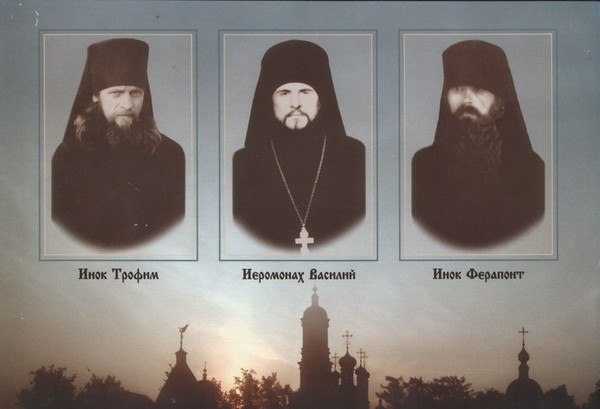
The complete opposite of Roslyakov was Leonid Tatarnikov, later named monk Trofim. The brethren and parishioners knew him well - the young man, who came to Optina in August 1990 from Biysk, stood out for his liveliness of character; he quickly scurried around the monastery and, without hesitation, took on any work. In the world, Tatarnikov managed to change several professions - after serving in the tank forces, he worked in the Sakhalin fishery, was engaged in artistic photography, was a photojournalist in a regional newspaper, a shoemaker, a shepherd and a fireman. He explained his departure to the monastery to his relatives as a sign: he saw a dazzling light emanating from one of the icons in the temple, and heard an unearthly voice.
Being an impatient man, Tatarnikov was in a hurry to become a monk. In Optina they recalled that once he came to ask that his tonsure be done as quickly as possible. “Or maybe you should be tonsured into the schema right away?” - asked the priest to whom he turned. “Father, I agree!” - Tatarnikov exclaimed then. For this - or some other offense - Tatarnikov was denied residence within the monastery walls for two months. The young man settled in a dugout nearby, but did not miss a single service. At the monastery, he managed the pilgrimage hotel, worked as a bell ringer, bookbinder, and repaired clocks.
Less than a year after his arrival, Tatarnikov achieved his goal and took monastic vows under the monastic name Trofim. “Trofim was the spiritual Ilya of Muromets, and he generously poured out his love on everyone in such a heroic way that everyone considered him their best friend. Me too. He was everyone’s brother, helper, relative,” Abbot Vladimir recalled about Tatarnikov.
Another future inhabitant of Optina, Siberian Vladimir Pushkarev, appeared at the monastery in June 1990, having walked 75 kilometers from Kaluga. Locals claim that, having reached the gates of the monastery, he did not knock, but knelt down and stood like that until the morning, patiently waiting for him to be let in.
A native of the Novosibirsk region, Pushkarev was known in the monastery as a reserved person - he spent many hours sitting in his own cell or carpentry workshop. The artist-carver Sergei Losev, who worked at the monastery at that time, said that in Pushkarev “one could feel the enormous inner drama and intense life of the spirit, which is characteristic of large and complex personalities.” “I don’t know what was behind it. But this was Dostoevsky’s man,” Losev said about the Siberian.
Unexpectedly, this taciturn man developed a good relationship with the “sparrows” near the monastery - the youth trusted him and willingly learned wood carving. A year and a half before his death, Pushkarev became a monk and took the name Ferapont. He began to run a carpentry workshop: he cut crosses, prepared boards for icons, and made furniture.
Easter-93
Believing eyewitnesses recalled that the murder of the hieromonk and monks in the Optina Hermitage was preceded by signs, and the monks themselves seemed to have a presentiment of approaching death. In the summer of 1992, the monk Trofim allegedly turned to one of the pilgrims: “Lena, why are you sour? There is so little time left to live, maybe a year. There is no time to be sad anymore. Rejoice! And with these words, the pilgrim claimed, he handed her a bouquet of wild flowers. Local resident Nikolai Zhigaev said that in a conversation with him, Tatarnikov predicted his imminent death. “I feel it in my heart. But I’ll live for another six months,” Zhigaev quoted the monk as saying.
After the murder, it was said in the monastery that during Lent, an unfamiliar man came to the monk Trofim’s bookbinding workshop, declaring that “monks must be killed.” The unknown person did not respond to the offer to calm down and have lunch within the walls of the monastery and promised that soon they would begin to “slaughter” the clergy. “You are ours, ours!” - the guest allegedly repeated, grabbing the monk’s hand in farewell.
In Optina they recalled that several novices were suddenly injured in the altar on the eve of Easter, and on the evening of Holy Saturday there was a strange haze over the monastery - “the air seemed to tremble, the contours of objects doubled, and the cores grabbed at the heart.” Local residents are said to have seen unusual atmospheric phenomena on Easter before - before the accident at the Chernobyl nuclear power plant.
The Easter liturgy on April 18, 1993 ended at about five in the morning. Monastery buses took residents of surrounding villages away from Optina Hermitage, and the police officers guarding the participants in the service also left with them. The inhabitants of the monastery and pilgrims went to the refectory. Father Vasily, who was to conduct two more services, only sat at the table for a while and, having congratulated everyone on the Resurrection of Christ, went up to his cell.
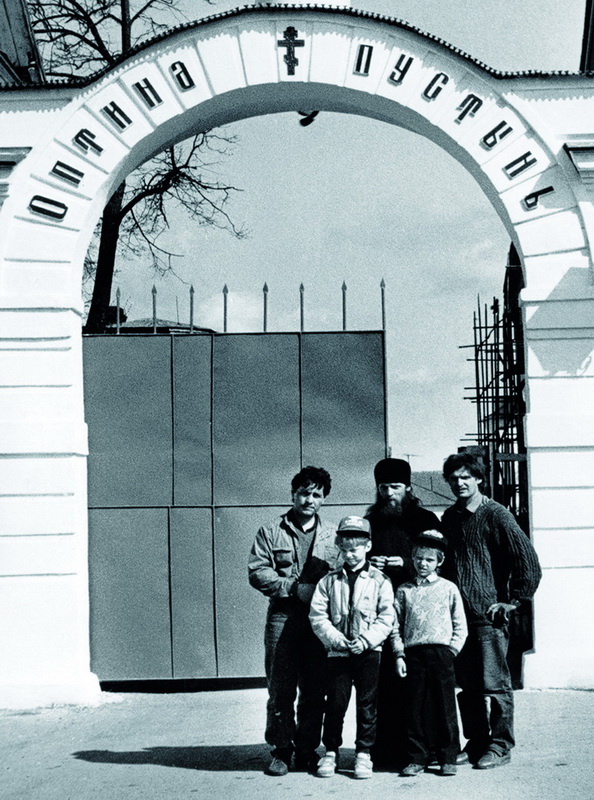
By six o'clock in the morning the monastery courtyard was empty. The last to leave for the monastery was Abbot Alexander, who met the monk Trofim on the way. “Bless me, I’m going to ring,” Trofim asked and, having received the blessing, went towards the belfry.
From the porch of the temple Trofim saw the monk Ferapont. They stood together at the bells when Ferapont suddenly fell onto the wooden flooring, pierced through and through by a long knife. Then a blow to the back overtook the monk Trofim, but before his death he managed to pull himself up to the bells on ropes and ring the alarm. Then the young man's body went limp, and the ringing stopped abruptly. Hieromonk Vasily was on his way to confess the pilgrims to the monastery at that time, but, hearing the sound of the alarm bell, he turned towards the bells and went to meet the murderer.
“It happened on Easter at 6.15 am. We were breaking our fast over tea in the icon-painting workshop when the bells suddenly stopped ringing and an alarming ringing rang out. “What a strange sound,” said Andrey, pouring tea. “More like an alarm bell.” And I also thought with annoyance: “Andrei is always with his jokes - well, what alarm bells? It’s Easter!”,” icon painter Tamara Mushketova later said.
Twelve-year-old Natasha Popova was the first to run up to her fallen father Vasily. Two years earlier, a girl from Kyiv was brought to Optina Pustyn by her parents. The hieromonk was lying on the path near the gate of the monastery. The rosary flew off to the side as it fell. “I didn’t understand why he fell. Suddenly I saw that the priest was covered in blood, and his face was distorted with suffering. I leaned towards him: “Father, what’s wrong with you?” He looked past me - into the sky. Suddenly the expression of pain disappeared, and his face became so enlightened, as if he saw angels descending from heaven,” Popova later said.
At seven o'clock in the morning, when the liturgy began in the monastery, a young novice Alexei burst into the temple, shouting: “They killed the brothers! Brothers!” The dying hieromonk was transferred to the church, placed next to the shrine containing the relics of St. Ambrose. The pale clergyman could no longer speak and, judging by the movements of his lips, was praying intently. “He prayed until his last breath, and all of Optina prayed in tears. The agony was already underway when the ambulance arrived. How everyone regretted later that they did not let Father Vasily die in his native monastery!” - Nina Pavlova writes in her book. The priest died on the way to the hospital.
Local residents noted that after the murder of the monks, it was as if winter had returned to Optina Pustyn - a cold wind blew, rain began to fall, and then snow. People gathered at the blood-stained belfry, crying and praying for the murdered monks.
"Satan 666"
“Okay, the inspection begins. In a central place, next to a wooden bench covered with a green flannelette blanket with a white check, lies a corpse... Is this Father Vasily? Oh, this is the monk Ferapont,” prosecutor-criminologist Larisa Gritsenko conducts an inspection of the crime scene while her colleague records what is happening on a video camera.
Law enforcement officers walk through the yard and, not far from the scene of the murder, find an army overcoat - the military donated a large batch of uniforms to the monastery, such overcoats were distributed to arriving pilgrims. The killer hung his on the stakes of a wooden fence.
“A knife was found in the pocket. Alexander Vasilyevich, what should I call him? The knife is like a dagger, with three sixes stamped near the handle,” continues Gritsenko. Another long sword with a hilt wrapped in electrical tape is found near the monastery wall. It was with this weapon, as experts will find out, that the monks were inflicted with mortal wounds. The inscription “Satan 666” is clumsily engraved on the blade of the sword.
Later, investigators will establish that the murder was carefully planned: local residents will tell them that before Easter an unknown man came to the monastery and squatted for a long time at the belfry. At the eastern wall of the monastery they will find a woodpile stacked in steps - along these pre-folded stairs the attacker fled from the scene of the murder, leaving in plain sight the overcoat with the documents of the monastery fireman in his pocket, in order to throw the investigation off the trail.
They managed to track down the killer two days later - a forester from a neighboring village told the police that a man armed with a sawn-off double-barreled shotgun had broken into his house, but he was calmed down with alcohol. The unknown person ate, drank, asked for clean clothes, and half an hour later left the house without harming anyone from the forester’s family. From his words, a sketch of the strange visitor was compiled.
“At this time, a woman accidentally came into the police department and identified this man. She gave his last name, said his name and said that they live in the same village,” said forensic expert Dmitry Osipov. So the law enforcement agency learned the name of the suspect - he turned out to be 32-year-old resident of the village of Volkonskoye Nikolai Averin, born in 1961. Later, Averin’s guilt was confirmed by a fingerprint examination - his fingerprint was preserved on the third layer of electrical tape that was wrapped around the handle of the sword. Soon he was detained in the regional center of Kozelsk - Averin, who had been hiding in the forest for several days, came to his aunt and, not realizing that her house was already being watched, calmly went to bed.
As the prosecutor’s office later explained, the killer served in Afghanistan and “came home without a single scratch, but with a broken psyche.” He first came to the attention of the police in the summer of 1990, when he and a friend tried to rape an elderly woman. But the men then apologized, the pensioner forgave them and withdrew the statement.
In April 1991, Averin was again accused of attempted rape. This time he beat the woman badly; the case against him was heard in the Kozelsky District Court. A psychiatric examination showed that the accused suffers from schizophrenia, and therefore should be sent for compulsory treatment. Until February 1992, Averin was in Moscow in a psychiatric hospital named after Gannushkin, after which he returned home to his parents.
In the vicinity of Optina Pustyn they claimed: Averin promised to kill the monks long before he managed to realize his plan. In the collective farm workshop they recalled how before Easter the killer came in to sharpen a sword on a machine, putting out some booze.
- Nikolai, who are you sharpening your grudge against - your future mother-in-law? - one of the masters joked.
“No, I want to cut off the monks,” Averin allegedly answered.
Alexander Martynov, a 29-year-old investigator for particularly important cases at the Kaluga Region Prosecutor’s Office, who was investigating the murder of Optina monks, also spoke with the workshop workers. They said that Averin was not the only one who approached them with orders of this kind: the fashion for “satanic” symbols in the Kaluga region allegedly arose after the television showing of the film “The Omen,” a 1970s thriller about the coming of the Antichrist.
The pilots of the agricultural aviation airfield, where Averin worked before the murder, recalled how he showed them the sword with which he later killed the monks, declaring: “I will become famous throughout the world!” Averin, they noted, was completely sober and did not drink at all, although he was actively selling vodka.
At the same time, anonymous letters with threats were sent to the monastery. One of the clergy allegedly received two photographs of the coffin and a promise to kill him with a “golden ramrod in the crown.” And shortly before Easter, a certain man, eyewitnesses recalled, shouted in the temple: “I, too, can be a monk if I kill three monks!”
Averin's verdict
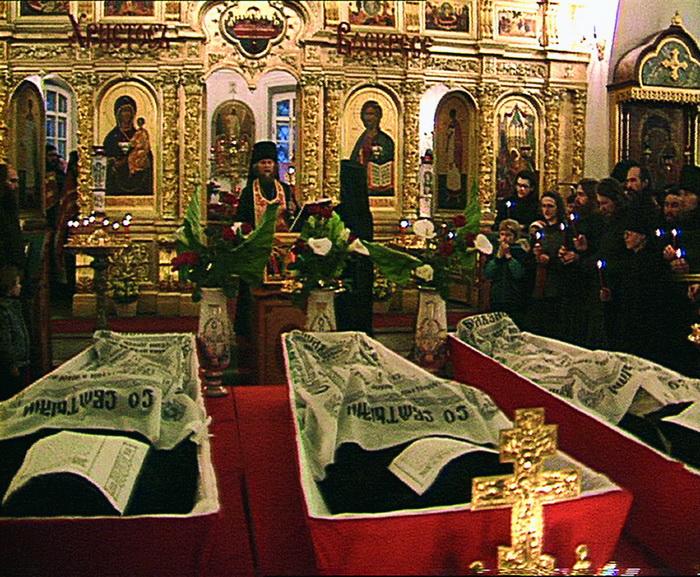
Three coffins were placed in the church in front of the open Royal Doors, crying people approached them with the words: “Christ is risen, Father Vasily!”, “Christ is risen, Trofimushka!”, “Christ is risen, Father Ferapont!” Parishioners placed blessed Easter eggs in the coffins.
Following a trial, the killer of the monks was declared insane. The version that Averin was a member of a certain sect of Satanists or was an adherent of occult teachings was completely refuted by the investigation.
From the case materials it is known that Nikolai Averin was tormented by unaccountable fears since childhood; he was afraid to sleep in the dark. After returning from the war, the man believed and, according to his parents, spent a lot of time in the temple, drying himself out by fasting, and soon began to “hear voices.” At some point, Averin announced to his relatives that in fact he was Jesus Christ. But later, the voice that sounded in his head began to mock the unfortunate man: he forced the man against his will to bang his head against the wall, eat paper and throw himself out of the windows. Averin opened his veins several times. Gradually, the idea took shape and became stronger in his mind that God wished him harm, and, therefore, intercession should be sought from Satan. Averin decided to take revenge on the cruel god by destroying his army - the monks.
According to the witnesses interviewed, in everyday life the killer gave the impression of a calm, polite, harmless person “with oddities.” He was well versed in everyday realities, and showed reasonableness in business.
Averin’s parents testified that their son came to Optina Pustyn more than once and talked with the monks; they reproached him for his pride and advised him to undergo treatment. Following this advice, Averin turned to doctors and psychics, but to no avail.
The medical report, which declared the defendant insane, noted that Averin was not aware of his own actions and could not control them. He is obsessed with delusional ideas and needs compulsory treatment because he poses a particular social danger, the doctors concluded. Averin was imprisoned in a psychiatric clinic.
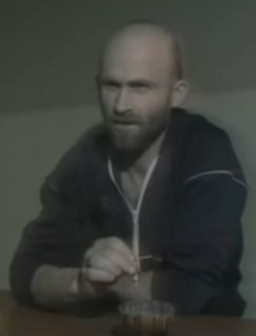
“I couldn’t get hold of God, because you can’t get hold of him. This machine is the most insidious and, roughly speaking, the cleanest in the universe. I can repeat that they [the monks] died a dignified death,” Averin explained in an interview with the film crew of Vakhtang Mikeladze, who was filming the series of programs “Sentenced for Life.” The only thing Averin didn’t like was that two of the three monks “left in an unmanly manner”—they screamed like women before they died. “I had no anger towards them, these guys. I didn’t kill someone for personal gain, I didn’t take the money, you understand,” Averin explained.
Contrary to the version of the investigation, there were rumors in the monastery that Averin did not kill the monks alone, but that a whole group of Satanists was operating in Optina, the purpose of which was to intimidate Orthodox believers. Two pilgrims, who saw from afar how the stabbed Trofim and Ferapont fell, recalled that two men allegedly stood next to them, and one of them said: “Just make a noise, and the same will happen to you.” In church circles they suddenly remembered the secret orders, human sacrifices and “psychic attacks of the SS”, which were rumored to be used against Soviet troops in World War II.
The Orthodox community was also offended by the fact that investigators were looking for the killer primarily inside Optina, suspecting the fireman and other inhabitants. But what most hurt the feelings of believers was the newspaper publications that followed the tragedy - at first, journalists suggested that the murder was committed on the basis of homosexual passion, and then presented Averin as a war hero who had lost his mind.
“The press unanimously made Averin an Afghan hero and declared him a “victim of totalitarianism.” There was no forensic examination yet, but the press was already making its diagnosis: “the young man’s psyche could not withstand the tests of the war into which he was thrown by politicians” (Znamya newspaper). “Twisted by the absurd war, the soul of a young strong guy, left without moral support, was tossing around” (“Komsomolskaya Pravda”). You can give more quotes,” Nina Pavlova is indignant on the pages of her book. She also claims that Averin never actually took part in hostilities: in 1981, after graduating from the Kaluga Cultural and Educational School, he worked at the Volkonsk House of Culture, during the same years he took driver training courses. “Everyone who has received a license knows that this requires a certificate from a psychiatrist confirming the absence of mental illness. Averin was given such a certificate, and until the day of the murder he drove a personal car,” the author notes.
When the case of the murder of the Optina monks was closed, the public-church commission conducted an independent investigation, the findings of which were then published by the newspaper Russky Vestnik. “The commission has evidence that at least three people were involved in the murder, who were seen and could be identified by witnesses,” the final report said. However, the demands of the Orthodox community for a re-investigation of the case and an independent psychiatric examination were ignored.
“But as unjust as human judgment is, so exacting is God’s Judgment. And when they began to collect the memories of local residents in Optina, it turned out that among those who destroyed the monastery during the years of persecution, there was not a single person who would not end up in a truly terrible way,” Pavlova notes gloomily.
The blade with which Averin killed Father Vasily and the monks Trofim and Ferapont is currently kept in the Museum of the Ministry of Internal Affairs in Moscow. Nothing is known about where Averin himself is now. Vakhtang Mikeladze’s program, aired on DTV in 2009, was his last mention in the media.
In a conversation with the film crew, Averin then behaved calmly and confidently. He said that he did not repent at all of what he had done and was unlikely to ever repent.
“There is a war between God and Satan, I can say that I was one of his best students. I'm against God, yes, and I'm glad that I'm with Satan. Because I am good,” Averin smiled, looking into the camera.