
Translated material
Gathered the cashier more "Robin Hood"
"Badgers" Potemkin "in the new biography of Sergei Eisenstein
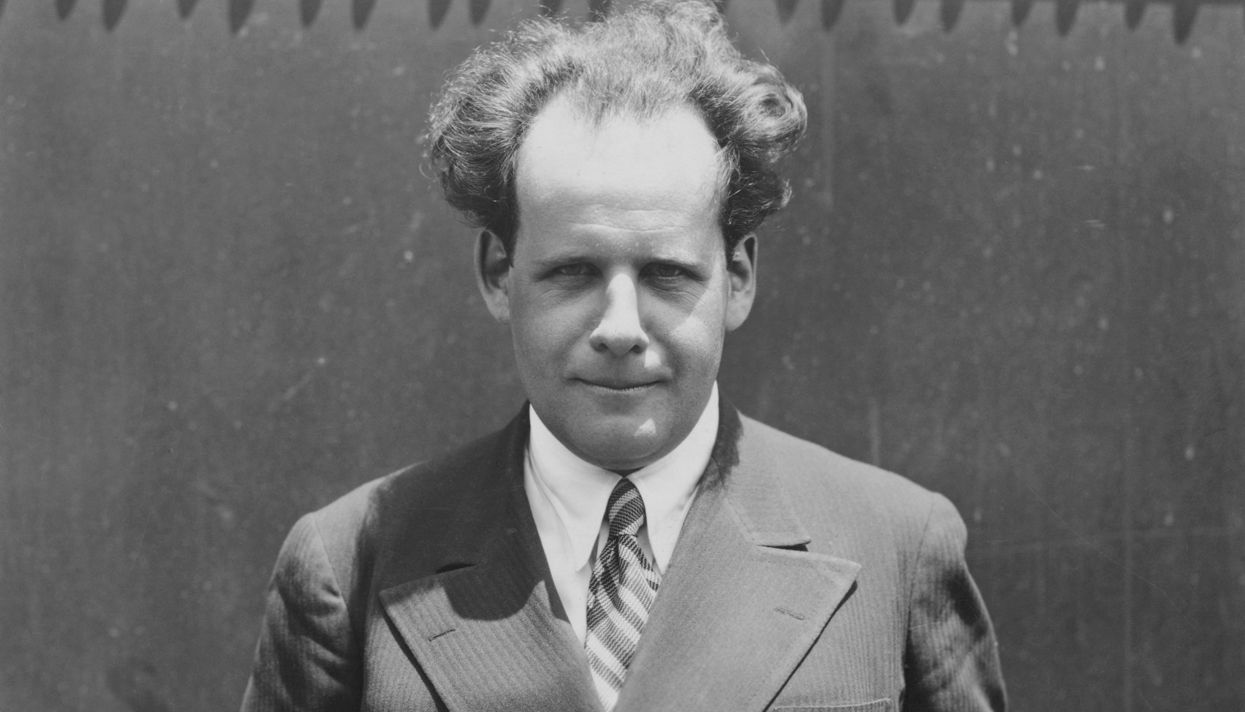
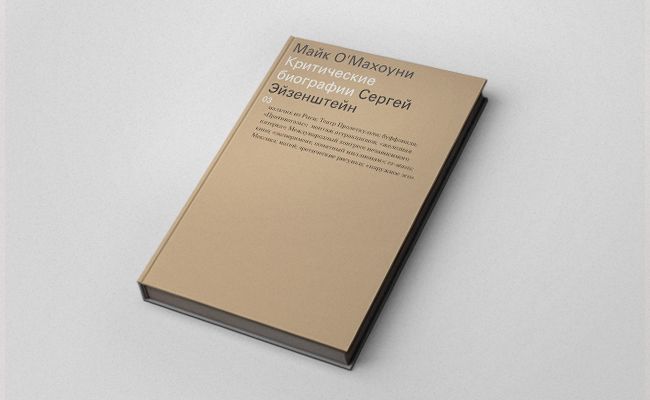
At the end of April, the AD Marginem publishing house has released a brief biography of Sergei Eisenstein, written by the British artist, Mike Omkhuni. In his book, he talks about the fate and work of the director, dwelling in detail on each of his film. "Medusa" publishes a fragment of the book "Sergey Eisenstein", published together with the Museum of Modern Art "Garage".
Like the Stock, Eisenstein thought his second project much larger than he ended up. In March 1925, the Jubilee Commission, established to organize celebrations on the occasion of the twenty years of the 1905 revolution, instructed the director to shoot a picture called “1905”. Together with Nina Agadzhanova-Shutko, a screenwriter and a member of the Bolshevik party since 1907, he began work, plotting the film as an extensive panorama of the events of 1905. Six parts of the film were supposed to narrate the Russian-Japanese war; the dispersal of the peace procession of workers in St. Petersburg-an event later known as “Bloody Sunday”; folk uprisings in cities and villages; universal strike and its suppression by the state; anti -revolutionary pogroms and the formation of the center of labor movement on Krasnaya Presnya. One of the short episodes of this historical chronicle was dedicated to the uprising on the Russian Warship "Prince Potemkin-Tauride".
During the summer, Eisenstein and Agadzhanova-Shutko worked on the script, locked in the country near Moscow. Under the pressure of the need to finish the project before the completion of the calendar year, Eisenstein began shooting at the end of August 1925 in Leningrad along with his “iron five” - Grigory Alexandrov, Maxim Straukh, Mikhail Gomorov, Alexander Antonov and Alexander Levshin. The lack of the sun complicated the process, therefore, on the advice of Mikhail Kapchinsky, by that time the already concerned director Goskino, they went to Odessa to continue shooting in more favorable conditions. It was there that it was decided to focus exclusively on the episode with the battleship "Potemkin". As Alexandrov later notes, “one episode, which occupied only three pages of an endless script”, eventually became a whole film.
Eisenstein tells the “battleship“ Potemkin ”about the events on board the“ Prince Potemkin-Tauride ”vessel in June 1905. The situation begins to heat up when the sailors are given rotten meat. Despite the protests, the ship doctor claims that meat with worms is suitable for eating. Sailors refuse to eat it, in response to which the captain, aggravating the situation, threatens them with a brutal punishment. The rebellion, still passing passively, develops into an open uprising when the captain says several instigators to be shot. In the subsequent brawl, sailors take control of the ship and throw several officers overboard. Their victory is overshadowed by the news of the death of Vakulinchuk, the inspirer of the uprising, which one of the officers shot at. His body is taken for burial to the port of Odessa, where they are met by a sympathetic population. The crowd quickly fills the pier and flows to the stairs to the Richelieu monument - better known as the Odessa staircase - which connects the city center with the port. Frightened by such a unanimous manifestation of solidarity, the government faithful to the tsarist regime directs the troops to disperse the rally, for which one of the most famous scenes in the cinema: the Odessa ladder, like an army of cars, soldiers are descending and hundreds of civilians are shot. In response to this atrocity, the Sailors of Potemkin give a volley of battleships in the city and destroy the General Staff. On the last frames, sailors on board the Potemkin find themselves face to face with the entire Black Sea squadron. Preparing for the battle, they urge their brothers-Moryaks to join them. At the last, climax of the film, the tsarist fleet refuses to shoot at the rebels and supports the rebels.
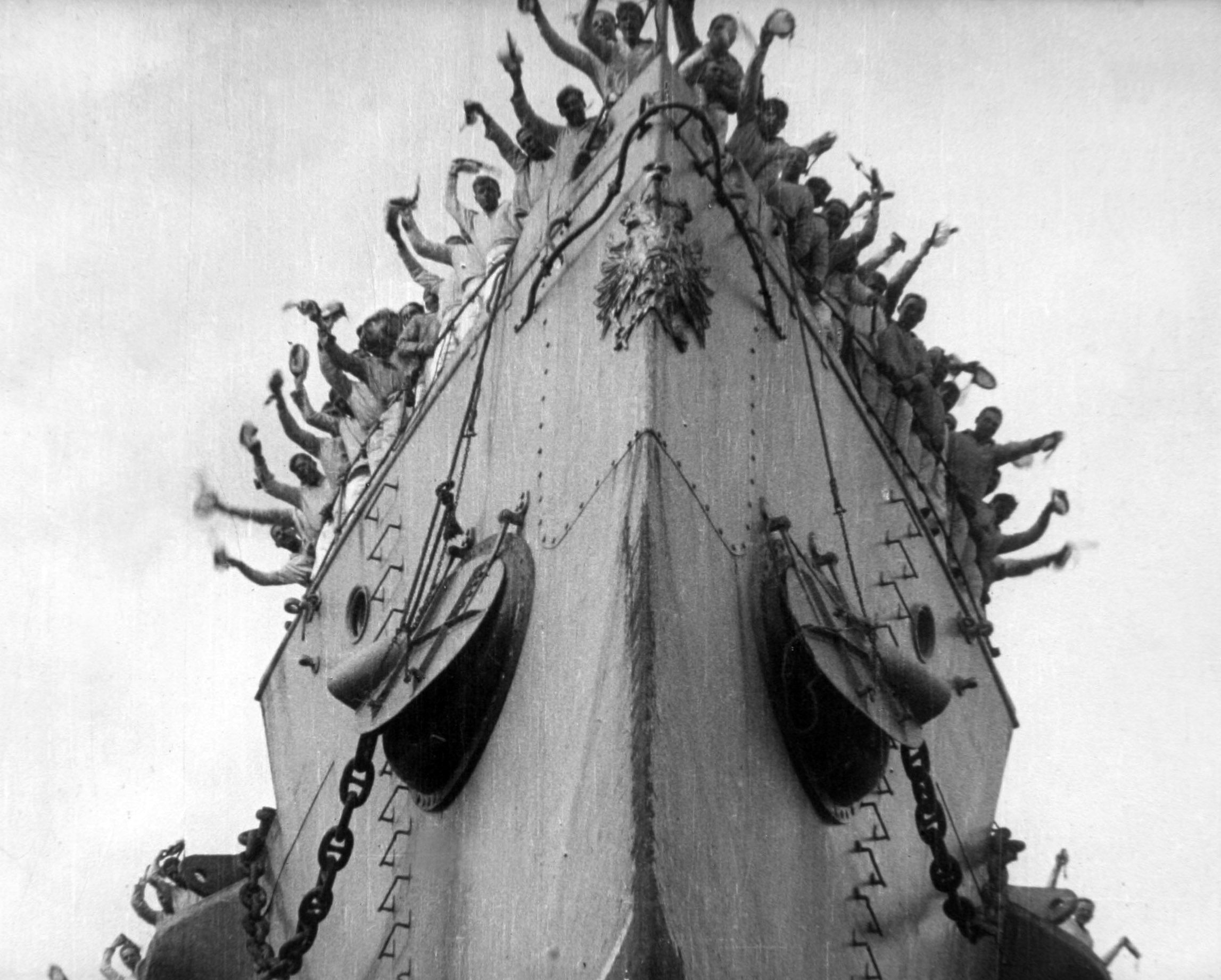
The output to the “Potemkin” screens, like “Stocks”, took place with extensive state support. Following the premise at the Bolshoi Theater (according to some testimonies, Eisenstein ended the installation right during the show), the film premiered in the first Gosquin theater (“art”) near Arbat. On the occasion of the solemn event, the facade of the cinema decorated the ship's layout with masts, banners and guns, and the tickets were dressed in a sailor uniform. The film was warmly met by critics; One of the most enthusiastic reviews belongs to N. Volkov, who, in his review for the newspaper "Trud" ( January 1, 1926. - Ed. ) Called "Potemkin" "a real victory of Soviet cinematography" and "a genuine work of modern cinema, deeply exciting its perfection." Alexei Gvozdev ( “Life of Art”, January 26, 1926. - Ed. ) Name the picture “The Pride of Soviet Cinema” and stated that even Hollywood was not able to shoot the paintings so “exciting in its performance and, at the same time, significant in content”. As in the case of a “strike”, more restrained critics were found. For example, Kuleshov in the ARC Association (Associations of Revolutionary Cinematography) said: “I am refrained in the issue of script and directing. The operator’s work is very satisfactory. ” Having honored Tisesse with a stingy praise, with his laconic answer he left no room for doubts about his views on Eisenstein's talent. Alexei Gan, author of a more tough review: “Eclectic work in a purely aesthetic plan, expressed an equally low assessment. The operator’s work is good, but almond ... In general, the picture is bad. ” Even Vsevolod Pudovkin, calling the “Potemkin” “excellent, high tension, powerfully impressive cinema”, could not but note the “depressingly template” acting ( “Film Mozernal Arc”, 1926, No. 2. - Ed. ).
It was not so easy to evaluate the reaction of the public. The government, of course, considered Potemkin extremely successful: they wrote that he gathered the cashier even more than Robin Guda with Douglas Fairbenx, who was in cinemas at the same time. But this is forced to doubt the words of Lunacharsky, who later said that Potemkin did not meet such a favorable reception. The picture and difficulties with its distribution did not contribute to the success: there was not enough film. In more remote republics of the USSR, the film was shown only after a few months. The inhabitants of Odessa, who participated in the masses on the set of Potemkin, had to wait for the premiere until 1927. And yet, regardless of how widely the film was used by the film, one is obvious: the first two paintings of Eisenstein were a turning point in early Soviet cinema.
Both the “strike” and “battleships“ Potemkin ”” tell about pre-revolutionary events, but differently. With regard to “Stoke”, it is impossible to say with confidence whether it is intended to recreate specific historical events or to outline the general picture of the organization of labor and oppression of workers in pre -revolutionary Russia. The obscenity is introduced by the fact that in 1913, a worker named Yakov Strongin actually committed suicide at the St. Petersburg Plant and this caused a production conflict. Nevertheless, Eisenstein does not claim the historically reliable transfer of the circumstances of the Suicide of Stronggin; In particular, in some scenes of the film you can find out the areas of Moscow, not St. Petersburg. And in the end, when the camera freezes over the symbolically defeated bodies of the proletarians, the viewer remind of the pre -revolutionary uprisings of workers on Lena, in Talca, Zlatoust, Yaroslavl, Tsaritsyn and Kostroma.
“Potemkin” was removed on the basis of a specific historical event, the details of which Eisenstein carefully studied when working on the script. The characters wear the names of the real participants in the episode, including the inspirers of Bunt Vakulinchuk and Matyushenko, and Eisenstein made a lot of effort to most accurately recreate the battleship himself and make the film in those places of Odessa where the 1905 uprising took place. On the other hand, this did not prevent him from drawing obvious parallels with some other historical events. For example, as the director himself later said, the scene of reprisals against the protesters on the Odessa staircase sends the viewer to the execution of workers in Baku in August 1905 and to bloody Sunday. He also wrote about other parallels:
“The rotten meat grows to the symbol of inhuman conditions, which contained not only the army and the fleet, but also the operated workers of the Great Army of Labor. The scene on Utah incorporated the characteristic features of cruelty, with which the royal regime suppressed any attempt to protest, where, when and no matter how it arose. ”
Thus, specific historical circumstances served as Eisenstein a means of expression of a broader idea. In the "Stoke", through the plot, he demonstrates the processes of labor organization and emphasizes this to the opening film by a quote by Lenin:
“The strength of the working class is an organization. Without organizing the masses, the proletariat is nothing. Organized, he is everything. Organization is the unity of action, the unity of the practical performance. ”
It can be assumed that this quote Eisenstein wanted to draw attention to the labor organization and collectivization not only in industrial production, but also in the field of creativity. Joint work and the organization of the masses formed the basis of his work both in the theater and in the cinema. In Potemkin, the story in the center of the plot is characterized by synecdokhi: in a separate episode of the armed uprising, the entire revolution of 1905 was reflected, and as a result - the October Revolution.
Both in the “Stoke” and in Potemkin, turning point of revolutionary moments occur at the beginning - in “Stoke”, workers leave machines and leave the factory’s building, in “Potemkin”, rebels throw officers overboard. In both films, this follows for a long period, when the revolutionary action retains its tension and develops against the obvious threat in the person of the hosts of the plant, brilliant police and the tsarist army. In the context of the mid-1920s, a call to maintain the spirit of the revolution contrary to everything that he was trying to undermine was consonant with anxious moods in society. The civil war ended, but the reasons for concern continued to cause both the apologists of the revolution and its secret opponents. In both films there is a tragic death of the individual - Stronggin in the "Stelka", Vakulinchuk in "Potemkin". After the recent death of Lenin, the scene in which crowds of people flock to give the hero the last honors should have caused a special response from the viewer. Eisenstein demonstrates how sorrow can become the driving force of conscious political activity.
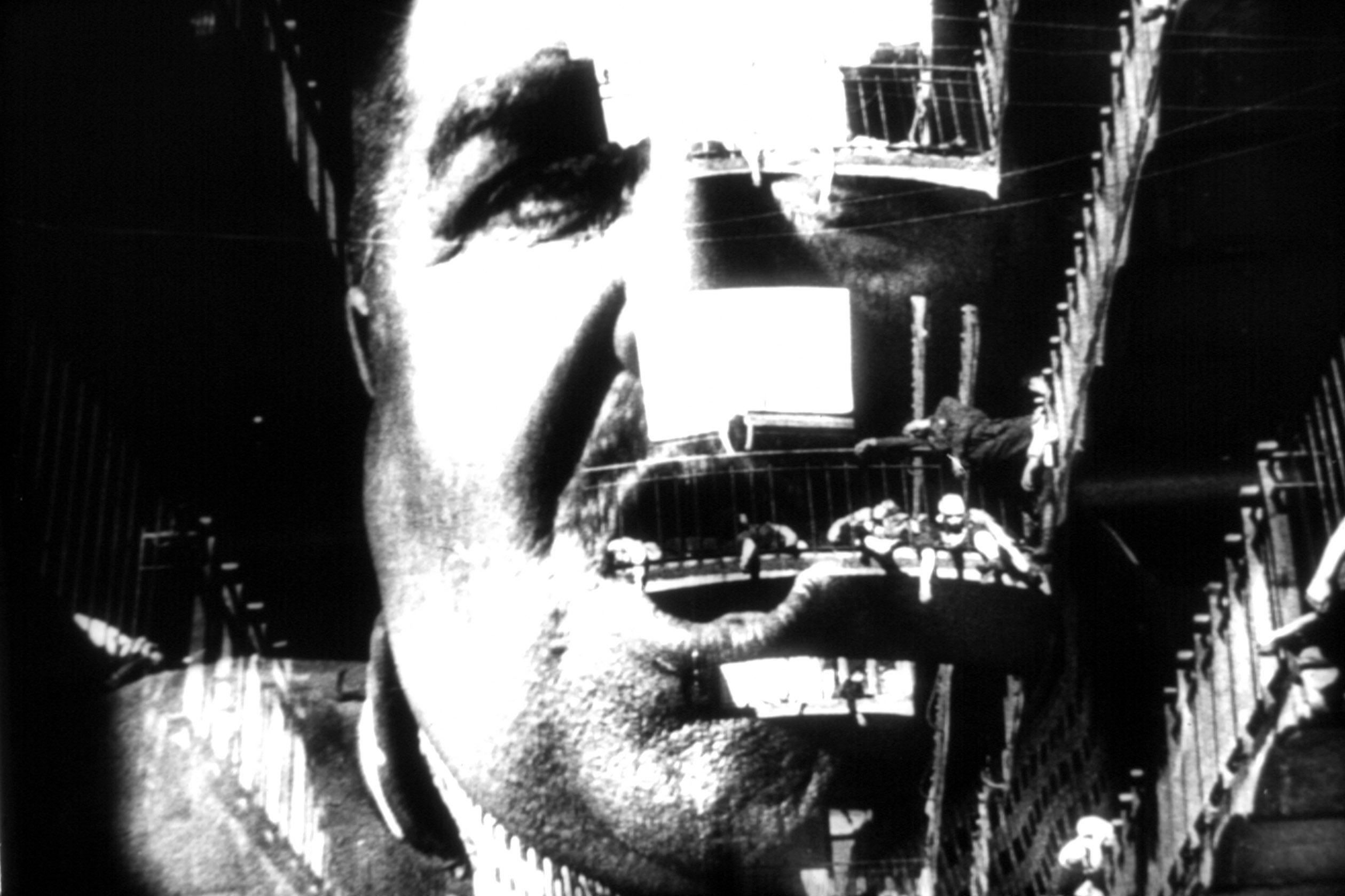
Both in the "Stoke" and "Potemkin" there are named heroes, but in the historical narrative of Eisenstein the main role is assigned to the masses. Creating the image of an anonymous hero-slave, he selected the actors primarily in appearance: each character was supposed to have physical data and facial features characteristic of a typical representative of his class. If possible, he hired local residents instead of professional actors, although in addition to them, the troupe of the Proletkult was still present in the frame. As a result, the workers in the “strike” and the sailors in “Potemkin” all as one differed in the rude physique acquired for years of overwhelming work before the revolution. Their physical power is contrasted with a puny or grotesque-flowing figures of their wealthy enemies, immediately setting up the viewer on the inevitable victory of the workers.
The mass gains its heroic status precisely in the scenes where the crowd acts. For example, when an uprising begins in a “strike”, workers pass through the building of the plant, and everything around - including the Tisesse camera - as if stretching after them. Eisenstein creates the illusion of a spontaneous phenomenon: the stream grows into a stream, a stream into a river, a river into a stormy stream. In Potemkin, he again uses this image of current water: the masses begin to move to the port after the arrival of the battleship, and at first these are small tributaries, then they are united in a metaphorical river, which flows along the streets and under bridges to the shore to honor the murdered Vakulinchuk. The unbridled human stream becomes the personification of the power of the revolution, as inexorable as the waves that beat about the wave -strip in the initial shots of the Potemkin.