
Translated material
Memory. Catherine II
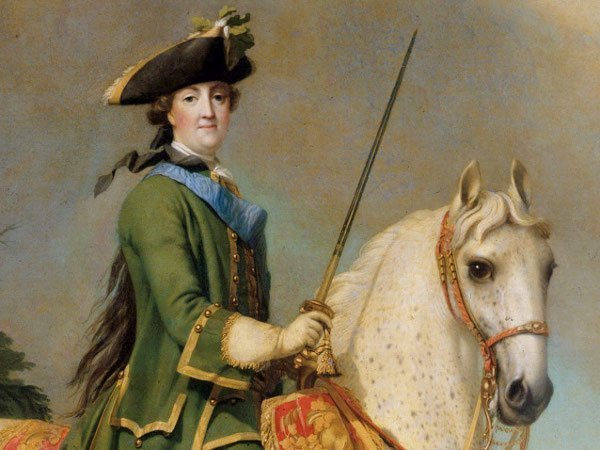
On May 2, 1729, Catherine II Great, Russian Empress was born.
Personal business
Sofia Frederick Augustus Angalt Tserbst (1729–1796) was born in the German city of Shtetin (now Schezitsin in Poland) in the family of the Governor of the city of Christian Augustus and Johanna Elizabeth. She received a home education - languages, elegant arts, history, geography, theology.
The fate of Frederika decided in 1743, when Elizaveta Petrovna, choosing the bride for her heir Peter Fedorovich (the future Russian Emperor Peter III), remembered that her mother bequeathed to her to become the wife of the Holstein prince, her brother Johanna Elizabeth. In 1744, the Current Princess was invited to Russia for marriage with his second cousin Peter Fedorovich.
Immediately after the arrival in Russia, I began to study the Russian language, history, Orthodoxy, Russian traditions, trying to get acquainted with Russia most fully, which I perceived as a new homeland. In particular, she studied Orthodoxy under the leadership of the famous preacher Simon Todorsky.
On July 9, 1744, Sofia Frederick Augustus passed from Lutheranism to Orthodoxy, receiving the name of Ekaterina Alekseevna (the same name and patronymic as that of Catherine I), and the very next day was engaged to the future emperor.
On October 1, 1754, Catherine gave birth to her son Paul. After that, the relationship between her and Peter, and before that, the former stressful, finally deteriorated - Peter called his wife the “spare Madame” and started mistresses, however, without preventing love affairs and Catherine. The spouses moved even more after the husband’s accession to the throne under the name of Peter III in 1762 - he began to openly live with his mistress Elizaveta Vorontsova, settling his wife at the other end of the winter palace.
As an emperor, Peter III did not gain popularity - he concluded an agreement unprofitable for Russia, announced the sequestra of the property of the Russian Church, the abolition of monastery land ownership and shared the surrounding plans for the reform of church rites. The reputation of the sovereign in the guard was especially badly affected. Supporters of the coup, "ripening" even before his ascent to the throne, accused Peter III of ignorance, dementia, dislike for Russia, complete inability to rule. Against his background, a 33-year-old smart, well-read, pious and friendly spouse looked favorably. In the end, she headed the coup on July 9, 1762, in the absence of her husband, taking the oath of the guard units. Peter III, seeing the hopelessness of the resistance, the next day renounced the throne, was taken into custody and died under unclear circumstances (it was supposedly poisoned). Ekaterina Alekseevna entered the throne as a reigning empress with the name of Catherine II. To substantiate his own (and not seven -year -old heir to Paul), Catherine referred to the “desire of all our loyal and unbearable” rights to the throne. According to Vasily Klyuchevsky, “Catherine made a double seizure: she took the power from her husband and did not give it to her son, the natural heir to her father”
The first important step of the new ruler was the reform of the Senate, which was divided into six departments. At the same time, the general powers of the Senate were reduced - in particular, he lost his legislative initiative and became just a body of monitoring the activities of the state apparatus and the highest court. Thus, the center of legislative activity moved directly to Catherine and its office with state secretaries, which can be considered the beginning of the transition to the policy of absolutism. The convened commission was a convened commission, the work of which was to systematize laws, lasted a year and a half, after which it was dissolved under a far -fetched pretext of the need to go to war with the Ottoman Empire.
Catherine considered the crown of her legislative activity “a letter of the rights, liberties and advantages of the noble nobility” and “complained to the letter to cities”, published in 1785. Both letters finally fixed the previously existing rights and privileges behind the upper classes and introduced a number of new ones. Thus, the nobility was exempted from the housing of military units and teams, from bodily punishments (as well as, according to the second document, merchants of the 1st and 2nd guild and eminent citizens) received ownership of the bowels of the land and the right to have their estate institutions. According to historian Nikolai Pavlenko, "in the history of Russia, the nobility has never been prosecuted to such an extent by various privileges as under Catherine II."
The parallel process naturally became the continuing enslavement of the peasants, who were called “slaves” not only late historians and contemporaries-foreigners, but also happy owners, as well as the empress herself. Decrees that worsened their position were accepted throughout the reign of Catherine; So, since 1763, the content of military teams sent to suppress peasant speeches was assigned to the peasants themselves; Two years later, the owners were given the right to send a peasant for disobedience not only to exile, but also for hard labor for an arbitrary period. So that the system does not give undesirable failures, two years later, peasants were forbidden to complain about their master.
A similar “pressure” could not pass without a trace - a series of different -scale uprisings followed. The plague epidemic caused a plague riot in Moscow in 1771. The uprising, which became one of the largest in the 18th century, was nevertheless crushed by the troops under the command of Grigory Orlov extremely quickly - in just three days. In a completely different way, events unfolded two years later in the Urals.
Here, the Don Cossack Emelyan Pugachev, who declared himself Peter III (he was not the first, but the most successful of those who sentenced himself for a wonderful saved emperor), managed to gather representatives of various social and ethnic groups under their banners, each of which had their own reasons for discontent. The core of the troops became the Cossacks dissatisfied with the loss of privileges, who were quickly supported by the workers (for the most part-by-and-as-registered peasants, who, due to the obligation to work at the factory, had no time left for their own economy), peasants and ethnic minorities (Bashkirs, Kazakhs and others). The full-scale civil war continued until 1775, becoming the largest confrontation between this kind from 1612 to the revolution itself. One of the consequences with difficulty suppressed uprising was some relief against the Cossacks and (it became easier for them to obtain the nobility), the peoples of the region (Tatar and Bashkir princes and Murza were equated) on rights and liberties to the Russian nobility) and workers (restriction of the working day, increasing payment). In addition, the uprising was one of the prepositions for the elimination of the Zaporizhzhya Sich. The situation of the peasants has not changed in any way.
More important, however, the result of the uprising was the disaggregation of the provinces - 23 provinces were transformed into 53 governors, each of which was divided into 10-12 counties. Since there were clearly not enough county centers, Catherine II renamed the cities of many large rural settlements; In total, 216 cities appeared in Russia (taking into account the construction of new ones). The provincial division introduced by Catherine was preserved until 1917.
The main directions of foreign policy in the reign of Catherine were Polish and Turkish. With it, three sections of the Commonwealth (1772, 1773 and 1795) were held between Russia, Austria and Prussia; The result was significant territorial acquisitions of Russia. In 1794, a “tripartite annexation” was attempted to reproduce, but the uprising under the leadership of Tadeusz Kostyushko was crushed by the troops of Alexander Suvorov, and shortly after the third section as a result of the conference of the three powers about the fall of the Polish state, it lost sovereignty.
The result of the first “Catherine” Russian-Turkish war of 1768–1774 (declared Ottoman Empire) was the Kyuchuk-Cainargian agreement, according to which the Crimean khanate gained formal independence (de facto becoming a vassal of Russia), and Russia-solid indemnity and the northern coast of the Black Sea.
In 1787, Türkiye tried to return the lost. The consequence was the brilliant victories of Rumyantsev, Orlov-Chesmensky, Suvorov, Potemkin, Ushakov and-as a result-the Yassky peace treaty of 1791, fixing the Crimea and Ochakov for Russia and pushing the border between the two empires to the Dniester. In general, according to the results of the two wars, the Northern Black Sea region, Crimea, and a bush went to Russia; The authority of the empire in the world arena has grown extremely. Another important outcome of the war was the St. George Treatise, which established the protectorate of Russia over Georgia. According to many historians, these conquests are the main achievement of the reign of Catherine II.
The reign of Catherine II is often called the time of "enlightened absolutism." The empress was really familiar with the ideas of European enlightenment and its carriers - her correspondence with Voltaire , a personal acquaintance with Didro became textbooks. A significant impetus was given to education: a public library, the Smolny Institute of Noble Maidens and the Novodevichy Institute for the education of philistine girls, and pedagogical schools in both capitals were founded. A network of city schools based on the classroom system was created. The Academy of Sciences under Catherine has become one of the leading European scientific institutions.
Catherine herself was engaged in literary activities - among her works, translations, fables, fairy tales, comedies, essays, a libretto to five operas; She participated in the weekly satirical magazine “Any things”, published since 1769, and considered herself the patroness of the arts. True, the researchers note that the enjoyment of the Empress to a much greater extent extended to foreign authors, although it was her reign that the heyday of Glory Denis Fonvizin and Gavrila Derzhavin came. Her attitude towards other wonderful contemporaries of the literature was completely different.
The most affected of them were Alexander Radishchev and Nikolai Novikov. Although there are no calls to the elimination of the serfdom and even more than the overthrow of the existing system in the “Travel from St. Petersburg to Moscow”, the author was sentenced to death in the death penalty (after pardon, he was replaced by a 10-year link to Tobolsk)-because his book “Filled by harmful intelligence, destroying the peace of the rest, belittling respect for power ...” magazine Novikova “Truck”, allowing himself to write about the arbitrariness of landowners regarding peasants, general corruption and other ulcers of society, was closed. The publisher, taught by bitter experience in the new magazine "Painter" tried to avoid acute social topics, but he also suffered the same fate. Finally, although the study of books issued by Novikov, specially “ordered” by Yekaterina, did not reveal anything “harmful” in them, in 1785 the publisher was imprisoned by the empress in the Shlisselburg fortress, from where only Paul I released it.
The Empress who contradictly ruled Russia for 34 years died on November 17, 1796 from hemorrhage to the brain in the Winter Palace. He was buried in the tomb of the Peter and Paul Cathedral.
What is famous
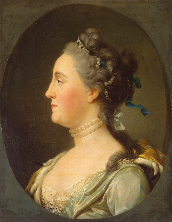 Wigilius Ericksen. Portrait of Catherine II in profile. GE
“Tsar-Baba” (in her own words), in which the Russian Empire gained the status of a great power, the first in the number of population in Europe. In its era, the country made extremely important territorial acquisitions (the expansion similar in terms of scale will have to only be the reign of Alexander II), the amount of state revenues increased four times, the army was half as much. The name of the Golden Age was firmly entrenched in Catherine’s rule (although this is true mainly in relation to the nobility).
What you need to know about
One of the most striking - and invariably causing the widest interest - will accept the Catherine's time favoritism. Repeatedly attempts to count the number of "persons especially close to the empress." The most famous of them were Sergey Saltykov (according to some assumptions - the father of Paul I), who became already after the connection with Catherine (and, apparently, partly due to such) the king of Poland Stanislav Penatovsky, Grigory Orlov , Grigory Potemkin . With the latter, according to some reports, Catherine was secretly married. The empress had two sons: Pavel I and (from Grigory Orlov) Alexei Bobrinsky; In infancy, daughter Anna died.
The personal life of Catherine is surrounded by many "scandals, intrigues and investigations." There is no doubt that her favorites were awarded undeserved incentives, which had a solid material and/or career equivalent: so, Field Marshal Rumyantsev was removed from the army command to please him, despite the undeniable military merits. The morals that reigned at the court, in general, “looking at the faces”, and not on merits, gave a bad example in the field: corruption became one of the integral features of the reign of Catherine II.
Direct speech
About the state: "In Russia, everything is under secret, but there are no secrets."
About the Radishchev sent to exile: "It goes to mourn the deplorable fate of the peasant state, although it is undeniable that the best fate of our peasants has no good landowner in the entire universe."
About serfs: “There are no slaves in Russia. Fortress peasants in Russia are independent of their spirit, although they are forced to force with the body. ”
About the prosperity of the people: "Our taxes are so unrelenting that in Russia there is no man who would not have chicken when he wants it, and since some time they prefer turkeys to chickens."
On the prosperity of the people- II (1770-a year of hungry riots): “In Russia, everything is going on as an ordinary order: there are provinces in which they almost do not know that we have been continuing the war for two years. Nowhere is there a shortage of anything: they sing thanksgiving prayers, dance and have fun. ”
About the sad fate of the ruler (turning to Denis Didro): “You write on paper, which will endure everything, I, the poor empress, on the skin of human, so sensitive and painful.”
About the passion for literature and legislativeness: "I cannot see a pure pen without the desire to immediately dip it in the ink."
About me (prepared auto -capital): “Catherine the second rests here. She arrived in Russia in 1744 to marry Peter III. At the age of fourteen, she made a threefold decision: to please her spouse, Elizabeth and the people. She did not miss anything to achieve success in this regard. Eighteen years, fulfilled boredom and loneliness, prompted her to read many books. Having ascended the Russian throne, she put all the efforts to give her subjects happiness, freedom and material well -being. She easily forgave and did not hate anyone. She was condescending, loved life, was distinguished by the cheerfulness of the temper, was a true republican in her beliefs and had a good heart. She had friends. The work was easy for her. She liked secular entertainment and art. ”
Belgian Prince Charles Joseph de Lin about the reign of Catherine: “Catherine gathered the remaining fragments and unfinished parts in the workshop of Peter. Having complemented them, she built the building and now, through hidden springs, sets in motion a gigantic composition, that is, Russia. She gave her a device, strength and fortress. This device, strength and fortress will flourish an hour from an hour more if the successors of Catherine will follow her traces. ”
Alexander Pushkin on the rule of Catherine: “The reign of Catherine II had a new and strong influence on the political and moral state of Russia. Eleased on the throne by a conspiracy of several rebels, she enriched them at the expense of the people and humiliated our restless nobility. If you reign, it means to know the weakness of the human soul and use it, then in this respect, Catherine deserves the surprise of offspring. Her splendor blinded, attracted friendliness, tied the generoes. The most sweetness of this cunning woman affirmed her rule. Producing a weak murmur in the people, accustomed to respect the vices of their rulers, it excited a vile competition in the highest states, for there was no mind, no merits, nor talents to achieve second place in the state. ”
Friedrich Engels about the Catherine era: “Catherine II's courtyard turned into the capital of the then enlightened people, especially the French; She managed to mislead public opinion that Voltaire and many others sang the Northern Semiramida and proclaimed Russia the most progressive country in the world, the Fatherland of liberal principles, and a champion of religious tolerance. ”
Vasily Klyuchevsky about the nobleman of the Catherine’s era: “... was a very strange phenomenon: manners, habits, concepts, feelings, the most language in which he thought - everything was alien, everything was imported, and he had no living organic connections with others, no serious business ... in the west, in it, they saw a change in tatar, and in Russia for him in Russia. We watched as a Frenchman who accidentally born in Russia. ”
8 facts about Catherine II
- The public administration system under Catherine the Second was reformed for the first time since Peter I
- It was under Catherine II that serfdom was introduced in Little Russia and New Russia
- The first few meetings of the stated commission were devoted only to how to name the empress in gratitude for her initiative to convene the department; Then the title "Catherine the Great" appeared
- Catherine was awarded the Russian orders of St. Catherine, St. Andrew the First -Called, St. George and St. Vladimir, the Swedish Order of Seraphim and the Prussian Orders of the Black and White Eagle
- According to Catherine prepared at the direction of Catherine, Voltaire wrote the history of Peter I, skeptically accepted by contemporaries
- Catherine sniffed tobacco - but in order not to poison the subjects smell, she took a pinch with her left hand
- The total number of Catherine favorites for authoritative estimate is 23 people
- Among the actresses who played the Empress in the cinema - Paul Negri, Marlene Dietrich, Bett Davis, Svetlana Kryuchkova, Marina Vladi, Nonna Grishaeva
Materials about Catherine II
A site dedicated to Catherine II
Historical jokes about Catherine II (18+)
Article about Catherine II on Wikipedia
Ekaterina II - biography
Name Russia - Ekaterina II Great
A monument to Catherine II will be erected in Tiraspol