
Translated material
New virtual
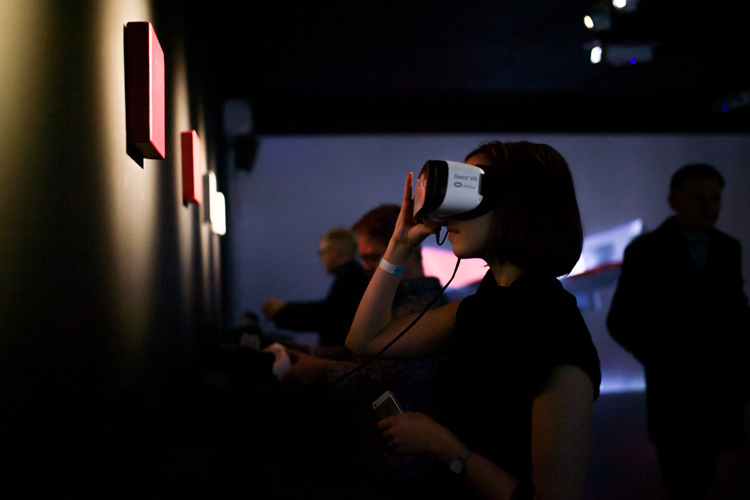
In the center of Mars opened the first Moscow Virtual Reality Exhibition of Methadama . Such an event is a good reason to turn to foreign experience and see how virtual art changes the art world.
"Methams"
The projects of the updated Center Mars have always been at the junction of art and “artethein” (from ART , “art”, and Entertainment , “entertainment.”- Ed .) And never pretended to be something else. More than a year has passed since the reboot of the center , and during this time four exhibitions of audiovisual art went out here. Having made a Moscow audience with digital art, Mars from a half -dead exhibition center imperceptibly turned into one of the flagships of the capital's media culture.
In April, a new exhibition opened here-a project created by the creative association of Artmossfer, responsible for the Street art, and the Interactive studio Lab , which added virtual reality to the reality of exhibition space. Wandering around the halls filled with parades and graphic images of authorship Nootk , Misha Most , Pokras Lampas , Alexey Kio & IVAN Benr and other street artists, you find yourself in a space most similar to an abandoned house or squat. But everything changes when the volunteers offer to wear a VR -she, in order to feel the space in a new way. And the focus manages: with virtual reality glasses, the exhibition doubles, images on the walls become voluminous, alive, forming another exposure. No matter how trite it sounds, but at that moment the feeling of joyful trepidation, which restores adults back to childhood, can be compared only with pleasure from a double burger. It is as tasty as the usual, but there is one important difference - it is more. So it is here: Mars’s halls turned into a total installation, street artists, under the influence of VR , are reincarnated into virtual gamland.
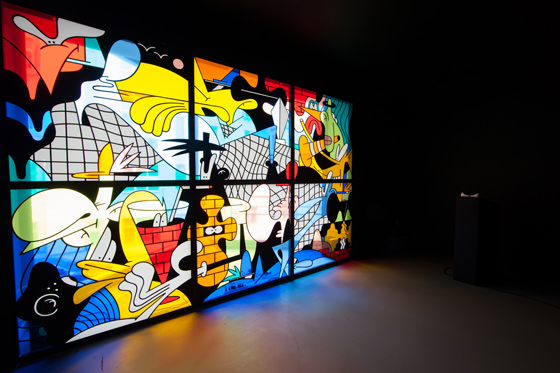 © Center Mars Hall NOOTK at the exhibition "Metforms"
VR + street art
Similar experiments of the transformation of the audience perception with the help of virtual reality have more than once happened in world practice. It all started, of course, with technology -the creation of the VR harnation Oculus Rift in the short time 2012. Following the expensive American invention, the product versions more accessible to the wide consumer - Google virtual reality helmets Cardboard and Samsung Gear VR : The latter was just involved at the Moscow Exhibition "Methadama". VR harnitors allow you to see objects in a volume of 360 degrees, control them with the movement of the head, and therefore perform certain actions -for example, draw a brush or spray, create structures, etc. But most importantly - they give rise to a feeling of complete immersion in this new, freshly built artificial world.
The use of VR technologies, coupled with street art, is perhaps the most natural combination of different media in art. Graffiti and a stencil spray-art themselves always complemented the reality of the city space and obviously asked for its limits. This is evidenced by the latest experiments of street artists with digital technologies. For example, the Street artist INSA invented a new form of art, calling it Giffiti . Drawing his graffiti layer behind the layer, he parallel to photographs them, and then creates an animated GIF image and puts it on the network. The Katsu Hacker artist used a supplemented reality technology to leave his tags in the Picasso picture in MOMA and the surface of the White House fence -to see these digital graffiti, of course, can only be on YouTube video. The artist Anthony Kapetto creates a 3D strap art , introducing virtual reality directly into the street space. His work can be found around the world: in New York, California, Dubai and many European cities. He also carefully catalogs them in his blog called Anthony Cappetto VR Art . A number of artists, including the Berlin Street Artist Sweza and the American Zenka , uses QR codes, integrating them into the graffiti space, the viewer with the help of a mobile application can “revive” the image and see it in 3D. The last hobby of technological street artists is Tilt Brush , a project from Google , completely transferring street art to a virtual reality space. Tilt Brush allows users of the HTC virtual headset Vive (analogue of the helmet Oculus Rift ) draw 3D production in an imaginary space, choosing tools, paints and effects. But whether this can finally lure artists from the urban environment into digital reality, transforming all the laws of the genre, time will tell.
 © Center Mars Hall Misha Most at the exhibition "Methadama"
VR + media art
Interest in new virtuality is also observed from artists working in the vastness of modern visual and media art. One of the pioneers of the use of virtual reality is everywhere recognized by the French artist Maurice Benayun. His contribution to technological art has repeatedly confirmed by the award of ARS Electronica - the artist has four of them. Benayun believes that fiction and reality are an indivisible whole in a work of art, and this idea became the basis of his concept of “critical synthesis” . The first project created using VR technologies was its Tunnel under the Atlantic (1995). This television installation embodies a symbolic interactive space connecting people between Montreal and Paris. The space inside the virtual tunnel is filled with layers of iconographic images from two different geographical and cultural spaces. At the time of its appearance, the work was a real technological breakthrough, and its creator still continues creative experiments, remaining on advanced digital art.
Maurice Benayun. Tunnel under the Atlantic. 1995
For a media artist from Canada, John Rafman, virtual reality is another tool for studying the relationship between technology and human experience. One of his latest resonant works, where VR technology is used, is the “Garden of Sculptures” (2015). Getting inside this immersive installation, the visitor finds himself in a dark garden, reminiscent of the maze of the minotaur, where he is awaiting a clash with digital reality inhabited by deformed busts, “garden sculptures” and other deities of the new technological world. In this fabulous world, the viewer experiences sensations at the same time fear and interest. The culmination of his trip is a collision with the central figure of the garden - the gold likeness of the space alien. The work refers to the aesthetics of computer games and concerns an important question for the artist: how new technologies move us away from themselves, creating parallel reality - gloomy, frightening, but nevertheless quite possible in the near future.
Creation of the Exhibition "Garden of Sculptures" by John Rafman in Zabludowicz Collection
Rachel Rossin is an American artist and programmer working with various media, from painting to interactive audiovisual installations. The leitmotif of her work is a virtual reality: so, one of the last Lossy projects (2015) is picturesque works, the images of which are clearly inspired by computer codes and pixels of the digital screen. You need to look at them through Oculus glasses Rift , transforming images in a volume of 360 degrees. The Lossy project is based on the idea of data loss (the term from the field of programming) is exactly what happens in our daily life, reminiscent of constant jumps from the monitor of one gadget to another (a wonderful example of such art can be viewed here . - Ed .).
VR and exhibition activities
The presentation of traditional media, such as painting, graphics and photography, in the space of virtual reality - a new word for exhibition practice. The opportunity to present the audience online using mobile applications to Google Cardboard and Samsung Gear VR is becoming an increasingly popular solution. So, London Royal Academy of ARTS until November 20, 2016 offers to see the AI WeIWEI 360 project. The works of the famous Chinese artist Ai Weiwei are represented in a stereoscopic 3D, in addition, a prepared virtual tour includes video and audio collection, explaining the ideas of the artist no worse than the most experienced guide.
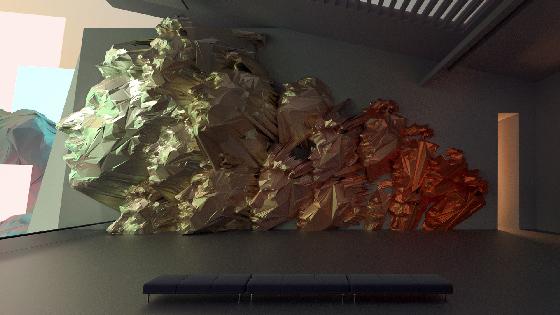 © Panther Project Mark Dorf for Panther, 2015
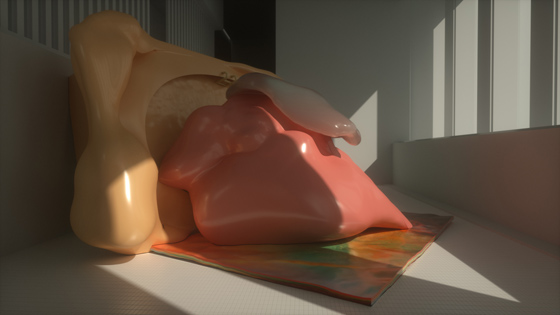
As a significant trace, the VR technology has already left in exhibition activities, you can judge by the emergence of two unusual projects -the Panther virtual art galleries and the museum of stolen art . Panther , an online platform created in 2014, offers a media artist to create a Site - Specific project in one of the spaces of a virtual gallery. The artist receives the “plan” of the dedicated room in the form of a 3D model. The viewer can visit the opening of a new exhibition without leaving home, while the possibilities to physically explore the space of art are only expanding - the technology allows us to consider digital objects from all possible angles. The gallery continues to replenish with new fantasy works - releases are widely covered by publications such as Wired and The Creators Project .
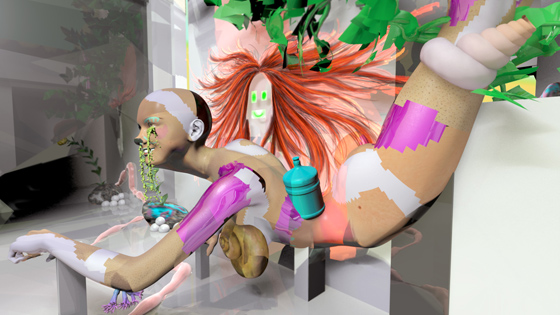 © Panther Project Katie Thorne for Panther, 2016
  © Panther Project Oliver Haiducca, 2014
Creator and curator The Museum of Stolen Art Ziv Schneider decided to introduce the world to forever lost works of art - and realized his idea in virtual reality. The museum of the stolen art looks alone as a classic exhibition space - white walls with paintings hung on them in gilded frames, only it is no longer possible to see these works live. Schneider plans to hold an exhibition of art lost as a result of military conflicts in Iraq and Afghanistan. This project, impossible without the use of digital technologies, paradoxically returns us to the reality of the present, recalling how important the presence of real masterpieces of world culture in museums and galleries around the world.
Museum of the stolen art
The first experiments of using virtual reality indicate that artists and theorists have yet to develop and manifest the norms of this visual language. But the fact remains: his invasion of the art scene has already occurred, and everyone will have to do something.