
Translated material
Home without fire
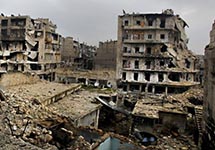
Washington and Moscow agreed to expand the ceasefire in Syria to the territory of the Aleppo province, where the battles of government forces with the opposition are still continuing. This is stated in the statement published on the website of the US State Department.
"As part of our efforts to de -escalate violence in Syria and the establishment of the US truce and Russia throughout this country, yesterday at the end of the day they agreed on the spread of the ceasefire to the Aleppo province, including the city of the same name and the regional areas," the State Department notes.
“We firmly intend to achieve the cessation of violence throughout Syria. We will continue efforts in this direction in order to reduce the level of violence, reduce the suffering of local residents and help create conditions under which the parties to the conflict will be able to continue negotiations focused on the political transition, in accordance with the UN 2254 Security Council and the Geneva Communist of 2012,” the document emphasizes.
The official representative of the State Department Mark Toner specified that the United States coordinates the final work with Russia to organize observation of the implementation of the conditions of the ceasefire in Aleppo.
In turn, the official representative of the Russian Ministry of Defense, Igor Konashenkov, said that the "silence regime" in the city of Aleppo is extended by 48 hours. "During the held telephone conversation between the leaders of the Russian Center for the Reconciliation of the warring parties and the analytical military-political center of the United States in Amman (Jordan), the American side supported Russian proposals for the re-introduction of the" silence regime "in Eastern Guta and Northern Latakia for 24 hours (until 24.00 May 5), as well as the continuation of 48 hours (until 24.00 on May 6)" The Silence Region "in the city in the city Aleppo, ”the general said.
Meanwhile, an open meeting of the UN Security Council on the situation that has developed in Aleppo has been scheduled for the evening of Wednesday. It will be heard the reports of the deputies of the Secretary General of Political Issues of Jeffrey Feltman and on humanitarian issues of Stephen O'Brien. The initiators of the convocation of the meeting were previously Great Britain and France.
On April 15, US Secretary of State John Kerry, in a telephone conversation with the Russian Foreign Minister Sergei Lavrov, asked Russia to use his influence on Assad’s regime in order to stop violations of the truce.
On April 16, the source of the State Department said that the United States is urging Russia to help to terminate the offensive of the Syrian government forces into opposition groups in Aleppo. In Washington, they fear that these fighting can lead to a breakdown of the ceasefire.
"The Barack Obama administration expressed the serious concern of Russia, which took the obligation not to participate in military operations against groups that participate in a ceasefire," the State Department said.
On April 19, US President Barack Obama, during a telephone conversation with Putin, urged Damascus to terminate the opposition attacks . The leaders of the two countries pledged to promote the regime initiated by Russia and the United States to cessation of hostilities in this country, as well as to ensure the access of humanitarian aid in the relevant areas. Obama also emphasized the need to promote the political transition process in order to put an end to the conflict in Syria. The presidents of Russia and the United States emphasized the importance of intersiria negotiations held in Geneva under the auspices of the UN.
From the night to April 30 , a temporary truce entered into force in the East Guta, a suburb of Damascus and in the Northern Syrian province of Latakia. These areas were added to the regions where the truce entered into force two months ago.
The "Silence Region" was introduced as a result of an agreement between Russia and the USA. The American side insisted on the cessation of hostilities in the Aleppo area. However, Russia abandoned this proposal.
When asked why the United States did not achieve the cessation of violence in Aleppo, Toner then replied: "Partly, this is the recognition that Aleppo is a very complex area. The struggle around it really causes anxiety. But we must start somewhere, and we are going to start with Latakia and Eastern Guta."