
Translated material
Why Marblah is very cool
What games with small balls did people think of
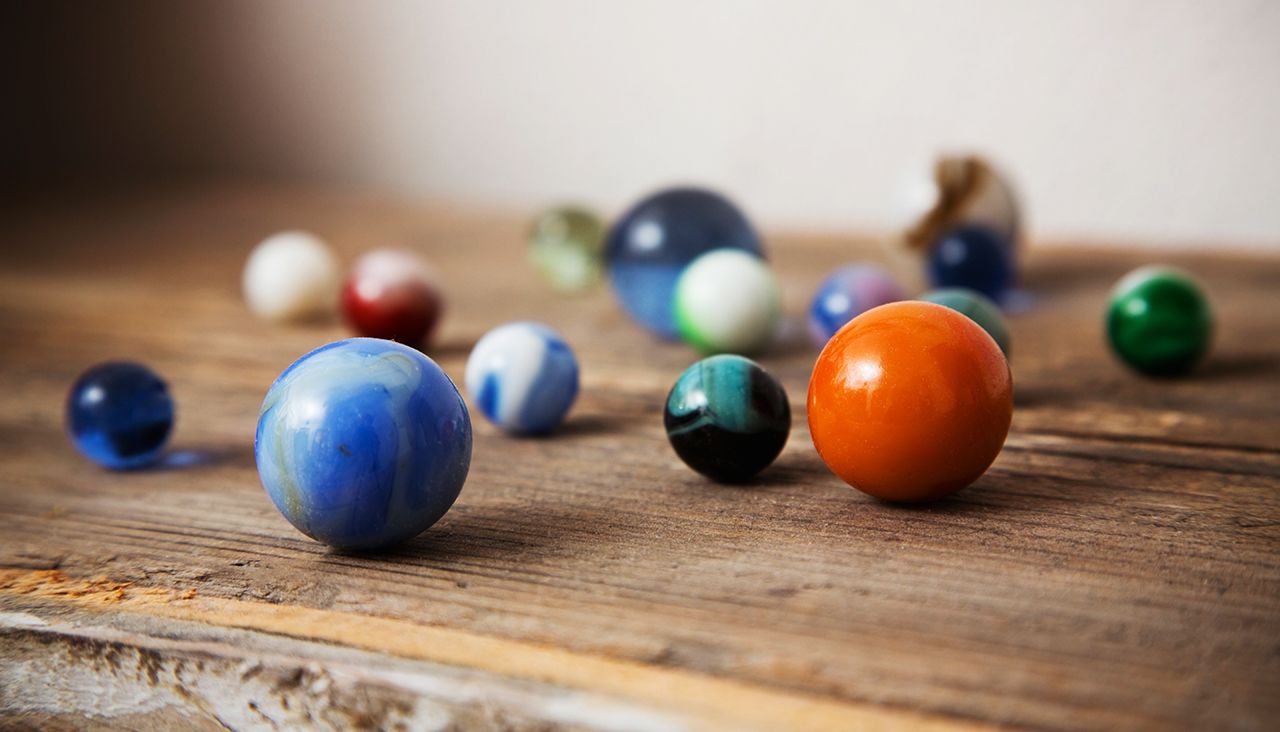
Recently, a video with balls, in which not only children, but also adults play play more and more often. For these balls, in other words, Marblov, make large labyrinths and come up with various competitions. "Medusa" tells what these balls are, from which they are made and how to play in them.
Marbble is a small multi-colored ball of glass, clay, stone or some metal. In the diameter of Marbla is usually about two centimeters, but this is not necessarily: there are Marbles and more and smaller.
The most ancient Marbels archaeologists date approximately 4,000 BC - they were found in Egypt. The first device for the manufacture of glass Marbls was invented in Germany in the 19th century, and their mass production began in the same century, but already in the USA.
And this is what their production looks like now:
Marblae has always been especially popular in the UK. It was there that in 1932 the championship in the game in Marbla appeared - it is held annually in Western Sussex on a passionate Friday. For example, the last competition in which the team from Yorkshire won (last year the team from Germany won):
The rules for participants in the tournament are quite simple and somewhat reminiscent of billiards, only without Kyiv and Luz. A player or team of players take turns throwing balls into a drawn circle in which other balls are already lying. The one who knocks balls from the circle takes them to himself.
Such games are only one of the entertainment with Marblah. There are others: for example, the production of complex labyrinths from the designer of the Kural, according to which these same Marbles travel.
The largest design, consisting of 126,285 details of Kural, was included in the Guinness Book of Records in early April 2016. The design was collected by 23-year-old Austin Granger from Minnesota. He began to get involved in K_nex when he was only five years old.
Even in the Guinness Book of Records there is a similar maze assembled from the LEGO designer. He was made by Mayko Arts and Ben Jonkman from Holland.
The labyrinth for Marblov can also be collected by children.
Some collect wooden structures for Marblov.
Sometimes labyrinths occupy a whole room.
Or they make musical machines from them!
The blogger Jelly Bakker from the Netherlands regularly lays on his Jelle+ Marble Runs in YouTube video with structures and labyrinths for Marblov. For example, he can collect labyrinths from a children's designer.
Another of the structures of Bakker is for 11 thousand marbls.
He also makes very large designs for these balls! One of his labyrinths occupied the whole house and the adjacent plot.
Bakker also arranges balls of balls in the sand. The length of the route built by him is about 230 meters. Here you can choose a ball you like and cheer for it - perhaps it will reach the finish line first.
Bakker himself is involved in the World Cup by Marblov races.