
Translated material
Gallery of cards in the Vatican
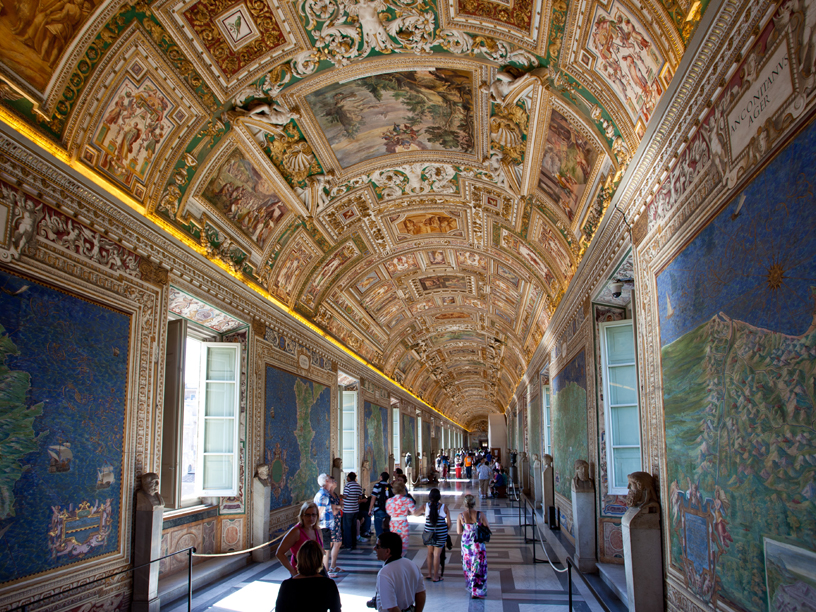
Recently, restoration work in the gallery of geographical maps of the Vatican museums lasted almost four years was completed.
Gallery of geographical maps (Galleria Delle Carte Geographiche) is located in the western part of the Belvedere palaces. It connects the Sistine Chapel and the Tower of the Winds. Its length is 120 meters, and the width is six meters. It is the most extensive series of wall paintings in the form of geographical maps. From floor to ceiling, its walls are covered with images of various regions of Italy.
Such a gallery was created by order of Pope Gregory XIII, which wanted to collect images of all the possessions of the Roman Church. A mathematician and a cartographer, a member of the Dominican Order, Ignazio Danti, who was a participant and another famous pope project - the introduction of a new calendar, which we call Gregorian, worked on the embodiment of the project. Danti gathered a team of artists, which included the Flemings of the brothers Mateis and Paul Bril, as well as the Italians, Jerolamo Muciano, Cesare Nezabia, Giovanni Antonio Nazino and Antonio Danti (brother Ignazio). They started working in 1580 and worked for eighteen months.
Lazzius and Sabia
Artists depicted the exact maps of various parts of Italy of the 16th century, reproducing the relief, rivers, and settlements on them. The valleys, hills, lakes, and even individual streets had correspondences in reality. Wall murals were accompanied by decorative elements characteristic of that era: Putti, Neptune, ancient Roman and contemporary ships in the sea, sea monsters.
Sea monster off the coast of Sardinia
The gallery covered Italy from south to north. On the eastern wall there were regions washed by the Adriatic Sea and limited from the north of the Alps, on the West were those located on the coast of the Tyrrin Sea. Each regional chartin map is accompanied by an image of the very populated city of this area. The city of Avignon belonging to the Roman dads is also depicted.
The island of St. Nicholas in the Adriatic Sea
Separately, at the exit from the gallery, four main Italian ports were depicted: Genoa, Venice, Ancona and Chivitacu, as well as two viewing cards of the entire peninsula - Italy is ancient and new. In the opposite part, there are separate maps of the islands of Sicily, Sardinia and Corsica, as well as images of two famous battles of Christians with Ottomans: the battles of Lepanto (1565) and the siege of Malta (1571).
Vicenza and Paduya cities
Saints, patronizing individual regions and cities (St. Ambrose for Milan, St. Mark for Venice and so on), as well as scenes from Italian history, were drawn on the ceiling arches. There you can see Caesar, crossing Rubicon, Hannibal, who leads the army and elephants through the Alps, the baptism of Emperor Konstantin, Roman Pope Leo I, convincing atilla to leave Italy, the meeting of Pope Alexander III and Emperor Friedrich Barbarossa and other significant moments. At the same time, historical events are depicted next to the maps of the places where they happened.
Under Pope Urban III, who occupied the Roman throne from 1628 to 1644, some details of wall murals were painted again, and some were simply painted over. Also, since three bees were depicted on the emblem of the pope, bees also appeared on the walls of the gallery.
Sicily
Nowadays, six million tourists a year visited the geographical maps for geographical maps. From the dust settling on the walls of dust, the paintings were gradually faded, and by the beginning of the 21st century there was a need to return the original appearance to them, and at the same time eliminate traces of previous unsuccessful restorations. In 2011, the Vatican turned to the Patrons of the Arts in the Vatican Museums Museum of Patrons of the Restoration funds. The sponsor of restoration was the California branch of this fund. The budget amounted to $ 2.4 million, half of which was donated by one philanthropist, and the rest of the amount was collected during a special program. Those wishing to make a donation chose a card, the restoration of which he would like to pay. There were basic options for sponsorship with a contribution amount of 35 thousand and 70 thousand dollars.
Since, as already mentioned, the cards are made in sufficient detail, the philanthropists had the opportunity to choose those of them where they depicts their places. For example, the Castignano family financed the restoration of Sicily’s map, since it also depicts a small town where its ancestors come from. And the Stanislavskis family chose the Umbria map with the city of Assisi, since St. Francis of Assisis is revered by them as the patron saint of their family.
Restorer Francesco Pranter and his team began to work in September 2012. Each Cartin map was divided into 64 sections in the same way as artists who created these frescoes in the 16th century. At first, each of the sections was covered with special thin paper, which absorbed the old yellowed glue remaining from the restorations of the 19th century. When the paper was removed, it was necessary to fix the painting with new glue. For this, organic glue based on Japanese algae Funori was chosen. Since it is very expensive (at least a hundred euros per gram), they decided to buy in Japan not the glue itself, but the raw materials for its production - algae. Of these, in the laboratories of the Vatican museums, glue was prepared for restoration. Then the artists carefully replenished the loss in paintings using paints prepared in accordance with ancient recipes, without synthetic components. According to the ancient recipe, plaster was made.
The work took a little less than four years, that is, twice as much as Ignazio Danti needed and his team to create a gallery. According to Maria Lyudmila Stust, the main restorer of painting and wooden artifacts of Vatican museums, during the restoration, several curious details associated with individual cards were found. In particular, a coin of Urban VIII was found inside one stucco relief, which indicates the time of the manufacture of this part. Also on the frescoes they found a large number of signatures of artists working on them.