
Translated material
Memory. Bulat Okudzhava
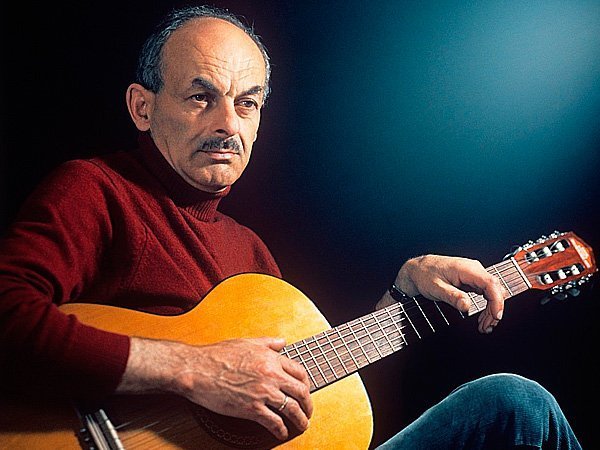
Personal business
Bulat Shalvovich Okudzhava (1924–1997) was born in Moscow in the Bolshevik family (Georgian Shalva Stepanovich Okudzhava and Armenian Ashkhan Stepanovna Nalbandan) who came from Tiflis for party studies at the Communist Academy. Soon after his birth, his father was sent to the Caucasus by the commissar of the Georgian division - Bulat went to Tiflis with him. His acquaintance with music began here - he became interested in the opera and even “put” performances in the yard with neighboring children. The child had an absolute hearing, and he was given to a music school, however, he did not go there for long.
The father was promoted to the secretary of the Tiflis city committee; In this post, he began a personnel conflict with Beria, because of which he asked Sergo Ordzhonikidze to send him to Russia. The result was the work of the party organizer in the construction of the Ural carriage plant in Nizhny Tagil. He soon discharged his family here (his mother all this time remained in Moscow in party work).
In 1937, Okudzhava's father was arrested in connection with the Trotskyist affair on Uralvagonstroy. After the “testimony” of the arrested director of the plant on the prepared attempt on Ordzhonikidze Shalva Okudzhava was shot. Bulat with his mother and grandmother returned to Moscow, then again moved to Tbilisi, where after his studies he worked at the factory by a student of Tokar.
 Bulat Okudzhava, poet.
In April 1942, Bulat Okudzhava sought an early drafted into the army. “Like many peers, he was desperately eager for the front,” the poet recalled. - Together with a friend, we visited the military enlistment office every day. We were handed the summons and said: "Pass them home, and tomorrow we will send you." It lasted so six months ... Finally, broken by our perseverance, the captain could not stand it and said: "Write your summons yourself, my hand does not rise to do it." We filled the forms and carried them home: he - to me, I - to him. " After reaching the eighteenth birthday in August 1942, Okudzhava was sent to the 10th separate reserve mortar division. For two months, he was prepared on the Transcaucasian Front, after which in October he was sent to the Minometer to the Cavalry Regiment of the 5th Guards Don Cavalry Cossack Corps. December 16, 1942 under Mozdok was wounded.
After recovery, he did not return to the army. Since January 1943, he served in the 124th Infantry Spare Regiment in Batumi and later a radio operator in the 126th howitzer artillery brigade of a large capacity of the Transcaucasian Front on the border with Turkey and Iran. Demobilized for health reasons in March 1944 with the rank of Private Guard.
Returning after demobilization to Georgia, in 1945 he entered the Philfak of Tbilisi University, which he graduated in 1950. He worked as a teacher in the Kaluga region for two and a half years.
Okudzhava began to write poems during the war - they were published in the garrison newspaper of the Transcaucasian Front “Fighter of the Red Army”. The first song, the text of which is not preserved, also belongs to the same period. The second - and at the same time one of the most famous songs of Bard - was written “Almost by chance” in 1946:
“Then I was a first -year student at the university. I was very proud of this new title and decided - since I wrote poetry - to write a student song. According to my ideas, the student song should have been very sad, such as “fast as waves, days of our life” or something like that. And once, once I sat down at the piano and with two fingers began to select the music for the verses of “Relusts and stubborn, Gori, Fire, Gori ...” The song turned out. Friends picked her up. And even earlier, at the front, I wrote poetry, invented a melody - and then our regiment sang: "We could not be saved in cold heats." But then I was not serious about this occupation ... "
In 1956, the first collection of Lyrics was published. In 1959, Okudzhava moved to Moscow and began to perform with his songs, quickly gaining popularity. The composition of many of the most famous songs falls on the period from 1956 to 1967 (“Song of Lenka Queen”, “Song of the Blue Ball”, “Sentimental March” [“Nadezhda, I will return then ...”], “Song of the Midnight trolleybus”, “Not a tramp, not drunkard”, “Moscow ant”, “Song of the Komsomol mob” and others). In 1961, the evening of the author’s song of Okudzhava was held in Kharkov. In 1962, he first appeared on the screen in the film "Chain Reaction", in which he performed the song "Midnight trolley".
Okudzhava also played the episodic role in the film “Zhenya, Zhenya and Katyusha”, the script for which he wrote together with the director of the picture Vladimir Motyl. The real breakthrough of Okudzhava to the movie film occurred in 1970; Rather, two breakthroughs at once. Pavel Lupecaev in the “White Sun of the desert” of the same Motyl sang to the music of Isaac Schwartz the song “Your Belorian”, which has become one of the most famous songs of Soviet cinema, and Nina Urgant in the “Belarusian station” - “We need one victory.” In total, more than thirty songs were written in co -authorship with Schwartz (two more “Heats” - “Cavaliergard Song” and “Love and Separation”). Okudzhava himself also wrote music to the verses of the Polish poetess Agnieshki Ossetskaya.
In the USSR, Okudzhava's songs spread in the records for a long time, becoming an integral part of the tape culture of those years. The first Bard of the Bard of Le Soldat En Papier was released in 1968 in Paris, where he went a year earlier. In the same year, a disk came out on which the songs of Okudzhava were performed by Polish artists, and one - “Farewell to Poland” - the author. The “vinyl” story of Okudzhava's songs in his homeland began in the second half of the 1970s-the first disc was released in 1976, as follows in 1978. In the mid-1980s, two more giants came out: “Songs and poems about the war” and “The author performs new songs”.
The first prosaic experience of Okudzhava was the autobiographical story “Be healthy, schoolchlar”, published in 1961 in the Almanac “Tarusa Pages”. Already in 1962, Okudzhava became a member of the Writers' Union. Later they saw the light of the novels “Poor Avrosimov” (“Sip of Freedom”) (1969), “Shipov Shipov, or the Old Vaudeville” (1971) and the novels “The Journey of Amateurs” (1976) and “Date with Bonaparte” (1983), written on the historical material of the early 19th century. He also wrote prose for children: the story “The front comes to us”, “lovely adventures”.
Leaving teaching, Okudzhava worked as an editor in the publishing house "Young Guard", then to the head of the Poetry Department in the "Literary Newspaper". In 1961, he quit and did not work anymore, engaged in exclusively creative activities.
Okudzhava was married twice; The son from the second marriage Bulat (Anton) Okudzhava followed in the footsteps of his father - he became a composer and accompanied his father at his last concerts.
Bulat Okudzhava died in the Paris suburb of clamar on June 12, 1997. He was buried in the Vagankovsky cemetery.
What is famous
The sign figure of the author’s song in Russia, one of the founders of the genre, for which during the beginning of his creative activity was not even a name. Bulat Okudzhava stood out brightly against the background of many followers of a recognizable trusting, chamber intonation of both performance and versification. Its lyrical hero is also characteristic - mainly the “Moscow ant”, “paper soldier” in various hypostles, understanding the greatness of both beautiful and terrible in the world around him, but firmly knowing: that is a little that he must do in his power.
Okudzhava’s songs “Let's take hands, friends ...” and “While the earth is still spinning ...” (“Prayer Francois Viion”) has become the anthem of many KSP ranges and festivals.
What you need to know about
In contrast, for example, from Alexander Galich, the songs of Okudzhava were not socially socially, and even more politically painted. More indicative, that, not being a dissident, in life the singer took a very definite position. So, he joined the Party of Okudzhava in 1956-only after the XX congress and rehabilitation of both parents (his mother was also arrested in 1938 and returned from the camps in 1947). Helping disgraced friends, he published under his name an article by Lev Kopelev about Dr. Haaze and a book of poems translated by Julia Daniel.
With the beginning of perestroika, Bulat Okudzhava began to take an active part in the political life of the country. He was a member of the Constituent Council of the Moscow News and General Newspaper, a member of the editorial board of the newspaper "Evening Club". In 1990 he left the CPSU. Since 1992, a member of the Commission on Party under the President of the Russian Federation; He was a member of the Council of the Society "Memorial".
In 1993, he signed a “letter of 42” with a request for a ban on “communist and nationalist parties, fronts and associations”, recognition of an illegitimate congress of people's deputies and the Supreme Council, courts over organizers and participants in the events of October 1993 in Moscow. Supporting the new government, Okudzhava did not have illusions to her account - in particular, the singer condemned the war in Chechnya.
In the house of Okudzhava in Peredelkino in 1999, a museum was opened, which was headed by his widow Olga Okudzhava. On April 23, 2016 , it became known that it was dismissed from the director’s post. Olga Okudzhava opposed the creation of a museum cluster, in which it was planned to include the house-museums of Korney Chukovsky, Boris Pasternak and Bulat Okudzhava, but her objections were not taken into account-the Bulat Okudzhava house-museum became part of the State Literary Museum, her position was reduced.
Direct speech
About the sixties: we are children of our time, and we need to judge by his laws and standards. Most of us were not revolutionaries, the communist regime was not going to destroy. For example, I could not even think that it was possible. The task was to humanize him. To date, she will seem small, but let's think historically. In those years, the very setting of such a task was an act. Of course, we were different, and the level of thinking was different, and the degree of revolutionary. And everything was - indifference, and fear, and blind faith, and cynicism. But this is not all determined the face of the generation. It was not very determined by, let a large group of people who committed socially significant acts.
About the most terrible trouble of the country: “We built an unnatural, contrary to all laws of nature and history, society did not understand that. Moreover, we still have not realized the truly degree of this trouble. True, we are very easily and verbose on this subject, but I feel that it is rather a tribute to another fashion, we still do not want to deeply figure out what happened to us, what we have turned into. We still do not know how to respect the human personality, we do not know how to see the highest value of life in it, and while all this will not be in our blood, nothing will change, the psychology of Bolshevism will continue to destroy us and our children. Unfortunately, it is too strong and destructive and unusually tenacious. ”
About the author’s song, 1989: “Music strengthens the impact of poetry. And the circle of interest to her is growing, poetry diverges wider. Poetry under the accompaniment has become a counterweight to an entertaining pop song, a soulless art, imitation of feelings. She was written in thinking people for thinking people. ”
The playwright Alexander Volodin is about Okudzhava's songs: “I talked and talked about him until the director of the House of Arts was curious what kind of songs were. I outlined them in my own words. And soon the first public evening of Okudzhava was planned in the Leningrad House of Arts. I phoned everyone, persuading to come. “What, a good voice?” They asked me. "That's the point, he composes the words!" - "Good verses?" - "This is not the point, he writes music himself!" - "Good melodies?" - "That's not the point! .." Before I had to present his listeners, he asked: "Just do not say that these are songs. These are poems." Apparently, he was not sure of the musical virtues of what he did. At the next evening of Okudzhava, a crowd stood in the house of art. "What is here?" - asked passers -by. "Adjubey arrived," they answered. "
Bulat Okudzhava Jr. about the gift of his father: “Of course, he was primarily a musician, with an absolute hearing and a beautiful voice, which began to“ sag ”only in old age. He had to engage in mainly music, but there was nowhere to perform, there was no education, he was embarrassed ... "
Sergey Dovlatov about the desire to Soriginal: “It was in the seventies. Bulat Okudzhave turned 50 years old. He was in disrepair. The Literary Gazeta did not congratulate him.
I decided to send a telegram to an unfamiliar poet. I came up with a non -standard text, namely: "Be healthy, schoolboy!" That was the name of his early story.
A year later, I managed to get acquainted with Okudzhava. And I reminded him of the telegram. I was sure that her non -standard form was remembered by the poet.
It turned out that Okudzhava received more than a hundred telegrams on the anniversary days. Eighty -five of them read: "Be healthy, schoolboy!" "
Dmitry Bykov about the intonation of Okudzhava: “Try to introduce Okudzhava by the author of the song“ Yak-fighter ”, written on behalf of this fighter; Imagine him in a mask of a scourge from the "River of Vachi" or a former prisoner from "Bathwood in the White"! Role song, monologue, ballad - often win in the energy sector, but lose in universality. Okudzhava, therefore, became the champion in the number of quotes that went into everyday speech - that the distance between the author and the listener (and the potential amateur performer) in his case is minimal. ”
Olga Okudzhava about the independent status of the museum, 2013: “We are independent, we fight for this for many years and hold on to it. So far, thank God, we have this status, we are not someone else's branch. Now it’s very alarming, because the new Minister of Culture has come, showing how “smart” he is, and makes many stupid things to get in front of the president. Therefore, all museums tremble. But, on the other hand, the funding is still more damn. Still, something is changing. We have an unloved child with the Ministry of Culture. They are very offended that I do not want to be a department or a branch. And they really do not like us for this. Therefore, this independent status is very important for us. ”
14 facts about Bulat Okudzhava
- Okudzhava was awarded medals “For the Defense of the Caucasus” and “For the Victory over Germany”, in 1985 - the Order of the Patriotic War of the 1st degree
- The performance of Okudzhava in Kharkov in 1961 was the first official concert of the author's song in the USSR
- Okudzhava translated poetry from Arabic, Spanish, Finnish, Swedish and Polish
- It was assumed that the music on the verses "Birds do not sing here ..." will write Andrei Shnita; However, he liked the melody proposed by Okudzhava so much that he took on only her orchestration
- The song "Goodbye, boys!" gave the name of the story of a friend of Okudzhava Boris Balter (1962), filmed by Mikhail Kalik in 1965
- Okudzhava considered the novel “Photographer Zhora” who came out in the West and never published in his homeland
- Okudzhava's favorite writers were Pushkin, Hoffman and Pasternak
- Okudzhava was one of the founders of the Russian Pen Center
- Since 1994, the singer has been a member of the Commission on State Prizes of the Russian Federation
- The name of the singer is assigned to asteroid No. 3149
- In 1998, the State Prize named after Bulat Okudzhava was established
- In 2002, a monument to Bulat Okudzhava Autcuration George Frangulian appeared on Arbat
- Okudzhava songs sound in more than 80 films
- Several song festivals in Russia and one in Israel are devoted to Okudzhava's memory
Materials about Bulat Okudzhava
Page of Bulat Okudzhava on Bards.ru
Bulat Okudzhava in the "Journal Hall"
Bulat Okudzhava: "We are sick, rush into delirium"
Dmitry Bykov. Bulat Okudzhava (chapters from the book)
A site dedicated to Bulat Okudzhava
Bulat okudzhava memory site
Article about Bulat Okudzhava on Wikipedia
To remember. Bulat Okudzhava