
Translated material
Pain in song lines
We publish the work of the winner of the competition of historical research work of high school students “Man in history. Russia-XX century ”2015 on the topic“ Pain in the song lines: songs recorded by the former fascist prisoners in the verification and filtration camp No. 219 in the summer of 1945. ” The author is Anna Antonova from the Lyceum of the city of Uryupinsk, Volgograd region. The scientific director of the work is Nikolai Alekseevich Serebryakov. Together with other works of the 2015 competition, it was published in the collection “Tear out the eyelids from captivity”: Russian history of the 20th century through the eyes of schoolchildren: a collection of work of laureates of the All -Russian competition of historical research work of high school students “Man in history. Russia - XX century ”(M., 2015). We are talking about the very contest of historical works of high school students, the summary of which this year tried to disrupt with the help of a hooligan action on April 28.
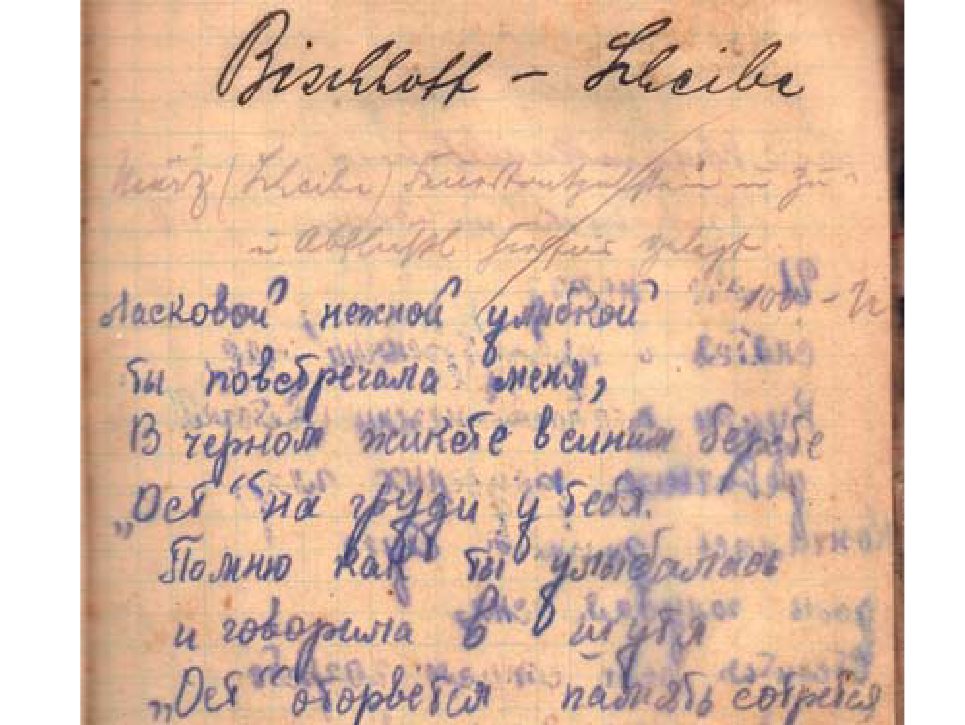
A relic - a small notebook in solid binding was brought to the Museum of the Uryupinsky Lyceum. On his pages, songs of the prisoners of fascist camps were recorded. We have a unique opportunity to understand through the lines of the songs that these people survived. The main sources of the study were the songwriter and personal documents of Stepan Ivanovich Popov.
Stepan Ivanovich Popov, veteran of the Great Patriotic War, one of the best machine operators of the Antoshinsky MTS, and then the Iskra state farm, died on February 25, 2004. It so happened that today there is no one to tell in detail about his life. He had no children, sister and brother died. Fortunately, distant relatives have preserved his personal documents and a front -line notebook. According to these materials stored in the Archive of the Kudryavtsev family, we tried to talk about a person who retained the most valuable military relic.
The testimonies of the former ...
Stepan Ivanovich Popov was born on December 21, 1917 in a small farm of harsh, hidden at the bottom of the steppe beam, in the north-eastern part of the Uryupinsky district. Like many of his peers of the 20s, whose childhood passed in the village was able to get only primary education. After collectivization, he mastered the profession of a tractor driver. On September 15, 1938, he was called up for actual service in the Red Army, where he served in a 14 -separate telephone regiment. Fired in the reserve on December 12, 1940.
On August 22, 1941, he was mobilized to the front of the Uryupinsky RVK. In October, Stepan Ivanovich is sent by a driver in 209 the cannon artillery regiment of the reserve of the main command. In the spring of the 42nd regiment was part of the 6th Army of the South-Western Front. Slogami of his guns in the area of the village of Mikhailovka Pervomaisky district on May 12, 1942 began the tragic Kharkov offensive operation. Due to the miscalculations of the Soviet command, the front troops were surrounded. The Red Army lost 277190 people, of which 170958 irrevocably. Artillerymen with their heavy guns and low -speed tractors had no chance to break out of the environment. On May 27, 1942, Stepan Popov was shell -shocked and captured. In a concentration camp, he worked at the mines with the Czechs and Yugoslavs. On March 29, 1945, the camp was liberated by the American army. After transferring the Soviet side since September 1945, he served as a orderly in 530 medical and sanitary company.
It so happened that the happiest days of his military life were the time of stay in the test and filtration camp No. 219, where he got after the release from captivity. Here he met his love - the Ukrainian girl Nadia, stolen to work in Germany. This feeling left an imprint on his whole life. The war separated them. Returning home, he was looking for his love for a long time. The pre -war marriage with Popova Alexandra Egorovna broke up. In family life, he remained unhappy, but as the most expensive relic, he kept a notebook all his life, in which he and Nadia recorded his favorite songs.
What did the old notebook talk about?
You can not remain indifferent when you hold old documents in your hands. And the songwriter who came into our hands evokes special feelings.
A notebook in size 205 by 125 millimeters contains notes made by a pencil and a feathee handle in two languages. In the upper part of the pages, the primary two -line inscriptions are visible with Latin. Their translation caused certain difficulties. In resolving the problem arising, we were helped by a friend of our museum Pastor of the Lutheran community of the city of Bremen Ernst ul. During the Great Patriotic War, his father died in a prisoner of war camp No. 123, located in Uryupinsk. In October 2013, he visited our museum. We sent him photos of some records. By a happy chance, Ernst Ul studied at school in the late 30s in the early 40s, when the Sütterlin manuscript font was taught in German schools. It is precisely this graphics, not understood by most modern Germans and foreigners, records have been made. They belonged to a locksmith, who carried out private orders for home repairs, and contained information about the customer, types and cost of work performed.
Below on the pages are songs of songs in Russian. Most of them are recorded by two people. This is indicated by the features of handwriting. And only the song “Spark (answer)” is recorded by the third person. The signature under this song “Camp No. 219 P/P 52703/19” allowed us to determine the place of recording. They are made in the test and filtration camp of the NKVD for former prisoners of war and displaced persons. It was located in the city of Witzhtok 80 km northwest of Berlin. The time of compilation of a songwriter can only be determined - the summer of 1945. It records 16 songs, and only two recording time is indicated. The fourth text was inscribed on June 4, 1945, and the tenth - July 8 of the same year.
The author of eight texts can be easily installed by autographs at the end of the songs. They are recorded by Nadia, a girl who was stolen to work in Germany. These signatures are the dedication of a loved one. They touchly emphasize very close relations arising with Stepan: “Your wife Nadia wrote,” “Nadia Popova wrote.”
We think that the notebook originally belonged to S.I. Popov, who did not sign his songs. Nadezhda recorded Russian and Ukrainian songs with the help of national alphabets. This may indicate that it was from Eastern Ukraine. More competent Ukrainian texts, mistakes in the Russian language related to the characteristics of Ukrainian pronunciation, indicate that it was the Ukrainian language that was a family for it. It seems to me that the transition in songs into Russian occurred at the request of the listeners, comrades of hope of misfortune. As for the issue of the ABC, indeed, until 1939, when the Western lands of Ukraine were attached to the USSR, several ABCs existed. But in the manuscript of hope there are no traces of other ABC than the one that was used in Soviet schools. And judging by vocabulary, there can not be such traces at all, because, most likely, this is a girl from the eastern or southern regions of Ukraine, where the Russian language had a stronger influence even on rural residents. There are no dialectic words in the text of the songs by which it would be possible to determine which area hope comes from. ”
Translation of 5 stanzas of the first Ukrainian song "Our Life" confirms this conclusion. The text of the notebook "Oh! Why did my mother give me, oh! Why did my mother Rodil, it would be better if she had drowned in the sea than in German life, was strikingly distinguished by her vocabulary from the classical Ukrainian language - “Oh! Owls Mati gave rise to, oh! The Mati has launched the Mati, more painfully in the sea of Bul Bula, NIZH (Chomu, ANIZH, ShO) in NIMETSKU ZHITTAL VIDAL. ”
The genres of the songs her favorite can also be told about the hope. These are mainly alterations - “blue handkerchief”, songs related to “prison romance”: “from far from the Kolyma Territory”, “Kolya, DIVCHA, I am Bula with you”, “Hello, mother, accept hello from your son ...”; Literary historical songs and romances “From the fallen strongholds of Port Arthur” and “I love you so madly.” It is safe to assume that she was born and raised in a city or a small industrial center. In contrast, Stepan Ivanovich, who grew up in the Cossack region, is dominated by folk songs and songs that became loved by soldiers during the war years.
E great value is the content of songs recorded in a notebook. Along with well -known and beloved works, the newly created “alteration” on the tango “light” - “hobly slowly” and the derivative of “dark mounds are sleeping” - “shame with the Germans” are presented here. And the “answer of the girls” to the last song is perhaps a unique record. We did not find this option of songs either in song collections or on the thematic sites of the Internet. But the folklore of the prisoners of fascist camps and "Ostarbeters" seemed especially interesting. Its content will be considered in detail. Russian texts are edited by the author of this work; Ukrainian - Viktor Vladimirovich Fedotov.
Lines soaked in pain
The first songs recorded in a notebook contain experiences related to fascist bosom: liberation, short stay in the test and filtration camp of the NKVD could not erase mental and physical torment. In works created by prisoners, with special tragedy, the topic of guilt is that they were in German captivity. They lay this guilt primarily on traitors in the Red Army. "A song from the life of the Russian captivity":
Not sparing either life or blood,
We fought, reflecting the landing,
But the traitor and coward is cheap
Lieutenant general betrayed us.
The pain is heard in lines dedicated to the dead comrades:
Only the raven in the wind will hear
A sigh of the last chest is young.
The captivity is realized as a collapse of life hopes, a foreboding of the inevitable death, grief that overshadowed the future life. But Nadezhda to return home does not leave the captives:
Oh, you are my dear Rus',
We will not return to you anymore.
Who will return, that century will not forget
Everything will tell the family family.
He will tell everything, tears will shake,
Drink a glass, the head will turn out,
Let the Lord return to the house,
Continue labor affairs.
The songs describe differently the situation of prisoners and stolen to work in Germany. So common for Ostarbeters and prisoners of war is the theme of hunger. But for the former, this is rather a problem of malnutrition:
Having received a piece of bread
Politsi we see a cafe
And the second with a raising lap
Sends the powerless to the plant.
The diet of prisoners was so scanty that many of them were dying of hunger:
You can’t be offended for feeding
We were fed to say a slaughter
Gram for two hundred with sawdust of bread
And half a liter of Balanda with a top ...
And in the morning, all the dead were brought
To that unknown huge barn,
How the clips were stored in order,
For sending, they prepared in paradise.
Folk songs conveyed the details of a terrible camp life, where the attitude of the Germans towards Soviet people was especially cruel:
Do not forget about you policemen,
All the guys are one to one
One hits, and the other kills
The eternal memory of him died.
Those of the Ostarbetaters who worked in factories, even if they were in workers' camps, but received even a small salary and had the right to enter the city, albeit with a distinctive sign of “OST” on their chests. Nevertheless, they everywhere felt a contemptuous attitude towards themselves and could be subjected to unmotivated violence. The song “Our Life”, on the motive of the Ukrainian folk song “Kolya, Divchata, I am Bula with you”:
The costume of the skew is here
I do not let NIDA pass
Z restaurants, - Kramnts is beaten up
I Sabakai Russian sound.
In an atmosphere of violence and humiliations in a foreign land with particular force, a longing for the homeland was felt, which, basically, personified with his home and, first of all, with her mother. This topic is present in every work whose words were written in captivity. It also sounds in folk songs collected in a notebook-“From the fallen strongholds of Port Arthur” and in the redone “Hello, mother, accept hello from your son ...”:
I will lie on a German bed
I recall my native house,
Oh, how I remember about my mother
That to plill with a hot tear.
Over the time of stay in the verification and filtration camp, albeit not in the wild, but surrounded by their compatriots, the experienced horrors are erased from memory. News come to the place of camp songs. Their main theme is love. Stepan conveys the feeling between the former soldier and stolen from Ukraine a girl in recorded songs. Nadia literally emphasizes her love. In the title of the romance “I love you”, the word “I”, written to her on July 2, 1945, is emphasized by 5 pyramidally reducing dashes, the word “you” is six, and the word “love” already with seven dashes. And she signs these songs "Your wife Nadia wrote." But their sudden happiness was overshadowed by the awareness of not only the upcoming inevitable parting, but also the understanding that his wife Alexander was waiting for Stepan at home. Nadia embodied this anxiety into the changing, perhaps the very line of the “blue handkerchief”:
An affectionate tender smile
You met me
In black jacket
In the blue beret
"Ost" on your chest.
I remember how you smiled
And she spoke jokingly
"OST" will come off
Memory will be erased
You will forget me.
Sometimes night
We met you.
But don't forget me
delicate smile
Russian girls with Oste.
Maybe we'll meet again
our time is ahead
In black jacket,
In the blue beret,
And without the "left" on the chest.
Not only close separation was disturbed by Stepan Popov. The possibility of soon returning home caused not only hope and joy, but also anxiety about how it would be met at home. They are reflected in the options for the song “Spark” and its alteration, which has found an independent life - “hobbing slowly”. In essence, this is one song, but in the first case it is said about love and fidelity, and in another, about the betrayal of a warrior “crippled” in battles.
But even more alarm was raised the question of how they would meet the Red Army soldier, who was captured by the Germans, and the girl who worked during the war for fascist Germany during the war. How will others react to them?
It is no accident that the last two texts of the collections reflect these experiences. The song "Young Girls" on the motive "Sleeps the dark mounds" has the name "Shame on a girl walking with a German." She was born in Ukraine during the years of German occupation. After the liberation of Donbass, it was recorded by the journalist of the newspaper Pravda B. L. Gorbatov. He inserted her into the story "Unconquered", published in 1943. Thanks to this book, the song has become unusually popular in the last years of the war. It spoke about Ukrainian girls who forgot their "lieutenants-people" and gave their love to German soldiers. It is symbolic that the last record in the collection is the “answer of the girls”, which contains an attempt to justify himself of unfair accusations. These lines are imbued with bitterness and resentment:
Dear falcons have you forgotten
How many grief girls brought war.
They cry poor, heartbroken, they are killed
Girls curse their camps ...
With old mother and small children,
You gave us to the German
Lieutenants pilots, fallen falcons,
How many times about fidelity did the Motherland swore,
But at the time you have forgotten a heavy oath,
In the first battles, the Germans took us.
These lines break off this diary - a unique document of the military era, and the story of the love and life of two people who retained the feelings and experiences of people who survived the fascist capacity breaks off.
Work on the study of a notebook helped me learn to analyze historical sources. She taught to read and understand every word of documents that fell into our hands. The songwriter is a unique monument of military folklore, and I am sure that it is necessary to make it accessible to professional researchers and lovers of history and folk songs.