
Translated material
Excess people
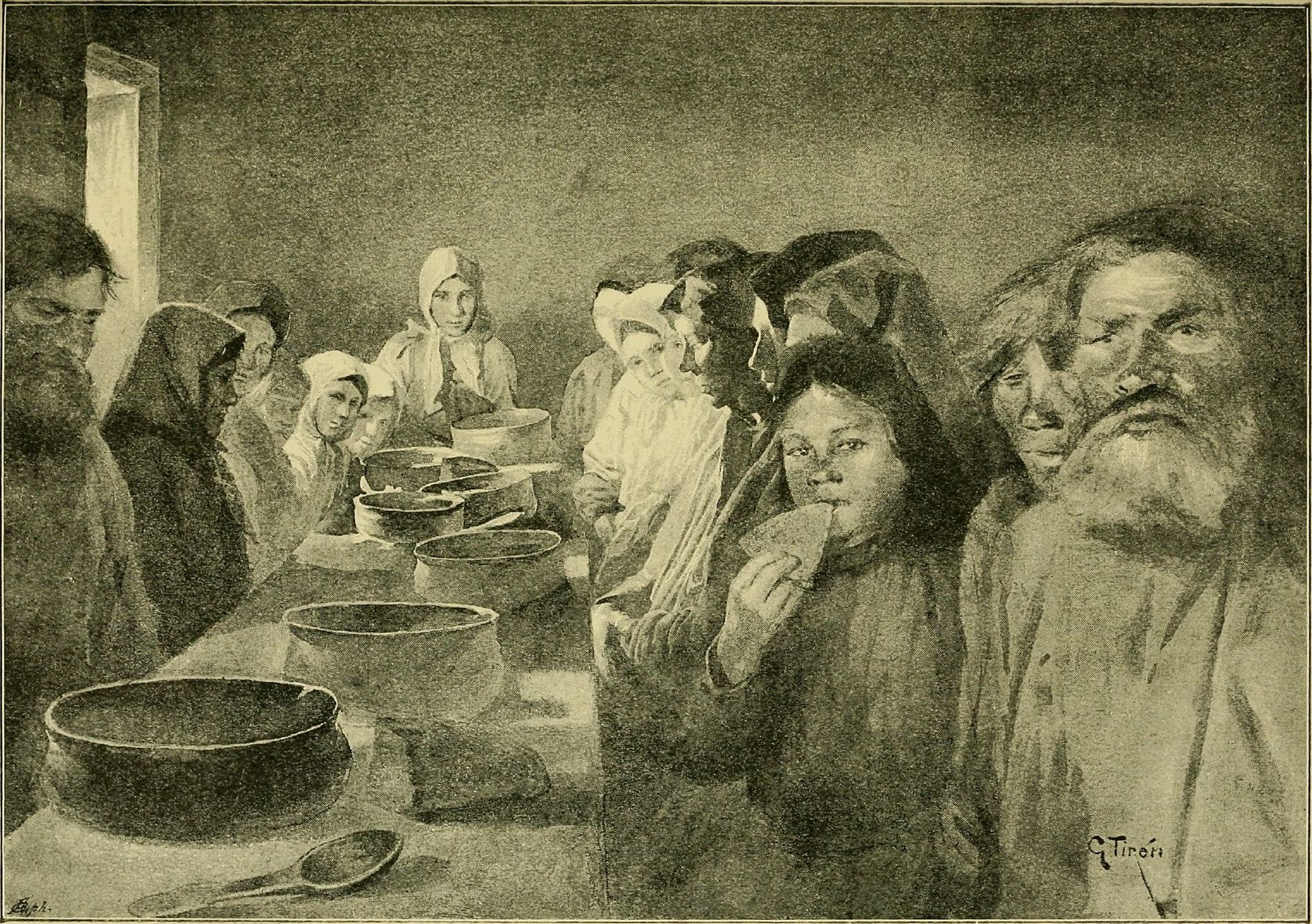
Maltusianism in Voronezh: how in Russia they fought with hunger in 1891-1892
A sharp increase in bread exports in post -reform Russia was accompanied by the most large -scale and cruel outbursts of hunger in the entire reliable history of observations in the pre -revolutionary era. This was due to the improvement of logistics conditions - the development of railways, which facilitated the export of food, and with institutional changes. The reform of 1861 undermined formal and informal institutions that provided the social protection of the peasants in case of crop failure.
This is, first of all, about the destruction of reserve funds of rural communities during peasant reform. On the specific lands (personal domain of the imperial surname), along with the palace and peasant smells, there have long also existed the third - “public”, the crop with which was sent to state -owned shops in case of hunger. To the board of Nicholas I Minister of State Property P.D. Kiselev also extended this system to state peasants, whose share by 1861 exceeded half of the country's population. Thus, the specific and state peasants were to some extent insured against hunger. The landlords, however, could traditionally count on help from the master, not interested in the extinction of their slaves.
The population of the empire, meanwhile, grew up by an American pace. From 1861 to 1891, it increased from 70 to 105 million people (excluding the increase by conquering Central Asia). How did this affect the socio-economic situation in the country?
Agrarian overpopulation
The development of the South of Russia really took place in many respects according to the American model: the country's economic center was more and more shifted towards agricultural and industrial clusters of Ukraine and the Black Sea region. For example, it is during this period that the Stroganovs close their Ural factories, unable to withstand competition with the Donbass Yuzovka, modern Donetsk.
But in central Russia, things were different. From the middle of the 19th century, a huge number of “extra” population have been accumulating in the local villages, which was associated with two circumstances.
The first prerequisite for agrarian overpopulation was communal land ownership, in which the land was distributed by the number of eating (sometimes men) in the family. This entailed several important consequences. Firstly, the peasants had an incentive to give birth to more children. For comparison: in the cultural and has long been overpopulated by France, the peasants since the 18th century systematically engaged in “family planning”, without rejecting unwanted children, on which the limited area would have to be divided. Secondly, the land plot, as a rule, could not be sold. This measure, which slowed down the paraperization, held the excess population in the village - the peasant could not go broke, sell the plot and go to the city .
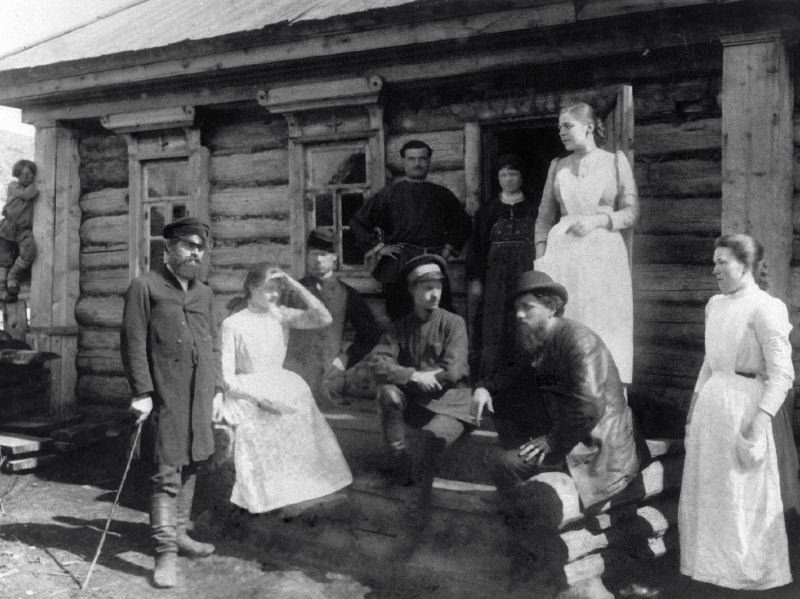
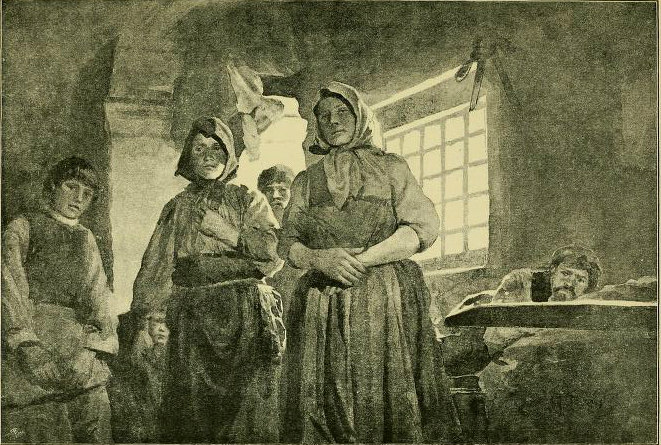
The second premise of overpopulation was the passport mode. He restrained as internal migration - a peasant from Voronezh could not get a passport and go to the Donbass without the consent of the community - and external. Paradoxically, it was much easier for residents of border western regions to get a passport for traveling abroad than the inhabitants of the center. It was with this that the mass migration of Jews and Ukrainians in the New World is connected, while for Great Russians such an option simply did not exist.
But in central Russia, things were different. A huge number of "extra" population have accumulated in the local villages from the middle of the 19th centuryIt is not surprising that the size of the peasant put in the post -reform years is steadily reduced - even in the whole country, not to mention the central provinces. As the economic historian Theodore Shanin shows, it was these, and already tightly populated provinces, where the population in 1863-1897 grew even more than half, later became the stronghold of the Bolsheviks in the civil war.
As mentioned above, all these processes occurred against the backdrop of a sharp increase in bread exports. It is in the post -reform period that bread (and above all wheat) becomes the main subject of Russian exports, replacing the forest in this capacity. If about 5% of the total harvest was exported abroad, then by the end of the 1880s-more than 20%. The main suppliers were, of course, large landowners, but the tax press of the state (recall the redemption payments that continued with the dismissal of peasants in 1861 until 1905) forced peasants to sell bread.
Tsar-head
The famine of 1891-1892 became the largest in scale for the entire post-reform period. The 1889th and to a lesser extent 1890 turned out to be lean, so that the poor bread reserves in state-owned stores were almost completely exhausted. But all this was only a foresight of a real disaster.
Following the unusually harsh winter of 1890-1891, a summer drought hit the Black Earth Center and the Volga region. Seventeen provinces were covered by the crop failure - from Voronezh and partially Kursk - to Samara. The rye crops in them accounted for 54%of the average for 1883-1887, wheat-45%, and oats-56%. A particularly difficult situation was in the Voronezh province, where three quarters of all grains died.
The massive malnutrition was accompanied by the epidemics of typhoid, cholera and smallpox, which came in 1892. It is difficult to determine the number of direct and indirect victims of hunger - despite the fact that the number of those who died directly from alimentary dystrophy seems relatively small, the peasants weakened by a hunger strike easily became a victim of infections. According to the calculations of the historian N.P. Pershin, the superiority in 1891-1892, that is, the excess of the usual level, is estimated at about 650 thousand people.
The massive malnutrition was accompanied by the epidemics of typhoid, cholera and smallpox, which came in 1892. It is difficult to determine the number of direct and indirect victims of hungerIn addition to human victims, peasant farms suffered tangible economic losses. By January 1892, the Voronezh province lost a quarter of horses, and Samara - half of the horses and cattle, as well as almost all sheep. In the Tambov province there was only half of the previous number. In general, European Russia, including not affected by the hunger of the province, lost about 15% of all horses. The situation was complicated by the fact that the peasants tried until the last to maintain draft cattle - the labor force necessary on the farm - they often fed them all winter, but in the end they were forced to score them by the beginning of spring, only having thus lost precious bread.
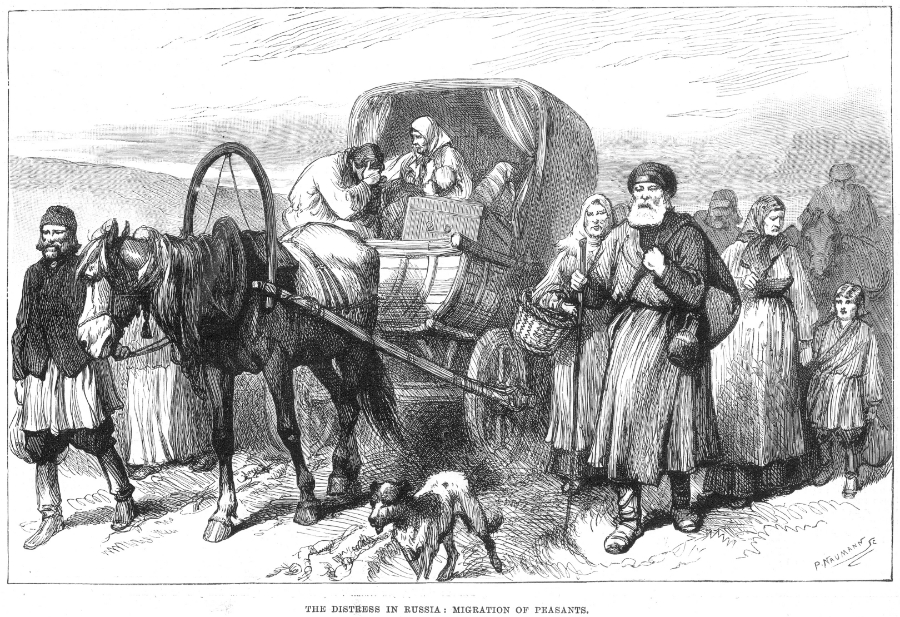
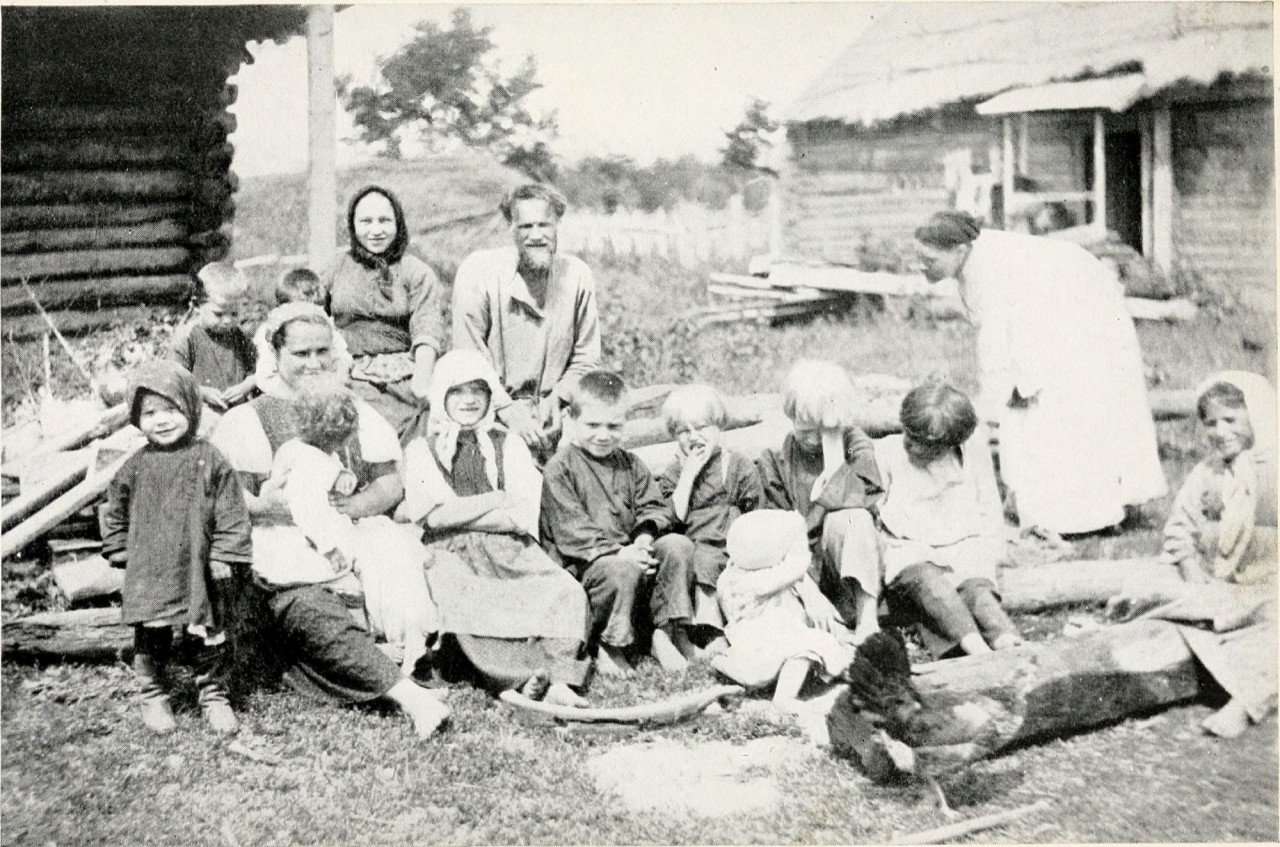
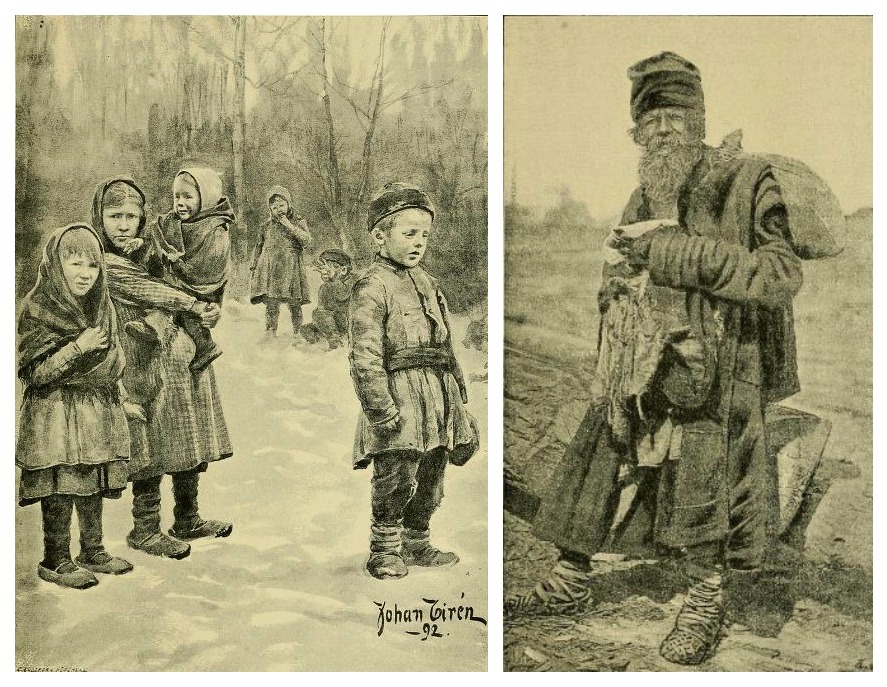 Fasting orphans. Tramp. 1892 Photo: From the book in the Land of Tolstoi; Experiences of Famine and Misrule in Russia
As described by the process of impoverishment of the peasantry L.N. Tolstoy:
“Before our eyes, the process of impoverishment of the rich occurs, the impoverishment of the poor and the destruction of the poor. The process is usually performed as follows: the rich first sells an extra cattle, that is, touching fixed capital, loses its security in case of hardships, the average lays part of the earth, takes money for earnings from the gentlemen and their clerks in advance, catching himself often in irreparable spring and summer work. The poor sells the last cow and then the horse and then lays or sells the land. The beggar walks around the world. When the rich is eaten by what is helped out by the cattle, he does what he does the middle. ”
This is not to say that the government completely ignored what was happening - it tried to fight hunger, first of all, by limiting export. From August to November 1891, rye export was consistent consistently, then all the breads except wheat, the main export goods, and, finally, wheat and all products from it. However, the ban did not last long - already in February, despite the ongoing hunger, the state proceeded to the gradual abolition of restrictions, the latter of them were lifted in August.
The fact is that, along with the relief of folk suffering, the Ministry of Finance, under the leadership of Vyshnegradsky, pursued another, perhaps more important task for him - maintaining a stable exchange rate and a favorable investment climate. The reduction in exports threatened the country with inflation and the depreciation of the ruble - to prevent this scenario, the government began to raise the accounting rate of the State Bank. On October 8, 1891, following the first decree that limited the export of rye, the rate rose from 4.5 to 5%. On October 19, she was raised again - now to 6%. Starting from January 1892, they began to reduce the rate, and by the time of removing all the restrictions on exports, it returned to the previous level.
The hunger of 1891-1892 is famous for the scale of the public organization in order to help the needyIn addition to measures to limit the export and forced reduction of tariffs for railway transportation of bread, the government began direct assistance to the population - the distribution of bread loans and the organization of public works. In 1891-1892, a total of 196 million rubles were spent on these needs, that is, about twenty percent of the state budget for 1891. How effective was this help? The question remains open so far - General M. N. Annenkov, who managed the organization of public work, was subsequently accused of large -scale theft and committed suicide.
City and Fear - to help the village
The famine of 1891-1892 is famous for the scale of the public organization in order to help those in need. In part, this process was sent by the state - under the Ministry of Internal Affairs, a “Special Committee for Assistance to the Population of Provinces, which suffered from crop failure”, which was engaged in the collection and distribution of voluntary donations, conducting charitable lotteries, and so on was created. The church - in fact, part of the state apparatus - also obliged to expel funds to the aid of the starving.
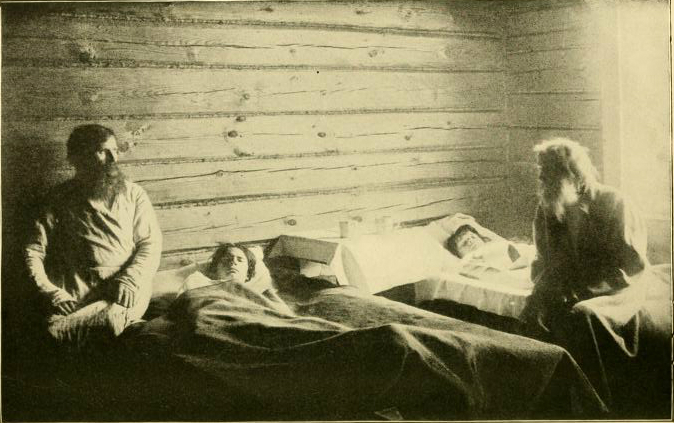
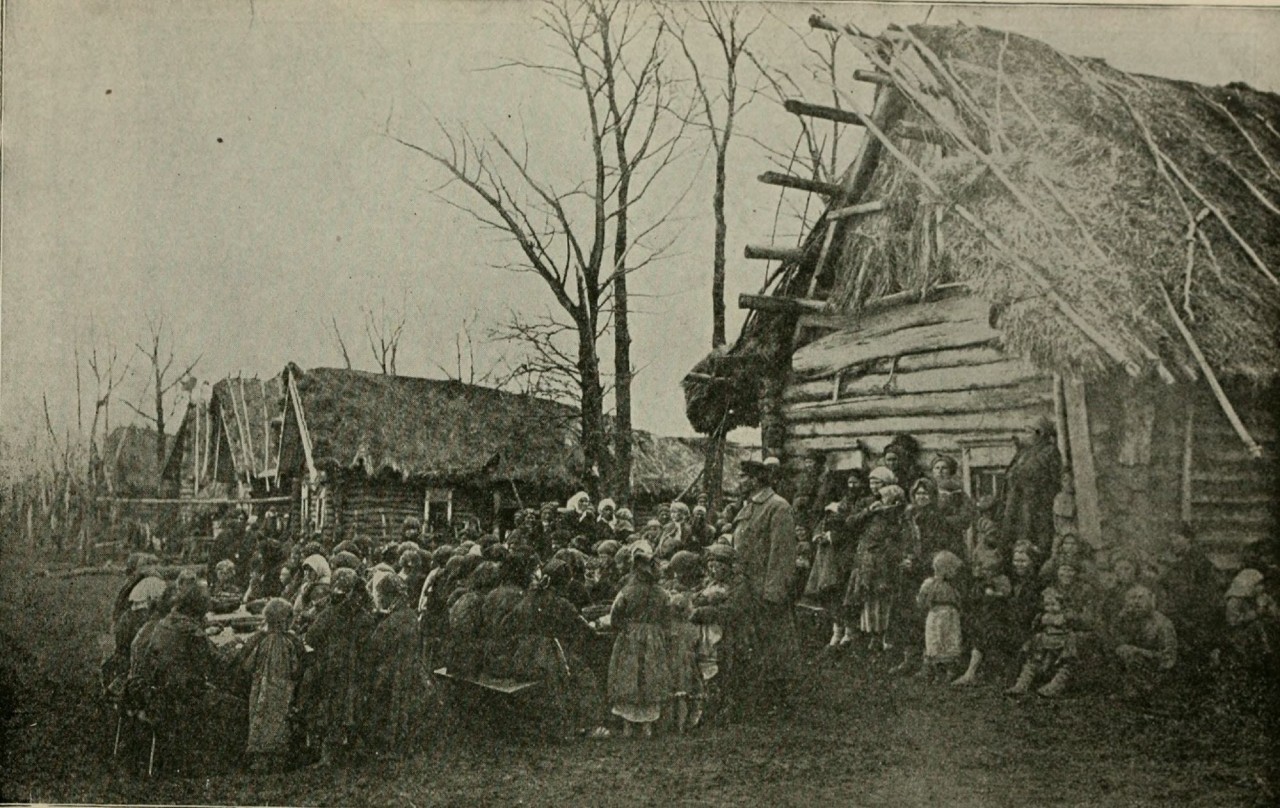
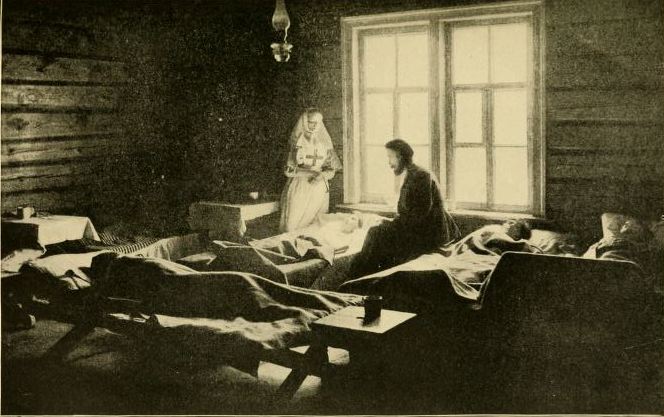 Patients with typhoid during hunger 1891-1892 Photo: From the book The Red Cross in Peace and War
Public and volunteer organizations played no less role in mitigating the consequences of hunger. The most important of these organizations was the Red Cross Society, which raised about five million rubles to help the victims. It is important to note that the Red Cross was engaged in solving not only current problems - the organization of patients, the organization of public canteens, overnight stays, grain distribution and the like, but also a decrease in long -term damage. This organization purchased new cattle for peasants, guns, fodder and so on - they sought not only to save peasant lives, but also to put their farms on their feet again.
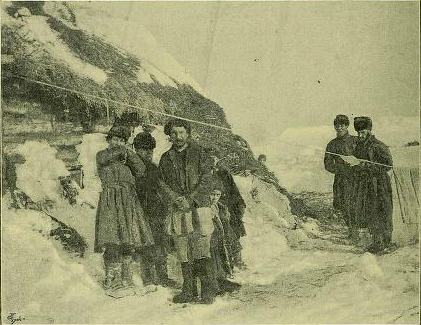
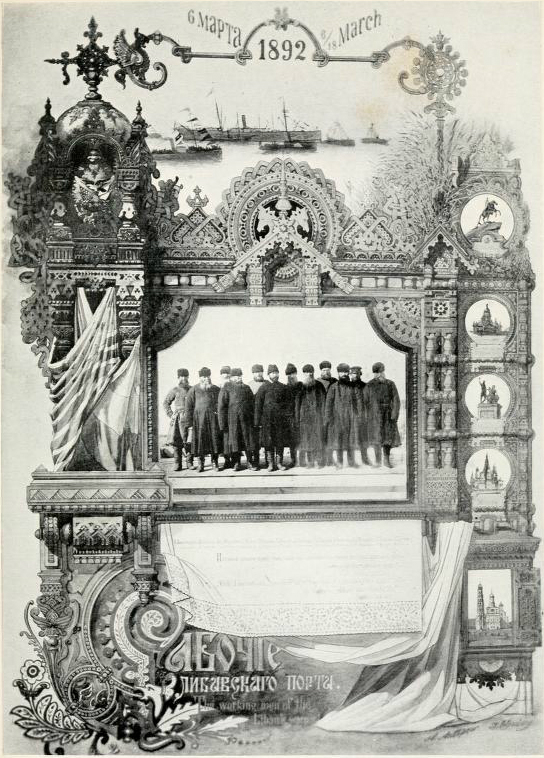 Gratitude of Russian workers in America for help and sympathy during the famine of 1892 Photo: From the book Russia then and Now
Direct help to the starving, first of all, by the organization of public canteens, were engaged in many celebrities of the then Russia, such as, for example, L. N. Tolstoy, A.P. Chekhov, V. I. Vernadsky, etc. This is not only about direct organizational efforts - their names were important as a kind of auspices for volunteering, alternative state. In the conditions of the repressive regime of Alexander III, public institutions and private initiative, previously perceived with suspicion, were now forced to rehabilitated. On the other hand, the authority of the state apparatus, which made hunger, fell significantly in the eyes of the educated class.
The world public did not remain indifferent to the tragedy that was happening. Probably the largest campaign to collect assistance for starving Russia in the United States was initiated by the editor of the Northwestern Miller newspaper William Edgar, who raised more than 750 thousand dollars from a variety of sacrifices-from private individuals and communities to the New York Trade Chamber. Subsequently, this gave Edgar the grounds to declare that American donations saved about 125 thousand Russian peasants. The scale of assistance received from other countries was more modest - in the UK, for example, four more donations were collected. Perhaps the generosity of the Americans is partly explained by traditionally friendly relations between the Russian Empire and the USA - it is enough to recall the diplomatic support of Russia of the North during the civil war in the peak of the position of European great powers.
The problem was that the peasants of starving provinces had no savings to buy this breadAs modern studies show, systematic hunger strikes in the then Russia were connected to a great extent with the powerful fiscal press of the state. In 1891-1915, ten large-scale outbreaks of hunger occurred, albeit inferior in the number of victims of the events of 1891. At the same time, not in any case, the crop failure was not total - so, in 1891, the Western provinces and the non -chernozem provinces of the Russian Center gave an unexpectedly good crop. The problem was that the peasants from the starving provinces had no savings to buy this bread - all the excess went to pay taxes and redemption payments.
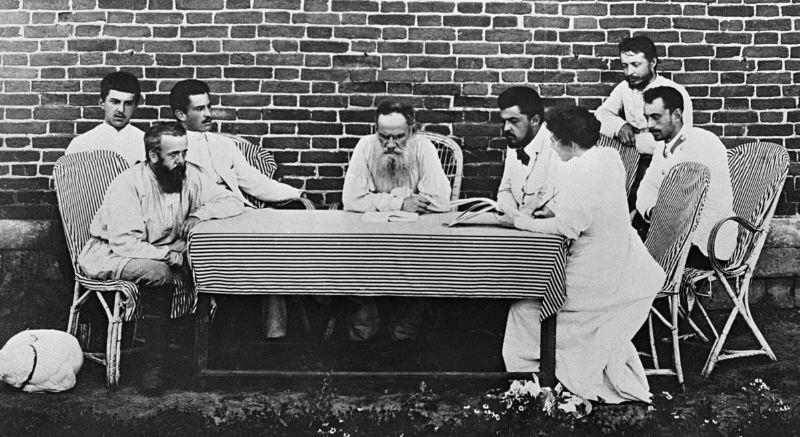 08/22/1891 The writer Lev Tolstoy (in the center) talks with members of the organization of assistance to starving peasants. Photo: RIA Novosti
The Russian state never made conclusions from the events of 1891-1892. As the historian, T.M. Kitanin, all the efforts of the bureaucracy were aimed at mitigating the specific consequences of this crop failure, it was perceived only as a natural disaster, and not as a symptom of a fundamental crisis. Russia continued to move along the Maltusian trajectory: from one agrarian crisis to another. It is symbolic that the law on the holding once every 12 years of the redistribution of land in peasant communities was adopted just in 1893. The next two redistributions came just in the 1905th and 1917 years.