
Translated material
Flying segregated bus
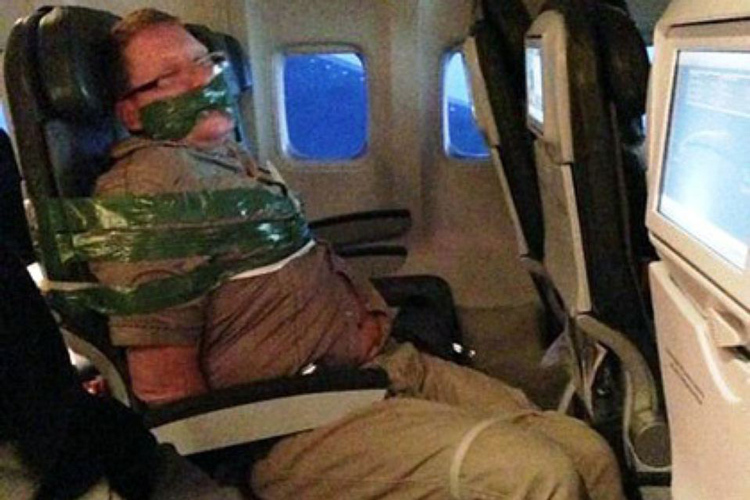
The name of the network community Shower Thumbs - This is the literal translation of "Thoughts in the shower." It is assumed that twenty minutes a day under a stream of water is the only opportunity to reflect on things that the rest of the time does not raise questions. “A plane is just a large, a large -parted bus, who is flying ,” one of the users writes and immediately collects seven hundred likes for an opened paradox. It would seem that the segregation is a classic evil, and the black American Rosa Parks , who in 1955 in Alabam defiantly refused to give way to a white passenger in a bus with “places for white” and “places for blacks”, is a classic nonsense hero. Why, then, a person who is in the cabin of an airplane in one of the empty business class chairs and ignores the requests of the stewardess to return to his place, will look obvious in our eyes with an obvious freak?
It turns out that economists and social psychologists with academic degrees have long been conceived on this topic. ProCEEDINGS magazine of The National Academy of Sciences was published by Professor Michael Normon from the Harvard Business School and Katherine Desiece from the Rotman Management School about the plane as a model of society with class stratification , convenient in every sense.
For aircraft, a proven “index of inequality” is suitable from the classical economy, which is usually applied to states.
You can do as much as you like that in the aircraft of the 2010s, unlike the buses of the 1950s, no one feels segregated: in the end, the price of a ticket is not a skin color, and theoretically everyone has the right to be the right to be in the business class. But here there are big data that say that all these considerations are poorly translated into the language of emotions. Here are the numbers: on flights where there is a business class, outbreaks of unmotivated rage for economy-class passengers for some reason occur 3.84 times more often. Moreover, the chances of such a flash of rage are 2.18 times higher, if passengers get into the plane through the front doors - that is, if they have to personally pass by the chairs when landing, where they are already sitting and reading their Wall Street Journal business class passengers, who are usually launched into the salon first.
To analyze the statistics of incidents on board: one of the major international airlines, which in a scientific article remains unnamed, provided the authors with access to their database for internal use. Regarding each bottle of Duty Fri launched at the stewardess, and each refusal to fasten the belts of the flight attendants are required to leave a detailed report in the journal: whether the passenger was sober, whether he acted alone or not where he was sitting at the window or at the passage. Moreover, the manifestations of "rage in the air" themselves (in the original " Air Rage ” sounds more neutral) must be laid out. By the way, differences between passengers with expensive and cheap tickets begin to appear here: some are more prone to “strong discontent”, others to “emotional outbreaks” (in the economy-class such incidents-6.2 percent, in the business class-2.2: perhaps the rich control themselves better, and it is possible that the flight attendants classify the same behavior depending on the status of the same behavior depending on the status passenger).
These records of the economists had the opportunity to compare with general information about the flight: how many hours the passengers spent in the air, with what delay the plane took off and even how wide the seats were. The contribution from different variables can be compared: the flight flying on the schedule, where there is a business class, is not inferior to the airplane in the cabin in the cabin without a business class, which rose into the air late at 9 o’clock and 29 minutes.
The width of the seats is also not an extra parameter. In 2014, Elizabeth Popp-Berman, an assistant professor from the university in Olbani, came up with how to measure the inequality in airplanes quantitatively .
On flights where there is a business class, outbreaks of unmotivated rage among economy-class passengers for some reason occur 3.84 times more often.
The classic economy has a proven “index of inequality” - this is a gini coefficient , which is usually calculated for different states. In a first approximation, he shows how the resources differ, which own 10 percent of the richest and 10 percent of the poorest. In the aircraft salon, such a resource is not money and not any means of production, but space.
Once upon a time, Popp-Berman writes, in the typical salon of the aircraft on intra-American flights there were three rows of business class chairs, where 7 percent of passengers were located, and they occupied 15 percent of the salon area. A situation where 7 percent of the “richests” own 15 percent of resources corresponds to Gini’s coefficient 0.08-that is, the stratification is three times less than between the poor and rich somewhere in semi-socialist Sweden. Over time, the situation has changed. In Boeing-777 of the American company United Airlines , flying from the USA to Europe, are first -class chairs that are laid out in a full -fledged bed, and “just the first class”. Together they occupy 40 percent of the salon area, but only 21 percent of passengers are placed in them. Now the Gini index is already 0.25 and three times higher than the previous one. That is, inequality is growing over time.
The work of Norton and the Des an anxle can be presented as a concrete answer to the question of what is so bad in the inequality. This question was often asked after the release of the “capital” of Picketti - fundamental labor, which proves that inequality is growing not only in aircraft. Grows, so what? Inequality, when it becomes visible - the trigger of antisocial behavior, the authors write. A person who can afford a ticket from America to Europe, the feeling of inequality makes him scream in a crowded plane into a voice and rush at the stewardess with bottles-although the reason for this behavior is just that he saw another person with Wall along the way to his chair. Street Journal in the hands sitting in the chair a little wider. The article lists other situations with the same demotivating effect: for example, when office employees on the way to their cubes pass by top-management cabinets with windows to the ceiling. Probably, the effect of ostentatious luxury in the big world is even more impressive - but there are no ready -made “big data”. Does this mean that inequality should be fought at all costs? It seems that it is not necessary-just economy-class passengers should be launched through the doors in the middle of the cabin, and the offices are designed so that the Directorship Cabinet costs the path to cubes, and then there will be less senseless aggression in the world.