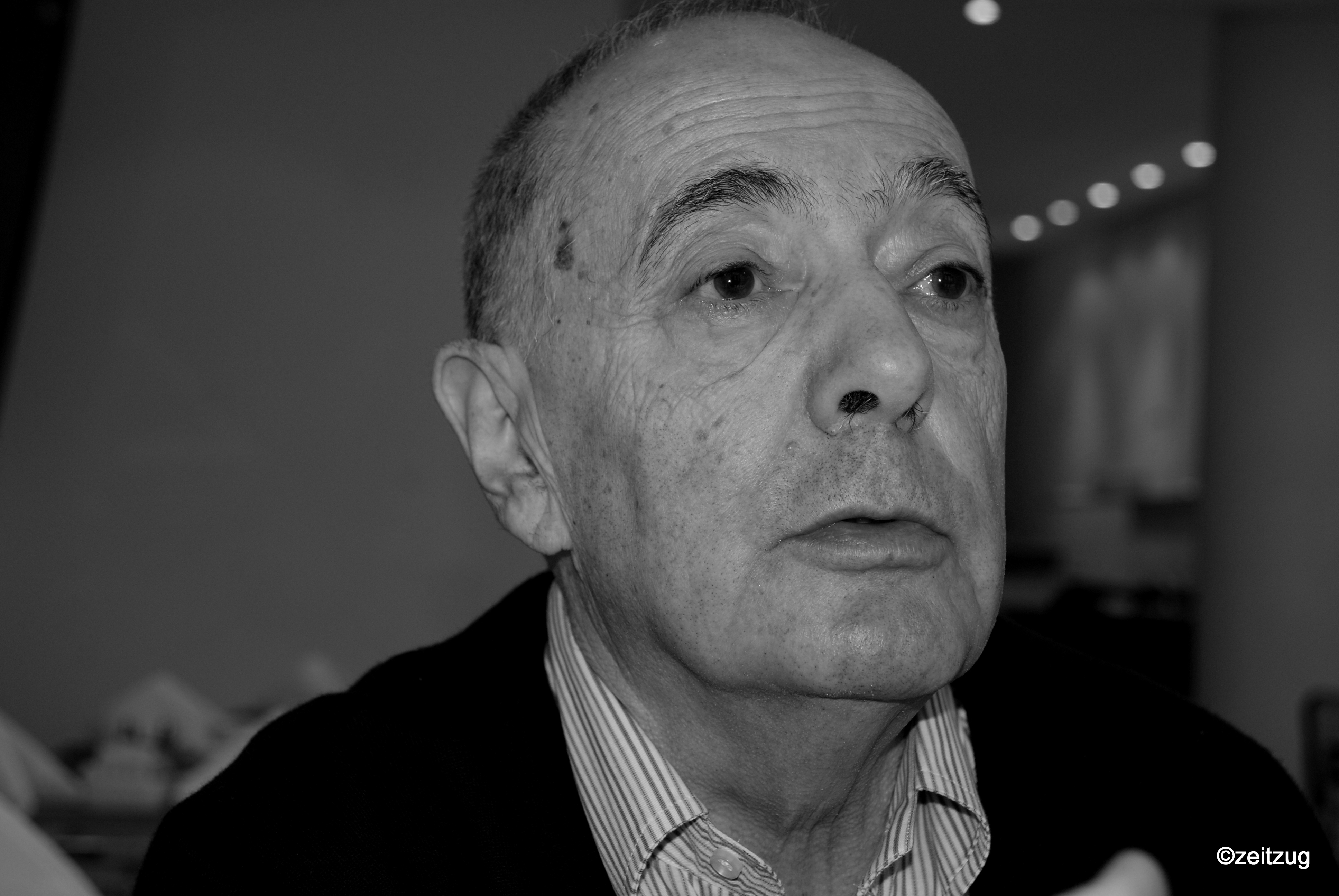
The writer Anatoly Nayman recalls. He was born in Leningrad in 1936. He graduated from the 222nd high school (in the past Petrishul). Since 1963 - literary secretary A. Akhmatova. The author of the collections of lyrics, including the books "Poems" (1989) with the afterword of I. Brodsky. Writes prose and essay. For the book "Stories about Anna Akhmatova" awarded the Tsarskoye Selo art prize.
I was without a month of 17 years, when he died, that is, I lived for 17 years during the bloody Stalinist regime, but I did not really realize that he was bloody. That the attitude towards him was special, I felt it perfectly and even myself was ready to fall under the manner of these relations. For example, we had then, I do not know how now, the cool boards lay wet rags, and the duty officer went to the restroom, to break through it. The most interesting thing was to leave with a rag at each other. The inkwells stood on desks, they could be offended, overturned. All this was gorgeous. They threw, threw until they got into the portrait of Stalin: someone left behind, fell into the portrait. In the class there was, I think, about 10 people, the rest in the corridor. There was a terrible silence, everyone sat on the desks.
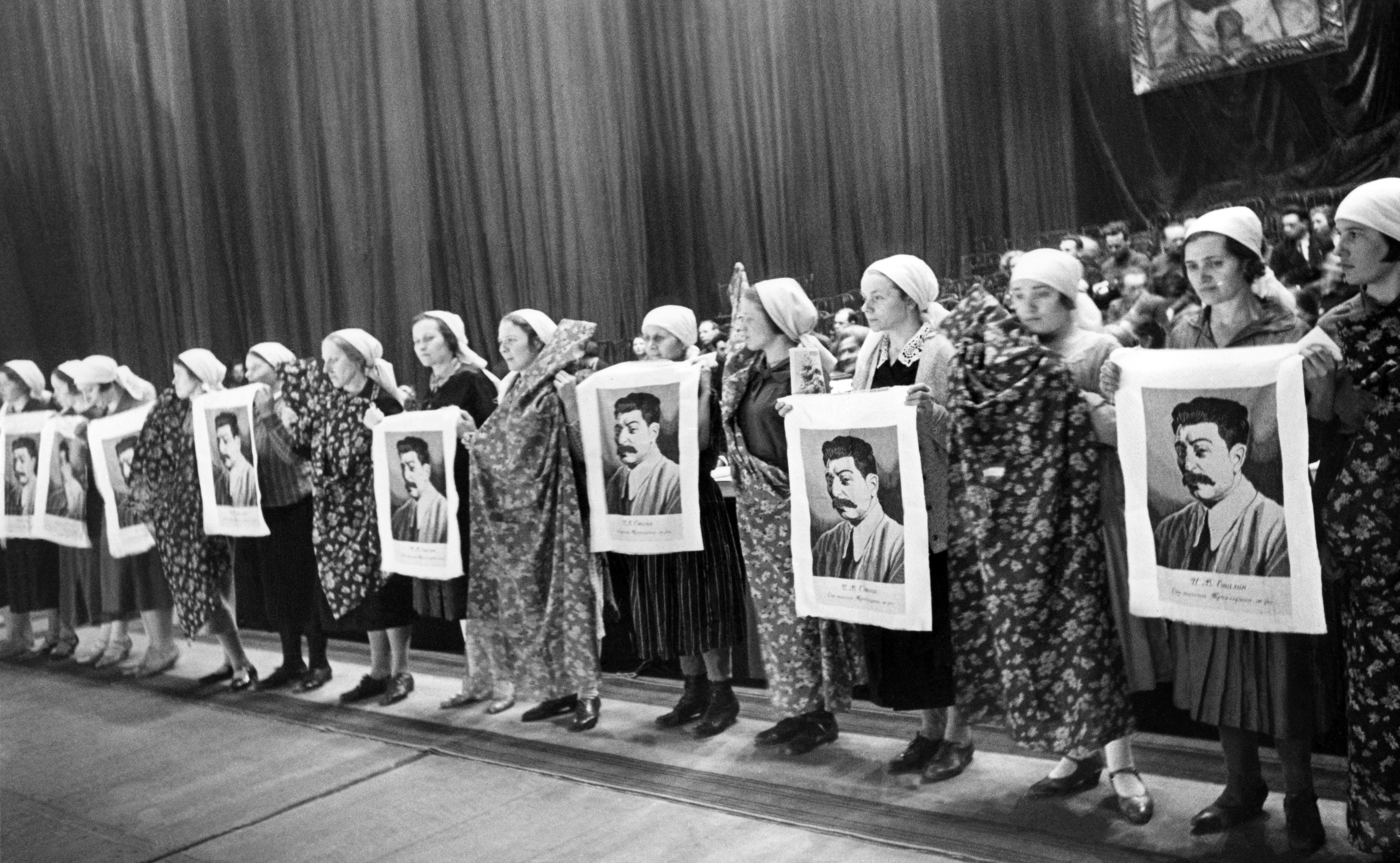
Workers of the Trekhgorenaya Manufactory at a meeting dedicated to the International Women's Day, 1935
But I had personal relationships with him, one -sided, although I was waiting for bilateral ones. There was a 70th anniversary of Stalin, each class had to send him an album. From our class, they chose an artist, in my opinion, he was three years older than me or two, then he was a mishmash after the war, in the 4th grade we had two people for 22 years. "You, Vadim, will be an artist, and Naiman will write, he has a very good handwriting, and he is very competent." They had a large room in a communal apartment on the corner of Nevsky and Herzen, there was a piano, there were photos on it, one of the photographs was his mother, who was either a ballerina or that, she had bare shoulders. As a matter of fact, the photograph was trimmed on his bare shoulders, which somewhat embarrassed me. I was focused on writing an album, albums should be ready tomorrow, and today they only brought albums from the store. It was necessary to stick some pictures, draw something, but I need to write. Closer to four o'clock, I just began to fall from the chair, so I wanted to sleep. Vadik said: "Lie down, do not go to the fool, I will write myself." - "How do you write to Stalin with your handwriting?" - "Don’t worry." I woke up for half a second, looked at what he did - there were glaring grammatical mistakes. The word "morning" was written with three "n". "You look at what you did, you need to rewrite the whole album." And suddenly he said: "Understand." And this is about Stalin - figure it out!
Aksenov told. In the school in Magadan there were specific children, mainly exiled. They walked along the corridor, and suddenly a guy, a full boy, smart, suddenly leaned toward Aksenov and said: "Stalin is an elephant in a chimney shop." And he ran away
Then I heard a similar story, Aksenov told. He studied at a school in Magadan, there were specific children in this school, the locals were, perhaps, in the minority, and mainly exiled. They walked along the corridor, Aksenov studied, in the 9th, as I remembered, and suddenly a guy, a full boy, smart, suddenly leaned toward Aksenov and said: "Stalin is an elephant in a chimney shop." And he ran away. So, when they sent this album to Moscow, I was waiting for the continuation of this story that the letter would come to the school: "Who wrote the album from the 8B of grade there? Take measures, they are completely illiterate." But there could be an option: "I got your album. Thank you." But no continuation arose. And the next time it was more spiritual, because Stalin died. Our school is the first Petersburg school, Peter probably founded it in some one-story house, and in my time it was already a five-story school, it was obliquely from the Kazan Cathedral. There was a very large hall. On the one hand, portraits of all the main Russian writers hung on the walls, except Dostoevsky, and we stood on the contrary between the windows and this wall with portraits. On March 5, they announced that he had died. We came to school, no classes, only incredible mourning of the face and the same mood. We were told to climb this recreational hall, we stood in a square, as usual. Our class had a mathematician. There was no director, the director was a wonderful type, a front-line soldier, he taught literature, taught it rather rudely, but still inspired some respect. Suddenly he appeared, firstly, his face was scratched, and secondly, just three meters from him carried alcohol. He went out and could not speak. In an interrupted voice, he said that that one had died and the word has Agnia Borisovna, our class teacher. Tears flowed across her face, which at the second when her name was pronounced completely stopped, and she said: "Why am I?" She spoke something there-it doesn’t matter, but it is important that this all gored some incomplete thoughts into the soul. There were two opposite sentiments: on the one hand, that everything is the end of everything, because God died, and the second that we will breathe now, but that was less. People somehow lived like that, nothing will live worse or you can live a little worse. This, by the way, somehow intersects with the current situation, intersects with our country.
A mourning rally on Palace Square in Leningrad at the funeral hour of Joseph Vissarionovich Stalin, March 9, 1953
This did not occupy me at all, because I was then in love. Then there was separate training, our male was, and a female school was nearby. At a break, girlish voices came from there and somehow worried blood. In this neighboring school, a girl with two gold braids studied below the waist, blue eyes, and she was called Regina Queen, that is, the queen twice. And in another class, parallel with our 10a, there was such a student Misha Trofimov, who was completely like anyone, he looked not like a person, but the word "gentleman". He was independent, walked around the city with a completely incredible young woman, which was nowhere to be nowhere, she was from some portrait of the beginning of the century. They walked, talked. He did not recognize anyone at all. He lived on a small stable in a underwear in a separate apartment. They said that his father is a surgeon. His windows went outside. I came up to him and said: "Can I sit with you after school, look out the window?" He said: "Please, as much as you want." This made a very strong impression on me, because, firstly, I can sit, and secondly, that, it turns out, you can talk with Misha Trofimov. And then at the institute three years after graduation brought a letter from the XX Congress, Khrushchev’s report, our course was collected in the audience. Two gloomy people came, close to the one that we had at the funeral then. Then I already realized that she was justified, this gloom. One was the dean, the other I do not remember who. They said: "Who can read it clearly?" A few votes said my name. They said: "Come here, then change you." I was not completely replaced, I read this letter. I must say, I read it very personally, so much so that I wanted to say several times: I ask you to get up and honor the memory of the victims. But I did not do this, rather, I did not rhythmically do this, because it somehow destroyed reading. I read it in a sonorous voice. After that, everyone parted quietly.
A man from the Department of Marxism-Leninism asked: "Tell me that in his book" Economic Problems of Socialism in the USSR "Stalin says?" I knew vaguely what he was saying there. I began to answer, he listened, looked and said: "What are you, Anatoly Nayman, no one canceled the works of Comrade Stalin"
The last time Stalin played a role when I graduated from school and went to go to the University at the Faculty of Chemistry. Why am I so carried away by chemistry? I was terribly passionate, captured. I also had a silver medal. Since I had a medal, I had the right to act without exams, then there were such rules. But there was such a colloquium, they asked me questions from organic, inorganic chemistry, I answered excellently. They told me: "Maybe you will go out into the corridor and sit there, wait, a person will come from the department of Marxism-Leninism." I went out, sat. A man came from the department of Marxism-Leninism, as it seemed to me, 40 years old, elegant, with a difficult face. He invited me to the audience and said: “Tell me that in his book (the book was only 20 pages)“ Economic Problems of Socialism in the USSR ”(Stalin had two brochures, this“ Marxism and questions of linguistics ”), what does he say?” I knew vaguely what he was saying there, I turned over, maybe once, but this longing was terrible. I began to answer, he listened, looked and said: "What are you, Anatoly Nayman, no one canceled the works of Comrade Stalin." Although the months have passed, it was already canceled, Stalin was not the same as he was before. He said: "By the way, is Naiman a Russian surname?" I said: "No, this is a Jewish surname." He said: "Well, still, go." And I was kicked out of the university.
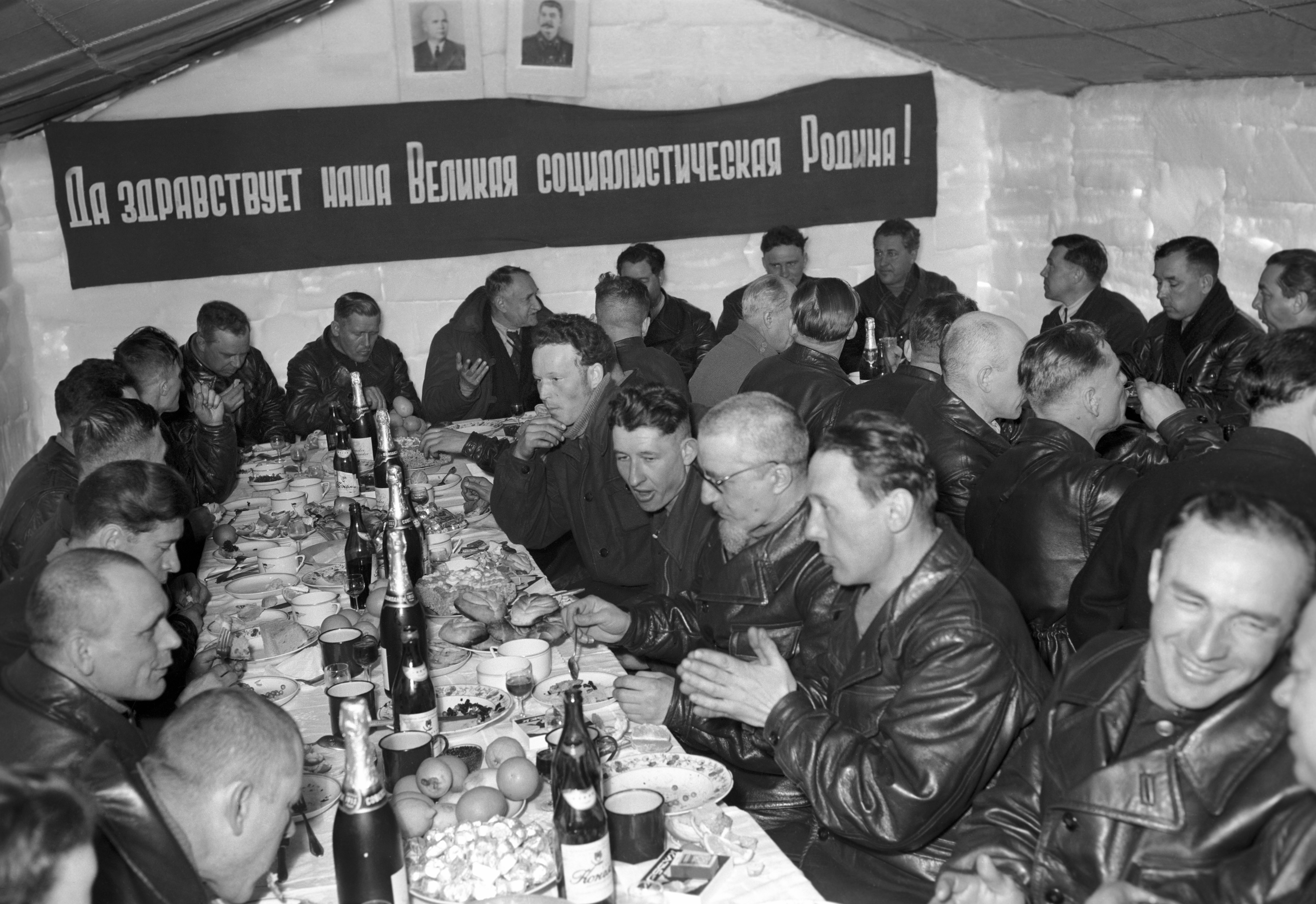
At the Soviet Scientific Research Drinking Station North Polyus-3, 1954
Now the attitude to Stalin is the attitude to the legend that has been created. The legend was created, also of course, not without reason. The fact that Stalin, among other things, was also a figure of imitation, is not connected with what he said as he should say, that he turned the phrase, but managed to add something to it, while she beat something to the same point, but already in another way, here with hardness, and here the softness was already felt, and here it was superfilled. It doesn’t matter what he said, it is important that the listeners terribly wanted to fall under the influence, under some influence, but the present. And then the party secretary, or who Stalin was then, spoke with that arrangement, in that rhythm, with that accent, he said that he wanted to fall under his influence, because if you fall under the influence, then everything will be in order with you. But how, waking up at night in a cold sweat, a person asked himself: how so, can he plant? Not specifically. "Yes, imagine, I can plant." - "I can die there." - "Yes, you can die there." But this is not someone says, but the one who needs to speak, that is, the next step to some god.
In general, there were taboo words - this is understandable. The word "Jew" was also taboo, but differently, from the completely opposite side. Somehow "Jew"-you seem to swear. Anna Akhmatova without any pauses said and always said Stalin. Sometimes sarcastically "Joseph Vissarionovich" is no matter. Not Dzhugashvili, nothing about his origin, there was nothing like that - it was not her path. In this regard, I now remembered the wonderful person Konstantin Bogatyrev, he was the son of a wonderful professor Bogatyrev, a linguist and philologist, and he himself was a wonderful translator Rilke and in general there was a rare man. He got into the camp in 1949. There, for example, was in his brigade a man who hit the case. Namely: he was from a mining family, stately, tall, beautiful, Slavic appearance. He was taken to the security troops and did not fall into the direct protection of Stalin, but, for example, when Stalin was driving in his country to his cottage, to Lake Ritsa or somewhere, they stood two or three meters from each other behind some stones. There was a conspiracy, some captain suggested that the attempt be. The denunciation followed before, and everyone was sent to the camp. He came to Bogatyrev, terribly attached to him. Because he generally had such a nature, he wanted to know everything that you can know. For example, he heard that there was such a poet Pasternak, and Bogatyrev knew Pasternak personally - it was incredible for him. Once they spoke about Khlebnikov. Bogatyrev said that there was such a poet Khlebnikov. "How can I find his poems?" - "And you ask in the library." He went to the library, asked Khlebnikov, there was some kind of book of Khlebnikov or a volume of some kind of collection. "Why do you need Khlebnikov?" - He was told. He said: "Here is Stalin's birthday, I write a poem in his honor, I want to read Khlebnikov, because I do not want to approach this matter after sleeves." He was given Khlebnikov, he read Khlebnikov. When he went out to read the poem, he said: "The poem to Comrade Stalin in the manner of the poet Khlebnikov."
Joseph Brodsky
He went on stage, everyone is looking at him, and he said: "Poem to Comrade Stalin":
Stalin, Stalunyunchik, Stalunyunya ...
He was pulled from the stage, I don’t know what was, but he managed to say these three words.
"Gutalin" was an official nickname of Stalin in unreliable citizens
There was a certain anniversary of Brodsky, 75 years old, where the people who performed were found, in any case I know two people who said that, of course, Brodsky would be for the accession of Crimea, because he was an imperialist. This is not even discussed when they say the dead. I would say when they ask what influence Akhmatova had on you, and sometimes they asked me, I would say that one of the influences that I can simply designate, in my opinion, are sheets from the diary, the memories of Mandelstam, they begin with a torn phrase, I say in my own words: the death of Lozinsky made it impossible to remember that I can not remember this. I thought: after all, until that time I thought that the death of a man ... I thought on the anniversary of Brodsky: what they want, then they hang on him. But Akhmatova could not remember that there was no one, who could refute her. So, I do not want to discuss Crimea in connection with Brodsky, I do not want to discuss his imperialism, which was more like a figure of poetry, I would say. Poetry is not in lines only. What can I say definitely is that Brodsky once said and said this not to me alone, I think: "What would we do without Hitler?" That is, what was meant: what would we say about Stalin if there was no Hitler, we would have no one to compare it with. Therefore, Stalin did not represent for the Brodsky theme. Another thing is that Brodsky was born in 1940 and was named Joseph. Then there was no such massive name, but the children were called Joseph and Adolf in honor of the two leaders. And if Mandelstam has a very important point of its worldview, then Brodsky, as it seems to me, did not specifically do this, rather jerking off it. In any case, nothing but the “cockroaches laughs”, there was nothing like that. I do not mean that he quoted it, I'm talking about the attitude. Rather, Gutalin could be heard from him. "Gutalin" was an official nickname of Stalin in unreliable citizens.