
Translated material
To stop Soviet power
40 years ago, in May 1976, eleven Soviet dissidents announced the creation of the Moscow Helsinki group (MHG)
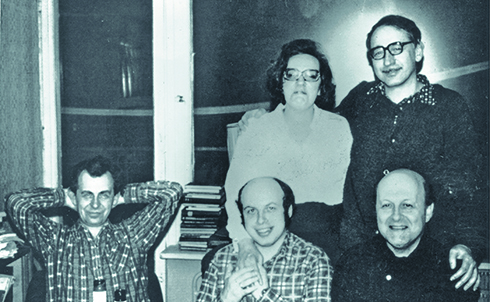
Members of the Moscow Helsinki Group at the very beginning of the journey. In the center is Lyudmila Alekseeva, next to her stands a member of the Soviet Group of International Amnesty Valentin Turchin. They sit (from left to right), Alekseeva’s husband, Nikolai Williams and two member of the MHG - Anatoly Scheransky and Yuri Manyukh, 1976–1977.
I believe that our victims are not in vain, ”the initiator of the creation and the ideological inspirer of the ICG Yuri Orlov said these words in 1979, on the third anniversary of the Moscow Helsinki group. He made his statement from the Perm camp, where by this time he was serving a sentence for dissent. Other participants in the human rights group were subjected to criminal prosecution.
Creation of a commission
On August 1, 1975, the USSR, together with other European countries, signed the Final Act of the Conference on Security and Cooperation in Europe in Helsinki. For the USSR, this next piece of paper was important, as it recognized the post -war boundaries in Europe, and therefore, including the annexation of the Baltic states by the Soviet Union. For the West, discharge was important. In the “third basket” of this act lay the “human rights”. The USSR thought that these rights would remain in the basket, but it was not there.
The signing of this document was an undoubted breakthrough for Soviet diplomacy, and the text was published in Soviet newspapers. Among the few who read the attentively voluminous (30 thousand words) the text was a corresponding member of the Armenian Academy of Sciences, physicist Yuri Orlov. It occurred to him to use this document for the dissident movement. “The agreements formally translated human rights from the sphere of good wishes and“ our internal affairs ”into the sphere of specific international policy, although in reality the Soviet regime did not recognize this, and the West has not yet used it,” Orlov later wrote. - Simple appeals to the Western public will not help, I thought. It is necessary to create our own commission, which will send expert documents on the violations by the Soviet authorities with international obligations signed by the authorities. ”
In the “third basket” of the final act signed in Helsinki, there were “human rights”. The USSR thought that these rights would remain in the basket, but it was not there
The Helsinki act allowed dissidents to appeal to foreign states and pay attention to the fact that their partner in the Helsinki agreements violates the conditions, and Western countries, in turn, could put pressure on the USSR. In 1977, the Belgrade meeting was held by the countries of the Helsinki Agreement, in 1980-Madrid. Multi -page review reports were preparing for such meetings. Andrei Sakharov later recalled his appeal to the Belgrade conference to verify the implementation of the Helsinki agreements: “In this document, I emphasized the fundamental importance of official recognition in the Helsinki Act of International Security and Civil Rights of Human and characterized those violations of these rights that take place in the USSR disumber from the Helsinki agreements.”
Follow your agreements
Orlov decided to create the Moscow Public Group to assist the implementation of the Helsinki agreements in the USSR. Simply put - a group that helps the authorities fulfill its own promises.
From the memoirs of the current chairman of the ICG Lyudmila Alekseeva: “Assistance” is an interesting word. If the Soviet government decides to fulfill its obligations in the field of human rights, it will be forced to terminate repression and, therefore, cease to exist. It is unlikely to be real. ” This doubt is akin to those that in the dissident environment accompanied the slogan of the famous rally on Pushkinskaya Square in December 1965: “Observe your constitution!”
On May 12, 1976, MHG issued its declaration. The group included Yuri Orlov, Lyudmila Alekseeva, Mikhail Bernshtam, Elena Bonner, Alexander Ginzburg, Pyotr Grigorenko, Alexander Korchak, Malva Landa, Anatoly Marchenko, Vitaly Rubin, Anatoly Scharansky.
Some members of the ICG considered it their duty to participate in her work, but did not share Orlov’s optimistic position. Malva Landa made a sharp statement: “I do not expect that in the conditions of the Soviet socialist system, respect for human rights and, accordingly, compliance with the provisions of the Helsinki agreements (humanitarian articles); I don’t know what to “help”, and I join the group in order to even more effectively expose the situation with human rights in the world's first country of socialism. ”
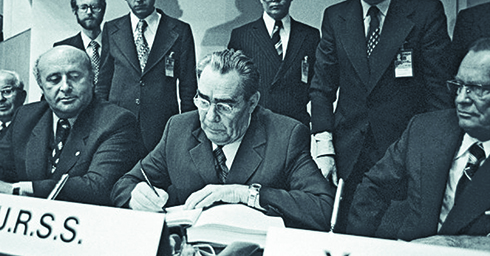
The Secretary General of the USSR Communist Party Leonid Brezhnev signs the final act of a meeting on security and cooperation in Europe; The MHG began with this document, August 1, 1975
Three days after the creation of the group, Orlov issued an official warning by decree of 1972 "On the application by state security authorities as a measure of preventive impact." This meant that if the MHG begins work, then the materials against Orlov will be transferred to the prosecutor to initiate a criminal case. Orlov said that “the PVS Decree (the Presidium of the Supreme Council) was never published and, therefore, according to another PVS decree, was not a decree of the PVS. This decree is samizdat, ”and refused to sign a warning. Three days later, the first MHG document came out - on the persecution by the authorities of the defender of the rights of the Crimean Tatars, Mustafa Dzhemilev. Like all subsequent documents of the ICG, he was on a form printed in the underground printing house of the Adventists.
During its existence, the ICG issued more than 200 documents and statements that concerned the provisions of national groups (primarily Crimean Tatars), the persecution of representatives of religious groups (Baptists, Adventists, Pentecostals, Jews from the village of Ilyinka of the Voronezh region), members of dissident associations and editorials of samizdat magazines. Naturally, great attention was paid to political processes and the position of political prisoners. In addition, the ICG drew attention to violations of social and economic rights in the USSR.
The local officials did not always understand what MHG is. Alekseeva recalled how they arrived in Vilnius to find out why the seven (!) Pupils were excluded from school. Her and member of the Lithuanian Helsinki group Thomas Ventzlov was accepted by the Minister of Education of Lithuania, not a very understanding with whom he was talking and gave his explanations.
Arrests and camps
Information about human rights violations was collected continuously, even camp terms could not stop this work. Orlov said that he remained in the camp, and participated in the collection and transfer of information, which formed the basis of the document “On the Regulations of prisoners in the camps of the USSR”. In 1976-1977, Helsinki groups were created in Georgia, Armenia, Lithuania and Ukraine. Interestingly, the idea of using the Helsinki agreements to control the observance of human rights, born in the USSR, began to spread around the world. In 1976, a member of the House of Representatives of the US Congress Millisent Fenwick arrived in the USSR. Among other things, she met with dissidents, listened to their idea, returned to the United States and created a Helsinki commission there! In 1978, Helsinki groups were nominated to the Nobel Prize of the World.
The Soviet government was extremely concerned about the emergence of a human rights association, and in 1977 arrests began. The authorities played in a large way: in the Soviet press, articles of the KGB agents-former political prisoner Alexander Petrov-Agatov about Ginzburg and the “refuser” (so called those to whom the authorities refused to travel abroad, mainly to Israel), Sani Lipavsky about Scharansky, appeared. There was a more serious reason. On January 8, 1977, an explosion thundered in the Moscow metro. This attack was convenient to enhance pressure on dissenters. The journalist and KGB agent Viktor Louis accused of a terrorist attack of dissidents, interrogations began. In response, the dissidents signed a large collective appeal in which they opposed violence.
On February 3, 1977, a member of the Moscow State Humanitarian Science Alexander Ginzburg was arrested (in July 1978 he received 8 years of camps). A week later, the founder of the ICG Orlov was arrested, who, having heard about the arrest of Ginzburg, considered him immoral to hide. In May 1978, he was sentenced to 7 years of camps and 5 years of exile. The course of the process was flagrant even by Soviet standards. For example, after Orlov abandoned the lawyer, he pushed him by force from the courtroom and locked in a separate room. On March 15, 1977, Anatoly Scheransky was arrested, a refuser with excellent knowledge of the English language (in particular, he was a translator at Sakharov’s press conferences). He was accused of relations with the CIA and transfer to the west of the list of refuseniks indicating their place of work, which was supposedly a secret. The accusation of "treason" gave the opportunity to discredit a person, and this put in a difficult situation of those who in Europe and the United States tried to speak in defense. Zaransky was convicted of 13 years (rehabilitated in 1992).
The course of the process was flagrant even by Soviet standards. For example, after Orlov abandoned the lawyer, he pushed him by force from the courtroom and was locked in a separate room
During the investigation of both Scharan and Ginzburg, KGB investigators (one of them, Evgeny Saushkin, was then chosen by the Mossovet deputy from “democratic Russia”) threatened the execution. By 1982, only Elena Bonner (59 years old), Sofya Kallistratova and Naum Meiman (71 years old) remained at large. A criminal case was instituted against the already middle -aged Sophia Kallistratova (75 years). In these conditions, it was decided to suspend the work. In total, from 1976 to 1982, eight members of the group were arrested and sentenced to different terms of conclusion or exile.
Public verdicts
But times have changed. In 1986, the Helsinki-86 group was created in Latvia, in 1988 the Ukrainian Helsinki group (with the new name-the Ukrainian Helsinki Union) was revived, many members of which went to politics. In 2005, President of Ukraine Viktor Yushchenko awarded all members of the Ukrainian Helsinki group. Many, as the deceased in the political zone of Perm-36, Vasily Stus, is posthumously.
In 1989, the ICG resumed work and revived its glory to one of the most reputable human rights organizations. A curious detail: in 1990, the chairman of the Supreme Court of the RSFSR Vyacheslav Lebedev refused to rehabilitate Yuri Orlov, six months later, in 1991, the same Lebedev Orlova rehabilitated. The MHS included human rights activists Larisa Bogoraz, Sergey Kovalev, Vyacheslav Bakhmin, Alexei Smirnov, Lev Timofeev, Boris Zolotukhin, Kronid Lyubarsky. The chairman of the ICG became Larisa Bogoraz, since 1996 - who returned from the emigration of Alekseev. ... 2001, on the Presidium of the Civil Forum nearby - human rights activist Lyudmila Alekseeva and retired KGB Colonel, now Russian President Vladimir Putin. Everyone expects that the new old anthem will sound at the end of December 2000. Lyudmila Alekseeva warned: she will not stand under the Soviet anthem. Can you imagine a television picture? Putin stands under the anthem, and continues to sit next to Alekseev ... As a result, the anthem never sounded.
Photo: Archive of the International Memorial, RIA "Novosti"