
Translated material
Eurovision 2016. Main
How they voted for Jamalu and Lazarev - and what does Australia have to do with it
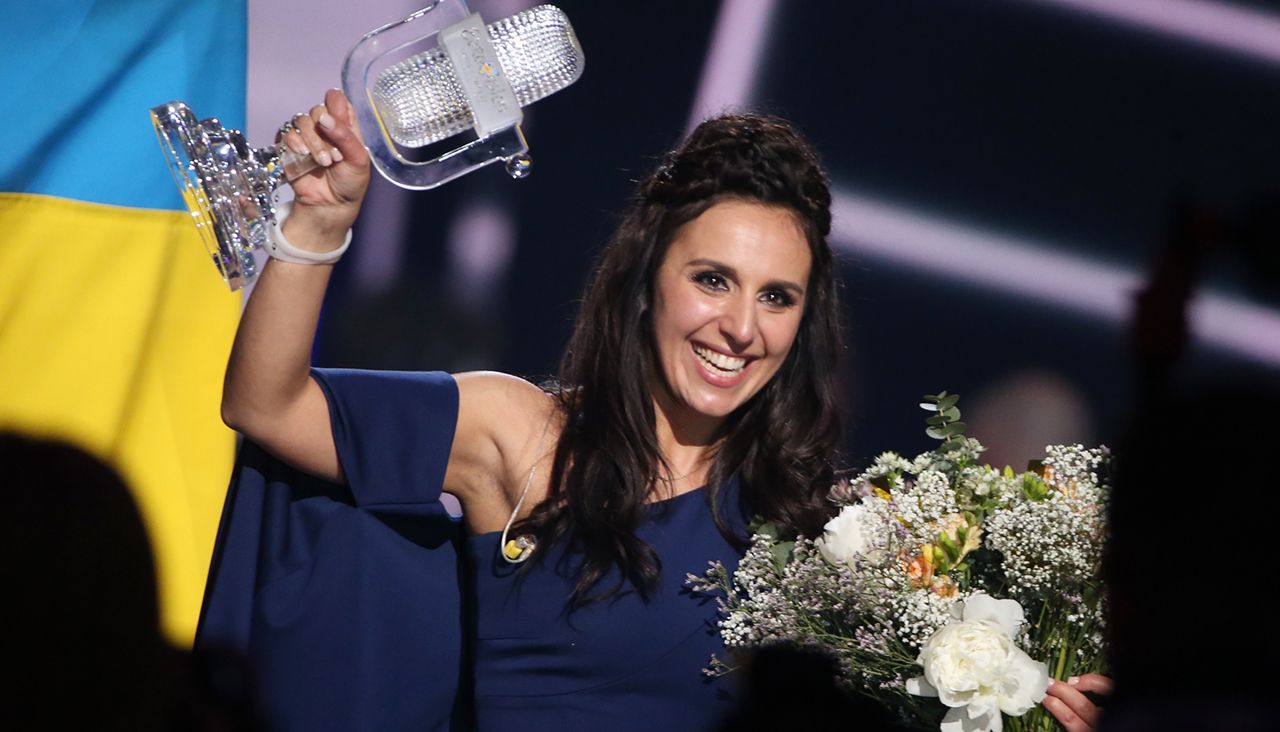
On the night of May 15, in Stockholm, the Ukrainian singer Jamal won Eurovision with the song “1944” dedicated to the deportation of the Crimean Tatars. Based on the results of the joint vote of judges from the national jury, she participated in the Eurovision and viewers' countries. In 2016, the voting procedure was more complicated than before: Jamala, for example, was not the first in the jury or in television -support; However, she had enough summarized points to get around the Russian Sergei Lazarev and another favorite of the race, the Australian singer Dami named after
Jamala won on the case. “1944” is a dramatic song that emotionally telling about the deportation of Crimean Tatars from Crimea in 1944 by order of Joseph Stalin. Unlike other Eurovision numbers, Jamala's song does not try to repeat the schemes of American pop music of a decade ago; Her arrangement refers to the British dabstep and Crimean Tatar ethnic music. Eurovision forbids to declare a song with political coloring to the competition, but the organizers of the competition decided that the composition describes a historical event and has nothing to do with politics.
Jamala is not an ordinary pop singer. On the albums of the 32-year-old Ukrainian singer Jamala (Susanna Dzhamaladinova), you can find a second, rhythm-end-blouse, ethnic motifs, light jazz songs and retro-pop in the spirit of Nancy Sinatra. Jamala is a honored singer with a strong and rich voice; Repeated laureate of numerous competitions, including the “New Wave” (2009). The victory at this competition turned the 25-year-old Jamalu into a famous artist in Ukraine, who collects large halls.
The leading “Russia 1” tried to go around the sharp corners on the air. For example, Dmitry Guberniev and Ernest Matskyavichus, representing the participants in Eurovision, told the story of the life of the Israeli singer Hovy, never utter the word “gay”: “Hovey loved to let his eyes to”, “Hovey found friends with the same interests”; About that spirit. Hovie is an open gay who recently complained about homophobia in Russia.
It turned out to be even more interesting with Jamala: Dmitry Guberniev connected a song about the deportation of Crimean Tatars with the migration crisis in Europe. The fact that the song also has a more obvious subtext associated with the accession of Crimea to Russia and criminal cases against the leaders of the Crimean Tatars, not a word was said on the air, although this was actively discussed both in Ukrainian and Russian social networks. The semifinals of Eurovision at Russia 1 even stated that the song is about those who leave their homeland in search of the best share.
Sergei Lazarev won the audience vote. In 2016, Eurovision has significantly changed the voting system. First, the jury of each participating country put their estimates at their grades, and according to the results of this stage, Australia led at a huge margin, and Russia was outside the fifth. Then the distribution of votes of viewers began, which were added to the points from the jury. The viewers chose the best Lazarev (evaluating, obviously, his outstanding production); Ukraine received second place, but in the total amount of points it became the first, and Russia sank to the third line. The second place went to Australia. Typically, the audience vote brought to the top 10 an openly bad song of the Polish performer, who, after the jury voting, was in last place.
Lazarev’s defeat was explained by the political conjuncture. The leading show on the “Russia 1” began to reason about the bias of the jury vote immediately after the victory of Jamala. In particular, Dmitry Guberniev said that the national jury in which professionals should sit often gave Lazarev either a low score, or nothing at all - contrary to the high level of song and performances. However, the host did not mention that the Russian jury did not put a single score Jamale with the obvious virtues of her song. Similarly, the Ukrainian jury was received: Sergey Lazarev did not get a single score from him.
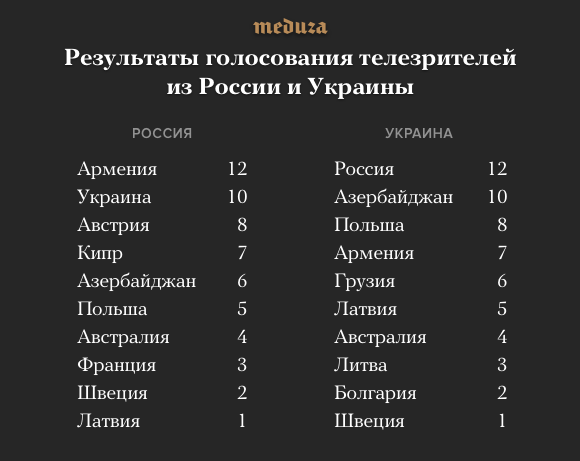
Ukrainians voted for Lazarev, Russians - for Jamalu. The audience voting was significantly different from the choice of national jury. In Ukraine, the best song “Eurovision-2016” calculated the composition of Sergei Lazarev. In Russia, the popular vote gave the first place to the singer from Armenia, but after her, Jamal immediately followed.
The second place was received by Australia. How is that? And so. Since 2015, Australia has received the right to participate in Eurovision, since this state is an associated member of the European Broadcasting Union. It is this organization that has been conducting Eurovision since the 1950s, and in Australia the competition enjoys great success-therefore, for this state, they made an exception. An important point: in the event of the victory of the Australian song in Melbourne or Sydney, Eurovision will not go. The rules of the competition allow the participation of countries not from Europe, but require that the competition itself takes place on the European continent. So even if Australia won, the next “Eurovision” took place in the country that took second place.