
Translated material
We support the domestic manufacturer
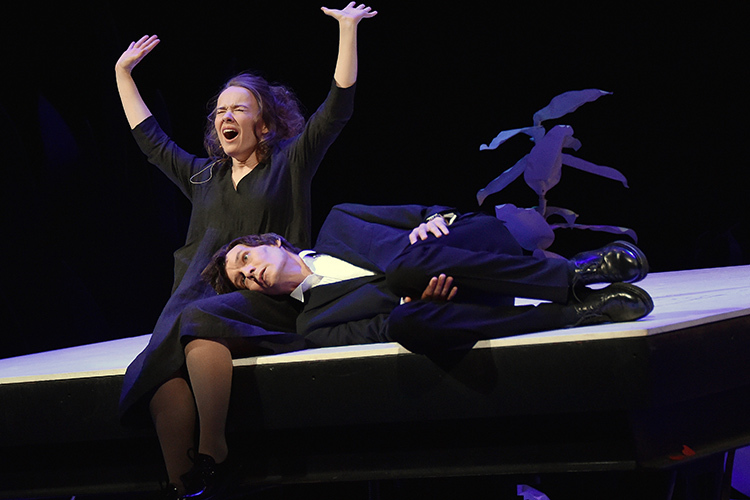
Claiming on a snow -white couch, a wealthy lady tells her husband about her fears. She does not represent life without a spouse and is afraid of his death in advance, although he, at first glance, is healthy and cheerful, it seems that nothing threatens. In fact, her nightmare will never come true, because she herself is dead, and the whole dialogue occurs in the imagination of her early widowed husband. David (Philip Yankovsky) depression. For several months, he has been communicating only with the deceased wife of Maryl (Svetlana Ivanova-Sergeeva), avoiding living people. Concerned friends are to him without an invitation to introduce a girl named Elizabeth (Inna Sukhoretskaya), working with a kind of friend. Elizabeth step by step returns David to life, instructing him on the path true by long monologues about love and the Universe.
Ivan Vyrypaev, who came up with this story, was once one of the most radical authors of the “new drama”-his early texts and plays, not everyone agrees. Later, the composition of “ DreamWorks ” (2013) is already quite a play: the conventional bourgeois drama, where the hero first hates the heroine with the whole heart, and then, of course, falls in love with it. All characters are rich Americans, that is, non -shaking, not real people. The play wears the subtitle “Hollywood Film”, as if in the very name “ DreamWorks ”, the playwright does not have enough reference to the famous Hollywood brand.
Vyrypaev - an actor by profession and by nature, he loves and knows how to change clothes, imitate, assign a foreign role, so he pulls to light genres. He writes jokes (“Comedy”), sings in the group (Sugar performance), conducts pseudo-scientific research (“Documentary” play “UFO ” , that is, “UFO”) and even removes the juice advertisement (short film “on the rights of advertising” ). Usually it works like this: Vyrypaev takes the form of a message that has proven himself to a modern audience, and fills it with its own meaning, which is atypical for this form. Each similar plan is initially permeated with irony, directed in both directions - to the author’s message and actually on the genre itself. Yes, the characters of the film “On Advertising Rights” talk about creativity, self -realization and other fundamental issues - but let's not forget that they just sell us juice. Firstly, it is funny, and secondly, this gives the author’s reflection additional volume.
“DreamWorks” is not a relevant text, disguised as melodrama, this melodrama is - deprived of one at once both relevance and saving irony.
What went wrong in the play " DreamWorks " ? Zorypaev seemed to overdate, getting rid of the next role - the role of a commercial playwright. The form assigned by the author and the contents he brought was unexpectedly close. “ DreamWorks ” is not a relevant text, disguised as melodrama, this melodrama is - deprived of one at once both relevance and saving irony.
With the lips of his heroine, Elizabeth Vyrypaev preaches dubious, but simple, prepared truths. Modern men, they say, have stuck something. They stopped being shy of emotions, allow themselves to cry and admit that they are scared. In a word, degenerated, crushed. But in fact, a man should not have time on grief and suffering. A real man acts, not reflects. Do you know what is a woman’s function in this normative world? A woman is needed to help a man find his mission. And what is the true meaning of intimate relationships between a man and a woman? It turns out that the love of the partner over time should go to the next stage - love for everything. Whether the author wants or not, but he indulges in the average Russian consumer of culture, idealizing the very concept of love, and approaching the questions of Gender, approaching a purely conservative position. Before us is a product of mass consumption, and, contrary to the subtitle of the play, clearly domestic, and not Hollywood production.
The DreamWorks prime minister in the Art Theater was set by Viktor Ryzhakov, who has been held as part of the Cherry Forest festival - in his track record , Vyrypaev has been the main author for many years. The director probably could somehow cope with the melodramatism of the play instead of strengthening it-but, apparently, unconditional trust in the playwright prevented this. Following the logic of Vyrypaev, Ryzhakov works according to the laws of the “democratic”, “spectator” theater - for example, surrounds the main characters with one -dimensional “characteristic” heroes and heroines, traditionally, are ridiculous idiots. The only actress who is absolutely owning the skill of pronouncing Vyrypaevsky texts is a well-known Svetlana Ivanov-Sergeeva with this drama. In the lips of the rest of the artists, the moralizing passages of Vyrypaeva sound completely unconvincing.
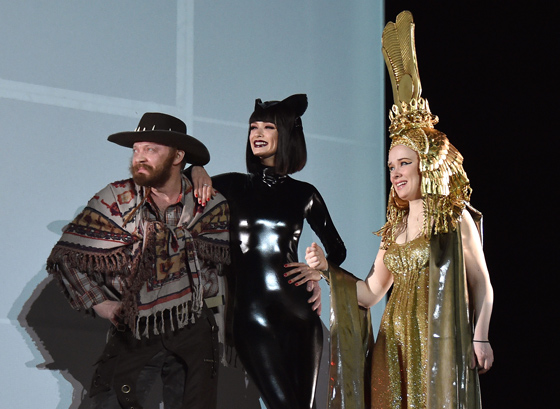 © Irina Buzhor / Kommersant
The scenography of Maria and Alexei Tregubovs seems interesting, but only the first fifteen minutes: with each permutation of meaningful details there are fewer, and the inexplicable kitsch is more and more. The action begins in the sterile designer apartment of the protagonist, heading the editorial office of the popular science magazine. The only visual accent in this minimalist white interior is a decorative picture with plant motifs. This kind of painting without personality is in great demand in office and hotel design, but if something similar is hanging at home - you are probably a person without hobbies. This is how the owner of the apartment describes himself: creative work for him has long become a routine. The scenery of the first scene is not a revolutionary, but high -quality, smart work of artists that helps the hero and his social environment: these are educated, wealthy people of progressive views, not without taste, but in the absence of a goal, the dead end in life. On this scenographer, to stop, but, unfortunately, the powerful resources of the Moscow Art Theater allow them to solve each scene in a new way. They rush to change the layout of the walls, change the floor level, and most importantly - add all the more strange elements to the situation.
The plant plot of the picture, as it turned out, is not accidental: at first in the depths of the scene, a large, above human height appears, a white plastic flower, then yet and yet, until finally artificial bushes take all the foreseeable space. As the hero of Vyrypaev - Ryzhakova gets out of depression and finds the meaning of life, he’s apparently paradise grows around him - but, frankly, among the spouses of three -sidedly resemble the festive design of the shopping center. As a result, one solution - intelligible, conceptual, interesting - is rapidly absorbed by another, excessive, naive, elementary sloppy.
Over the past ten to fifteen years, the Russian theater has made a noticeable evolutionary leap. He is actively looking for his place in a changing world, his tongue becomes more diverse, the very concept of the theater is interpreted more broadly than it was before. Without Ivan Vyrypaev and Viktor Ryzhakov, without their joint and independent projects, this process would probably be unthinkable. But why they entered the territory of the bourgeois theater - God alone knows.