
Translated material
Brothers and return
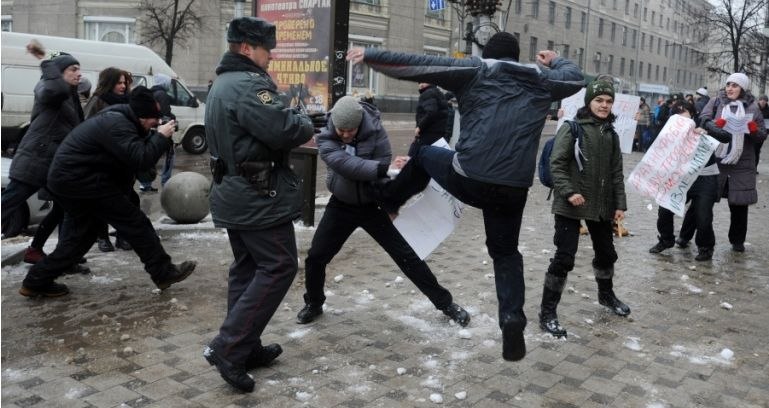
Street violence against disagreement becomes everyday life. Titles in tunic or Cossack papahahs are operating with impunity near the Kremlin , at the Moscow House of Cinema ,at Anapa Airport and on St. Petersburg Street , no exceptions for women and children. Criminals enjoy the obvious patronage of security forces and special services.
For power pressure on the opposition, the groups controlled by the Kremlin began to be actively used after the first Ukrainian Maidan of 2004.
In 2005-2006 - attacks on the National Bolsheviks using the services of attack aircraft from football fan "companies". Bloody attacks on the "bunker" of the NBP and various meetings, beating of individual activists. On April 13, 2006, 40 people from the Prochrevsky organization "Local" attacked the National Bolsheviks near the Tagansky Court, where the claim of the prohibited NBP against the Ministry of Justice took place. The attackers used traumatic weapons, stones and bottles, the National Bolsheviks were active. The criminal case was instituted only on the defenders, the seven National Bolshes were convicted of terms of one and a half to two and a half years.
On January 31, 2009, a group of militants of the “Young” militants attacked the inconsistent “march of disagreements” in Polyanka. Several demonstrators were injured, but liberal activists gave the attackers a rebuff. The police who arrived in only a few participants in the demonstration.
During the mass rallies of 2011-12, provocations on the part of Mger and Russia Young regularly occurred, but it did not reach bloody clashes. Since the fall of 2014 - regular attacks of Activists of NOD, SERB and Anti -Maidan on anti -war pickets in Ukraine, single picketers and inconsistent peaceful actions on Manezhnaya, defenders of the Nemtsov memorial.
Since the beginning of 2016, there have been attacks on political leaders during election or campaign trips (Mikhail Kasyanov, Alexei Navalny), an attack on the participants in the Memorial events (Lyudmila Ulitskaya and Schoolchildren).
From the second half of the 2000s - repeated attacks on eco -activists (defenders of the Khimkinsky and Tsagovsky forests, Hopra, Moscow parks, etc.). Since the beginning of the 2000s, attacks on LGBT activists have practically not stopped, periodically studying, as in 2013. Among the attackers are nationalists, "Orthodox activists", "Cossacks", football fans.
In most cases, the police and investigating authorities remained in the role of observers. Pre -investigation inspections and criminal cases on the facts of attacks, if they started, then reluctantly, and the investigations were sabotaged. In some cases, the victims of violence were subjected to threats or repression by the authorities.
Attempts of self -organization in order to ensure security are interpreted by law enforcement officers as extremism. As part of the swamp business, Sergei Udaltsov was charged with "the organization in Ivanovo, Yaroslavl, Nizhny Novgorod, Volgograd, Kazan and Lithuania of training camps in order to organize riots in Russia." In the case of Dmitry Buchenkov, under investigation, self -defense classes, held in the club with his participation.
How to act in a situation of a constantly increasing threat of physical violence? The opinions of activists who, in particular, were involved in the safety of public events.