
Translated material
Should I read Bykov about Mayakovsky?
Galina Yuzefovich - about a new book about the poet. And five more biographies
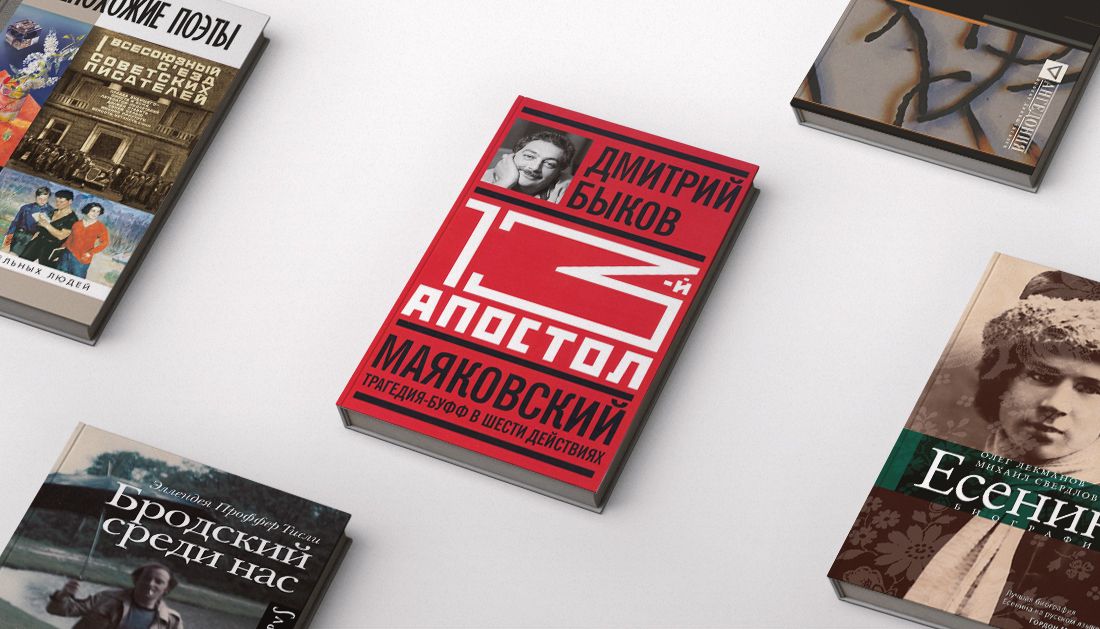
A weekly literary critic Galina Yuzefovich tells at Medusa about the most interesting book novelties published in Russia. In the current review - “The Thirteenth Apostle. Vladimir Mayakovsky: Buff tragedy in six actions ”Dmitry Bykov and five more good books about poets.
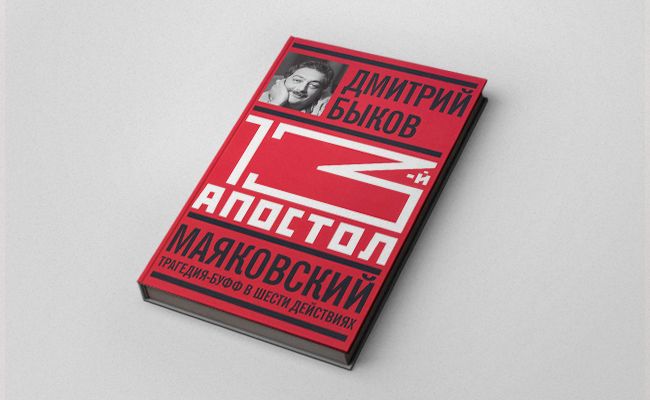
Dmitry Bykov. The thirteenth apostle. Vladimir Mayakovsky: Buff tragedy in six actions. M.: Young Guard, 2016
The “Thirteenth Apostle” Dmitry Bykov is a book that does not imply a frivolous review of a half pages with a schematic retelling of the plot at the beginning and the vigorous teaser at the end. This unbearable (kilogram of weight) is so tightly packed with thoughts, philological insights, historical parallels, internal controversy, painstaking factual crumbling, emotions, tongue twisters and longs that an attempt to move at it at any fast pace is fraught with risk in this labyrinth to get lost. Each sentence invites to discussion. Each detail, each third -stage character pulls a separate narrative line - sometimes continuous, sometimes intermittent. Each idea is spoke many times, each time a little differently, forcing the reader to almost permanently differently, to check-so who was the most faithful student of Mayakovsky, Ravich or Kirsanov? Mayakovsky-He is for Bykov who, Christ, Harlequin or rather Don Quixote? ..
Perhaps this is the first - although it is definitely not the main thing - what I need to say about the new book by Dmitry Bykov: it is painfully inconvenient to read, especially at first. Without becoming (contrary to the initial plans) to include the “thirteenth apostle” in the “ZhZL” series, the publishers entered carefully and humanely - in fact, this book is not a biography, but a cyclopean (eight hundred pages) is a prodigal essay, poorly edited and, it seems, in some places not re -read the author themselves. Not a coherent story, but everything that Bykov has ever read, heard, thought or was just going to think about Vladimir Mayakovsky.
Therefore, it is not too surprising that the first impression of immersion in the book is absolute chaos. The author quarrels with the heroes or ironizes them (sometimes it seems that his conversation, say, is self-certified with Gorky or Selvinsky and does not need the presence of witnesses, that is, readers), criticizes someone, comforts and encourages someone. He gives quotes from poets in which he feels the influence of Mayakovsky or, conversely, seeks his forerunner, and after as if predicting the reader's question, he slows down: “What, do not see kinship? Now I will explain ... ” - and further for a couple of pages, forgetting about everything, diving with his head in a deep analysis of the text. He writes the chapter on Shklovsky in the manner of the dark and torn prose of Shklovsky, and the chapter of Chukovsky is in the spirit of the sarcastic and the hobby of the criticism of Korney Ivanovich himself. From fragments of memories (if Bykov needs to be quoted, he is not tricked out-there are quotes in his book for three and five pages), from his own thoughts, from the poems and air of time, he collects a portrait of Mayakovsky-man, lovingly adds the details, and then argues with himself, erases the resulting picture, draws again-and again returns to the original option.
Read the "Thirteenth Apostle" as a biography is impossible, and not necessary. This compensation of heterogeneous information is more likely to blank for the future biography, not one, but two or even three. Not a statue, but a huge block of Carrara marble - very beautiful, there is no dispute, but pristinely wild.
However, who said that the statue is so better than marble? Of course, the reader (and the admirer) of the exquisitely verified Pasternak, in which there was not a single extra line, is difficult to reconcile with this chaotic power. However, if you renounce your own expectations, it turns out that the “thirteenth apostle” of the book in a sense is no less wonderful - and certainly no less important.
Firstly, if you look into the table of contents with a chiterian way, it turns out that among the boiling chaos, some guide structure is still traced-conditional and unsteady, of course, but nevertheless. The book is divided into six parts (it is no coincidence of its subtitle-“The Buff tragedy in six actions”), each of which has an end-to-end theme: “Shot” concentrates around suicide, “Voice”-around Mayakovsky’s stage performances, “The leader” tells mainly about the time when the poet actually led the literary life of the country. Inside the “actions” there is also a certain repeating pattern: each has the chapter “Twelve Women”, telling about Mayakovsky’s lovers, and the head of “Contemporaries”, which refers to important people who played one or another role in the poet’s life (almost all of them begin in one manner - “It turned out very badly”, “It turned out not quite well with Khlebnikov”). Moreover, with all the abundance of the pro -Tubeans spreading in different directions, the book as a whole has a kind of ring composition: starting with a fatal shot, it ends with them.
And secondly-and this is the most important-in this book there are such strange, unpopular and, like, completely non-obligatory things, like greatness and nobility.
Bykov, in his journalistic hypostasis, known as a merciless wit, this time does not speak truly bad about anyone, does not take accounts with anyone. His gaze is inherent in genuine wisdom and depth, excluding the possibility of petty irritation and hostility: even about Gorky - almost the most repulsive character of the book - he says that he is visible primarily a complex living person, and not a petty, vengeful and dishonest (disassembled with Mayakovsky dirty and false rumors) a medium -sized writer. Climbing to the unattainable height and from there, from the skysheus, relying the world he recreated by him, Dmitry Bykov demonstrates the inalienable properties of the local god - all -bearing (but not all -laws) and absorption (but not readiness for total amnesty).
As for greatness, it naturally follows from the scale of the author’s talent and plan: not every day you meet a book, inside which lives, breathes, tosses the whole world - huge, absurd, chaotic, diverse and therefore especially alive. The world that can be left for a long time, pretending the door behind it so that it does not through the outside.
Well, the last remark. Bykov would not be himself if, along with raw, written as if fragments in his book, passages of such crystal perfection were not found in his book that they want them - using Pasternak’s words - to wear with him, to know in the teeth, to stagger around the city and rehearse. In a word, not the biography of Mayakovsky and in general the devil knows what, and not the book, but definitely one of the most important literary events of the year. And those who need a good, smart and in a good way of the traditional biography of the poet, will allow himself to redirect the Swedish Slavist Bengt Yangfeldt “Stavka-Life” to the book, the benefit of it was reprinted, so now it is again available in paper.
And five more good books about Russian poets:

Valery Shubinsky. Human life in the wind. M.: AST: Corpus, 2015
The best biography of Daniil Harms today. Petersburger Valery Shubinsky immediately warns the reader that his hero is an exemplary person without a biography. Despite the fact that the life of Harms was furnished with a huge number of theater and grotesque, he was actually a person mainly “internal” - closed, shy and distant. It was not easy to understand him during his life, and after death it became completely impossible. Thus, the author finds himself at the fork: either to reduce Harms to creativity all his life, or to tell mainly about the people surrounding him. Shubinsky chooses the second strategy - and from his thorough notes about Harms contemporaries and the world in which he lived, an amazingly drawn out the clear contour of the poet himself.

Ellanda Proffer Fishley. Brodsky among us. M.: AST: Corpus, 2015. Translation from English V. Golyshev
The main advantages of the book of a many -year -old friend and publisher Joseph Brodsky, co -founder of the Ardis publishing house Ellanda Proffer - absolute honesty and equally absolute kindness. Ellenda knew Brodsky for many years (they met in Leningrad), and after he moved to America, she and her husband, Karl Profer, became completely like a surrogate family for the poet. Despite the fact that in their relationship there was a bad (a lot) and good (even more), Ellenda Proffer manages to go along the subtle face and avoid the mistakes of most domestic biographers and memoirists: it does not take accounts from Brodsky, but does not charge the pedestal either. As a result, her book is one of the most accurate and at the same time human scheme of the poet.

Oleg Lexmanov, Mikhail Sverdlov. Yesenin. M.: AST: Corpus, 2011
The book of philologists Oleg Lekmanov and Mikhail Sverdlov is a rare case of the ideal balance between scientific value and novelty on the one hand and reader fascination-on the other-on the other. Having shoveled, having weighed, having analyzed and comparing all the existing documents and evidence of Sergey Yesenin, the Lexmanov and Sverdles at the output created a book that, with all the objectivity and completeness, does not insult anyone's feelings. Bright, complex, talented, unequal, cruel, vulnerable - Yesenin in it looks simultaneously completely alive and at the same time not contrary to any of the sociocultural roles assigned after him. Well, the abundance of illustrations (there are almost half a thousand in the book) makes the book of Lekmanov and Sverdlov also the visual encyclopedia of the Yesenin era.

Pavel Nerler. Osip Mandelstam and his colaiger. M.: AST, 2015
Our main, perhaps, today, Mandelstamovee, Pavel Nerler, undertaken this time a truly titanic work. The book "Osip Mandelstam and his colaiger" is an attempt on the basis of the smallest grain of information collected by thousands of sources, to reconstruct, to recreate the last one and a half years of the poet’s life, from returning from the Voronezh link to death in Vladivostok. Who was driving with Mandelstam in one echelon, who lived with him in neighboring barracks, how the camp society was arranged, which fed prisoners and how their life was arranged - all this is not tin from random memoirs, from half -forgotten letters and oral stories (simultaneously weeding a huge number of myths and perpetrators - both comforting and comfortable, as well as comforting exaggeratedly terrible). As a result, his book becomes simultaneously both the Osip Mandelstam Osip and one of the most important texts on the history of the Gulag.

Zakhar Prilepin. Unlike poets. M.: Young Guard, 2016
The current book is not the first exercise for Prilepin in the biography genre: a few years ago, he already had a book about the prose writer Leonida Leonov. This time, he again plunges at the same time-in the twentieth to three years of the twentieth century, and three poets, iconic for their generation, but today almost completely fell out of cultural everyday life. Vladimir Lugovskaya, the author of the famous “Songs of the Wind” (from which everyone at best remembers the first line), Boris Kornilov, who was shot in 1938, who was departed from the work of Yesenin Anatoly Marienshof ... Each of them is important for the author, but all together they are a kind of prism- through which we today can look into the era, when “to that” The bayonet was equated with a feather, ”and the role of the poet was perhaps the most magnificent, dangerous and glorious in the history of mankind.
Other reviews of Galina Yuzefovich can be found here .
Galina Yuzefovich
Moscow