
Translated material
Single -industry towns is immersed in unemployment
A government report indicates a critical reduction in jobs in enterprises
A government report indicates a critical reduction in jobs in enterprises
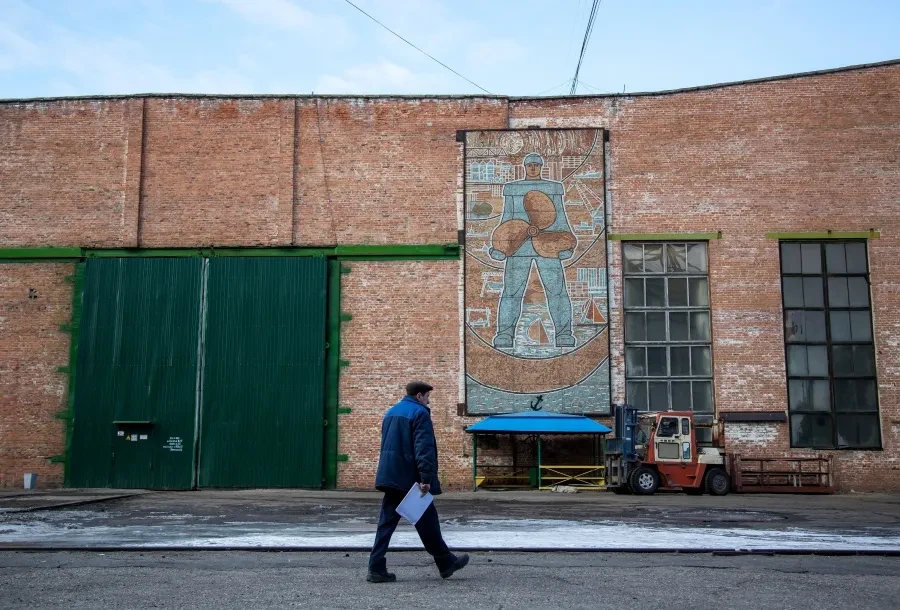
The city -forming enterprises in Russian single -industry towns are experiencing a serious crisis: the internal demand for their products falls, and the debts nominated in currency are becoming more and more difficult. The compression of sales markets is poured into a reduction in production and mass dismissals - the recorded unemployment in single -industry towns with 115 thousand people last December reached 139.3 thousand in early May. In the near future, the work may lose another 16 thousand. More than 106 thousand people work in incomplete employment mode - a third of all partially occupied Russians live in single -industry towns. This is the data of one of the last closed reports prepared for the Kremlin by the Analytical Center under the Government together with the Federal Security Service, the RBC newspaper reports with reference to its sources.
According to official statistics, in Russia there are 319 single -industry towns with the total population of almost 14 million people. Natalya Zubarevich, director of the regional program of the Independent Institute of Social Policy, believes that this figure was greatly overestimated - in 2009 the regions themselves made lists of single -industry towns to get financial support of the center. “In many of these cities, the compression of employment has occurred a long time ago,” the expert says. -What is it a single-industry woman if 5-10% of all employees work at the central enterprise? (In Monogrone, employment at one enterprise is at least 20% - A.Kh. ) "
Nevertheless, the problem of the development of monoprophic cities is recognized at the highest level of the government. According to the head of the Ministry of Labor Maxim Topilin, last year the number of single-industry towns that fell into the “red” zone in terms of the complexity of the socio-economic situation increased from 74 to 99. The head of the Ministry of Economic Development Alexei Ulyukaev spoke about the upcoming shortage of budgetary funds for their support. For a complete understanding of the degree of depressiveness of the single-industry towns, you need to look at the situation through the eyes of the population: according to a survey of the FSO services for December 2015, 60% of residents evaluate the socio-economic situation in their city as “intolerable” or “tolerant with difficulty”.
This year, domestic demand in the economy continues to compress, and from work “in the warehouse” of the mono -enterprise they are moving to a reduction in production. In 2015, the reduction amounted to 4.8% in real terms, and the unemployment rate increased by more than 20%. This is noticeably higher than on average in Russian economics, where the decline in industry amounted to 3.4%, and an increase in unemployment - 10%.
Economist Natalya Zubarevich believes that poor indicators of single -industry towns are quite logical: when the decline in the economy lasts several years, sooner or later employment begins to contract. “Yes, the situation in the labor market in single -industry towns is worse than in the country as a whole, it is difficult to argue with this,” says the economist. -About 13-14% of the total Russian unemployed and 10% of the economically active population live in single-industry towns. This is really a problem, but not a disaster. ”
The level of registered unemployment in single -industry towns today is 1.9% - this is not even twice as much as on average in Russia. On the other hand, in 2009, unemployment reached 3% throughout the country, Zubarevich notes - today it is far from those scale. “There are no mass dismissals, and the additional 16 thousand unemployed at 6 million employees will not change anything: active measures to support employment will cost the budget less than 100 million rubles,” the expert says. After the mass strikes of 2008, which required the intervention of the first person, the authorities learned to quickly cope with such situations.
The most problematic single-industry towns belong to one of the three categories: these are cities with manufacturing industry, cities with old non-competitive enterprises and small cities with a population of 20-40 thousand people. The crisis is quite localized: in winter of cities in which there was a noticeably increased level of unemployment, it was 10-15, says Zubarevich. The state to intentionally turn these cities into “territories of special development” - special economic zones with a preferential tax regime. “The single -industry toward is a systemic problem, the solution of which will require decades,” the expert explains. - It is necessary to approach it, increasing the mobility of residents, improving social capital and infrastructure. And in the crisis, the most important thing is the support of people. ”
Supplements like “close” or “resettle” is fundamentally the wrong approach that goes beyond the civilizational paradigm, says Irina Irbitskaya, director of the Center for Urban Planning Competencies of the RANEPA. “The question is not even in resources, because the solution here is quite simple: you need to engage in not global strategies, but to think how to save people and money. First, you need to look very carefully and impartially at these cities and find out what grounds have remained from state socialism there and that from this it can be revived with the help of modern liberal models. ” One thing is clear for sure, the expert continues: the relationship model “We will give you money, and you will develop” no longer works. And while it will be imposed on top, nothing good will happen to the single -industry towns.