
Translated material
Kremlin hits Gongo
On May 16, the Human Rights Council under the President of the Russian Federation conducted special -expression dedicated to the upcoming elections to the State Duma, which were representatives of public organizations designed to ensure control over the voting progress. Which of the social activists actually works for the state and how the veterans of the Russian Gongo are different from beginners - the New Times sorted out
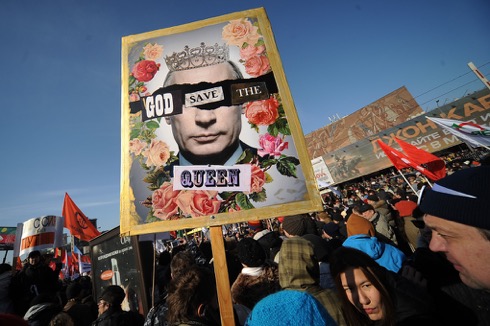
Gongo's task is also that after the election there were no rallies of protest, as in 2011-2012, Moscow, March 10, 2012
The HRC meeting lasted more than four hours. Literally on the eve, it became known that in the lists of those who wanted to perform along with recognized experts in the field of suffrage and representatives of famous organizations that traditionally monitor the purity of the elections, they included many people whose names the expert community were previously unknown. Sources pointed to the targeted blurry of the agenda from the supply of a member of the Special Cry of Igor Borisov. It was he, they say the sources, that he insisted on forming a queue for the tribune of people who spoke a lot and empty about increasing confidence in the elections, without bothering themselves with specifics. If you look at the history of organizations of these speakers, a loyalist background is easily found: they are constantly criticizing the Western electoral system, the operation of the opposition in the elections, but they ignore most messages about the application of the administrative resource or illegal agitation of the EP.
The authorities began to create structures controlled by it, engaged in monitoring the elections, back in the middle of the zero. It was believed that they balanced the general information picture of the day in favor of the authorities: independent observation organizations for a year in the year spoke of mass violations by United Russia, and loyal observers - about provocations against the authorities and violations of the parties opposing the EP.
For such organizations, there is an international term Gongo (Government Organized Non-Government Organization). These are pseudo -public organizations working in the interests of the authorities.
In the vicinity of the CEC
Some of these organizations are directly related to the Central Election Commission. For example, the Russian Center for Teaching Electoral Technologies under the Central Election Commission (RTSOT), founded in 1994. It is headed by the former chairman of the CEC, Alexander Ivanchenko. According to the official site, the goal of the organization is to “increase the legal culture of elections participants, training in elections and referenda organizers, other participants in the election process.” Rttsit receives serious budget financing for this. The CEC website published an action plan for 2016. According to this plan, the organization will conduct full -time and distance learning seminars in the regions, to publish brochures to help observers and commissions, in total, it is supposed to spend 58 million 770 thousand rubles.
Another former chairman of the Central Election Commission, Alexander Veshnyakov, since 2003, the Honorary Chairman of the Russian Free Elections, one of the founders of which is the CEC. Representatives of the Fund go on business trips as international observers, conduct their monitoring of violations, work closely with the Central Election Commission and are inexplicable in the public field.
Another former member of the Central Election Commission, Igor Borisov, who is now sitting in the Presidential Council for Human Rights, plays a large role in the work of Gongo-observers. It is noteworthy that in the zero Borisov admitted in sympathy for the concept of “sovereign democracy”, the author of which is the former deputy head of the presidential administration Vladislav Surkov, however, after the change of leadership of the domestic political bloc with the same enthusiasm, it now praises any actions of the new first deputy head of Vyacheslav Volodin; Now Borisov tirelessly sympathizes with the course on “competitiveness, openness, legitimacy of elections”, which Volodin regularly speaks of. Borisov heads the Russian Public Institute of Electoral Law
(ROIP). According to the ROIIP website, in recent years the Institute has been very interested in the transparency and honesty of elections in Western countries. If you believe the ROIIP reports, there are huge problems with democratic elections.
On May 7, 2015, the organization published a report on elections to the House of Communities of the UK Parliament. “British sociology and the electoral system were not ready to switch to competitive multi-party elections,” “it is not able to respond to time challenges and de facto distorts the free will of voters,” the authors of the report come to sad conclusions."Gongo" with experience
Another observer-Loyalist, Alexander Brod, also meets the Presidential Council for Human Rights. In 2007, he became the co -chair of the Association of Non -Profit Organization for the Protection of Electoral Rights “Civil Control”. The Presidium of the Civil Code includes a member of the Public Chamber Vladislav Grib, a member of the Presidium of the “Committee for Honest Elections” Mikhail Polyansky, as well as representatives of organizations, with the elections in no way, for example, Sergey Frolov from the Moscow Transport Union or Yaroslav Ternovsky, the co -chair of the Catholic Heritage movement. According to the organization’s website, “civil control” in recent years has been guarding honest elections not only in Russia, but also abroad. So, for example, experts of the Civil Code condemn massive violations in local elections in Ukraine, criticize the imperfection of the elected system in Poland and Great Britain.
The organization actively participated in the process of observing the elections in 2013, when the mayor with the participation of Alexei Navalny was held in Moscow, and Yevgeny Roizman fought (and won) in Yekaterinburg. “Civil control” then recorded “isolated cases of violations that were not significant and rude” - for example, a number of voting cabs in Yekaterinburg were equipped with too short curtains. But the organization noted that on this day, in the local elections in the suburbs, “technology” was used with the participation of observers: they reported mass violations, but the information was not confirmed during the audit.
In a conversation with NT , a ford noted that the information that his organization is observed mainly abroad is not true.
“We are constantly monitored by the Russian elections and are already observing now for the primaries of United Russia, and for preparing for voting in the State Duma elections,” Brod said. The data refused to provide data on the financing of his organization.
In recent years, according to their own sites, they have not been conducting in recent years and two more “gongo” organizations with similar names: the Committee “For Honest Elections” and the Public Council “Honest Choice”.
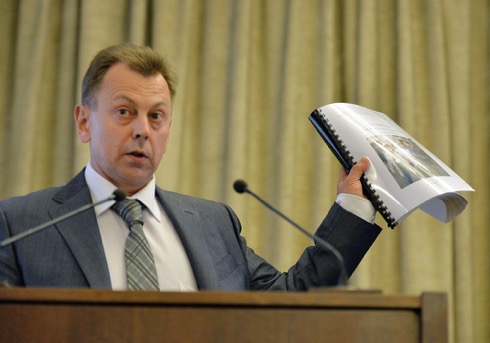
Igor Borisov, a member of the HRC Igor Borisov, did not try to make an objective conversation about the election on the counseling of the Council, Moscow, May 16, 2016
The “honest choice” is headed by the same ford, as well as the ex-president of the Izvestia newspaper, a member of United Russia Vladimir Mamontov and political scientist, general director of the APEC, member of the Supreme Council of United Russia Dmitry Orlov. In 2011, the Council published a statement according to which "in Moscow on the day of voting in the elections in the State Duma of mass violations and falsifications that could question the election results, not recorded." In the opinion of the experts, the vicious violations were committed by the Voice Association, which published the data of the Exitpols before the closing of polling stations, as well as LDPR agitators who called for vote for their party.
On the website of the Committee “For Honest Elections” to understand what he is doing now is completely impossible: 99 % of the news is reposts of publications in the press regarding elected subjects. The sites of regional departments look more likely - there is monitoring of the election in the field. The members of this organization performed at the last meeting of the HRC and said that they were actively riding as observers again to foreign elections with the OSCE mission. At the meeting, the representative of the Committee “For Honest Elections” Alexander Kobrinsky served from the audience, why people who “do not vote” themselves, so it is necessary to “spy and peep”. “I have enough 5-7 minutes to understand what is happening on the site. I do not need to watch video surveillance for this, ”Kobrinsky said.
New call
There are also observant novice organizations.
The corps of lawyers “For honest elections” (not to be confused with the above committee “For Fair Elections”. - NT ) arose after rallies against falsification of the elections to the State Duma
2011-2012. One of his public persons then became United Russia Alexander Karovisov. Now Karovisin periodically appears in observation groups in social networks and writes about the honesty and legitimacy of the elections, causing irritation of the rest of the groups. The same Igor Borisov from the HRC is included in the public council of the corps.
Finally, in the second half of 2015 it became known about the emergence of another organization - an open alliance of observers. The project’s website has its own “Map of Violations”, which is very similar to the famous project of the Voice Association to monitor elections. However, anyone could send information to the “Voice Card” “Voice”, and the “Map of Violations” of the Open Alliance would work for its observers through a special mobile application.
Alliance coordinator Dmitry Trifonov says that the alliance will focus on working with non -parliamentary parties - for example, in the autumn in the fall of 2015 in the Kostroma region, they worked with the “Homeland”, “Party against all”, “Green”, “Communists of Russia” and a number of other organizations. According to Trifonov, the ideological inspirer of the project is political strategist Alexei Kolodyzhny. It is known that Kolodyzhny collaborated in various pre -election projects affiliated with political strategist Oleg Smolkin, who has been working for the Moscow City Hall in recent years. The “Open Alliance of Observers” exists on personal funds of coordinators, emphasizes Trifonov.
The outgoing era
According to the website of the Public Chamber, the presidential grants in 2015 did not receive looilist observer organizations to monitor the election. Experts state that in the new political system, where the capabilities of independent observers and the media are very limited by legislatively, loyist organizations, only creating a background of distrust to the elections with a critical public, gradually become not needed.
These structures initially did not have any goal, except for the development of budgets, the creation of information noise and imitation of public support from the elections, said Alexander Kynev, head of regional programs of the information policy development fund.
“This does not even pull on trolling, since independent organizations usually simply ignore them, and they themselves are not able to make anything anyway. It is significant that, apparently, due to a shortage of personnel to the leadership of a number of such Gongo, they were forced to take people who entered and worked for the party in power. Therefore, the topic of trust here did not spend the night. Everyone knows everything about them: there are no illusions, ”says Kynev.
** “I have enough 5-7 minutes to understand what is happening on the site. I don't need to watch video surveillance for this "**Power contains observers-Loyalists by inertia. Gongo wants to be necessary, since this is their business, but their time has gone, I agree with Kynev the co -chair of the Voice in Protecting Voter Rights, Grigory Melkonants: “These guys have a generic flaw: they cannot talk about violations and shortcomings. Their task is to praise the elections and their organizers and discredit independent observers. They themselves promoted the theme of observers and helped to draw attention to election problems. When on federal channels they said that violations were invented by observers, and the audience on themselves felt coercive to voting, this led to dissonance and outraged the active part of the population. ”
This year, the same risks for the authorities are preserved. “If the authorities, along with Gongo and federal channels, deploy a campaign against independent observers, this, oddly enough, will help independent observers in the mobilization of the asset and strengthen election control,” concludes Melkonian.
“British sociology and the electoral system were not ready to switch to competitive multi-party elections, is not able to respond to time challenges and de facto distorts the free will of voters”
Photo: Valentina Svistunova/Interpress/ITAR-TASS, Yuri Martyanov/Kommersant