
Translated material
"The forward is rejoicing on the run"

Football in Russian and Soviet poetry of 1910-1950
In the publishing house of the Higher School of Economics, the book “Jurishes the forward on the run. Football in Russian and Soviet poetry of 1910-1950. ” The authors of Alsu Akmaldinov, Oleg Lekmanov and Mikhail Sverdlov describe the evolution of the football theme in the domestic poetry of the first half of the twentieth century - all its main milestones: how first the corresponding motives adapted to an unusual environment, almost smuggling into poetic texts, as they then conquered more and more places on the pages of magazine poetry and collections of lyrics and finally, and finally, and finally How they gradually surrounded by a set of stable semantic halles.
It was even more important for the authors to show how new motives for poetry changed, reflecting the momentary requirements of our time, deforming under their influence, and sometimes desperately resisting them. With the permission of the Publishing House of the Higher School of Economics, “Such Affairs” publishes an excerpt from the book “He is jubilant of the forward on the run”, which tells about the first penetration of a football theme in the media and poetry in the 1900-1910s.
On September 12, 1893, one of the first football matches in Russia took place on a sports ground near the St. Petersburg Tsarskoye Selo Station. It was arranged in the break between the competitions of cyclists. A brief and, characteristic, the ironic report on this event was printed by the “St. Petersburg leaf”:
<b> SL announced an intermission. At this time, the audience was entertained by the gentlemen athletes by playing the football (Football). A person of 20 signed up, the essence of the game is that one party of the players tries to drive a ball - tossing with his foot, head, with everything, not with his hands - into the gates of the nasty party. The area for the game was covered with dirt. Gentlemen, athletes in white costumes ran through the mud, now and then slapping from all over the scope into the mud, and soon turned into chimney sweeps. All the time in the public stood an inconspicuous laughter. The game ended with the victory of one party over another ...
But Russian poetry, in order to pay attention to football, took for more than twenty years-the first domestic poem we found, which describes this game, the “through wind” of Sasha Cherny, dated to 1910:
The graphite on the roof is hot.
The window is open. Stuffy.
Pad a dusty maple
And dozing indifferently.
Boys from schools gathered.
The notebooks are forgotten instantly
And fussy frantic football
On a cut area.
Do not be surprised that the first Russian poem about football was printed in a magazine designed for a mass audience. The honor of mastering new ones for domestic poetry and motives at the beginning of the last century often fell to the authors of poetic feuilletons in periodicals. These authors sought to revive the newspaper or magazine page by any means. Football exotic for the time being and all connected with it ensured almost one hundred percent attention.
Sometimes, however, journalists and feuilletonists have painted information about the newfangled sports game with additional spectacular shades and details. For example:
No matter how strange and funny it seems to be, but there are athletes-replections-one-legged football players or with damaged legs. Meanwhile, football requires, perhaps, more other sports of good addition, strength and lightness. These "only in the world" players are, of course, in America; All of them, with small exceptions, are the patients of Renangton's hospital and all of course victims of sports - all kinds of competitions. Truly, "Woe from ... sports." But still they do not lose heart - true love and true calling for sports are saved.
Or:
In St. Petersburg, the troupe of Liliputov artists is very successful. Small artists are very seriously and thoughtful of their art. They play as large ... And what a variety of repertoire they have - drama, comedy, an opereta and even review! Our photographer shot his favorite liliput entertainment - a game of football. In the summer, almost all their leisure artists devote to this sport.
Or:
We are informed that Bas Chaliapin learns to play football. He is “boiling” in the morning on the stage of the Bolshoi Theater of a People’s House, which is in size at least a football field. When G. Chaliapin’s voice will completely disappear, he will travel on a tour of Russia as a competing football.
One way or another, but the king of the poetic feuilleton Sasha Black will be more than once or twice to write and mention football in his poems. It is precisely the gymnasium students and schoolchildren who play football in Russian verses (as in the second stanza of the “through wind”) will often be depicted - in the poem by Sasha Cherny, this natural connection is additionally supported by the rhyme of “schools” - “football”. It will be repeated (in the poem by A.M. Baranovsky in 1913) and the contrast - boring study vs. Fun game:
Sasha Black has forgotten "notebooks" vs. "Frantic football", and Baranovsky:
So the youths are sweet
When in dust
Under the heat
Rush to the swarm
And rushes like a horse
Their young fire!
Forgetting and "
"Cola" and "five",
They are enthusiastically shining ...
It seems logical that the first foreign boys were the first to be the Football players depicted by the Russian poet: football was perceived for a long time in Russia as a foreign and not too suitable fun for our person, but, however, not German, but English.
“Football (English Football), along with the cricket, the most popular game of the ball in England,” “Brockhaus and Efron's Dictionary of Brokeus and Efron” proposed such definitions of football in 1909. “Despite the enormous successes that football in all states of the continent is still an exemplary country for this sport is his homeland,” the well -known Moscow specialized magazine “Russian Sport” summarized in 1913. “Only in England the players go through the right school and from an early age lead a cautious, moderate lifestyle that the sport they have chosen requires.”
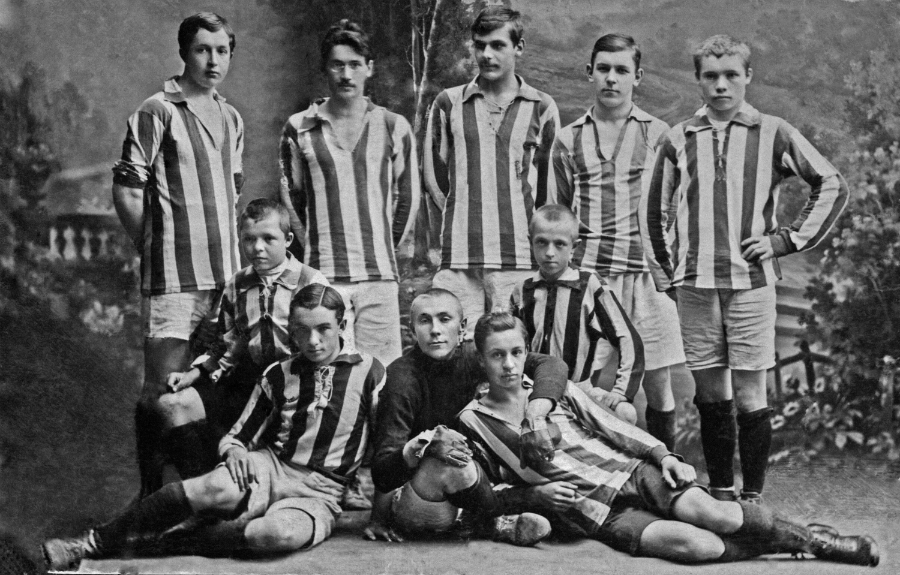 Football team "Novotorzhsky sports circle", 1913 photo: TASS
To complete the picture, it must also be recalled that England at the beginning of the last century was perceived in Russia not only as a country of football, but in general as the main sports power in the world. Only in a mocking poem (Satyriconza Vasily Knyazev) could the Russian layman ask a question:
Monsieur, already in the field of sports
We will not win the British?
The serious answer to this question was: the British, these "children of cold and sports", in football, tennis, crockete and rowing are inaccessible.
Another key for the early Russian poems about football motif, clearly sounding in the poem of Caalyan, is the motive of the nudes of athletes (“Moreover, everyone is undressed / so that a little bit of a goal”). This motive almost never stained with domestic authors playful and erotic.
Much more often the nudity and athletic addition of athletes served for the authors who wrote about football, the reason for the comparison of modernity with antiquity.
We also quote an excerpt from the ironic miniature printed in “fragments” in 1915:
With the onset of spring, along with flies, our players also came to life. For some reason, football players have an addiction to loud names. There is a triumph football circle, there is a “gladiator”, there is a “victory”. They say that the mugs of “thunder and lightning” and “splash” are also born.
However, among the gladiators there are such gladiators who have no more than one and a half arshin, and the legs are thin, like pasta. However, to say that what gladiators can be born in the cold climate of the northern capital?
The Triumph also resembles ancient Rome, where the winners entered the triumphal chariot, under the triumphal gates, crowned with laurel wreaths. But not a single triumph from the Triumph we saw on the head of a laurel wreath. Maybe because the bay leaf is sold in the shops already dried, along with pepper?
Returning to the listing of comparisons, metaphors and hyperbol of the ball in Russian poetry of the early twentieth century, we recall that in one of the two football poems of Osip Mandelstam, a cut off human head was likened to football poems in 1913. Two Mandelstam “football” should be in touch with those of his poems in 1913, in which the anger of the then day was intensively mastered. These poems mentioned or meant the death of the Titanic, skyscrapers, cinema, tennis, boxing, polo, croquet, American bar ...
On the one hand, in the Mandelstam hobby, modernity could be seen by following the principles of acmeism, which proclaimed the priority of the native and momentary over mystical and eternal. Just as Bryusov, Mandelstam in all three versions of his poem abandoned the lightest, begging path - the theme of England never arises from him. This was a conscious, thoughtful decision, which, for example, indicates a comparison of the 1913 Mandelstam poems with a fragment of football from the later Mandelstam prose "The noise of time" (1923):
At the suburban, in the courtyard of a huge profitable house, with a deaf wall, from afar, a prominent side, and a Shustovskaya sign, a dozen three boys in short pants, woolen stockings and English shirts with a terrible scream played football. Everyone had the form that they were taken to England or Switzerland and there were prisoned there, not at all in Russian, not in gymnasically, but in some kind of Cambridge.
Since football in Soviet Russia took root well, it was, if not completely, it was almost completely forgotten about its English roots in Soviet poetry and prose of the early 1920s. Accordingly, Mandelstam could calmly afford to remember the “English shirts” and “Cambridge Lada” boys from the Tenishevsky school.
Perhaps, however, another explanation of the almost complete absence of specifically English motifs in two Mandelstam's “footballs”: these motifs were already played out in his “tennis” and another poem of 1913, later printed in the “new satyric”:
The ruddy skiper threw the ball heavy,
And the mob you liked it quite.
The descendants of thick -skinned football -
Croquet on ice and polo on horseback.
In the middle of the young men now - in the old days
The jump and lunge of the discolus blooms,
When they come down in a light canvas
Oxford and Cambridge are two chanting schools.
But only that really an athlete -
Who tore the sad life captive:
He knows the world where joy is breathing, foaming ...
And children's crockete hammers,
And our northern towns,
And the gift of the gods is magnificent tennis!