
Translated material
Diary of May
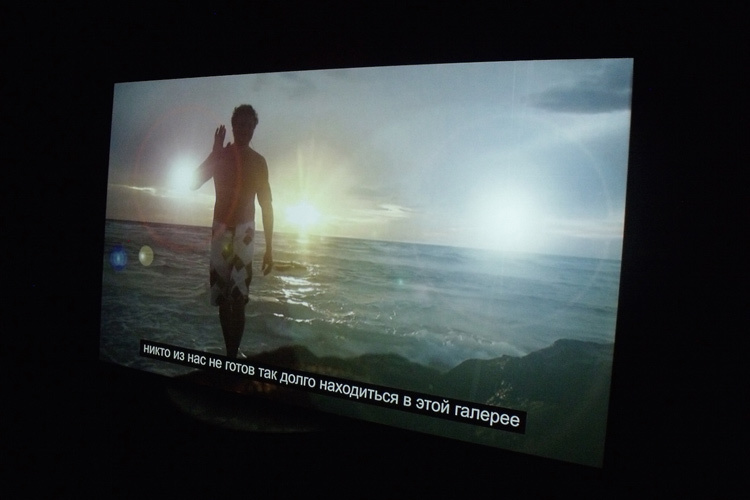
A brief reminder of the editor -in -chief that when betrayal is committed by those in power, ethics is flattened to morality
The text of Olga Deryugina would be or rather called "The Diary of May to Plue Gtzsi (State Center for Contemporary Art)." In view of the rhythm of work on this number of “Disagreements”, Olga passed the text on May 25, when the story around the GTSIA just began to unfold (this explains the conversation in the future of the May events in the last paragraph of the diary). On the same day, the Minister of Culture of the Russian Federation Vladimir Medinsky announced the accession of the GTSIS to Rosiso under the new authorities - the next sharp and directive measure of this official, aimed at centralizing state control over cultural institutions.
The case of the GTCSI is one of the main ethical cases of the month. In particular, the exposure of his former director Mikhail Mindlin, who passed the institution without any critical commentary, and even more so the struggle, happily accepting the new position of the director of the museum named after Andrei Rublev , - while the employees of the GCC sign a desperate petition about the preservation of the center . This petition, alas, is unlikely to change something when the official authorities have already agreed on everything with each other. However, even such an act of solidarity is important as a reminder that culture is a common thing and a matter of everyone, and not just the relevant ministry, bureaucrats, churchmen or sponsors. Yes, this is moralism, which we tried to avoid in this issue of "Disagreements". But here I can only again repeat the thesis taken into the title of this small editorial.
"Each exhibition - at the concert!" - So the motto of the month could sound. In May, the cultural life of the capital was saturated with a musical and festival spirit. Festival "Prepared Wednesdays" in the center of Mars; Polytechnic festival at VDNH; Musical concerts at the Sidur Museum; The night of the museums, during which in the Tretyakov Gallery, the painting of Kandinsky danced; Electro -acoustic concert in Lenin; a lecture about Nietzsche as a composer; Finally, an exhibition-concert " Speak Volumes ! " .
Holding the task of writing a May diary in my head, I firmly intended to miss most of the concerts, and from the upcoming events the greatest response in me was caused by events related to the problems of cyberspace and artificial intelligence. However, immediately, reality almost in an anecdotic form intervened in my plans: the fascination with music turned out to be so ubiquitous that even my hairdresser, who, as it turned out, studies at the DJ; And the founders of the literary magazine “12 extremes”, where I once had the honor of publishing, organized a punk-chanson group and recently recorded their first EP .
The starting point for reflection on the reasons for the current active interest in music for me was the event of the Logos magazine - a lecture and a concert “Biography from the Spirit of Music: Nietzsche as a composer”. As you know, the work of Nietzsche “Birth of the Tragedy, or Hellenism and Pessimism” is built around the contrast of Apollonian and Dionysian principles in culture. According to the thought of the philosopher, art opens up to a person the possibility of overcoming the a priori scheme of knowledge. Music affects, in addition to awareness, bypassing cultural conventions that interfere with the understanding of the essence of the universe, and thereby fulfill its true purpose - to be the "Dionysian mirror of the world." Nietzsche speaks of the tyranny of language, thoughts, logic. The language, which at first, perhaps, sometimes conveyed big feelings, has now only become a carrier of dry information. "... to other suffering of mankind, the suffering of conventionality joins."
Apollonian in its modern form is the management of everything and everything.
Taking advantage of the Nietzschean dichotomy, it can be noted that the current cultural situation declares the desire to free oneself from Apollonian in its modern form - namely the management of everything and everything; Fresh from the current symbolic codes and discourse as such - and come to Dionysian. And in music she dreams of emanciper potential.
Peter Slaterdike, in his book “Thinker on the Miller”, suggests that the critical suspicion of the German philosopher comes from the constant “swinging from the Apollonian side of the mask to the Dionysian and vice versa”. The fluctuation from one state to another cannot be completed, since "no matter what I say on the stage, it will always be symbolically represented by the Apollonical artistic construction."
Of all the musical events of the month, I fell only on one thing: the mystery of Bicapo Hermann Vinogradov - the mystery is quite in the Nietzschean sense. The affect obtained during the musical action is close to its cantian definition - what surpasses reflection. Unlike socially defined affect, this experience has no name, it is not discursive. This is what exceeds the possibility of expression in words.
Affect and choice
Cultural events participate in the general capitalist race for attention, expressed in the number of visitors. Social networks present a wide range of cultural events, in a single information stream, kitchen gatherings compete with large festivals.
The concept of choice as an ethical category in a world like a supermarket is supplanted in favor of the concept of choice as aesthetic. Advertising slogans begin with the imperative “Feel/feel ...” and gravitate to the form of aphorisms, pretending to be useful wisdom.
What is now occupying the most part of our time is the process of choosing from a certain set of capabilities. The subject is formed by this choice.
The act is performed as necessary, and not selected from a number of opportunities.
The mass culture focuses us on satisfaction, received from the choice-as aesthetic,-always appealing to affect. At the same time, the choice usually implies already prepared (constructed by the situation, society) emotional reactions-I must have fun, attending the concert, to feel my own generosity, helping someone, to imbue righteous indignation, signing the petition ...
The main misconception regarding the choice is that it is interpreted as an act and a manifestation of freedom. However, the choice is totalness, inevitability, and the choice of passive - you choose from the proposed set, which is already a certain construct. Ultimately, the situation of choice is designed to exhaust, lull vigilance and distract from true action. Indeed, in fact, the act is committed as necessary, and not selected from a number of opportunities.
* * *
How do you feel about the fact that you are added to friends of the institution? How can you be friends with the service? How to relate to a situation where SMM is built on the basis of personal contacts? Are you hesitating, sending an invite to an event to a stranger? How many posts a day or a week should be published in order to maintain attention to your public page, but not to bore readers?
Social networks open a number of dilemmas to users. It is no less interesting about the policy of representing events on the network than about the events themselves. The logic of SMM is the basic law of representation, reducing any action to the general denominator of the economy of likes and views. From here the indistinguishability between the party and the exhibition follows. In the tape, the boundaries between information and marketing are erased. In the announcement of the exhibition, you can find the phrase “most relevant art”, and the word “modern” appears twice in one sentence.
To create an event on the Facebook network, it is enough to hang out the picture attracting attention, place not a very long and not very abstract text - that’s, in principle, everything is ready. A little later, a couple of days after the estimated date of completion of the event, several photos of happy visitors should be hung. It remains only to add the coveted line to your CV artist or curator. After all, the main thing in the event is his documentation.
The exhibition is just a party for the type of closed club.
“ Premium Class Triumph 2016” by Alexei Taruts is one of the few examples where the artist purposefully works with the situation of mediation of the event that “herself became an event”. The exhibition opening were as distance from what was happening as those who followed it through the screens of mobile devices ( the Afisha.ru portal arranged online broadcasting). Those who came by invitation fell into the half -empty hall of the Triumph gallery with several prints on the walls and a monitor with a short, looped video; For about half an hour, guests were in a languid expectation of the event. Finally, sounds were heard from the basement floor of the room. Going down, the audience found a second crowd of spectators, surrounding a small scene on which the artist was. The musical performance itself lasted about ten minutes. The result of physical presence was not communication between participants, but documentation. According to one of the guests, "got into the documentation - and that business." The music here played the role of the soundtrack - whose function was reduced to filling out space - and voids, the lack of an event. And ultimately, she served to reduce the discussion to zero, to relieve comment. Another, no less important, problem is also indicated here - the exhibition ceases to be self -valuable. The exhibition is just a party for a closed club - and, possibly, further discussion.
Power and technology
At the collection of the club of Internet and society lovers and at the Conference “Internet Design”, key problems were again related to the language - this time with the language in which agreements between states are established. If cultural figures turn to music in search of Dionysian, then the power is discovered by a source of Dionysian - that is, an uncontrolled and fraught with a threat to the current government - on the Internet.
The report of Oleg Demidov about the “cyberwater and responsible behavior of states in cyberspace” states that the terminology of cybervae does not exist at the moment; In international law, the norms governing actions in cyberspace are not enshrined, and there is no instance that would consider offenses in this area.
Despite the fact that the definition of cyberwoman itself is not enshrined, in the United States, for example, there is the concept of “threshold of damage from cyber attacks” - here human sacrifices and mass damage to the infrastructure, as well as damage to the economic and political interests of the United States are implied. In the case of cyber attacks, military forces are endowed with the right to answer by any means. In Russia, the same situation in official documents is not spelled out. The very definition of cyberspace in the Russian Federation, the USA and European countries is different. It is obvious that while disagreements in terminology are reached, a convenient situation is created for aggressive actions that may remain unpunished.
One of the striking examples of cyber attacks is the case of the STUXNET computer virus that affects computers running the Microsoft Windows operating system. In 2010, Stuxnet was discovered at the Uranus enrichment installation located in Iran and disabled about 900-1000 centrifuges, as a result of which the Iranian nuclear weapons program, experts believed, was discarded several years ago. It is believed that the development of the USA and Israel were behind the development of the virus. However, whoever is involved in this or any other cyberurinic, how could the guilty be punished in the absence of regulatory acts?
It is important to emphasize that virtual is not a separate alternative reality; The virtual action is inconspicuous, sprayed in space, but cyber is always a goal of physical reality.
In the absence of an agreement at the international level, a discourse on the global network is formed within the states themselves as a source of threat. So, starting in 2005, in the sociological surveys of VTsIA and Thomas there are formulations on the dangers of the Internet and the need for state control over it. According to such polls, most citizens recognize the potential threat associated with the use of the Internet, and advocate its regulation by the state.
Internet researcher Grigory Asmolov says that traditional media (for example, television) remain impact on the formation of attitude to new sources of information and communication. The issue of regulation of the Internet asmolov proposes to consider through the model of three measurements of the power of a political scientist and social theorist Stephen Lux. There are three levels:
Power interactions between actors A and B (Decision-Making Power) ;
Access to discussion
Ideological: the influence of actor A B by by formulating desire and motives.
The Internet is valid in all three dimensions. If at the time of its creation the global network was perceived as a place of free expression, “no -territory”, now the Internet appears an arena of struggle for hegemony between dominant players - the state and business.
The lecture of David Edmonds was also devoted to the problem of control over technology "Do the robot read Kant?" - He turned to the applied aspect of ethics related to robotization. Edmonds considers a well -known moral dilemma about the trolleys that has lost control, which proposes a choice between the salvation of five human lives or one, for which one of the ways should be directed. In the second version of the dilemma, there is still a train and five on the rails, only this time the subject stands on the bridge next to the fat man-and must decide whether to drop him down in order to save those five (a suicide jump under the conditions of the task will help). The lecturer draws the situation of the near future, when cars without drivers will drive through the streets and a moral dilemma will become a task for the robot. Who in this case should decide how to program the car - the state, corporation or car owner?
* * *
Having missed the festivals and the night of the museums, I went to the exhibition of Sasha Pirogova "Focus" .
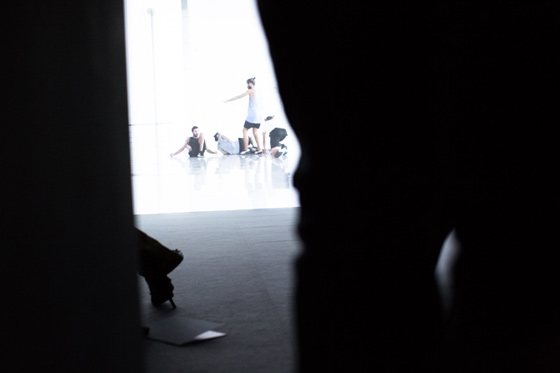 © Manege Sasha Pirogova. "Focuses"
In her video work “Agon”, the artist demonstrates a distrust of the tongue: the reference to the ancient Greek tradition of the competition is solved through body plasticity and performance and leaves the second meaning of the word behind brackets - associated with the ideal of democracy, built on the idea of equal access to discourse. This work is sealed and resists contextualization, knowing the failure of the interpreter language: not having knowledge of how to judge choreography, to advance further by the statement of the fact that this video is about technology, about Work - Out , it does not succeed. Depriving the viewer to participate in a productive dialogue, the author forces him to surrender to his non -articulated aesthetic preferences.
So far, as part of cultural institutions, artists are trying to hide from the language or come up with projects to participate in the Biennale of young art to add a weighty line in CV , and participate in the race for the number of spectators, Moscow activists arrange quiet pickets in the Moscow Metro. These pickets successfully demonstrate that the space of culture is not closed within the exhibition halls and social networks. On the contrary, the access to the public space, where the influence of power discourses is sprayed and not focused, makes it possible to hear another - for example, a conversation between participants in quiet pickets and passers -by expressing opinions about their posters.
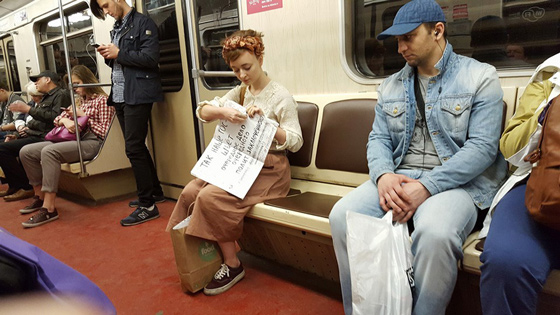 © Sergey Maksimishin Daria Serenko
In this month, two large-scale events will perform in the final musical chords: Walking Castle- “Modern circus of arts, symbiosis of mediaart, sculpture, painting, performance, contemporary-dance, poetry, artistic costume, architecture and music” and the opening of the Museum of Russian Impressionism, where “in the eyes of the amazed audience” “Five top paintings from the collection will be announced” “Fashionable Composer” by Dmitry Kurlandsky. This feast of spirit will take place already beyond the scope of the diary.
Download the entire issue of the magazine "Disagreements" (No. 4) "The swollen eye. Ethics Commission ": PDF , MOBI , EPUB