
Translated material
Alef, or card is not equal to the territory
Control over the space is carried out in two ways: by direct physical control and through the mediating layer of metaeography. The metaeography here is the mental and conceptual framework that set our perception of space and the boundaries of the terms in which we understand the world. The question of how to relate to the dominant methageography immediately leads into an ethical direction. Namely: do we participate in the creation of a methageography myth or are we trying to describe the specific material grounds on which this myth is based, and thereby deconstruct it? This question is similar to better known: to build metaphysics or engage in deconstruction through a critical theory.
There are the most controversial opinions on this subject. Russian geographer Dmitry Zamyatin believes that imagination is in itself a powerful emancipating agent and the right to territory can and should be feasible, first of all, in the imagination [I] . And the Catalan geographer Xavier Oliveras Gonzalez in the text “Exclusion of anarchist and places: anarchist criticism of mosaic-state metaeography” claims that, despite the multiple processes of creating other spaces in the 20th century, dominant methageography still exists in the world. Gonzalez calls her mosaic -state ( Mosaic - Statist ) and tries to criticize [II] .
The situation with virtual spaces is even more confusing. Until as a product of a certain set of technologies, they apply for a universal liberating force. However, according to Donna Harauay, their original goal is on the contrary, the strengthening of the imperialism of the Western/Northern/First World and the dominance of not an animal, savage or woman, but men as an author of space, called history [III] . Because in modern virtual spaces that claim to be global, only one specific type of virtuality associated with a specific dominant metaeography has been realized.
So, when are we talking about space where the liberating role of imagination ends and its vast majority begins? At what point does the imagination in relation to space lose the function of emancipation and begins to work to maintain Status quo , only fixing the existing relations of power and control?
The myth of the existence of many equal spaces
The idea of the infinity of possible spaces was developed in the 20th century in protopostomodern and postmodern texts. The potential existence of a huge set of equal spaces was accepted in them as an unconditional blessing, as a liberation from the dominant large totalitarian metaeographs. The exemplary text here is the story of Borges “Alef”, where the hero enters the space, which contains all other possible spaces that can be carried out at any time. Starting from the second half of the 20th century, the whole space, especially urban, began to be perceived as Alef, and the goal of the artists was to actualize a particular space that is potentially contained in the space of everyday life. And by the method of this actualization, the direct bodily multiple action, carried out in the urban environment, began to think.
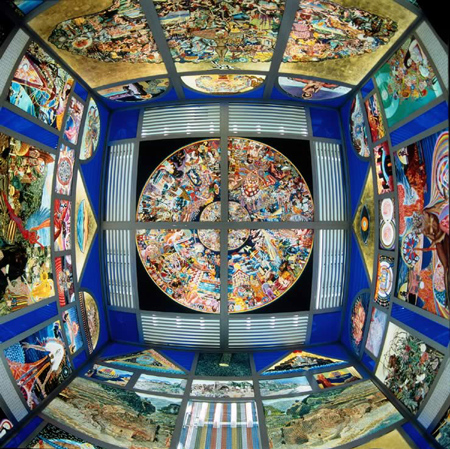 Mati Clarwein. Sanctuary Alef. 1963-1970. Reconstruction 1992
From the middle of the 20th century, in the context of the transition from modernity to postmodern, there was an active decay of total narratives and the corresponding large spaces. Private, local and partacular played all the largest role, including in space and its imagination. It became possible to talk about the multiple geographies of postmodern instead of the large unified geography of Art Nouveau. Similar theories and practices played an important liberating role. Among other things, the theory of the triune space of Henri Lefera is important here. According to it, space is a social product that has three hypostases that form a single form: representation of space, the space of representation and direct practices of spatial material production. The most important role is assigned to the space of representation - that is, the bodily, cultural space of life, carried out by the inhabitants themselves. In this theory, a citizen can directly affect the production of space.
The concept of “third space” ( ThirdSpace ) , Edia, who created the theory of “postmodern geographies”, is also indicative. This is a space containing fragments of numerous possible other orders other than the existing one. As Suj says, the knowledge of the “third space” leads our desire for liberating changes, gives hope for ex “framework of framework conditions, leads to an unlimited set of life worlds [IV] .
In all these and numerous theories inheriting them, the imagination acts as an important agent, an action begins with him, in him, as in the mother’s womb, the best space is growing up to update. However, having begun as critical deconstructive movements, these theories came to the fetishization and mystification of other possible spaces. In the mature years, Lefevr and Suj formulated mystic-Marxist theories, where the implementation of the best spaces occurs by unclear, metaphysical ways, on which all extremes and concepts coexist, forming unpredictable synthesis. An ethical alternative to such theories is to stand in an external position on the myth of multiple spaces generated by the 20th century, and to see what socio-political system, what metaeography produced it.
The madness of the colonialist in the spirit of Leo Tolstoy, who wore a peasant shirt, but at the same time did not cease to be a barin.
This myth structurally corresponds to neoliberalism, where any multiplicity is the path to creating a new product. It is no coincidence that agents of actualization of another space are free imagination and a direct, unrelent action, and the struggle of possible spaces for implementation is conceived as their competition - the values of individual freedom and market relations, cornerstones for neoliberalism sound here. Today it becomes clear that Folk-Politics -a direct, bodily, unreleased action-no longer frees anyone even in America and Europe, where the values of private and individual traditionally high [v] .
The economy of supposedly free desire, which is put at the forefront in the theory of updating the best spaces, often does not take into account mechanics of production production in the colonial system of production of the subject. Gayatri Spivak writes about this in his text "Can oppressed talk?" [vi] . It is important to think about the role of another in the myth of multiple spaces - the other can be colonized, if not physically, then at the level of imagination: to become different, to feel others, to appropriate his lifestyle and thoughts, having previously attributed to the uncomplicated, pure desires and intentions to exothy.
The experience of populists is indicative here. They fought for the common space and made, as it seemed, a decolonizing suicidal gesture to abandon their own repressive identity. However, the attempt of a small nobleman Dmitry Karakozov on Alexander II was prevented by the peasant Osip Komisarov, a representative of the people, who was going to free Karakozov. The suicidal gesture of the Narodniks has the wrong side, acting as the forerunner of the neoliberal schizo-object, which is in constant determinization and the search for new resources. The imagination works as a new round of expansion and seizure of resources, as the madness of the colonialist in the spirit of Leo Tolstoy, who wore a peasant shirt, but did not cease to be a barin. It is inside neoliberalism that the imagination works as a tool for the seizure and production of goods. And in the history of Russia, the role of imagination was more often not to prepare the foundation for the liberating action, but rather to create a myth that supports internal and external colonization.
Ethics of space in Russia
The space in Russia is not a private, but the imperial business, at least the last three hundred years. Therefore, the imagination is aimed at mastering a large common space or at compensation for its physical lack, and glorification of imagination more often comes from power. The construction of the national space, or, in the words of the Thai geographer Thongkaya vinichakul [VII] , the geotel of the nation, is a project that gave tangible results in the second half of the 19th century.
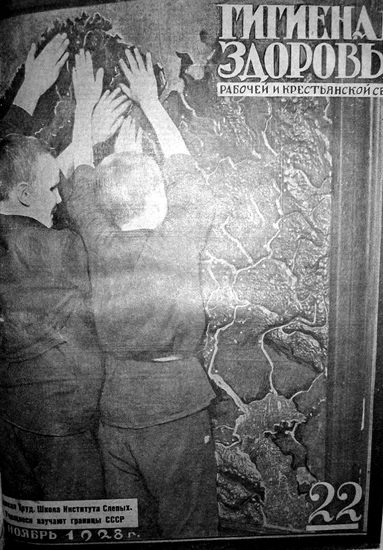 Pupils of the Labor School of the Institute of the Blind study the borders of the USSR. Cover of the magazine "Hygiene and Health", 1928
The irony of history is that the national Russian space was first clearly expressed by an artist who was not rooted in him and performed in relation to him a wanderer, Isaac Levitan. Being a Jew, this artist translated the power of the trait of sedentary from kilometers into metaphysics, which gives rise to uncertainty, hidden sadness and painful admiration of the outskirts. The imagination of Levitan is a compensatory way to exercise the right to space, reaching exalted admiration and dissolution in the open spaces.
But there is its own logic. As Hannah Arendt showed [VIII] , there was an internal affinity between the theories of pandvifications and the “baseless” being of the Jewish people. The folding of the national geotillas of Russia, stimulated by the liberation of peasants in the second half of the 19th century, took the form of pan -Slavism - ideology that recognizes the highest significance of the people regarding the state. The small prevalence of private ownership of land and religious traditions supported the attitude to space as a homogeneous, no -higher, higher one. According to the tenant, the position of the masses of mass in large cities, so successfully mobilized by totalitarian movements of the 20th century, including Stalinism, was like the position of Jews.
The “emphasis on the map” was proclaimed, which a huge number were produced for schools, each pioneer had to be able to imagine his country.
And the fact that Levitan unconsciously expressed at the end of the 19th century, in the Stalin 1930-1940s, was designed consciously. In 1934, a decision was issued to return physical geography to Soviet schools. The Bolshevik ideology of the space of the 1920s, striving to create an infinitely expanding world of the permanent revolution, was replaced by the restoration of science about the spiritualized space [IX] . The “emphasis on the map” was proclaimed, which a huge number were produced for schools, each pioneer had to be able to imagine his country. The maps became hyperrealism of Stalinism, they noted not only real, but also planned objects, the difference between the imaginary and real collapsed, the map made reality, allowing it to manipulate it with the help of imagination. History has become nature.
In the imperial Russia and the Stalinist USSR, the real implementation of collective ownership of land and space was replaced by the imagination of large spaces, in fact, working on further oppression of powerless. In such a situation, the destruction of the imaginary order formed on a material medium - space would become the liberation. And the notorious “black square” in this context is seen by a radical ethical gesture in relation to painting-the liberation of the material order of the picture, a statement by imaginary superstructures, parasitizing on forms-tests performing all artistic work. Only the length of the space belonging to everyone remains, and only one action can be carried out with it: measure and release. This is exactly what the Bolsheviks proposed in the 1920s in the project of geodetic utopia, until the powerful virtual superstructure returned to the 1930s.
Virtual spaces
In the same way, one can look ethically at the genealogy of virtual spaces: to emphasize the material carrier, pay attention to the coordinate system of the virtual order, what metaeography it corresponds to. Like any ethical knowledge, such an emphasis is more often annoying than structural saving moves offers. This knowledge is similar to knowledge of the origin of money, which can complicate their further carefree use.
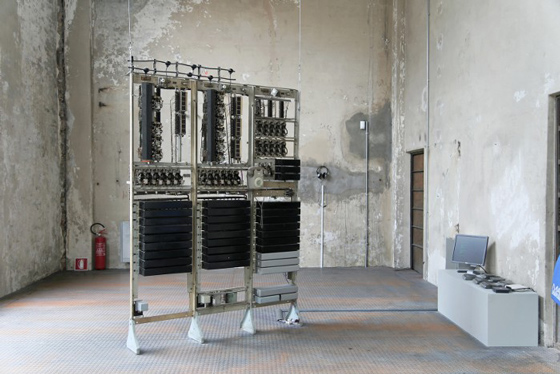 Harwood, Wright, Yokokoji. Tantalum memorial. 2008
For example, why know about the terrible price of mobile technology - after all, this knowledge makes each of us a passive accomplice of a grand crime. Control over Koltan’s prey (Columbus-Tantalite)-strategic raw materials in the production of mobile phones-was one of the causes of Congolese wars-a protracted African conflict, as a result of which about four million people died. The involvement in this story of many interested players, from corporations and governments to mercenaries and intermediaries, makes the conflict almost insoluble. And the need for raw materials consumed in the form of mobile technologies with a huge number of people helps to continue the conflict. Of course, the benefits of mobile communication function, like any technology, were repeatedly emphasized. But a group of artists Harwood, Wright, Yokokoji makes knowledge about the price of technology as a kind of material medium. With their installation in the form of an outdated telephone technology - the Strogener switch - they create a memorial to the victims of the Koltan wars and urge us to think about whether we need modern mobile technology if it gets this way. At the same time, this installation operates, communicating between African refugees.
Technological theories today experience a second birth in connection with the development of the Internet and social networks. Their supporters in every possible way emphasize the emancipating role of new technologies designed to radically change the world for the better. But here you can trace the genealogy of these theories and always remember their material foundations.
Cyberspace are born in the culture of late capitalism and realize only one of the possible types of virtuality.
The concepts of digital land, multiple virtual spaces, infinitely invested in one another, carry a powerful utopian potential. Cyberspace immerses objects in depth, the logic of the bodily surface disappears, manipulations with space are like surgery, the world appears as many layers and streams [x] . The whole planet turns into a huge geoinformation system, where the real space acts as Hardware , correlating with Software , which forms hyperreality.
Non -critical sticking into such virtual constructions promises a lot of benefits, and it seems that they are already here, at hand. However, the search for the source of such ideas leads us in the 1960-1970s, by the time of the appearance of California ideology, which was the bright embodiment of the values of neoliberalism [XI] and born in specific historical conditions, place and time. Obtaining a picture of the Earth from space and the transformation of the United States into a global power led to the birth of a new global vision. Technologies are designed to endlessly expand consciousness, giving birth to a kind of new anthroposophy. Its founder Rudolph Steiner understood the whole world as various levels of consciousness, in connection with this the main task is to continuously expand our consciousness. The body of Steiner is also a certain level of consciousness, but lower. In the process of expanding consciousness, the engine is the brain, which is in an almost weightless, suspended state in the upper body. The body is subject to gravity, it strives down, but the brain as a result of a special suspended medium is connected with the cosmos, being directed upward. Critically speaking, the Anthroposophical brain carries out an endless colonization of the world, trying to overcome the material. In these conclusions, the logic of the Cartesian subject, and the patriarchy, and colonialism are recognized, in which a certain substrate (objects, women, natives) is subject to the development of a more organized essence. The word “virtuality” itself originates from the Latin Vir - “man” and is originally connected with the actualization of the totality of all excellent qualities.
According to the secret conviction, modern virtual spaces lead to good. However, the cyberspace was born in the culture of late capitalism, their logic is the binary logic of zero and a unit, and although they claim to be global and granting everyone uniqueness, they realize only one of the possible types of virtuality, behind which is a particular metaeography. Not to mention the fact that not all are users of expensive technologies.
Under these conditions, a decolonizing gesture will be:
- The conceptual release of virtuality as potentiality from the power of one private interpretation and related technologies and media.
- A description of metaeographs that determine modern virtual spaces, and cognitive mapping of abstract global structures, which Frederick Jamison wrote about.
- refusal to construct virtual identities and images as goods that doom the local to exist in the form of a commodity label in the global market.
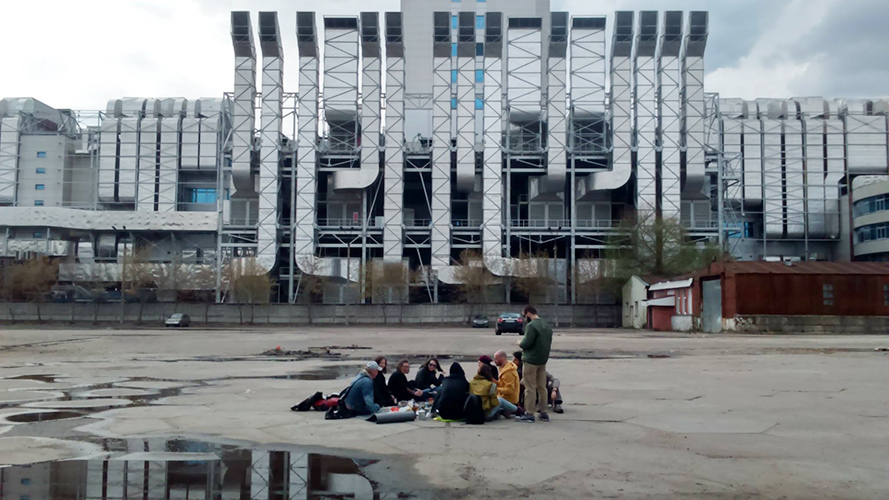
— Подчеркивание материальных аспектов технологии, буквальное документирование проводов и серверов. Как, например, в недавней акции медиагруппировки eeefff (Дина Жук и Коля Спесивцев), где люди собрались у крупнейшего дата-центра Сбербанка, чтобы «посмотреть на сервера в их естественной среде обитания».
[i] Дмитрий Замятин. Метагеография: пространство образов и образы пространства. — М: Аграф, 2004.
[ii] Xavier Oliveras González. Deny Anarchic Spaces and Places: An Anarchist Critique of Mosaic-Statist Metageography. Anarchist Developments in Cultural Studies, Volume 2010.1.
[iii] D. Haraway. Gender, Race and Nature in the World of Modern Science. Primate Visions, New York: Routledge. 1989.
[iv] Edward W. Soja. Thirdspace. Malden (Mass.): Blackwell, 1996.
[v] Nick Srnicek and Alex Williams. Inventing the Future: Postcapitalism and a World without Work. Verso (November 17, 2015).
[vi] Гаятри Чакраворти Спивак. Могут ли угнетенные говорить? // Введение в гендерные исследования. Ч. II: Хрестоматия / Под ред. S.V. Жеребкина. — Харьков: ХЦГИ, 2001; СПб.: Алетейя, 2001. С. 649—670.
[vii] Thongchai Winichakul. Siam Mapped: A History of the Geo-Body of a Nation. University of Hawai'i Press, 1994.
[viii] Х. Арендт. Истоки тоталитаризма / Пер. from English. I.V. Борисовой и др.; Postwell. Yu.N. Давыдова; Ed. M.S. Ковалевой, Д.М. Носова. — М.: ЦентрКом, 1996.
[ix] Г. Орлова. Овладеть пространством: физическая география в советской школе (1930—1960-е гг.) // ВИЕТ, 2004, № 5.
[x] John Pickles. A History of Spaces: Cartographic Reason, Mapping and the Geo-Coded World (Frontiers of Human Geography). Routledge, 2003.
[xi] Richard Barbrook. Andy Cameron. (1996) [1995] The Californian Ideology. Science As Culture 6.1 (1996): 44—72.
Download the entire issue of the magazine "Disagreements" (No. 4) "The swollen eye. Ethics Commission ": PDF , MOBI , EPUB