
Translated material
Towards the swan
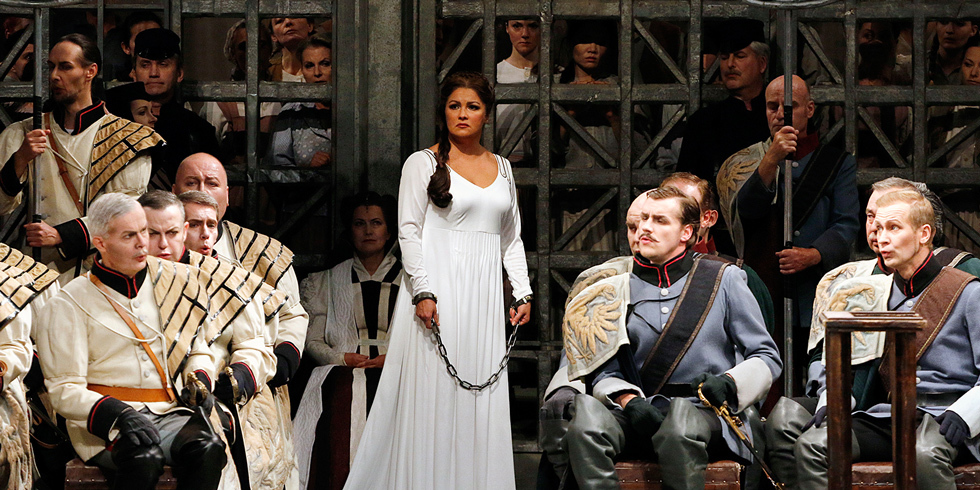
The news of this debut has excited the minds and the Black Market for a year: Anna Netrebko will debut in her first Wagnerian role - Elsa in Loellerin Richard Wagner. Well, or almost the first-at the dawn of a foggy opera youth, even before the Salzburg debut, Anna sang one of the "girls-flower" in the "Parsifal" of the Mariinsky Theater.
For the debut, greenhouse conditions were created: elegant and impressed by Wagnerian traditions, but in its own way, a cozy-provincial Dresden, the estate of the conductor Christian Tilemann, the Saxon State Capella with its perfectly transparent and structured sound, experienced Wagnerian and Bayroit singers Georg Tsepenfeld (King Henry), Evelyn Hurlitsius (Ortrude) and Tomash final (Telramund). Finally, the proven opera partner Peter stared - like Netrebko, a Belcantist debuting in Wagnerfach ( Wagner League ).
No directorial risks: for the sake of Netrebko, they restored, updating and cleaning, the historical production of 1983, which Opera opera was opened after restoration. Then, LoEngrin was put by Christina Militz, the beloved student of Harry Kommer, but today her light dissident strokes (for example, the formation of knights and the people of Brabant in columns, which are remotely reminding the third Reich) to be considered with the help of a magnifying glass. Lates and velvet camisoles dominate, LoEngrin sails on a silver swan, and Anna-Elsa flaunts either in the royal mantle, then all in white and regularly faints, gracefully stretching on the carpet of the scene. It’s hard to watch with an habit, especially recalling Hans Neyenfels in Bayroita, the ironic and impudent “LoEngrin”. But it was with this patriarch of the director's opera that our diva did not agree on the characters in November 2014, refusing two weeks before the premiere of the Manon party in Munich.
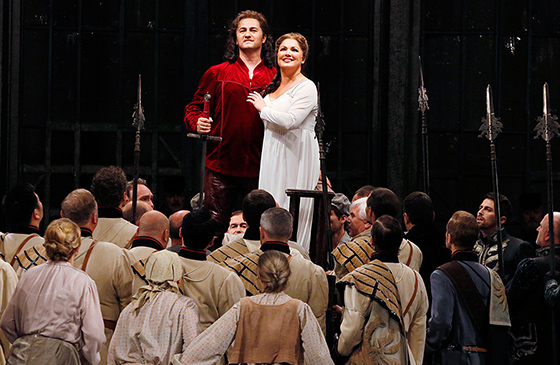 © Daniel Koch / Semperoper Dresden
Only four performances in Dresden, from May 19 to 29, of course, hopelessly sold out. Criticism wrote about “perhaps the musical“ LoEngrine ”of all time” ( Die Welt ) and “Stylistically impeccable Elsa ”. Indeed, both Netrebko, and Buchala “everything worked out”: the notorious “Wagnerian Legato”, and the shining top, and the ability to sing quietly where it is necessary (in Wagner it is not everywhere should “give a whole voice”).
The culprit and organizer of this cosmopolitan triumph was Conductor Christian Tilemann, strategist and musical director of the Bayroit festival. Anna Netrebko several years ago voiced the desire to sing Wagner. It came to specifics after meeting Tileman, who, according to Netrebko herself, "approved, encouraged and promised to help." Already during the New Year's concert on December 31, 2014, which was broadcast from Zhger’s opera throughout Germany, the ZDF channel (Anna Single Silva), it was clear that the “bridge” was built in Dresden and the German barrier was overcome. Tilemann, after the boss of the Berlin Philharmonic, concentrated his ambitious ambitions on Bayroit, of course, greatly wrapped up his nose when Netrebko will perform in his new LoEngrin in 2018 (though not with Berkal, but, apparently, with Alanya as a spacer). By the way, Alvis Hermanis will be set up, and Neo Rauch volunteered to become an artist of the scene, already noticed on a green hill. Bayroit is still a magical place.
But much more interesting than Bayroitsky rumors and all this Wagnerian cuisine, which has been cooked and gurgling for more than one and a half centuries, which is happening with a non -reck. She clearly made some strategic decisions regarding where to develop further. And the fact that the singer had just abandoned the debut in the party of the norm, bringing the Covent Garden into confusion, as logical as the record for the star six weeks invested in the training of the Elsa party on a much more modest Dresden stage.
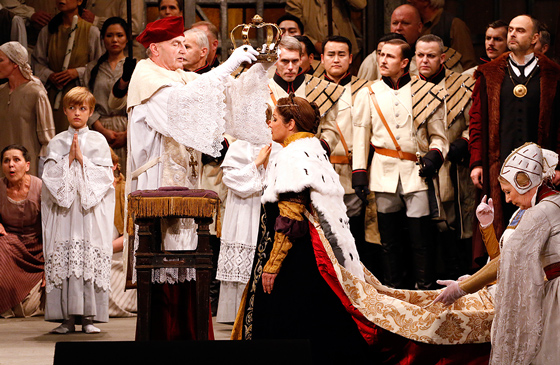 © Daniel Koch / Semperoper Dresden
Netrebko’s power is not only a unique voice that the critic of Eleanor Buning characterizes as “velvet embroidered with diamonds”, but also what is usually called “stage intelligence”, and, most importantly, the head on the shoulders. Wonderful affairs are taking place with a voice: it has become more complete, darker, dramatic, unheard of overtones and registers appeared in it. In an interview in the April issue of the specialized edition of Opnernglas, Anna Netrebko says: “I myself was almost scared when I noticed that I could now! Now I only need the right breathing - and go! " “I admit to you: I am glad for every kilogram of my weight, because I know that it helps me to extract such a sound.” Anna knows very well that the transition to a new repertoire requires gigantic work on equipment, a kind of “vocal bodybuilding”.
" Guys , i Tell You : Singing Wagner Auf Deutsch IS no -oo t Easy ! " - Netrebko states in one of his many tweets from Dresden and makes terrible eyes. But if you take a course on Isolda or on the party of Richard Strauss, it will be even worse. These parties suggest not only memorizing the text with what kind of outstanding language coaches, but also the ability to speak and think in German, which, in turn, changes consciousness very much. Possession of German, the ability to use its resources and instruments, honed for centuries of philosophy and crafts - this is, in fact, also a huge pleasure.