
Translated material
"There is nothing worse than sticking together into a mass of ash depressed"

At the request of the editor -in -chief of “Disagreements”, psychoanalyst Maria Esipchuk and teacher Masha Ivasenko discussed the ethical aspects of their work - directly regarding the issues of desire and power.
Masha Ivasenko: The first question: why is the desire to help suspiciously? This is how you can characterize your desire to characterize if this is not a desire to help?
Maria Esipchuk: We risk falling captive of a mirror reflection, where you can, as it were, can fall into my place of a psychoanalyst and estimate, how is it to analyze people? Maybe I'm talking about the desire to help, but I want to rule it myself? Or am I enjoying the riddles that you need to solve? Of course, suspicious! What does another want?
But this place, the place of desire of the analyst, is the result of a personal analysis, where a dissociation occurs not only from such a mirror imaginary logic, but also from any general. Including from the general ideals, which, it would seem, can unite us under the common banners of the psychoanalytic good. Psychoanalysis is a practice, the logic of which is formulated differently: not through the conversation alone heart to heart, not through the logic of universal good, but through the desire of an individual. And this is curious. Desire to analyze.
Ivasenko: You said about curiosity. I have a similar word - this is “interest”.
Esipchuk: Curiosity is that in psychoanalysts it attracted me initially. When I first saw and heard the Lacanists, for me, students of the Faculty of Psychology, this was a grand event. These were a completely different batch, who were definitely not engaged in psychology: from psychotherapists they were distinguished by the absence of such a literal, as it were, of course, the desire to help. These were people who asked very interesting questions, first of all, ethically interesting.
 El Greco. Saint Martin and beggar. 1597-1599
Ivasenko: Psychoanalysis is really such a practice that is kept on interest, in curiosity both from the analyst and from the analyzant. That is, this is a study, a trip to the unknown land that you go to to find out something ...
But it’s very difficult to get rid of this “help”. This topic is very relevant among people who heard something about the analysis, and the first question that they address to a person undergoing analysis-"Well, how does it help you?" And what can you say in response? Is the symptom eliminated? And if it is not eliminated, then “does not help”? And then you say: “Well, in general this is not the main task - to eliminate the symptom; Elimination of the symptom is a side effect. ” This makes them a strong impression, most often negative: why then pay money if it does not help?
Here is such a pragmatist constantly pops up; And the pragmatist is tied to the good. That is, we can’t get rid of the good when people crave good. They think these helping things - psychotherapy, psychoanalysis, crisis centers - as one and equate them to the good that they should produce. And the criterion here really becomes performance. And when people are faced with the fact that help is not the main task in psychoanalysis, they fall into the hole of misunderstanding: why then is it necessary?
Esipchuk: Why is this needed, really? We know that people wish bad things - as Kant says, “pathological objects” - and suffer from this, although life is not life without this. But Kant Metal to the universal, where the rejection of evil is still possible for everyone , even if turned inside out, as in the case of philosophy in the boudoir de Sada. Freud saw in the desire of the bad structure of repetition, which insists that things bringing suffering inside the symptom, nevertheless, even twisted pieces of intimate pleasure. In this regard, Lacan will say that a person is always happy, because he already has what he wants. But this happiness can cost a lot, cause real suffering. We will recognize his price at the moment when, having come to the office to the psychoanalyst, a person, although he will be ready to apply all his strength to be delivered from the unbearable, will keep the figure in his pocket - I will not give it!
People usually wish bad things.
Ivasenko: The position “I don't want to know anything about it” is a completely natural position. Just save me.
Esipchuk: There is still surprise. A person can demand help, even curse, but psychoanalysis begins at the moment when he is surprised. Freud does not say hysteria: "What did you dream of today?" -She herself begins to tell what she had dreamed of, because she knows that there is something there. He knows unconsciously, without knowing it. This is the most amazing. Psychoanalytic work does not promise any miracles, but woven from wonderful things.
Ivasenko: Yes, she does not promise miracles, but miracles happen, and in the most unexpected place. It's amazing!
Esipchuk: I remembered an example from the Lacan seminar by ethics about St. Martin, for whom the question of what the naked beggar actually wants, since their good was to cover up ...
Ivasenko: I just read this part of the seminar the day before. There, Lacan says about the good: "I will talk about good today, and I will talk about him badly." And from this parable, he concludes that the fabric to cover nudity, which suddenly turns out to be a text, is related to power. That is, good is not just what you give, owning it, and this is the presentation of the authorities.
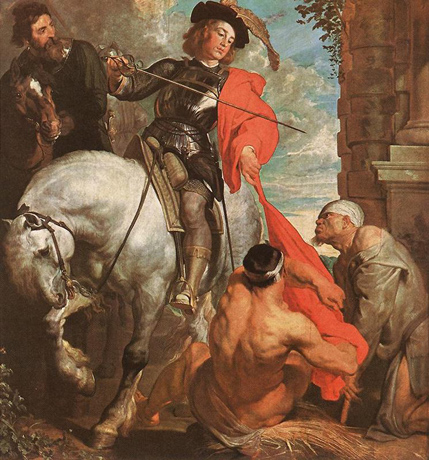 Rubens. Saint Martin and poor. 1621
Esipchuk: Yes, charity is not the production of good, but the will to power. Saint Martin made for the beggar what he wanted for himself, but he wanted to hide from the rain, and this became patronage. The analyst should not rush to do good, this is the most difficult thing in this matter. I was formed as a future psychotherapist, and to distinguish psychoanalysis from this “benevolence” and “dialogue” is the main task for me. The unconscious establishes a different place of the subject, radically unequal to himself. A beggar as a patient does not know what he requires.
Ivasenko: I had a long time to the question of why I work in charitable organizations, why I get a penny and continue to work there, why I get a bunch of all kinds of negative impressions there, encounter terrible things and continue to do it. And I enjoy it. This continues for years: I move from one organization to another. What kind of activity I produce?
This is a discourse of power. That is, I put myself in the position of the same oppressed, who shares his good, his last robbery, and thereby, and thereby my will to power is carried out very well. I had a lot of questions about this: why is this happening? How does this happen?
As a result, I began to work with adult autists not in institutions where everything is quite rigidly regulated, but in open space according to the type of home club, where you do not need anything, where you should not take off the last robbery, because these people, oddly enough, communicate very well if they do not interfere.
I thought about a mother who was born such a child: she suddenly notices that he does not pour towards her, does not speak with her, does not notice her, and, of course, she experiences a strong anxiety. To make the autistic speak so that he is subjected to is his mother’s desire. And where does it come from from the mother? This is the desire of society. This term “socialization” and the idea that we need to socialize is a machine of production. And in this home club you can’t do anything much, because you see that they don’t notice you, and nothing terrible happens, at some point they can turn to you, but you don’t even have to answer, although you work there as “helping”. If you don't like something, you can ignore. And I realized that this is a choice, how to get rid of this ... edification, or something. At the same time, I always worked in groups. And analysis is such a thing where the third is impossible.
Charity is not the production of good, but the will to power.
Esipchuk: Well, how to say. In the case of autists, we just find confirmation that it is not only possible, but also very appropriate.
Ivasenko: Translator?
Esipchuk: What is called the "practice of many." The principle by which group work is being built in lacanists is just based on the opportunity to turn to the third: when the communication of tete-a-tet is complicated, you can not turn personally, but, for example, comment on what the patient is doing or says, turning to a colleague, thereby including the patient in the discourse, where he can also take a place in the language. In the case of paranoia, you simply cannot afford the conversations of tete-att because of the risk to become a pursuer for paranoid. Or with autists, for whom words are able to invade really, bodily, some even have to cover their ears with their hands. There is no transfer that makes the analyzant come to the office, but there is something else that we can also approach.
Ivasenko: Can you tell you more about these projects in which you worked? What does it look like? How many people are there?
Esipchuk: We are currently making a group for migrants. It so happened that many Africans come to us, and among them the vast majority of psychotics, that is, are quite lost people. This is something like a club, they can come and hang out. There are events in the center that are organized for them, language courses, conversational groups, lectures, but the analyst and I initially decided not to organize anything on purpose. We said that we have a group where you can come in free mode. It turns out unpredictably, we can never know in advance how many people will come and what will happen, it is quite unusual, even for us. In addition, such a new moment is connected here (let's call it in quotation marks “anthropological”) - migrants begin to talk about their homeland.
 Jean Bourdishon. The Eve of Anna Breton. 1503-1508 Saint Martin and beggar.
Ivasenko: And there are problems with the language? There are people who, apparently, speak Russian ...
Esipchuk: No, no, we speak with them in French and English, these are immigrants from the former colonies, and they all speak one of these languages. And this is the most interesting, because these are people for whom both French and English came from the outside: they studied at a school where the lessons were conducted in these languages, but nevertheless their mothers speak other languages. And everyone has their own language, and there are a lot of adverbs in Africa, in one cameras more than a hundred. There may be five Camerines in one room, and when we asked them to voice the names of their languages, it turned out that these are five different languages, although people from one country where official languages are French and English.
So our work itself is marked by that ambiguous "Europeanism", which not only allowed us, representatives of very different cultures, to understand each other, but is also associated with the poor position of migrants. And I think that it is important not to support this transfer to Europe as a promised land, where there are rights and freedoms, not to make its values universal, but to maintain its otherness. The other that is culture and language is our field of work. But psychoanalysis relies on the fact that each has its own language. The analysis ends just with a similar discovery that there is no other, general universal other. So the “anthropological” interest is secondary to personal stories.
Ivasenko: The universal is, in fact, a fairly rigid spherical structure, that is, it has appearance and inside, it includes and excludes. The versatility of fascism will be ideal: the universe is closed on the race, and everything else is on the periphery, and inside this universe is really equality.
Where, where, and in the office of a psychoanalyst you understand how not free.
Esipchuk: You can formulate modern liberal ideals from the perspective of the universal: they say, everything is equal with us. Men and women are equal, black and white, mentally retarded and geniuses - all are equal! In this kind of universalization, there is a risk of flat opposite trends that are rooted in the same relationship of the universal. And fascism will really be a logical consequence of such universalization, where there is no way to build a difference. Anything can become so universal, even a fashionable installation on an “individual approach” today is also a rather strict structure.
Rene Girard writes in his book “Violence and the Holy”: “The modern world dreams of equality between people and instinctively inclined to see the differences, even though they have nothing to do with economic and social status, only a obstacle to harmony in human relations.” The difference is a hindrance. And modern equality rests on the ideals of the original, natural, peaceful foundation of the coexistence of people, which, of course, is a great error, which the whole culture testifies to. In this book, like any intellectual European, he analyzes ancient Greek myths and Shakespearean tragedies-analyzes, drawing attention to the tension that arises due to the ethical maintenance of the difference, which is not resolved universally, but requires the invention of itself from generation to generation. Because this is not transmitted to us directly through any congenital collective-conscious myths, but is invented along with the assimilation of the language, always in an impromptu way.
Ivasenko: Equality and differences are the tension of thought. In the middle of the 20th century, Delez, Guattari, the left French thinkers said: "It is important not what we are like, but how we differ, and we need to build a thought on these differences." This is a special ethics - ethics of differences. Still, we need to figure out what we are different, how different we are, and work with it. Jacques Rancier in the book “On the edge of the political” analyzes the phrase of Michel Rocar, who said: “France cannot contain the whole poverty of the world.” If you hear this phrase in a news political report, you will think that this is a nationalist statement. But according to Ransier, everything is much more complicated. What does “France cannot accommodate the whole poverty of the world”? “The whole poverty of the world” is something universal, that which generally levels and depersonalizes. And here France will accept one person of such, another person, but the whole poverty of the world ... Sorry, we do not know what it is.
They will not leave a person to lie on the street, but they will drag him home, into the family.
Esipchuk: In France, it is really not bad. One gets the impression that this transfer to Europe from the former colonies coming in search of social guarantees is borrowed from the myth of the Lord, who came and left, leaving the mark. Such a phantom transfer that does not deprive it of real effects. And Russia, in the view of most of the third world residents, is also Europe.
One of my patients from Cameroon thought that she could not conceive a child, because she was sick, and that only European medicine could help her, because in Africa medicine is not suitable for a line. And the first man who meets her at the airport in Russia, where she came to be treated, becomes the father of her unborn child. Wonderful healing! She believes that the case is in the medicines that she was prescribed here. But what was my surprise when she admitted that these were the first sexual relations in her life! Yes, wonderful healing! To get pregnant, something else needs! And it can be assumed that the disease that she tried to cure for several years and which was designed as a myth at the place of lack of real relations served to maintain this transfer to Europe, where life is possible, unlike Africa, where even a child cannot be conceived.
Ivasenko: Is there a transfer in Europe in relation to postcolonia? Can we also identify it?
Esipchuk: Of course, huge resources are invested, there are whole institutions that are engaged in the study of Africa and languages of small nationalities. But the actual voltage point is in Europe. Don't you think that the European is outdated with his conceit? And the transfer to Europe in these African children is now and then discovers its naivety. Another sketch. A person from the Democratic Congo says: “Listen, you are so great! If something happens on the street, you can always call an ambulance. ” And he begins by singing a laudatory ode to the European system of protection of rights, where there is a police, a court. But suddenly he begins to tell a completely opposite story: “You know, but we have no homeless people in the Congo. Because if you pass by the person who lies on the ground, then this will certainly be your relative, or a relative of your neighbor, and just shame if you leave him like that! ” This is an unwritten law, but this law is much stronger than any structure. There are no psychiatric clinics, somehow people themselves cope. I idealize, of course, - it was in the village where he lived, and in the cities everything is arranged according to the European type. Nevertheless, how he describes this world, suggests that they are not so bad there and do it without these institutions that pull their responsibility and, as it were, remove it from each, destroying the horizontal type of community.
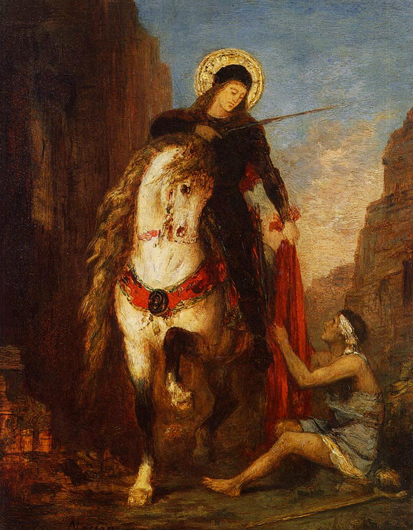 Gustav Moro. St. Martin. 1882
Ивасенко: Мне кажется, тут просто другая институция — институция рода.
Есипчук: Клановая, да.
Ивасенко: Я работала в интернате, где был подопечный из Баку. Это странно, что он оказался в Питере, хотя вся его семья в Баку, в Азербайджане, а там нет таких интернатов с кучей отделений. И он рассказывал, что там рождаются дети с инвалидностью, живут люди с инвалидностью, но они все живут дома, в семье. Для них это мусульманская идея, что какой бы ни был человек от рождения, он должен быть в семье. Но этих людей ты не увидишь на улице, потому что с ними просто не показываются, с ними не гуляют.
Есипчук: Это что-то позорное?
Ивасенко: Практически да, позор: у нас в семье некрасивый человек... Так что нет больших интернатов и институтов, но есть мощный институт рода, и он такой, что, конечно, не оставят человека лежать на улице, но затащат его домой, в семью.
Есипчук: Можно солидаризоваться с желанием дать ему право самому решать, но решает все-таки еще и структура — Другой не дает свободу, он устанавливает рамки. Уж где-где, а в кабинете психоаналитика ты понимаешь, насколько несвободен. И, пожалуй, только познавая суть этой несвободы, ты можешь хоть как-то подступиться к свободе, которая тебе все же в рамках твоей психической структуры дана.
Свободу предлагает, скорее, капиталистический дискурс: ты приходишь в супермаркет и можешь выбрать любой йогурт. Но проблема в том, что эта свобода на поверку оказывается причиной стирания различий, в частности, различия полов. И такой, например, странный симптом, как депрессия, — это совершенно логичное следствие неспособности как-то назвать эту проблему, и в итоге депрессией называют все, где с желанием что-то не клеится. Но на самом деле что-то не клеится с тем различием, которое оказывается выкинуто на помойку той свободой, что нам предлагает капитализм. И здесь как раз видны риски универсального в его идеальном либеральном воплощении.
Угнетенные — они как бы вне пола.
Ивасенко: Смотри: получается, что угнетенный — каждый, потому что он угнетен языком, вписан в структуру. Поэтому разделять, кто больше угнетен, кто меньше, психоаналитику уже не имеет смысла. В психоанализе мы как бы возвращаем этих угнетенных к первой и всеобщей угнетенности — угнетенности языком. Но тут все же нужно видеть, чем мы различаемся, и это вызов — как уйти от этой классификации сексуальных меньшинств, людей с особыми потребностями, мигрантов и прочего.
Есипчук: Да, ведь язык — это не только культурная вещь, с которой можно солидаризироваться и работать с языком, например, правильно и политкорректно всех называя и классифицируя. Вообще-то в основании психоаналитической теории лежат вещи довольно непристойные. И вот наделить того же мигранта полом — это отдельная задача.
Ивасенко: Потому что угнетенные — они как бы вне пола.
Есипчук: Да, у каждого есть пол, и нет ничего хуже, чем слипнуться в массу бесполых угнетенных, с которой мы хотим что-то поделать при помощи психоаналитического дискурса. Пол сильно эту массу раскрашивает, и это цвета желаний.
Ивасенко: Можно связать это с феминистками. Женщины долго просто не были включены в общий язык: в нем не было для них места. И с требованием со стороны женщин права голоса и равных прав приходит, на самом деле, новое мощное угнетение. И в действительности женщина обретает голос только тогда, когда она изобретает свой язык, начинает говорить на своем языке. Для меня очень важны оказались женщины, которые в XX веке начинают говорить средствами искусства, акта перформанса, художественного акта именно о женском. Не о равных правах, не о том, что «я тоже могу голосовать, как он, как мужчина», а, грубо говоря, «я, как женщина, представляю свой орган, он другой, совершенно другой, вы о нем ничего не знаете, и у меня происходят такие эффекты и такие аффекты». И я считаю, что феминистский дискурс как изобретенный язык возникает именно в искусстве. То есть для меня язык искусства — это язык, имеющий отношение к истине, к знанию, язык символический.
Мужчины и женщины различаются не социально обусловленным, но скорее логическим образом.
Есипчук: Джудит Батлер, анализируя Лакана, мне кажется, упирается в тупик другого рода: не совсем тот, где мы можем упрекнуть феминисток в чрезмерной тяге к фалличности, когда, примеряя мужской фаллос, они тем самым отказываются от той инаковости, которая есть по ту сторону фаллического. Батлер говорит о гендере как о следствии подчинения культурным требованиям, но это не то же самое, что пол в психоанализе, который является результатом сексуации, то есть особого, хитро устроенного бессознательного выбора говорящего существа. И вот этот момент вносит путаницу, так как язык можно так и понимать как общие для всех требования — предстать перед Другим в качестве мальчика/девочки. Но для аналитиков язык нельзя свести к матрице, ни к эдипальной, ни к какой-то еще, так как изначально суть языка — в наслаждении, где мужчины и женщины различаются не социально обусловленным, но скорее логическим образом.
Ивасенко: Но никто не запрещает же пользоваться языком психоанализа. Лакан изобретает четыре дискурса, и в результате психоанализ выходит из кабинета.
Есипчук: Важно отдавать себе отчет в том, что Лакан изобретает эти дискурсы, будучи аналитиком, для того, чтобы отличить психоаналитический дискурс от остальных. И здесь важно тоже свою позицию обозначить: кто я? Если я аналитик, заинтересованный в исследовании социальной связи, которая возможна только в уникальном опыте кабинета, я буду иметь точку отсчета. Не существует метаязыка, скажем так.
Ивасенко: Да, не существует.
Есипчук: Видишь, мы тут такую внутреннюю восьмерку закрутили на самих себя. Будучи аналитиком, я не хотела бы говорить о поднятых нами вопросах как об абстрактной социологии, а хотела бы поставить насущные клинические вопросы, связанные с нашим опытом. Потому что первый вопрос, с которого мы начали, — о благе — не носит универсального характера, когда речь идет о личной заинтересованности. Но это еще надо доказать.
Ивасенко: Ничто не носит универсального характера в случае с психоанализом.
Есипчук: А пол? Мужской, например. В том-то и парадокс, что говорить, что аналитики вовсе отказываются от универсального, неверно. Так же как и говорить, что они не делят людей, не классифицируют: это тоже лицемерие, потому что есть половое различие, и это принципиально.
Download the entire issue of the magazine "Disagreements" (No. 4) "The swollen eye. Ethics Commission ": PDF , MOBI , EPUB