
Translated material
The sense of the homeland
Mikhail Baryshnikov returns to his native language - so far in the play by Alvis Hermanis “Brodsky/Baryshnikov” on the stage of the new Riga Theater
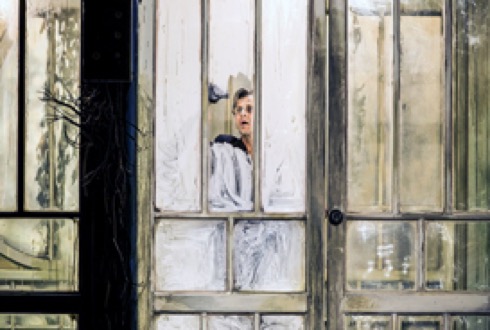
Mikhail Baryshnikov returns home to Riga, where he was born, with one suitcase and is alone on an old glazed veranda
Mikhail Baryshnikov nevertheless returned to Russia, this is a failed fact. In Riga, the capital of Latvia, where many speak and live in Russian and where, moreover, in the last few years, a rather large number of Russian citizens have moved to a permanent residence, in the very center of the city, in a cramped theater on Lachplesh Street, the Russian artist Baryshnikov reads poetry of the Russian poet and hesge the Russian hall. The performance of Alvis Hermanis is an ode to return to their home - to language, to birth, to youth, to memory, to friendship, to youthful dreams and vows, to the carelessness of youth, for the inevitable loss and the inevitability of aging, which had to be prepared even when only feelings rhyme. And at the end of the summer, another Riga premiere will take place: on the stage of the Opera and Ballet Theater, Baryshnikov will be released in the image of Nizhinsky.
Theater of one dancer
Baryshnikov made his debut as a dramatic actor in 1971, in the television test of Sergei Yursky Fiesta through Hemingway prose. A blond dancer with a thin flexible figure and crazy-blue eyes inspired by a romantic handsome man, Matadora Romero, a seducer of female hearts and a desperate brave man. Three years later, he will run west directly from the Canadian tour, and FIEST will put on the shelf for many years. The dramatic role of the Baryshnikov will return only in 1989, when the director Stephen Bercoff will offer him to play the Kafkian hero Gregor Zamza in a staging “transformation” - a role that requires not only dramatic talent, but also dizzying plasticity, since the hero spends most of the time in the image of a disgusting insect.
In 2004, Baryshnikov played the protagonist in the performance of Rezo Gabriadze “Forbidden Christmas” (the premiere took place in New York), then there were “short stories” by Samuel Beckett (2007, New York, director Joan Akaletis). In 2011, Dmitry Krymov released a performance with Baryshnikov and actress Anna Sinyakina in Helsinki, whom the whole theater world spoke about-“in Paris” according to Bunin's prose. By this time, Baryshnikov had already finally left the ballet scene and experienced real psychological "breaking": the body used to daily training required a mandatory dose of creative tortures. For the first time in many years, “in Paris” he spoke Russian and plunged into his favorite Russian cultural environment, part of which he invariably considers himself.
This is an ode to return to their home - to language, to birth, to youth, to memory, to friendship, to youthful dreams and oaths, to the carelessness of youth, to inability
Robert Wilson, a well -known theater experimenter, saw in Baryshnikov the characters of Daniil Harms: the play "The Old Woman" was released in 2013 and became a real event. In the “old woman”, Baryshnikov works with the cult Hollywood actor William Defoe - they are united by a similar appearance, a sense of self -irony and absolute subordination to the director. Russian speech in the "old woman" appeared by itself, quite by accident and became another actor, the responsibility for which is entirely assigned to Baryshnikov. It is difficult to see the “old woman”, she rarely and far goes. Just the other day, Baryshnikov himself announced in Riga about the premiere of the new project of Bob Wilson: the play “Letter to the Man”, which the actor and director will be shown in the Latvian National Opera and Ballet Theater in August this year. In the “letter” of the Baryshnikov for the first time and finally (such proposals came in his whole life more than once, but he never agreed) will play Vaclav Nizhinsky, whose diaries will form a dramatic basis of the performance.
Russophile and "Russophobe"
The duet of Baryshnikov and Hermanis in this small but star row of dramatic projects occupies a completely separate place. This is Baryshnikov's first work in his homeland. This is a poetic work, more close to the art of readersa, dramatic than spectacular. This is a work dedicated to not only the brilliant Russian poet, but also the artist’s closest friend. This is the first work of Baryshnikov with such a huge amount of Russian text. Finally, the first monoscope in his creative life.
For Hermanis, “Brodsky/Baryshnikov” is not only the first experience with the world star, but also the first Russian work after the actual breakdown of all ties with Russia. According to some reports, Hermanis is included in the Russian Foreign Ministry in the so -called black list of citizens who are prohibited from entering the territory of the Russian Federation. After the capture of Crimea, Hermanis was one of the first cultural figures who publicly announced their refusal to cooperate with Russian partners, canceled the tour of the new Riga theater planned in Russia and broke the contract for the next production in Moscow. In Russia, he was immediately recorded in the ranks of the “Russophobes”, despite his sincere worshiping Russian culture and classics.
The creative and civil temperament of the director is akin to the Russian mentality: Hermanis is a passionate personality, contradictory, implacable. Maybe that's why our authors are so close to him. Alvis put Gogol and Dostoevsky, Sorokina and Tatyana Tolstoy, Gorky and Shukshin. The visiting card of the Theater of Nations - the play "Shukshin's Stories" - is already the eighth season on continuous upsudes, tickets for it are sold a few months in advance. In the fall of 2014, on the Day of National Unity, President Putin visited the Shukshin’s stories and said gratitude to the director and actors who “match the brilliant writer” from the scene. ” Commenting on this event, director Hermanis called what was happening in Russia by “Soviet lumpenized psychedelia”, and Putin’s policy was “anti -Russian”.
In such a historical context, another Russian project of the disgraced director was born, which sounded in the midst of the emergence of a new Cold War.
A man with a suitcase
Brodsky left the Union in 1972. With one suitcase in which there were a couple of bottles of vodka, a printing machine and a collection of poems by John Donna.
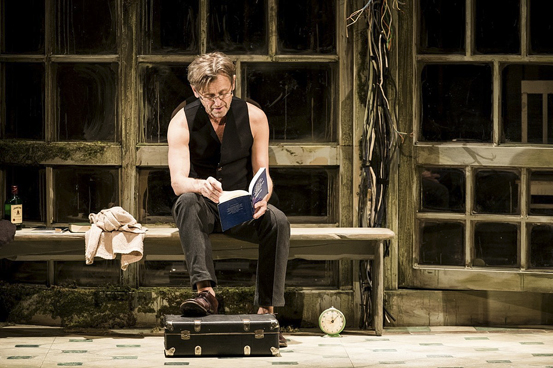
With verses of Brodsky Baryshnikov, he refuses “acting reading” - he talks about his friend
The hero of Baryshnikova returns to his homeland with exactly the same suitcase and hat in his hands. He appears on a forgotten glazed veranda (artists of the performance-Christina Yuryan and Gleb Filchensky) under a dull yellow light of a naked light bulb hanging on the wire from a cracked ceiling. The floors creak under the careful timid steps. The door with a cracked glass drying with time is rattling.
He sits on the bench by the veranda. Opens a suitcase. He takes out a bottle of whiskey, a round Soviet alarm clock on his legs, a stack of books. He drinks a sip of whiskey, opens a book, leafs through the pages and fluently reads many times read the lines, whispers them out loud, and the sound of this whisper is barely distinguishable. This veranda room will become for the hero the embodiment of his nightmares and a painful center of attraction, where he is drawn, as a criminal in the crime scene. The room of fear and happiness beckons to itself and pushes into the back, as soon as you step on its swinging floor.
Baryshnikov, by his own admission, never experienced nostalgic feelings in relation to Russia. The famous story, which became an apocryphus, was about how Brodsky and Baryshnikov secretly visited Russia - was born from their semi -speaking conversation on the topic "but to come and see with one eye." They didn’t go anywhere, but it was at that moment that Baryshnikov, looking at Brodsky, realized what it was - the feeling of a homeland, which this homeland in the heart of his friend left the wound that had not been long.
Maybe that's why these tragic gaps between parting and return, youth and aging, carelessness and despair, forgiveness and betrayal are so clearly heard in the play. Baryshnikov, due to his unique plasticity, perceives poems not as rhymed lines, but as a musical score. He does not stage them, does not illustrate - he dance them, pronounces with his body. “The body, frozen, prolongs the chair and looks like a centaur” - this is how a poetic metaphor gains flesh and breathing. And the “black horse” rushes around the room, and the “butterfly” is spinning, sticking his arms-wings to the cloudy glass, and the “tragedy” itself laughs with a satanic laugh, writhes in a chair, and then, broken, w tuck on it with his whole body, frozen in the position of Jesus removed from the cross.
The roll call of the living and the dead turns the dramatic work into a sacred ritual, which can only be bored with his breath, so as not to violate the priesthood itself by random invasion
At an hour and a half of the performance, several dozen verses were accommodated: the lady reads them from the stage, they sound from the reel tape recorder, they say the walls of the room, its ceiling and empty eye sockets of the windows. The voice of Brodsky himself arises only twice, when the hero himself causes his spirit, as if in a spiritual session. The poem “I entered instead of a wild beast in a cage” Baryshnikov begins to read, parodying Brodsky's famous manner of Brodsky, - a charter. At some point, Brodsky responds and picks up a friend, turning a monologue into a duet. And the second poem sounds on stage Brodsky’s voice - “still life”, one of the most mysterious and the most tragic. "When the darkness turns, then I will talk." This roll call of the living and the dead turns the dramatic work into a sacred ritual, which can only be bored with breathing, so as not to violate the sacredness itself by random invasion.
Brodsky is loved by actors. His poetry is incredibly spectacular, theatrical, I want to play like a Shakespearean drama. Brodsky brilliantly read Mikhail Kozakov and Alexey Devotchenko from the stage, read Sergey Yursky, Alla Demidova, Anatoly Bely. “Acting reading” Brodsky himself did not complain, believing that only the poet can read poet’s poet. Unlike actors who pass the verses through themselves and pronounce them as a confession, with a different degree of frankness - but they talk about themselves. Baryshnikov talks about Brodsky. He seems to take his friend's hand and leads his hour for an hour and a half from the shadow, and he silently hides behind him. This is a farewell to a friend and a hug with him. Together they roam this empty lifeless room of the past, fill it with live breath, laughter, music, sleepless nights, and night revelations. In order to once again speak, finish, feel, finish. Introduce. Now forever.
Photo: Janis Deinats/JRT.LV