
Translated material
Operation "Citadel"
The United States seriously took up the Islamic State*. The luck of Bashar al -Assad under Palmyra, obtained with the support of Russian aviation and military advisers, pushed the Americans to develop success: the coalition forces began an attack on Rakka, the capital of IG*
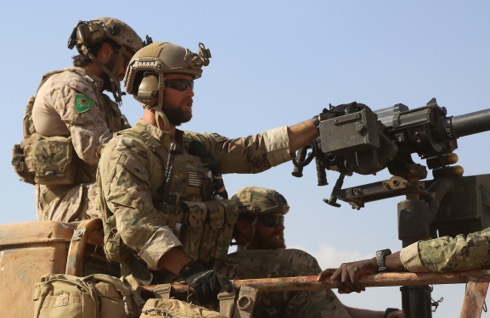
Military personnel of the US special operations forces (in the picture) are ready to help Kurdish militia and detachments of the Syrian democratic forces (SDS) in the attack on Rakka, * Fatisa, Northern Syria, May 25, 2016*
As a shock land force, the States use the Kurds, their traditional ally in Syria: the advanced detachments of the Kurdish militia have already reached the boundaries located only 35 km from the main stronghold of the Islamists. Syrian Racca, a city on Euphrates, 70 km from the border with Turkey, has been under the control of IG * for three years: in the spring of 2013, opponents of the Assad regime captured it almost without a real battle. Local clashes lasted only a few hours, after which units of the 17th division of the Syrian army fled. To commemorate the victory, the rebels demolished the gilded statue of Hafuz Assad, the former president of Syria and father Bashar al -Assad.
Checking readiness
The Americans and their Syrian allies began to prepare for Rakka’s return from the Islamic lobe in the winter. The first bell was messages in various media about the fact that near El-Kamlyn, in the area of the city of Ramaylan (Syrian province of Khasaka), the Americans will equip air base to support the coalition, ready to oppose IG * . Then rumors began to seep that American special forces appeared in Syria, that is, the military, ready to train militias, coordinate actions in the air and on the ground, as well as provide competent target designation. And more recently, already in May, it became known about a trip to inspection purposes, including for meetings with the commanders of the Kurdish militia and detachments of the Syrian moderate opposition in the location of one of the American military bases in the north of Syria, General Joseph, the commanding of special operations of the US Armed Forces. The general drove along the Syrian-Turkish border along a number of cities under Kurdish control. By this time, the Kurds accumulated about 20 thousand people for Racca.
** American planes threw leaflets on Rakka, in which local residents were warned of the beginning of the assault and they were recommended to leave the city **On May 18, American planes dropped leaflets on Rakka, in which local residents were warned of the start of the assault and they were recommended to leave the city. Finally, on May 21, from local battles in the north of Syria, the Operation Citadel - conditionally call it like this - it began.
Shares of fame
The fact that there will be no easy victory under Racca is already obvious. The forces of IG * , holding the capital, have up to 15 thousand people - albeit less than that of the attacking side, but quite comparable. Without exchanging the defense of the surrounding settlements, the leadership of IG * pulled all his strength into the city. According to some reports, penal battalions are formed from the prisoners of local prison. So battles for city with a three hundred thousandth population can last weeks, if not months.
Meanwhile, against the background of the attack on Rakka, another battal unfolds: diplomatic. Russia, which positioned itself for several months as the main fighter with the “Islamic state” * and achieved in this field of certain successes (the main one, of course, is the capture of Palmyra at the end of March), claims to be part of the laurels and in the capture of Rakka.
On May 24, Russian Foreign Minister Sergei Lavrov announced the readiness of Russia to participate in the main battle against the Islamic State * : “Of course, Racca is one of the goals of the anti -terrorist coalition, as well as Iraqi Mosul. We are convinced that it would be more effective and faster to free these settlements if our military (Russia and the USA) began to coordinate their actions much earlier. Now there is a chance that such coordination will take place, ”said the main Russian diplomat. At the same time, he explained that we are talking about the readiness of Russian aviation to connect to air strikes, while the troops of Bashar al -Assad can support the Kurds on Earth.
On May 20, Russian Minister of Defense Sergei Shoigu spoke in unison Lavrov, who offered the coalition forces, led by the United States, from May 25, to start joint planning and inflicting air strikes on terrorists. However, it is not entirely clear which “terrorists” had in mind Shoigu, since he immediately stated that Russia reserves the right from the same day, May 25, unilaterally strikes the militants who had not joined a truce. The fact that IG *, in principle, does not fall under the ceasefire, was emphasized by Moscow even before the ceasefire regime began to operate on February 27 in Syria.
Meanwhile, the Kurdov quite arranged such a statement of the question: the leader of the Syrian Kurdish Party "Democratic Union" Ibrahim Ibrahim immediately declared the readiness of the militias to coordinate their actions with both the Russians and the Americans. However, in the United States, the Kurds did not immediately support the Kurds to sit at once on two chairs. The Pentagon spokesman Lieutenant Colonel Michel Baldans said that the United States is not going to free Rakka together with Russia.
Battle for Rakka:
Kurds and detachments of the Syrian opposition against IG**
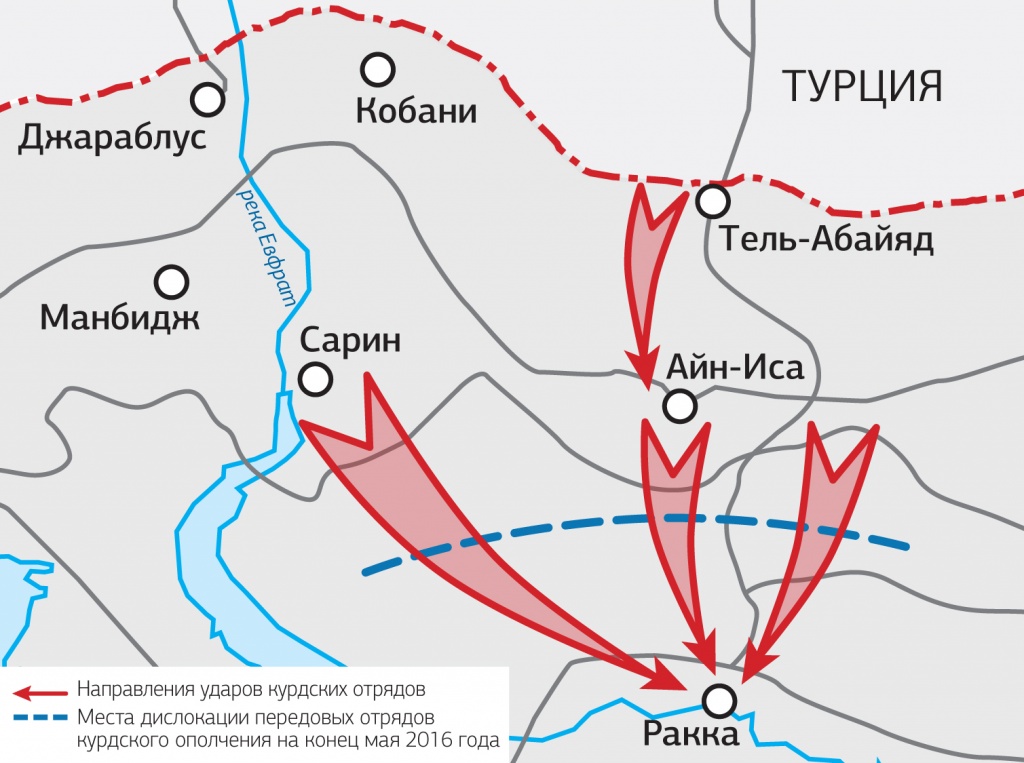
Source : Based on Media Materials, May 2016
However, for the sake of objectivity it should be noted: there is no unity in the question of the degree of military interaction with Moscow in the United States. The official representative of the State Department Mark Toner had previously made statements in the spirit that yes, Russia and the USA, ideas of joint operations against the Islamic State * are still discussing in Syria. Obviously, in the polemic fights between the military and political elite of the United States, the first is the top so far. This means that in the near future, American-Russian cooperation in Syria will be limited to the exchange of intelligence information, as well as information to prevent incidents in the air, which our countries agreed on last fall.
At the same time, it is obvious that this position of the United States is dictated not so much by military as political renosas. Russia has so actively intervened in the Syrian situation, which little by little begins to get rid of the negative reputation that arose after the Ukrainian adventure, and is more and more perceived as a key player in the Syrian issue. Russia's participation also in the main battle against the “Islamic state” * will give Moscow the opportunity to claim an even more serious role in the formation of the post -war Middle East. And the Americans would like this the least.
The skin of an indestructible bear
Although the battles for Rakka have just begun and their outcome is unclear, everyone is already ready to share the skin of the still not yet killed bear. Garib Heso, a representative of the Syrian Party of the Democratic Union in Iraqi Kurdistan, has already shared plans for the future fate of Raqua. “Since the assault is conducted by the“ democratic forces of Syria ”(that is, the Kurdish militia with the symbolic participation of individual Arab and Turkoman detachments. - NT ), it is logical that after the capture of Rakka it will automatically enter the democratic federal system that we created in the north of Syria,” said Heso. In other words, if the Kurds are drunk from IG * RACKA, then in the future it should become a Kurdish city that is part of Kurdistan.
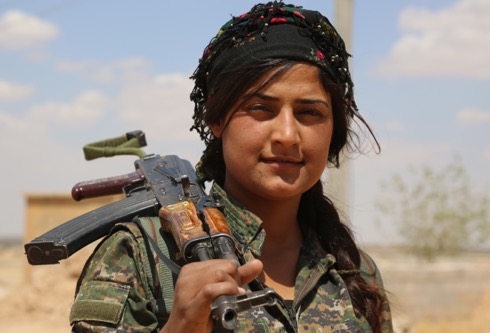
This Kurdish girl Ghana is participating in the offensive on Rakka, Fatisa, Rakka Province (Syria), May 25, 2016
An important point: by the wording of the federalization of Syria, Kurds mean the creation of a formally autonomous, in fact - independent Syrian Kurdistan. The "federal region of Northern Syria" was proclaimed in the territory of Syrian Kurdistan and in neighboring areas back in March. The problem, however, is that the rest of the communities in the country (including Arabs-Sunnites and Alavites, Turkomanov and Christian Assyrians) do not support these plans at all, either for a single and indivisible Syria, or believing that this issue should be postponed-at least until the formation of a new coalition government.
Kurds believe that if they repel ig* rakka, then in the future it should become a city that is part of an independent Kurdistan
Today, the main opponent of federalization is just the current president of the country Bashar Assad, and Garib Heso, who makes plans for the future of Raqua, knows this very well. It is no coincidence that in the same statement he mentioned that "the Syrian army in the storm of Rakki is not involved, it is far in the south" and that "the regime of Bashar al -Assad will not be able to contrast anything (the Kurdish offensive)." Perhaps this is so. But the Kurds should not forget about what Moscow would like and what Sergey Lavrov has already managed, namely: Russia - for the joint participation of the Kurdish militia and asadites in the liberation of Rakka. It turns out that Bashar al -Assad should help the Kurds recapture his city and immediately give in to its temporary allies. It is clear that the regime in Damascus will not agree to this. As Moscow does not agree.
Erdogan in the corner
Finally, Kurdish plans for the fate of Rakka are able to seriously affect the position of Turkey. Ankara has always considered the “Islamic state” * a secondary threat: in the foreground for her was the struggle against Kurdish separatism. This was the reason for the serious cooling of American-Turkish relations. Washington insisted on the more active participation of Turkey in the fight against IG * . However, recently, the situation began to change, in response to artillery blows from IG* on the Turkish provinces of Kilis and Hatay, the Turks struck the positions of Islamists in the regions border with Turkey.
When in May it became clear that the Kurdish attack on Rakka would begin from day to day, Turkish President Recep Tayyip Erdogan announced his readiness independently, without a wide Kurdish participation, to deal with IG fighters * . At the current level of relations between Ankara and Washington (not to mention the relationship of Ankara and Moscow), Erdogan's statement preferred to skip past the ears. And in vain. Ignoring Turkish interests finally drives Erdogan into a corner. After all, the picture was like this: on one side - Erdogan, on the other - at once the two largest powers of the world, interfering in the Syrian situation, while both heavyweights support the main headache of Turkey and the Kurds. For both countries, Erdogan is a classic “bad guy”, their policy regarding Turkey is reduced to the support of any opponents of its leader within the country. For Erdogan himself, to voluntarily as a replacement for the Kurdish militia, confronts the IG * , it's too late.
In this situation, the Turkish president can go to the most unexpected alliances. The Islamic Caliphate * may seem to him not just “less evil”, but a temporary ally on the principle of “the enemy of my enemy is my friend”. Another fact is even more interesting: the strengthening of the Kurds with American support creates common interests by Erdogan and his implacable enemy - Bashar al -Assad. Thus, the possible military success of the Antihilov coalition in Racca is quite capable of reformatting the situation. And even if the defeat of the “Islamic state” * will take place, especially taking into account the superiority of the forces opposing it, then the subsequent peace of the region is still under a big question.
***** “Islamic State” (IGIL), Islamic caliphate is a terrorist organization banned in the Russian Federation.Photo: Delil Souleiman/AFP