
Translated material
The image of ovulation
The instinct of continuing the genus in a person is nevertheless laid down, as in any primat. Women (and monkeys) can become pregnant only during ovulation or a few days before its onset, therefore, it is at this stage that they should attract a partner, such is biological expediency. But if the primates have everything rude and visibly, and the signs of ovulation are so noticeable that it is not difficult for the male to choose a female, women do not have such obvious signs of a fertile period. This circumstance gave rise to various hypotheses about the nature of hidden ovulation. Perhaps this is a valuable evolutionary acquisition, thanks to which a man shows interest in a partner constantly, and not two or three days a month. It is also possible that a woman thus tries to attract excessive attention of the opposite sex on certain days in order to be able to make a choice herself. There are other hypotheses, but none of them cannot be checked in practice. Be that as it may, attempts to hide female ovulation failed with a bang, because men still feel it.
A few years ago, the world was interested and amused the results of a study by psychologists from the University of New Mexico (USA) [1]. Scientists have found that dancers performing erotic dancing on the knees of men, in the days preceding ovulation, received significantly more tips from customers than in the luteal phase of the cycle (it occurs after ovulation and lasts until the start of menstruation). The difference was significant for women who did not accept hormonal contraceptives. This is not a very representative study, only 18 dancers participated in it, but there are enough other results that show that with a woman in the days previous ovulation, in her fertile period, some changes, which are not indifferent to men, still occur.
The review of these studies, many of which they themselves conducted, made specialists of the University of California Martie G. Haselton and Kelly Gildersleeve [2]. Men had to consider photos of female faces and a full -length photo with closed faces, listen to audio recordings, evaluate female outfits, smell of T -shirts in which the ladies spent the night. The results showed that in the fertile period in women, gait and plastic, appearance and voice, behavior and smell are changing, and it is these days that they attract men more. These changes are associated with fluctuations in the level of sex hormones, mainly estradiol, the level of which increases sharply a few days before ovulation. But one thing is a laboratory study, a photograph of an unfamiliar woman or a dancer in a club, and another is a real life partner. Do men notice signs of ovulation in their wives? It turned out that yes, although this kind of work is a few. Women note that during the period of fertility, husbands become more jealous and seek to control the behavior of the spouse. I must say, beautiful halves give them a reason. According to the same studies, women on their fertile days are cooling for husbands, they are drawn to more masculine, testosterone guys, they choose more sexy clothes, more often go to clubs, more willingly accept an invitation to dance from strangers. Therefore, it is difficult to say what caused a change in male behavior: a changed voice, the smell of a girlfriend or her reinforced coquetry, causing a man to attraction or jealousy. By the way, women with an increased level of estradiol themselves are more jealous than in the luteal phase.
Specialists of the University of Vienna, Masarika University (Brno, Czech Republic) and the University. Komensky (Bratislava, Slovakia) were able to identify objective signs that allow them to distinguish the face of the ovulatory woman from Lutheral's face [3]. Scientists used portrait photos of 20 girls, applied the marks on the image and traced how the coordinates of these marks change in different phases of the cycle. It turned out that in the lutein phase the face is less symmetrical, the lower part of it becomes heavier, as if into a bite, the eyebrows are more noticeable and slightly frightened. In the stage of ovulation, the lower part of the face is thinner and lighter, the lips are more complete, the face itself is more pink, probably due to increased circulation of peripheral blood, the skin is more uniform. Thin features and chubby lips are a sign of youth. European beauties are traditionally white and blush. A blush is also a sign of health. It is not surprising that the faces of women in the phase of ovulation seem more attractive, healthy, sexy, friendly, deserving, young and pretty than lutein. It turns out that the features of a female person, which, as is commonly believed, make him attractive, actually signal the ovulation and estradiol level.
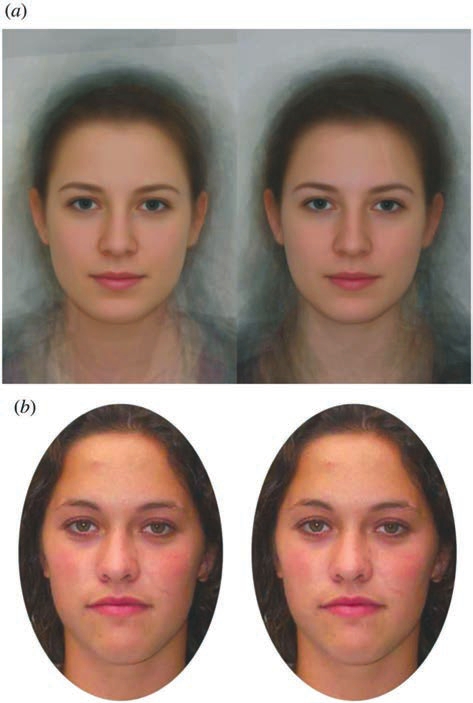
This issue was investigated by psychologists of the University of Berne led by Professor Yanek S. Lobmier. Scientists suggested that if faces in the phase of ovulation really become more beautiful, they will be considered by such not only men, but also women. And if these changes are aimed at notifying others about their readiness to become pregnant, women do not necessarily consider them attractive, but they may feel a threat.
Checking this hypothesis required a rather complicated preparation. First, the researchers created a prototype (see drawing). They photographed the faces of 18 women in the fertile and lutein stages of the cycle and applied 179 points on each image that determine the features and shape of the face. Then the images were brought together and received 179 averaged marks for each fertile and lutein phase. That is, the prototype is a consolidated image of 18 women.
Then the researchers made incentives. To do this, they chose 20 photos of women with a neutral expression on their faces, put on it the same 179 tags and then, using a computer program, led to a fertile and lutein prototypes.
The first stage of research was conducted online, 160 women of different sexual orientations from 18 to 40 years participated, 77 of them took hormonal contraceptives. They showed a couple of photos in random order and asked to choose a more attractive face. Researchers found no connection between their choice and phase.
The second stage was held in the laboratory. The same incentives were shown to 60 women. The participants in the experiment were asked not only to choose a more attractive person, but also to indicate which of the girls in the photo could take away the guy from them, to compete directly on the date. Faces at the ovulation stage did not seem more beautiful or more dangerous to the girls. The situation changed when scientists divided the participants into those who accepted and did not accept contraceptives and analyzed separately the answers of each group. It turned out that the subjects who did not take hormonal drugs consider girls to be possible for possible competitors, although they do not find them more attractive.
Psychologists tried that all the participants in the survey be in the same conditions, and minimize external influences. The studies were carried out in the daytime, the participants were asked to refrain from food, drink (only water) and physical exertion within an hour and a half before testing. All of them during the experiment were in the luteal phase, but in women who do not use hormonal contraceptives, the estradiol level is higher. Researchers believe that it is the estradiol that allows a woman to evaluate the hormonal status of another woman and understand whether she is a rival or not, especially since the subject herself is at that time in the luteal phase, that is, at a minimum of attractiveness.
Although signs associated with ovulation do not make a female face more attractive to other women, they still do not remain blind to these signals. Ladies with a high level of estradiol, that is, with high reproductive potential, feel the danger and can take measures by changing the strategy of behavior towards the partner and possible rivals.
1. Miller G., Tybur J., Jordan BD OVULATORY CYCLE EFFects on Tip Earnings by Lap Dancers // Evolution and Human 2007. No 28. P. 375–381.
2. Haselton Mg, Gildersleve K. Can Men Detect Ovulation? // Current Directions in PSYCHOLOGICAL Science. No 20. P. 87–92.
3. Oberzaucher E., Katina S., Schmehl S. Holzleitner, Mehu-Blantar I., Grammer K. Myth of Hidden Ovulation: Shape and Texture Changes in the Face During the Menstrual Cycle // Journal of Evolutionary Psychology. 2012. No 10. P. 163–175.
4. Lobmier JS, Bobst C., Probst F. Can Women Detect Cues To Ovulation in Theer Women's Faces? // Biology letters. No 12. 2015638.