
Translated material
Pony Apocalypse
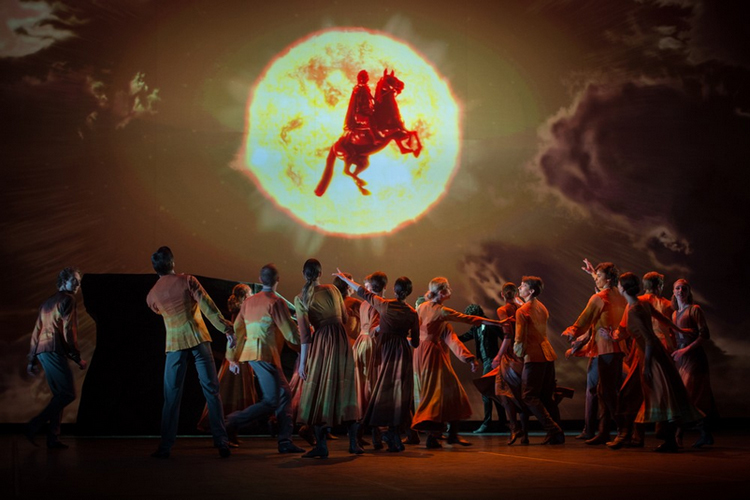
The ballet novelty with the enchanting name “I love you, Peter Creation ...” In the St. Petersburg Mikhailovsky Theater, it might not cost our readers attention if the Mariinsky Theater had not released the Bronze Horseman for two months earlier. Both performances specially for Colta.ru was studied by Sofya Dymova.
1995, Petersburg. The mind, honor and conscience of the great city with the regional fate Dmitry Sergeyevich Likhachev addresses the artistic director of the Mariinsky Theater (MT) with a request to resume the ballet “Bronze Horseman” (1949), this symbol of the unrequited spirit and greatness of the city’s blockade. A year later, to return the “horseman” to the people in an open letter to the new director of the Mariinsky ballet is already demanded by Alexander Arkadievich Belinsky. The new ballet director Mahar Vaziyev in an interview reports that “music for the platform of the Moscow station” will not allow the theater. (For those who do not know: everything that remains of the “horseman” in cultural everyday life / collective unconscious is the “hymn to the great city”, accompanying the departure of the “Red Arrow” and “Sapsan”.) The shadow of the idol loomed on the eve of the 300th anniversary of the city and later. The batch of conservatives inside the theater did not calm down, but instead of the desired sweet -haired birds of youth, bourgeois balancins, Neumayer, and Forsyt flew completely.
2015, Novosibirsk. Offended by acquaintances only by first time Tangaiser and becoming the director of the local opera, V.A. Kekhman announces the production of the "Copper Horseman".
Our Pushkin
For the reactionary public, a ghost ballet has become a universal remedy for spiritual cockroaches. When the MT finally decided to resume the “horseman”, the new director in Novosibirsk hastened to expose him as an icon against depraved tangiaisers: the Virgin, the Blekhshchuinniks of the run. It would be completely ridiculous to copy the Mariinsky production, so Mr. Kekhman decided that he would have his own small “horseman” with Glier and Pushkin. The idea was transferred to the St. Petersburg Mikhailovsky Theater, possibly for the sake of the stereo effect of “two in one” from the arsenal of travel agencies: from the views of the Great City it intercepts the throat first in the hall, then upon leaving the theater.
For the production from New York, the artist George “George” Tsypin, announced as the director of the opening ceremony of the Olympics in Sochi, was a little sad: we still remember his grandiose scenography in the performances of the MT of the 2000s. In the play of the Mikhailovsky Theater, the outstanding theater artist Tsypin, however, formatted his talent for the current historical moment-his “Copper Horseman” perfectly responds to creative state holidays, intelligibly exposing the electorate of the national idea and leading objects for patriotic pride: but we wish you to look at this island, where we have everything. Pushkin - here he is dancing with a pen in his hand. Falconets monument flies in fire, like Chelyabinsk meteorite. The third symphony of Glier scatters with fabulous gems-the same as about Ilya Muromets: for some reason, they decided to neglect the original partitura of the “Copper Horseman” in Mikhailovsky. Recognizable open -time species float along the back: you will see the Hermitage and the Peter and Paul Fortress, today the most suitable weather for a sightseeing tour of the city.
If the buffet of the Mikhailovsky Theater was not so exceptionally good, two half -hour action could be easily united in one. The fed curly curly subject of his protagonists puts on the scene, explains to them the historical need for the founding of St. Petersburg, and when the time comes, he persuades to die (“it is written here” - Pushkin holds out Eugene with a poem, he stubbornly waves his head. It looks like the heroes did not conspire about the price of the transaction). The distraught hero is threatened by a 3D unfortunate from the screen, flying through a flock of single-winged ravens in epic armor. The bronze Peter personally takes Eugene in his arms a dead zombie bride. However, everything here is a little zombie-including surveyor and spectators in the hall, looking at the gloomy and dramatic strange performance.
You will see the Hermitage and the Peter and Paul Fortress, today the most suitable weather for a sightseeing tour of the city.
The choreographer is a masterful American Lar Lyurov, specialized in musicals and ice ballets, and working out the vague ideological interests of a foreign country. Between the lines of pre -premiere interviews it was read: I am 73 years old, what can I do? The sad Dr. Faust looks tiredly at the enterprise, started by his friend George Tsypin. The true content of the play Lyubov is mortal fatigue from all kinds of creations.
Lyubov was impressively built by kaleidoscopes of corps de ballet scenes, diversified the duets and trio of heroes non -banal support, but mainly choreography is lexically scarce and served in an ineffective, dry manner. On the stage, at the same time, an impenetrable tragedy sword, from the seriousness of which it reduces the cheekbones. Dear Doctor, smile, please! After all, the original is much easier, with a crafty squint, charming, almost chronicle optional. “It was a joke,” the Pushkin countess babysit under the muzzle of a gun.
However, the genre of the performance of the Mikhailovsky Theater - a set of a novice patriot - obliged. Separate symbols are taken from the text of the poem and separately bloated to the scale of the ancient tragedy. The resulting throwing of Pushkin, Parasha and Eugene against the background of condo video are pure speculation. This way of thinking is instilled in us not only by Olympic ceremonies, but also with public networks, where masks, quotes, and the facts of biographies are separated from their carriers, acquire features of morality, life hack. Ten rules of Pushkin’s life: how to competently survive the flood and write a clear poem about this. Pavel Durov, the author of the “Copper Horseman”: the great poet becomes a kind of frand or virtual model for imitation.
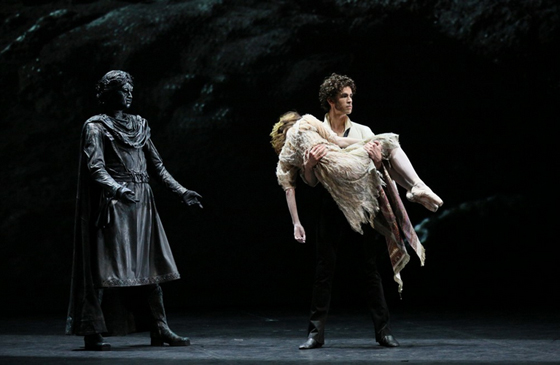 © Mikhailovsky Theater
Mariinsky ours
So here the "horseman" waited - the twenty -year standing ended with the triumph of the Leningrad school, sweet spring winds blew, like 67 years ago. They were able to repeat. In the air, plans for the galvanization of such performances are carried out from which there are not even photographs left. It was decided to scoop a well of a beautiful Soviet past to mud.
In 1949, the “Bronze Horseman” was important as a monument to the winning city, who managed to survive both in the face of the elements and in the terrible of the wars-in this capacity of the prime minister was equal to the transport of Samson's statue along Leningrad streets two years earlier. Pushkin’s compact poem, a house in Kolomna was completed to a massive palace, only from the first lines about Peter, a prologue on the shore of desert waves, a giant scene on a shipyard and a picture of the Assembly. In the final, the fenix city shone unharmedly, reflected in the deafening copper of the anthem to himself, while the founding father blessed Leningraders for a new happy life on the stage.
On the eve of the premiere of the revived “horseman”, the theater was overexcited: under the white veil, there was a triumphant arch with reinforcements, geniuses and glory. The covers were sleeping, and Bender's "Sower" was revealed to the audience.
Suppose, the point is not in a line scenography and the confused void of the huge MT-2 scene-all the more strange that its inhabitants are dressed in luxurious historical costumes. Even explanatory projections on the super -tan is not embarrassed: the silhouettes of Eugene and Parasha are floating, and they will not be together, but Peter and the waves are deserted. We are used to the fact that they do not trust the audience at the MT and in almost every premiere instructively poke their nose, clarifying where it is sung about good, and where is dancing about evil. The fact is that the project “Bronze Horseman”, in the poster of the declared as a ballet, does not have two main functions: artistic, aesthetic and professional-craft-that is, dancing itself.
The covers were sleeping, and Bender's "Sower" was revealed to the audience.
The Mariinsky “Bronze Horseman” has a huge load. The function is social: to give a sense of demand for the scenes to veterans, to express reverence on behalf of youth - the performance consulted a dozen participants in the previous production. The magic function: to become a spell-renewal, so that both the artists and the audience feel protected from enemies-tanizers. The function of self-preservation: The theater represented by the permanent artist-director gave the installation not to make the play “too modern”-working with new models is scary, that is, it is unsafe for the psyche of the theater as a closed organism. Patriotic function: look, son, and proud - Pushkin, Peter the Great, sovereign hail (see above). Sanatorium-resort function: a performance as a form of passive leisure, which does not require intellectual investments, most of all, which is most like watching an evening series in a boarding house.
If you choose from two “horsemen”, the championship, of course, will remain for MT - here the aesthetics of spectacular scientific scientists, the aesthetics of the Olympiad was carried out more sequentially. A series passes before the viewer: the king-kamenotes, the tsar-stroke, the launch of the first ships, the cut of the beard, the magic passes that raise the palace embankment in the backlight from the wound, the commentator is not enough. Here you have another function of the performance - souvenir, export (although I would prefer to fail, but not to give such a souvenir to anyone).
The performance of the Mariinsky Theater could become a concentrate of Genius Loci , capable of uniting the audience with an awareness of belonging to the city on the Neva. The directors had a beautiful idea: in the finale, where the entire orchestra picked up by the “Anthem of the Great City”, which was started by the “Anthem of the Great City”, to show the abstract “Ball of the White Nights”, no longer related to the plot. The material generally made it possible to arrange a complex stereochronous narrative-damn it, put a “copper horseman” about us, because we are sitting in this city right now and in every breath we drink the mortal air, and drag the famous street pipe-pipe Misha on the stage for the final solo, putting it on a transformer booth.
The indicated Genius Loci in a particular performance is not measured by the number of Peters of the former on the stage. Anyway, the ancient Romeo and Juliet in MT-with its green thinnous nights and poisoned sunrises, with his Renaissance, spied in the Hermitage and Palazzo halls on Marine and Kryukovo-this ballet “About Verona” will say much more about St. Petersburg-Leningrad than a hundred stadium “horsemen”.
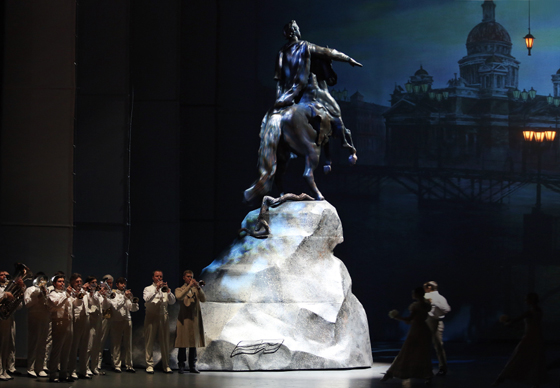 © Mariinsky Theater
We are roofs
The "Copper Horsemen" of the Mariinsky and Mikhailovsky are related by two problems.
First: both there and there - to a lesser extent Lyubov, catastrophically in MT - there is nothing to dance.
No, a lot, a lot of tedious dances are delivered. After the premieres, they began to talk about the “reconstruction of the classical choreography of Rostislav Zakharov” and “new trends”, but both are not true. It is impossible to reconstruct what did not exist: seventy balerin's dumps in the first arabesque is not yet choreography. To add to them all the well -known jumps and tricks - from despair in order to occupy kilometers of the music that has taken - is not that new.
D.S. Likhachev perfectly understood the symbolic and cultural functions of the “copper horseman”. We do not know how much the scientist was a knowledge of choreography. As usual, everything is much rougher in the ballet - if you do not dance, you come out of the form. Receiving mythical reconstruction of the excellent past from year to year, that is, regularly performing the functions described above, MT almost does not give artists a nutrient material for the body.
The problem is number two - in our hopelessly bipolar consciousness: for a compatriot, ballet is only plot or plot. Technique or acting. Today it is believed that the viewer was overeated with abstract ballets without literary lining (“Russian eyes was fed”, as one young author wrote), so the “Copper Horseman” is in trend.
Both performances are impressed on the archaic faith, as if from a novel or poem you can choose an armful of names, topos, plot positions and mechanically put them to the ballet body.
A different type of theater-the plot and plot-to-be opposition-, of course, is not true for us: let's say, the last ballets of Alexander Ekman (but only well-known “cacti” in Russia-they are about another)-this is somewhere on the moon and does not concern us. So we go: not a dramat, so choreographic symphonism, not Balanchins, so Zakharov. We will look for a way out of these four pines until we die from hunger.
Both performances are impressed on the archaic faith, as if from a novel or poem you can choose an armful of names, topos, plot positions and mechanically put them to the ballet body. (The expression of Corps de Ballet once meant precisely the scenario scheme of the ballet performance.) As if the content of the work was not enclosed in its form, and the novel or poem can be rewritten in a different way, except as words on paper. This is an artistic perversion in our blood: we do not believe in the unique capabilities of each of the arts, we always need crutches and top dressing. Without a thorough libretto in the program, Blynbard and Flafa Falcone's life of the human spirit will never illuminate Arabesques, pirouettes and other turflydors of a soulless classical ballet. The great Pushkin ordered to sit on a stone lion - we will sit and sit on that.
“If the picture - let it have content, fit into literary formulas; If the symphony - tell me what she transfers? Theater is just a branch of literature; including opera; Ballet is also driven into the same number - let the things that can be formulated in the word. <...> So, when we say that the dance does not need the plot, which fits into the form of the plot of dramatic, i.e. literary, i.e. Word, we say nothing else, as the fact that the dance is independent material for art <..> as a picture or a symphony, the dance should cause excitement in the viewer, a response to the creative process of understanding some phenomenon of life in the forms of choreographic, giving knowledge that does not fit into a musical or verbal form, and therefore choreographic, that it is not verbal. "
Lyubov Blok wrote this in the mid-30s, when the idea of choreographic poems-stories was already lobbying, but was not yet brought to the absurdity of the “copper horseman”.
Forgive us, Lyubov Dmitrievna, we did not understand the hell.