
Translated material
Pour Pythagoras!
If you can’t learn to consider the change correctly or still do not understand why you need to cut the path obliquely in hypotenuse - immediately seek help to the first self -proclaimed philosopher Hellas named Pythagoras. This is the person who brought to the West the idea of vegetarianism, secret societies and the theory of the relocation of souls. They say that he was a demigod, flaunted his foot out of pure gold and knew how to determine the nature and inclinations of the interlocutors at first sight. But the main thing is that he revealed to his ancient contemporaries the secret of sacred mathematics.
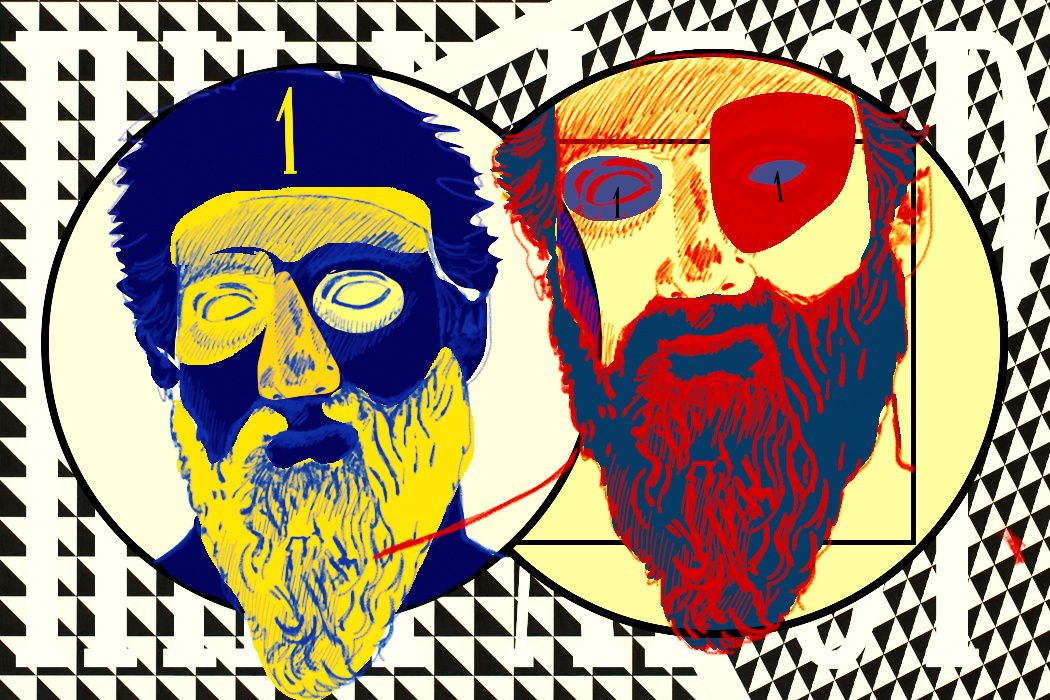
Regarding the origin of Pythagoras, there is no exact evidence, more precisely, all evidence contradict each other. There are no doubts that such a person existed, but everything related to him is covered with darkness due to the statute of limitations and the bias of judgments. We know for sure that he was born in archaic Greece, when this country existed as a conglomerate of polis cities. The Greek priesthood was a unifying link between scattered policies, in which it performed cult and religious functions. In addition, the priests also gave quite useful tips like where to base new colonies, how to find a common language with natives and foreigners and not to slide too often to internecine wars. Temple workers were engaged not only in spiritual and mirror activities, but also by science: they collected and systematized knowledge, secret and not very. The father of Pythagoras, Mnesarch, who, according to various sources, was either stone -coaching or a jeweler or Apollo himself, once sailed to a consultation with the most authoritative priests in the delfa, then considered the center of the Earth, in the affairs of their city. Instead of practical tips, he received a notice that his wife Partenida hates "a son who would bring good to all people for all times." Then the father of the future philosopher gave his wife the name of Pifaid, and they decided to call his son Pythagoras, that is, "the one whom Pythia announced." According to some legends, along with the prediction of great fate, parents were also given parting words that the boy needs to be devoted to Apollo, the search for truth and knowledge, and also that he needs to look not in Greece, but in Egypt. Thus, the fate of the baby was predetermined even before his birth, and parents from the earliest years encouraged their son’s craving for knowledge, and he absorbed everything he could, and quickly won the glory of an extremely smart and rational efeba. When Pythagoras reached the age of eighteen, the Samosian tyrant Polycrates, who drew friendship with the Egyptian pharaoh Amazisem, decided to send him to Egypt to study local priests, culture and knowledge of his Greek colleagues.
Having sailed from Greece to Egypt, Pythagoras began his initiative journey to the east, which had been extending for several decades and made it one of the most enlightened minds that ever lived and broadcast. For twenty -two years in the country of the Nile, the Egyptian priests spent a stranger in all steps of secret initiation, taught his science of numbers and the art of will, astrology and healing, shared with him the secrets of the true structure of space and the human soul, opened the curtains of the subject life and talked about the methampsykhoz - the journey of the soul from the body to the body, from rebirth to rebirth. Under the leadership of one of the supreme priests of the Egypt, Sophisa Pythagoras reached the highest steps of priesthood, but just by the end of its long-term training in Egypt, the Persian despot Cambiz was cut out, he cut out a significant part of the Egyptian aristocracy, and the priests, among whom was the Greek of Pythagoras, took away with his main forces to Vavilon. At that time, three schools of esoteric scientific truth shone in Babylon: Chaldean magicians, Persian dedicated and representatives of esoteric Judaism - and Pythagoras with unheated enthusiasm studied the best of the fact that all these exercises and schools could offer. Common to all secret exercises, accessible to the priesthood and inaccessible to the masses, was the recognition of a single god, taking many different guises and forms, but always indivisible and holistic. In Babylon, Pythagoras deepened and perfect his knowledge in the science of numbers and astronomy, mysticism and magic, and he was simply soaked in the atmosphere of the most advanced metropolis of that time. After twelve years in Babylon, he returned to Greece with crowded knowledge and ready to train fellow countrymen of the right life.
In his native lands in Pythagoras, the sage was quickly recognized, and soon he gained authority with his speeches on soul -saving and acute -social topics. In archaic Greece, there was no concept of “philosopher” before Pythagoras, there were only sages, that is, people with wisdom and true knowledge. Pythagoras modestly became called the philosopher, that is, the lover and seeker of truth, refusing to attribute to himself the possession of it (which did not prevent his disciples from suspecting him of monopoly on him).

In the sanctuary of Pythagoras there was a sculptural group consisting of ten figures: Muse of Urania controlled astronomy and astrology; Polygimity possessed the art of divination and possessed knowledge about the secret life of the soul; Melpomena represented the science of life and death, transformation and reincarnations; Calliopa was in charge of the science of health; Clio patronized magical practices, and eutherpe - dogma and morality. Muse Malsichore, Erata and the waist patronized physics, science of elements, stones, plants and animals. The tenth in this group was Hestia, the guardian of the hearth and the representative of the divine fire, the spirit present in all things.
Before receiving the first degree of initiation and becoming a pifagorean student, the candidate lived for some time under the supervision of Pythagoras himself, who carefully studied the properties of the new recruit: he appreciated the tendency to listen and delve into, instead of ranting and asserting; He watched how a person behaves in anger and in difficult situations. He contrasted his softness, and he considered wild disposition unsuitable for training and prone to licentiousness, incomprehensibility and shamelessness. Soft disperses, in his opinion, had a steady intention to study and treated new knowledge with a chaste thirst and responsibility. Pythagoras officially accepted those who had the necessary qualities as a student and ordered to master three virtues: the desire for truth at the mind level, the desire for righteousness at the level of the soul and the desire for purity at the level of the body. A pure and strong body, he said, creates a favorable basis for revealing the soul and mind. The purity of the soul increases courage, devotion and faith in man, reveals it to perceive higher matters. And, finally, the clear work of the mind in conjunction with a pure body and pure soul brings devoted wisdom, the ability to distinguish between good and evil, and see the highest law in everything from the small to the Great.
Pythagoras used the image of the letter “y” as an allegory of fork on the path along which the student walks. At a certain moment, its unified path is still divided into two roads, and in order to continue the journey, it is necessary to make a choice. The left road leads to earthly wisdom, the right - to the wisdom of the Divine. In the Egyptian mysteries that Pythagoras relied on, two female figures appeared before the candidate during the initiation: one wrapped in white clothes, the other hung with precious stones. A woman in white called for neophytus to the Hall of exercises and mysteries, and Guria hung with stones into the Earth's Hall. The right road leads to immortality, the left - to oblivion. The Pythagorean “Y” is repeated in our time, for example, in the “matrix” of the Vachovski sisters: Morpheus offers neo to choose one of two tablets, because otherwise the path cannot be continued. Having swallowed a blue pill, neo will forget about all his spiritual claims, he will follow a woman hung with precious stones (a woman in red), and will die in absolute ignorance and ignorance. Having swallowed a red pill, nevertheless will fall into the hall of exercises and mysteries, and, overcoming harsh trials, material hardships and a constant threat to life, all the steps of initiation will pass and reveal its spiritual essence. When the student of Pythagoras chose to go to the right, he fell into the courtyard of the Pythagorean temple.
In the temple of Pythagoras, built in the city of Kroton under the patronage of the local nobility, there was a courtyard, in which only students of the highest, third degree of initiation were allowed. Those students who gained access to this sacred space were also admitted to secret knowledge and were called esoterics (from the Greek “internal”). Other students, exoterics (from the Greek "external"), lived in the outer part of the temple, led and the protection of the muses.

The Pythagorean Day began with a long meditative walk, during which he put his own soul in order and set his mind in a harmonious way to come into contact with the brothers, already at the height. Some time after breakfast, which consisted mainly of honey and bread, the students began to study the texts, mathematics and courageous conversations, after which they were waking oil and engaged in running, some even worked with weights. But still, the first thing, after the morning meal, the Pythagoreans decided public affairs, accepted foreigners and dealt with political issues. In the evening, the students also took long walks, but not alone, but three or four in conversations digested the known in the day, shared their plans for the future and talked about the eternal. At night, Pythagoras personally conducted esoteric trainings with his chosen students, during which, according to legends, he told them about the travels of the soul after death, explained the true connection between the macrocosm and the microcosm, the inner life of man and the life of distant stars. For internal use, Pythagoras also wrote the book Hieros Logos, in which he formulated the foundations of sacred science and philosophy. The book has not reached our time, but you can familiarize yourself with some provisions from this treatise through a presentation in Plato's dialogs and Aristotle treatises. The teacher broadcast to the students “about gods, demons and heroes, about space and all kinds of types of movement of heavenly spheres and luminaries, about the fences of some others, about eclipses, about deviations from the correct movement, about eccentricities and epicycles, everything that enters the world order, about the sky and the creatures between them, visible and invisible.” The main science was proclaimed mathematics, and arithmetic was considered the basis of mathematics, that is, the science of numbers. Geometry, music and astronomy, which occupied the central place in the entire Pythagorean system, relied and depended on arithmetic. Arithmetic was a self -sufficient science. At the same time, astronomy was considered secondary in relation to two other sciences: the size, shape and movement of celestial bodies are determined by geometry, and their harmony and rhythm - music. From these definitions, one can understand that the music had much more meaning for Pythagoras than a simple sequence of notes. The music was not only used to understand metaphysical truths, but also specially selected and prescribed for the treatment of diseases; The students listened to special music in the morning, and the evening harmony was different from the daytime. As for astronomy, many modern researchers believe that Pythagoras, and before it, the chosen priests of Egypt and Babylon in those days adhered to the heliocentric model of the universe and believed that the Earth has the shape of a sphere.
The students of Pythagoras underwent three degrees of initiation, and on each of the degrees the interaction with the teacher was of a different character: students of the third degree, entering the courtyard, were more honored and personal instructions. The first degree of apprenticeship was called "mathematics": on it, neophyte mastered arithmetic and geometry. The second degree is “theory”, and on it, students not only learned to apply the knowledge gained at the first level, but also learned the continuation of the exact sciences in the spiritual world. The third degree was called "chosenness." It was believed that the student has already achieved a certain degree of perfection on it and became a master: now the teacher can lead him to the heart of the mysteries so that he could instruct his younger comrades on his own. Pupils of the first two degrees were considered “exoterics”, and despite the fact that they were obliged to keep the secrets of the Order, they did not have access to the internal affairs of the brotherhood. Students of the third degree reached the level of "esoterics" and were allowed to all the secrets and goals of the order. Aristotle in an essay on Pythagorean philosophy writes that the Pythagoreans divided people into three categories: God, man and creature similar to Pythagoras, that is, demigod, or hero. The teacher in their understanding possessed a dual nature and was a guide for higher, divine knowledge.
If possible, Pythagoras refrained from eating animals and bequeathed to his students to do the same. The karmic law of the resettlement of souls implied that the animal also possesses the soul, and it was not necessary to deprive this soul of the life shell without need. In addition, abstinence from meat has a positive effect on the state of mind. The heroes of the Homeric epic eating bulls and whipped wine, and then rushed with a spear to aptly pierce the enemy’s liver, or at all for several days ran one after another around the unfortunate Troy, so, again, to hit someone's vital organ. For philosophers, contemplative people, it is not necessary to kill and experience the basic aggressive instincts. Therefore, when Pythagoras retired for several days, or even weeks for meditation and internal wanderings, he prepared special food and drink. The food consisted of equal parts of poppy and sesame seeds, sea onions, from which juice, Narcissus flowers, mallow leaves, barley and peas were squeezed out. All this was flavored with wild honey. The drink consisted of cucumbers seeds, raisins without bones, coriander flowers, mallow seeds and portula, grated cheese, milk and oils mixed together and also with honey. Pythagoras allegedly claimed that Hercules invented this diet during traveling in the Libyan desert - but info is not one hundred percent, since it was unclear where Hercules took milk, cheese and oil in the desert and whether he could use the refrigerator.

In Greek policies, the times of Pythagoras existed three main regimes of socio-political life: democracy, tyranny and anarchy. The ideal of most cities-states was democracy, in which free citizens, versatile, who own themselves and property, gathered, gathered, discussed social problems, solved collective and practical issues. The conscious majority controlled the policy taking into account the interests of an equally conscious minority (though not particularly soaring about slaves). There was a universal system of laws that partly consisted of instructions of Delphic oracles and several other similar institutions that glued dozens of cities-states into a single culture and political structure. In many cities, most often located on the islands and separated from other cities by the sea, there were also local laws. In the ancient democratic system, new laws or amendments to the old could make any free citizen. But in order not to abuse such a right and not rogged unnecessarily and so working system, which offers the law, a person in some places was obliged to come to the assembly area already with a loop on his neck: if his law did not receive universal approval, he was immediately lifted up on his own rope. The weak side of democracy (except for slaves) was a tendency to oligarchy: groups from the most influential citizens appeared inside the equal majority. These groups began the struggle for the greatest influence, and then society came into an unstable state, crossing into two other undesirable forms of the device. To overcome public crises in policy democracy, the position of a tyrant was invented: it was endowed with extraordinary powers for a limited term so that he would fold them after all the conflicts are resolved. In fact, tyranny often delayed, for example, Pythagoras spent most of the time in Greece during the reign of tyrants. Anarchy - the third and most unfavorable version of the social structure - usually did not last very long, but led to the most deplorable consequences like civil wars and cheap hunger.
Pythagoras was engaged not only in metaphysics and music of spheres, but also by the problems of the social structure and issues of the state. He was well acquainted with the Greek, Egyptian and Babylonian political life, as well as with global geopolitical trends of that time. According to all the grounds, it followed that Greece, like Egypt to her, would inevitably fall if it remains in a fragmented state. Pythagoras believed that in order to consolidate Greece, it is necessary to educate, collect and rally influential like -minded people from all over Allads - and specially prepared and enlightened people could cope with this task. По версии Пифагора, на роль этого объединяющего звена как нельзя лучше подходили его ученики пифагорейцы.
Общественная модель Пифагора строилась на том, что в каждом крупном полисе должен править совет, состоящий из тысячи свободных граждан, и в этом он сходился с представлениями большинства греков о том, что такое демократия. Расхождения начинались в пункте, в котором, по Пифагору, над советом тысячи должен был главенствовать совет трёхсот. Эти триста человек в большинстве своём должны были быть просвещёнными и посвящёнными философами, людьми пифагорейского толка. Пифагор хотел, чтобы правителей государств избирали на демократических основаниях — но из посвящённых высшей пробы, и чтобы добродетели и мудрость ценились выше угодливости и интриганства. Эта идея была достижима в рамках пифагорейской общины, и её представители в кратчайшие сроки распространили такую систему на множество греческих полисов, а центром этого политического движения осознанности был Кротон, в котором располагалась резиденция Пифагора. Однако всё же к власти рвутся не только посвящённые — но и агрессивные профаны. Обладая богатством, влиянием и жаждой повелевать, они шли к Пифагору за ключом к вершине социальный лестницы — но по понятным духовным причинам получали отказ. По легенде, такие власть имущие профаны и восстали против Учителя. По политическим мотивам на него и на его последователей начались гонения: пифагорейцев сажали в тюрьмы и убивали на месте. Пифагор возглавлял своё тайное общество на протяжении тридцати девяти лет и встретил свою материальную кончину в доме, наполненном его ближайшими учениками. Этот дом окружили противники пифагорейства и сожгли под основание вместе с людьми и Учителем внутри.
В расцвете сил (то есть далеко за шестьдесят) Пифагор завёл себе молодую жену из преданных учениц, и она родила ему, по разным версиям, от двух до четырёх детей, мальчиков и девочек, которые воспитывались в школе своего отца и после его смерти способствовали сохранению и распространению пифагорейства. Ещё несколько столетий после смерти Учителя его общественно-политические идеи продолжали будоражить греков, а затем и их римских завоевателей. Математические штудии великого грека до сих пор озадачивают воображение школьников со всех уголков мира, пытающихся понять формулу Пифагора, согласно которой сумма квадратов катетов в прямоугольном треугольнике равна квадрату гипотенузы. Философские идеи Пифагора были подхвачены всеми последующими философами Эллады, а эзотерическое учение до сих пор постигается и используется в тайных обществах вроде масонских. В наше время имя Пифагора известно всем образованным людям — но среди них крайне мало людей, которые знают, кто же на самом деле скрывается за этим именем и о чём говорил этот человек.