
Translated material
About the Kremlin threshold
Why are the President of Russia so worried about radars in Romania and Poland
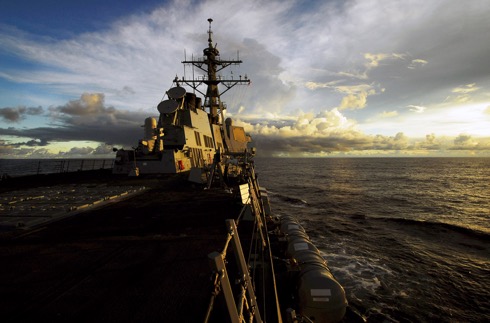
US Navy ship with a complex of AEGIS of the sea base, July 2014
During a recent visit to Greece, Vladimir Putin made the most tough foreign policy of NATO and the USA, the most tough from the beginning of the year. “We will now be forced to react accordingly,” said Putin, commenting on the placement of missile defense systems (Pro) the USA, which the Americans transferred NATO as part of the European defense program in Romania and Poland. “And if yesterday are still parts of the territory of Romania, they simply did not know what it is to be under the sight ... Today we will have to perform certain (response. - NT ) actions that will ensure our safety.”
“Certain actions” - it sounds almost like a “doctor”.
Putin and Iran
On May 12, the Americans launched in Romania a complex about AEGIS ASHORE (24 SM-3 anti-items, radar and tracking equipment), and on May 13 began to build a similar complex in Poland. These two events strongly impressed the Russian leader. News from Romania and Poland barely came to Sochi, not one, but a whole series of meetings with representatives of the Ministry of Defense and the military industry complex took place.
In the public field from the lips of the President, threats were then threatened at the address of Eastern Europe, who now will have to pay for the “short-sighted US policy”: “People who made appropriate decisions should know: so far they have lived calmly, comfortably, safe. But now, after the placement of these elements of the pro, we will have to think about stopping the threats arising regarding the security of the Russian Federation. ”
And behind closed doors they meticulously dismantled how and what to answer the US-NATO initiative, which, as they are convinced in the Kremlin, is caused not by threats from the Middle East, but is aimed primarily at weakening the nuclear potential of the Russian Federation. At the same time, Putin recalled that the United States and its allies have always connected the need to post a missile defense system in Europe with the threat of Iran and its nuclear program. “Where are these nuclear threats from Iran now? They are not. " And Pro, Putin made it clear, is, it means that the point is not in Iran, but in Russia.
** Putin, based on many issues based on Soviet experience, cannot help but remember what confusion the Soviet leadership of the Soviet leadership in the 1980s Raiganovskaya “Strategic Defense Initiative” ** **Of course, Putin is in a hurry with the conclusions: the threats from Iran remained. Yes, in Geneva it was possible to agree on the key parameters of the Iranian nuclear program - one headache was removed. But everyone sees: after he was left alone with uranium centrifuges, Tehran began to modernize his ballistic missiles. This means that if suddenly tomorrow the Ayatolles unilaterally terminated the Geneva agreements, the West will not have one, already two headaches: both Iranian enriched uranium and Iranian media.
The Iranian Ayatall and Putin have a common line: their power is non -alternative and endless, like a tape of Mebius. The US presidential candidate from the Democrats Hillary Clinton, having rejected the Polit, the other day in her foreign policy speech directly called Putin the "dictator." But there is a difference: Iran does not need to maintain strategic nuclear parity with the United States, drawn into an expensive arms race. Iran is so far content with the role of a regional power, which costs the national economy much cheaper. Putin has more complicated the task: to maintain power in the conditions of international sanctions, a stagnant economy and impoverished treasury, while maintaining great -power pathos. So Putin is not at all in vain considering a high -tech and promising American about as a real threat - first of all, the threat of his power.
Shadow of soy
Putin, on many issues based on Soviet experience, cannot help but remember what confusion the Soviet leadership of the Reagan “strategic defense initiative” (soy), whose essence, laconically and at the same time delicately explained to the three venerable Soviet politicallectors in the famous interview in the Gorbachev era, “this The global space shield that will protect the West from an unprogrammed missile attack. ” Then the Soviet viewers even showed the animation-how it would work: the satellite dispatcher in the near-Earth orbit sends a signal to complexes about ground, sea and air-based-missiles flying to destroy the United States, no matter how many of them are intercepted and destroyed. But this - defense - part of the program was not very disturbed by the Soviet Politburo. “We understand what a shield is, but we want to know what can fly in our direction because of this shield?” - The head of the USSR Foreign Minister Andrei Gromyko, who personally came to the studio of the CT, asked a question in one of the television programs. And most importantly: the creation of a new generation of weapons using radial, electromagnetic, kinetic, ultra-high-frequency technologies that can destroy several thousand targets for several minutes, Tactical missiles “Earth-Cosmos” and “Air-Cosmos”-all this was already unbearable for the Soviet military-industrial complex, although, it is said that there was a secret decision of the Politbue to the beginning of similar developments. However, they say something else: the same Thatcher was sure that the USSR would find a response to Soy, putting 5-10 times less in the development of offensive weapons. But our military -industrial complex did not have to tackle for long. Work on soy turned off. There were many reasons - both financial, technological, and psychological. The constant presence of powerful weapons in space, high above people - for many then such a prospect was inspired by fear. But there was another factor, because of which, I am sure, soy was put under cloths-the dialogue with the United States on military-strategic issues that began thanks to Mikhail Gorbachev, already in 1987, he and Reagan agreed to eliminate medium and smaller missiles. Why spend money on service in the era of disarmament - the rational approach prevailed. But only Putin is not Gorbachev.
Around the dead end
Today's American about came out of yesterday soy. Only she is an order of magnitude more technological. Moreover, the Americans managed to adjust and reduce the cost of the system (now it costs only $ 800 million) literally in the last few years: a solid part of the SM-3 interceptor missiles that could hit the targets in space, they transferred to sea basing. Another factor that caused the alarm in Moscow is AEGIS complexes can be turned into drums, with a range of missiles of 2.4 thousand km, Russian experts are sure. Putin has already been explained: OPE elements in Romania and Poland are only the initial stage of development. And what will happen next-does anyone know this in the General Staff?
But the president, suppose, will receive an answer to this question. When asked - where to get the money for an “adequate answer”, when the budget is cracking at the seams, and the army re -equipment program until 2020 is already called into question - I'm afraid no. The recipe recently proposed by the head of the working group of the Economic Council under President Alexei Kudrin - to reduce geopolitical tension - Putin replied: "We were not the first to start." The first to finish is not for him.
To the question - where to get the money for an “adequate answer”, when the budget is cracking at the seams, and the army re -equipment program until 2020 is already called into question - there is no answer
Vladimir Putin once spoke out in the spirit that two people in the 20th century - Nicholas II and Mikhail Gorbachev - are already to blame for not holding power, and this caused collapse and death of the state with subsequent tragic conflicts.
In fact, Putin himself was now in a situation that hardly gives him scope for maneuver. On the one hand, he cannot afford to start a new arms race with the United States is too fresh the legend about how it ended for the Soviet economy. On the other hand, after the Crimea, the political dialogue with the West is completely reset, without which it is impossible to openly discuss the issues of control over weapons and go out to mutually acceptable interchanges. In addition, Putin is not trusted and called him a "dictator." And the threats to take Romania, Poland - yes, at least anyone - in this situation, most likely, they will not change anything.
Photo: navaltode.com