
Translated material
Purely Russian impression
In Moscow, the Museum of Russian Impressionism was opened. What the creators had in mind, giving the new cultural center such a name, - The New Times sorted out
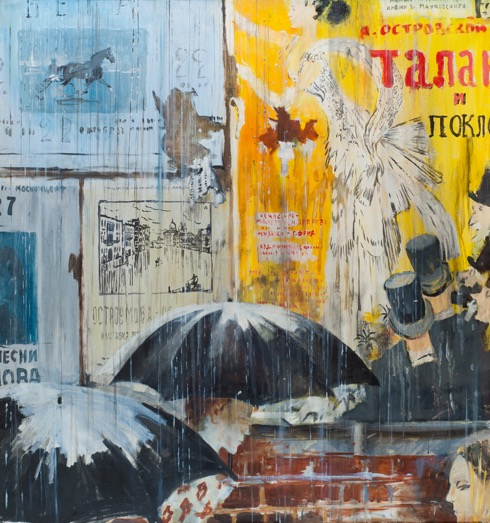
Yuri Pimenov. "Wet Posters", 1973
The paradox is that impressionism is the direction of French painting, and not one of the artists presented in the constant collection of artists was and could not be. At the same time, the creators of the institution demonstrate to visitors about 70 paintings of Russian painters, in particular, Valentin Serov, Konstantin Korovin, Igor Grabar, Konstantin Yuon, Peter Konchalovsky and even Yuri Pimenov.
Barbizons and Batignois
The term “impressionism” (Fr. Impressionnisme, from Impression - impression) first appeared in the feuilleton critic of the magazine Le Charivari Louis Lerois, who wrote a review of the “Anonymous Society of Paints, Sculptors and engravers”, which opened on April 15, 1874 in the nada nadar studio on Bulvara Kapucinov. Leroy called his sarcastic article “Exhibition of Impressionists” - referring the audience to the picture of Claude Monet “Impression. The rising sun. " The term was neglecting and pointed out the appropriate attitude to artists who wrote in an optional, frivolous manner. The “anonymous society” lasted about a year and, besides this exhibition, did nothing else, and since the paintings were sold poorly, it went bankrupt in an elementary way. However, it is this exhibition in the Nadar studio that is called the first exhibition of impressionists.
By that time, in Paris, the conflict has risen between the official salon, on which the paintings were selected by the authoritative and conservative jury, and the numerous “outcasts”, who actually had nowhere to exhibit. The conflict came to such an extent that Napoleon III intervened in it: “The emperor received numerous complaints regarding works of art rejected by the jury of the salon. His Majesty, wanting to enable the public to come to his own conclusion about the legitimacy of these complaints, decided that the rejected works would be exposed to another part of the industry palace. ” In fact, it was about the conflict of supporters of academic painting with the new generation of artists (in Russia there was a similar situation - on the one hand, the Academy of Arts, on the other - a partnership of mobile art exhibitions).
The impressionists appeared, of course, not from scratch. The first “living” movement in French painting was Barbizona artists, they united on a geographical basis-they lived around the village of Barbizon in the Fontainebleau forest and painted a realistic national landscape: fields, rivers, and village-which was considered among academicians a rather vulgar task. By the way, it was they who influenced the most in search of young Vasily Polenov, when at twenty -three he first came to Paris. Later already in Paris, Claude Monet, Auguste Renoir, Alfred Sisley, Kamil Pissarro, Eduard Manet and other artists of this circle, who were not allowed to the cabin who were usually met in the Hernbua cafe and discussed pressing problems, settled around the Bulvar Batignol. “This dentisting infuriates me,” Cezann grumbled in relation to these parties. He was especially annoyed by his elegance and bourgeoisness Manet.
There is the famous canvas of Henri Fanter Lature “Atelier in Batigniola” (1870) on which some of the regulars of this society are depicted. So the “impressionists” are a more modern and wide definition of a group of artists who united around the Cafe “Herbua”. This is a story. But practice was slightly different from the theory.
Blue stack
Konstantin Korovin recalled how he got to one of the high -society techniques: “At a large round table, guests were located for tea. “Now such a painting has gone,” said one lady. - Horror! All with strokes and strokes, nothing can be understood. Terrible. I recently saw an exhibition in St. Petersburg. They said they were impressionists. A haystack is drawn, and, imagine, blue ... impossible, terrible. We have hay and, I think, everywhere - green, isn't it? And he has blue! And strokes, strokes ... The famous, they say, an impressionist artist, Frenchman. This is horror what is it! You are good that not an impressionist, I hope we don’t have them, and thank God ... ”
“I recently saw an exhibition in St. Petersburg. They said they were impressionists. A haystack is drawn, and, imagine, blue ... impossible, terrible. We have hay and, I think, everywhere - green, isn't it? "
Indeed, French artists focused on a bright palette, actually abandoning black color, sought to ensure that their paintings did not get dark over time, that is, they conveyed a wonderful bright mood to the audience. They also used “covering” paints that poorly pass the light and are unsuitable for mixing, because they quickly turn her away. This allowed them to create paintings not with the “internal”, but “outer” light reflected from the surface. All this was not an innovation - so Turner still drew.
Despite criticism in the press, impressionism quickly attracted the attention of the audience with the ease of the visual series, emphasized by the sketchiness of the paintings, the sentimentality and unpretentiousness of the plots. The plots were emphasized neutral - no story and hysteria. The viewer had to emotionally experience what he saw, not plunging into a serious historical or, God forbid, political context. A similar approach to painting was extremely annoyed by both French artists and Russians. The classic canvas, which was exhibited on the Parisian salon, should have been seriously written and carry a deep metaphorical meaning. “This is just a struggle for the market! If earlier the artist painted a picture in several sessions (the portrait of Ermolova Valentin Serov wrote for 32 sessions, and this was a speed record for him), then it was possible to convey “impression” in just a few hours, ”the opponents of the impressionists reasoned rightly. That is why, for only a few years, the art market of France was filled with the lubricated heads of Renoir, drawn as if under a carbon copy, or the sketch sketches of his colleagues.
Russian retirement artists (that is, those who received a state pension-a scholarship-for life abroad) were quite skeptical of a new trend. The Repin and Polenov who lived at that time in France did not even come to the Nadar studio to look at the “impressionists”, although new trends were not alien to them. The same Korovin recalls that his teacher Polenov was extremely surprised when in a conversation he found out that neither Levitan nor Korovin never heard the term “impressionists” and were not familiar with their work. Therefore, he devoted a whole occupation about them.
Impressionism in Russian
The “Museum of Russian Impressionism” was created on the basis of the collection of the famous entrepreneur Boris Mintz, who decided to open not only the museum of what he likes, but also the cultural and educational space with a cinema, lectures and periodic exhibitions. Once, Mintz was at the same table with the famous non -conformist Oscar Rabin and decided to show him one of the early works of the 1954 artist, which is not very similar to his modern paintings. "Did you even draw this?" - asked Mints. “In the early 1950s, I was still indulging in impressionism,” Rabin answered. This seemingly non -meaningful conversation prompted the collector to start gathering the work of Russian artists, on whose work, in his opinion, the passion for impressionism was reflected.
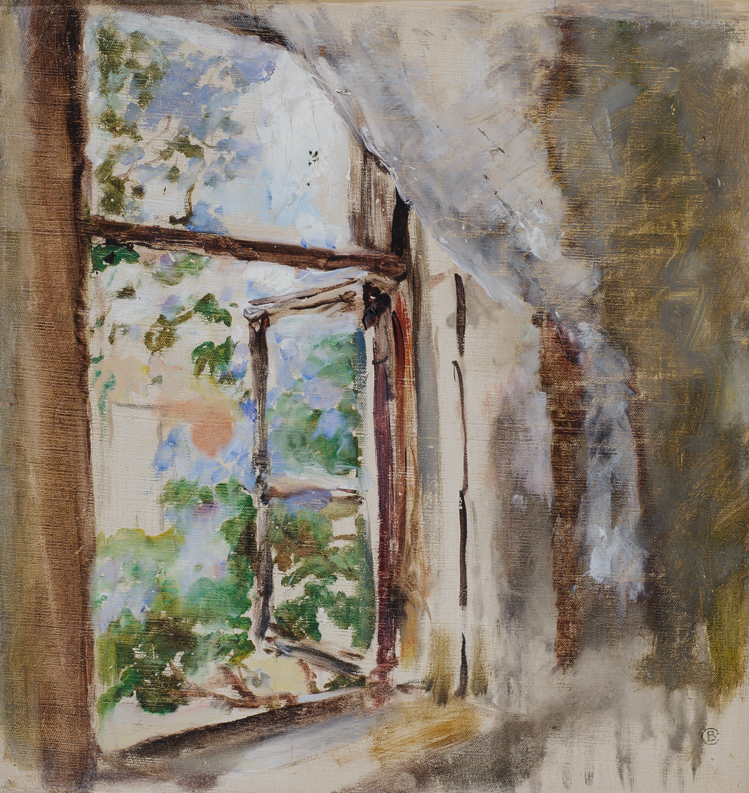
Valentin Serov. “Window”, 1887
A completely unpretentious story resulted in a curious artistic project. Mints says that he was carried away by the gathering, “he began to read more about Russian painting, and being in Paris, he walked around the museums. There are many museums not as famous as Ors, but with collections of about the same time, only smaller. They have Claude Monet and other great names; There are less known, although the quality of their painting, it seems to me, is no worse. And when I already had a dozen two works on the topic and I more and more deepened into it, I thought that it would be right to raise it at that level ... ”
In the catalogs that accompany the exhibition, the term “Russian impressionism” is interpreted so widely that it can be understood by anything. For example, in the late 1940s, critic Abram Efros draws a parallel between the French impressionists and Sergey Gerasimov, the author of the "collective farm holiday". “We pushed away from the works of Vasily Polenov: in our collection there are two of its Crimean sketches of the beginning of the 20th century and the relatively early picture of 1879. It was in the 1870s that the first impressionistic tests appeared in Russian art, ”says Julia Petrova, director of the new museum. Indeed, many painters of different generations survived the impressionism of “how youthful illness” experienced, which did not make them impressionists. Therefore, attempts to unite completely different Russian artists of the 19th and even XX centuries into a group of "Russian impressionists" look rather strange. Moreover, starting in this from Polenov’s work. However, the museum curators conduct their history further through Yuri Pimenova, who considered himself a “realistic impressionist” (which also sounds ridiculous) to the contemporary artist Valery Koshlyakov.
Fascinated
Mints repeatedly repeated that his task is to glorify the “Russian impressionists” in the country and the world, holy at the same time by virtue of PR. You can take this skeptical of this, but in itself the fact of creating a new cultural and exhibition site in Moscow is an infrequent thing. The building designed specifically for this museum (the former Bolshevik factory on the Leningrad project in Moscow, previously placed a flour warehouse), is equipped with the latest technology and has its own cinema hall, in which they plan to show documentaries about artists.
Indeed, the enthusiasm for the impressionism of “as a youthful disease” was experienced by many painters of different generations, which did not make them impressionists
Within the framework of the new center, it is planned not only to show a permanent exposition (and in it, regardless of its “impressionism”, wonderful samples of Russian painting are represented), but also temporary expositions. In particular, the exhibition “The Fascinated Wanderer” (a bold reference to Nikolai Leskov) was prepared for the opening there, a secondary Russian painter, a native of Chernobyl and a student of Ilya Repin Arnold Lakhovsky, collected according to state galleries and private collections. In 1925, Lakhovsky emigrated to Paris, exhibited in Europe, and in 1933 he moved to America, where he painted portraits of wealthy ladies to order.
The prospects of private collections that their owners plan to turn into museums are still quite vague in our country. Once these meetings were revolutionically transformed into the “Museum of Personal Collections”, in which the individuality of each collector was actually leveled (this is the general practice of the Soviet years, which began with the destruction of the collections of Schukin and Morozov). Boris Mints, creating a museum of “Russian impressionism”, will try to avoid such a fate.
Photo by the Museum of Russian Impressionism