
Translated material
Game of King Lyra and Leo Tolstoy
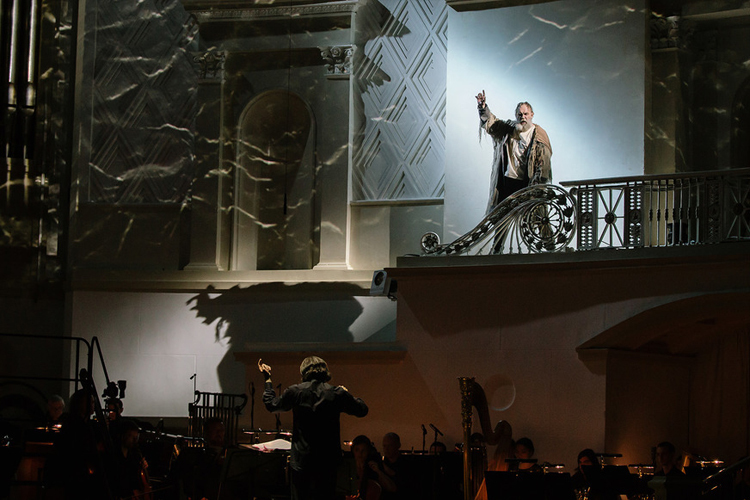
Under the curtain of his annual summer Philharmonic cycle “History with the Orchestra”, Vladimir Yurovsky presented a large -scale, complex and unlike nothing - the world premiere of the new opera, and in a completely theatrical form. The Patriarch of the St. Petersburg composer, Sergei Slonimsky, presented to the conductor Sergey Slonimsky, presented his score of the “King of Lira”, written at the turn of the 20th and XXI centuries, after Yurovsky in 2012 performed the 1st act of his “Masters and Margarita” in the Mikhailovsky Theater. And so, in the year of the 400th anniversary of Shakespeare's death, she waited in the wings.
The scene of Tchaikovsky’s hall, surrounding its ports, one of the side lodges, passages in the stalls and even the space where the organ department usually stands, correctly and inventively filled the director of the theater of Pokrovsky Mikhail Kislyarov along with the video artist asya Mukhina and the artist in the light of Gennady Alekseev. The chosen composition of the musicians led by the Yurovsky HASO occupied the right side of the scene, performing not only the instrumental parties, but also the replicas of the simple -minded modern spectators of the conventional Globus Theater commenting on what is happening in the Shakespearean text. The rest of the space went to the large team of slightly encouraged soloists with expressive three sisters of Cordelia (Lyubov Petrova), Goneril (Ksenia Vyaznikova), regane (Nadezhda Gulitskaya) and even more expressive king Lyr (who, in the performance of Maxim Mikhailov, turned out to be Boris Godunov with the holy fool (Maxim Pasteur - the holy fool - the holy fool. Rigoletto). An additional pleasant and non -binding aroma was introduced by a slender accordionist with a French bang, walking during the performance of his direct responsibilities among the characters and entering into various relationships with them.
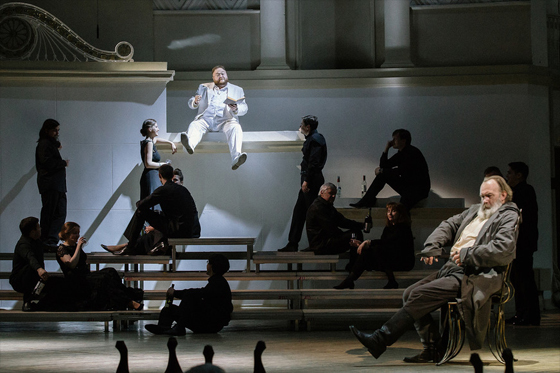 © Moscow State Academic Philharmonic
But that's not all. On top of the textbook plot and audience replicas, the composer made a story about how Lev Nikolaevich Tolstoy criticized the William of our Shakespeare at one time, and introduced into the opera a bearded and displeased colloquial character in a well -recognized canvas shirt, scolding the absurdity of what was happening on the stage. And the Maestro Yurovsky, whose functions, of course, were not limited to one conducting, he hid this topic to the end. With a microphone glued to his cheek, he polemicized with Tolstoy, sympathetically nodded his head of Cordelia, sat on the attack on the side of the scene in the pose of the Vrubel Demon and ultimately formulated the main spectacular conclusion - about the similarity of the life finals of the Russian writer and Shakespearean lyre (for which both were indistinguishable from each other on stage). Then, instead of the final stage bloodshed, the concert performance of the final part of the opera.
It turned out a sort of hypertext in a hyperkub, where the orchestrants suddenly became actors, a conductor-either a participant in the performance, then a lecturer, or even a preacher, and the performance easily and very organically flowed into reasoning about him, noticeably delighting that part of the listeners who was about to fall into despondency from the harsh music, which was completely unwilling to entertain anyone. The composer is not the first to determine the genre of his work by the ancient term Dramma per Musica , says that it is guided by the XVII century, the era of Kacchini, Peri and Monvereri, when the vocal monodia was accompanied by a stingy ensemble accompaniment. The recitative text (which, by the way, would not have interfere with subtitles) is very dosed by the genre songs of the jester and theatrical outbursts of the orchestra in climax. But in general, this music is more opposed to the restrained attention of a narrow circle of experts than those stormy appliances that fell upon the end of the performance.
So, the conductor-class theater of Vladimir Yurovsky conquered the new peak and added another score to the list of those that we would never have heard otherwise.