
Translated material
Culture officers
Recently, in the “Art” section of Colta.ru, an article by Natalia Serkova was published, in which the author expressed the opinion that the subordination of the GCSI Rosiso by decision of the Minister of Culture of the Russian Federation and the temporary closure of the Electric Power Gallery-a good, as they are able to withdraw the art environment from the usual cozy sleep. So Serkova spoke across the indignation of what happened, which seemed natural in a party of contemporary art. And although I myself share this indignation, its text seemed to me charming as an eccentric trick against normative consensus. Therefore, when Sergey Guskov suggested that I state some other opinion about the situation with the GCC and the “electrical circuit” for the “Art” section, first I was in a stupor. It seemed to me that I had already expressed my personal indignation by the behavior of Mikhail Mindlin and that otherwise I can only repeat, as, in spite of everything, the institutions that were subjected to obstruction were valuable - and I could not understand why and from what point of view could I want to write about what happened.
But a day later, I went to St. Petersburg, where police officers burst into the apartment at the birthday of my friend, who, without introducing themselves, began to demand to leave the room-and in response to our attempt to fix what was happening on the video camera became angry and moved to force measures. As a result, I with two friends (one of them is a birthday man) spent a weekend in the chambers of the preliminary imprisonment of the ATS - on charges of disobedience to the “legal request” of the law enforcement officer. Left in the cell for several hours alone and without means of communication, I remembered the proposal of Sergei Guskov - and realized that now I have from where and why answer him: I saw a rhyme between the fate of the GTSIA, the "electric factory" and our festive party.
War is a profitable matter, but the security forces are able to make profit in peacetime.
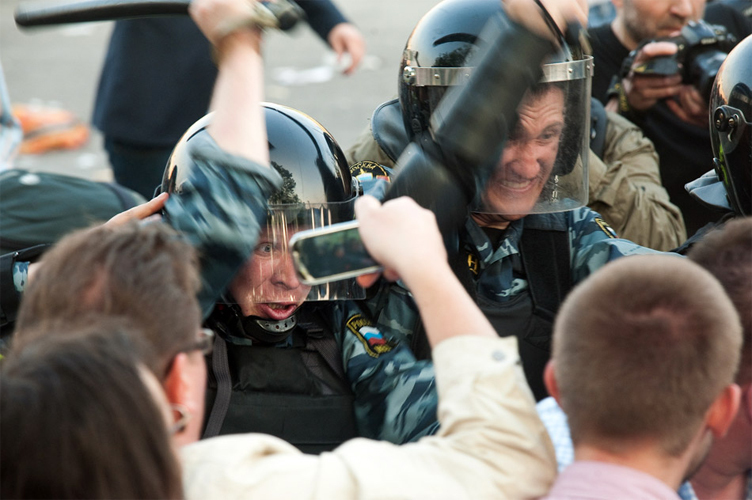
All these three stories are about the invasion of external power into the territory of autonomy, whether it is the autonomy of culture and art or autonomy of private space. The agents of this traumatic destruction of autonomy, committed by force and outside, had power actors in all three stories (if you use the Gramshian classification of political resources for power, economic and symbolic) - namely the police and the military. Let me remind you that the “electric power plant” lost its former premises due to the intervention of the private security companies, out of the habit of outraged by a loud vernissage and provoking the police, and at the head of the Rosiso, after the absorption of the GTSIA, a graduate of the Alma Higher Military School Sergey Perov was delivered. And it is not without reason that the commander of the current cultural policy is Minister Vladimir Medinsky-part-time chairman of the Russian Military Historical Society, which offers to see the main object of popular pride and the resource of the ideological union of the state won by the Russian Empire or the Soviet Union.
And even if we talk about alternative institutions and models of artistic life, now it is necessary to look at the increasingly active agent of cultural policy - a person in the form: in uniform and with a police token on the chest or simply in a strict official suit. Already now, the State Council of Higher Professional Center is forced to send to such people - the new leadership of Rosiso - plans for exhibitions for approval.
However, increasing the importance of the power resource and direct state intervention in Russian public life, incapitating to conversations about the police state and new feudalism, does not exclude the completely capitalist logic of commercial efficiency, the leading actions of “people in the form”. The defeat of our birthday celebration, as well as the extremely low percentage of law enforcement officers recognized by erroneous actions in general, is generated, in addition to circular bail and corruption by an administrative-economic factor-gravitating from the police, reporting on successful disclosure of crimes guaranteeing employees of this sphere to receive the desired premiums. And the actions of Vladimir Medinsky as a whole correspond to the neoliberal model of culture - this can be read in detail, for example, in an interview with sociologist Alexander Bikbov . And - a small, but characteristic detail - the new leadership of Rosiso has already expressed a wish that attractive souvenirs are now sold in the book stall under the HCCI. War is a profitable matter, but the security forces are able to make profit in peacetime. And, of course, you should never forget who is at the head of the modern Russian state - a security forces who temporarily ensured the monstrous stabilization of new Russian capitalism.