
Translated material
A trip to Tbilisi
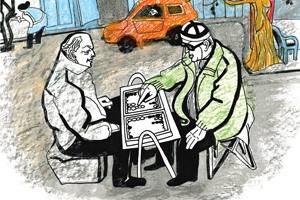
The artist and activist Victoria Lomasco continues his new project - a cycle of trips to the post -Soviet Caucasus and the East. Colta.ru is glad to publish her Tbilisi report.
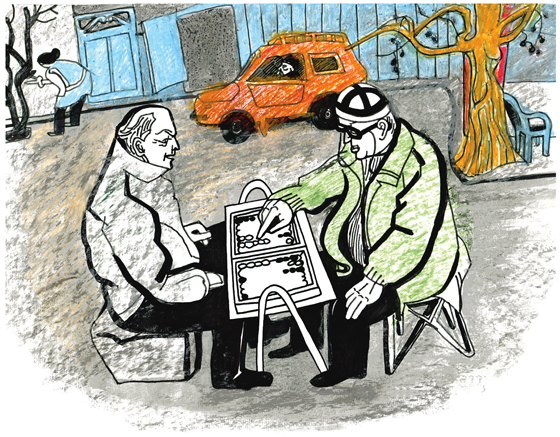 © Victoria Lomasco
Even before the trip, I heard many enthusiastic reviews about Tbilisi from my friends. They talked about the beauty and hospitality of Georgians, about the feasts with songs, about the old Tbilisi courtyards ... "What new can I tell about this tourist city?" I thought.
In the first Tbilisi house, in which I was visiting, the date of April 9, 1989 sounded in the conversation. The owners were surprised that I did not know anything about this day - for them, as for many Georgians, this is a turning point in the relations of Georgia and Russia. I decided to meet several participants in those events.
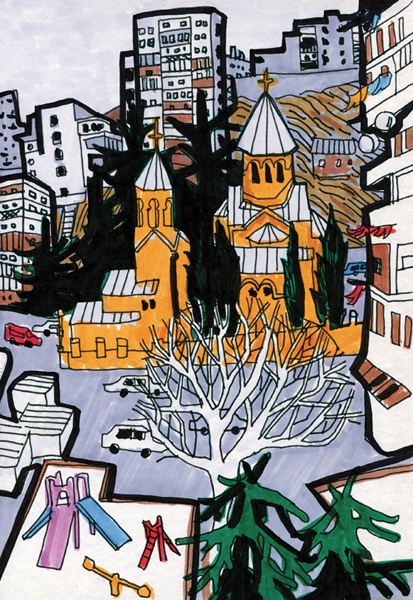 © Victoria Lomasco
April 9
“After April 9, everything turned over 180 degrees,” says driver Nucrius, a participant in the 1989 Georgian independence rallies, “people were finished off with shovels like cattle. If we shot, we have already passed. ” The sapper blades, with which Soviet soldiers beat the participants in a peaceful demonstration, were exhibited in one of the windows at the Tbilisi Museum of the Soviet occupation.
Independence rallies began in Tbilisi on April 2. On April 7-8, military units and tanks entered the city. Many understood that there would be power acceleration. Catholicos Elijah called on the participants in the demonstration to go to pray to the church, but they did not listen to him. A few minutes later, the soldiers attacked the crowd using shovels and a fighting poisoning gas. Several people were killed, mainly women.
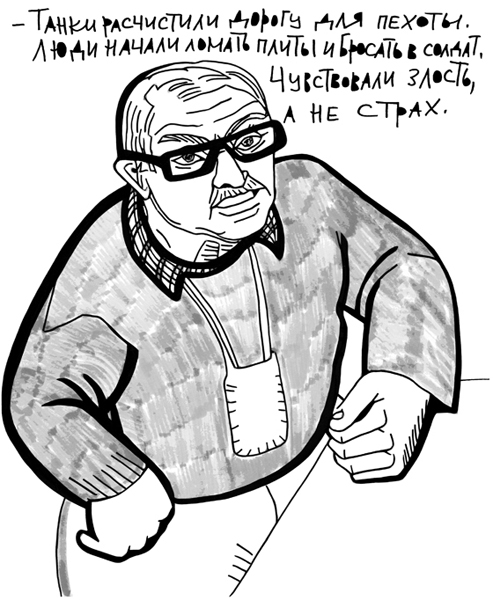 © Victoria Lomasco
David is a historian, an orientalist, a teacher, a participant in the events of April 9.
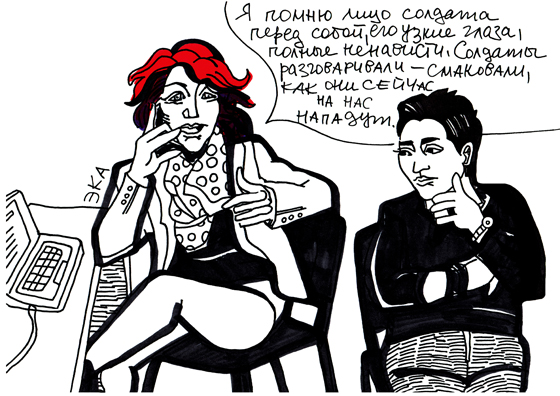
Eka, the head of the feminist organization Women's Initiatives Supporting Group (Wisg) , participated in 1989 rallies with her student friends: “Someone put it in the loudspeaker that soldiers brought tanks in the city. We got on asphalt, wanted to block the road to tanks. ”
 © Victoria Lomasco
“The then Georgian police tried to protect us. They were disarmed in advance, but they stood in front of us. We were driven into the Rustaveli cinema, we found a spare exit and left. Then 16 people were killed. We felt despair, but not powerlessness, threw stones at tanks, ”recalls Eka.
The chairman of the Presidium of the Supreme Soviet of the USSR Mikhail Gorbachev refused to take responsibility for these events. At first, the government tried to claim that people died in a till.
“I hate large states. I would like all large states to be divided into many parts and do not create this with the small ones, ”says Nucrius.
 © Victoria Lomasco
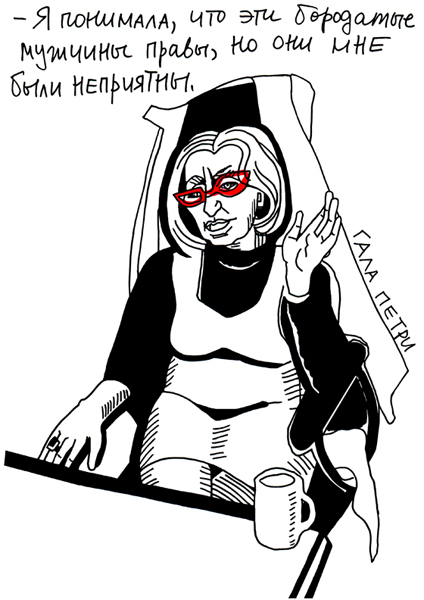
Journalist Gala Petri moved from Irkutsk to Tbilisi in 1984. She recalls that in the late 80s-early 90s there were plenty of "primitive patriotism." If until April 9, the Georgian elite spoke Russian, it was fashionable to give children to Russian schools, then after children who studied in Russian schools, they began to tear. Gala transferred her daughter to a Georgian school. Gala does not remember any physical violence against the Russians. “The Russians left Georgia later for economic reasons,” she explains.
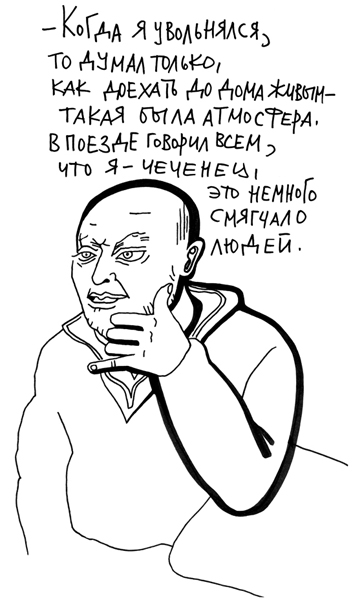
Returning to Moscow, I asked many friends what they knew about the tragedy on April 9 in Tbilisi. Only one person was able to answer me, the Shovkhalov, editor of the Caucasian magazines “Dosh” and “The Word of a Woman”, was able to answer. In 1989, he served in Western Georgia, in the city of Samtredia.
“On April 9, together with other soldiers, I patrolled the city. People gathered on the streets, talked on Georgian, worried. In the evening to the city, a rumor reached that in Tbilisi, when the rally, the soldiers chopped a pregnant woman with a shovel. If until April 9 the people were kind, the soldier fed for free, then after the soldiers they began to perceive as killers.
Once, businessmen from Tbilisi, who participated in the dispersal of the demonstration, came to our part. They said that the Georgians were very brave and arrogant - they went to a soldier with bare hands, both men and women fought. Not all soldiers were ready to use shovels and gas against the protesters and as a result were beaten by them. ”
 © Victoria Lomasco
Religiosity
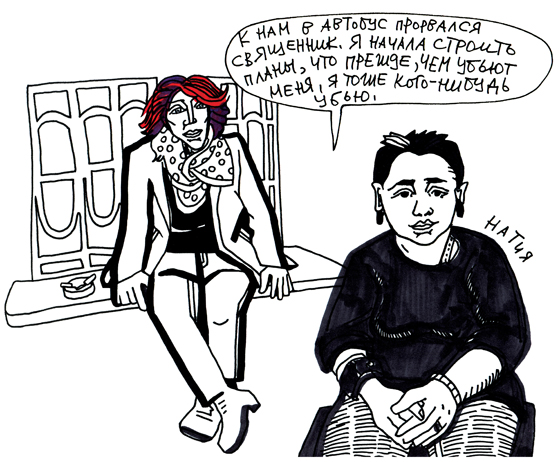
Eka and National, the second head of the WISG organization, were among activists who decided to conduct LGBT demonstration in the center of Tbilisi in 2013. On May 17, a crowd of 20-30 thousand, which was headed by the priests, came out against hundreds of demonstrators. The police failed with the pressure of the crowd and began to evacuate LGBT activists in buses and minibuses. Many LGBT activists have suffered greatly. Of the attackers, four people were fined 100 Lary (less than 40 euros).
“There were five of us in this bus, the crowd chased us. Most attackers were men from 17 to 40 years old. I thought that if they get to us, then they would be publicly raped at first, and then kill, ”says National.
 © Victoria Lomasco
“There was not a single whole glass in the minibus, three people received a concussion. After that, I could not use public transport for a long time. I thought which of the surrounding people then rushed at me with stones. ”
Journalist Nino also remembers the events of May 17 well. She went to the demonstration as a correspondent of Liberali magazine and as LGBT film to support activist friends. Together with her was a colleague-journalist of homosexual orientation. Friends gave her a poster with the inscription "I have the right to love." Nino recalls that when the defeat of the procession began, she threw the poster and only thought about how to get out of the crowd of alive and bring her colleague.
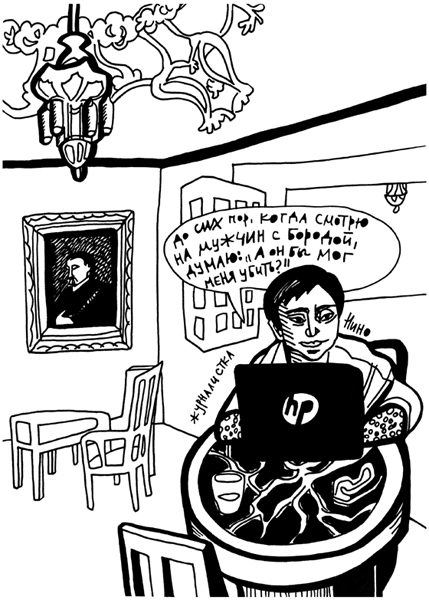 © Victoria Lomasco
A few days after our conversation about the defeat of the 2013 LGBT, Nino wrote to me that her seventeen-year-old son, a stylish young man with long hair, some men on the street took for gay and beat. He talked on the phone with his girlfriend, said in parting: "I love!" - And they immediately attacked him: "How dare you, fag!"
 © Victoria Lomasco
  © Victoria Lomasco
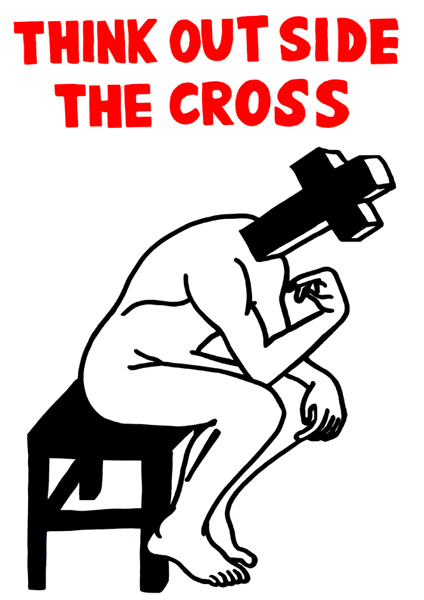
This work was done at the master class “Feminist stencil on paper”, which I spent in Tbilisi for Georgian activists.
For the Tbilisites, the stool is almost a symbol: a stool as a weapon used one of the priests who smashed the LGBT-Belief on May 17.
The main topic with which participants in the master class wanted to work is to control female sexuality by society, family and the church. They talked about how it is difficult for young unmarried women leading sexual life in Georgia to get the help of a gynecologist - “Google instead of a gynecologist”, about the absence of psychological assistance - “a priest instead of a psychologist”.
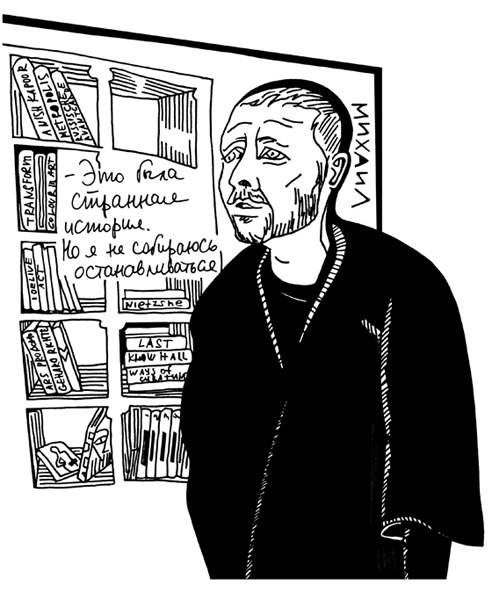
Religious Georgians are ready to control not only female behavior. In 2015, a Kampus activist library was attacked on one of the organizers of the activist library. “District guys” came to the library, and at a lecture on the novel “So Zarathustra said”, one of them did not like the quote “God died”. “He came thieves, found out who the organizer of the lecture, and poked a knife in the heart,” Mikhail says a miracle. Leaving the hospital, Michael moved the library to another place and continued lecture programs.
 © Victoria Lomasco
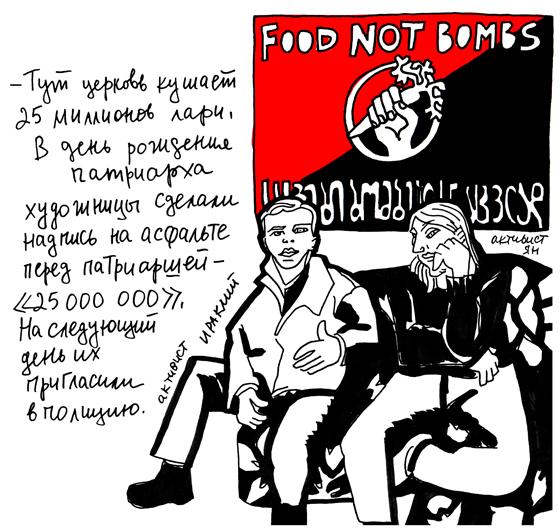
Some Georgian artists are trying to criticize the church. Activist Irakli spoke about the 2015 action.
 © Victoria Lomasco
The painting of the “Theotokos-Samobitan” by the artist of Leah Ukleba caused a great indignation of religious Georgians. It depicts a pregnant Virgin Mary, bringing a gun to her temple. Despite the enormous authority of the church, the artist escaped with attacks on the Internet. In Georgia, there are no analogues of Russian laws on "exciting hatred or enmity" and "insulting the religious feelings of believers."
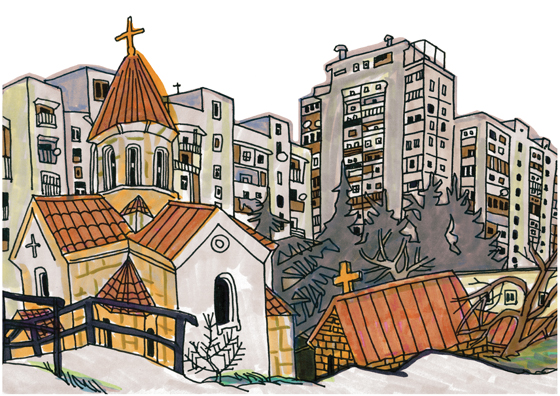
There are a lot of church churches in Tbilisi, especially in the Sababurtalo area. For example, this Ascension Church on Panasquerers Street was built in 2003 in the territory that was selected from the state kindergarten.
 © Victoria Lomasco
“Why didn’t anyone protest when a large part of the territory was taken away from the kindergarten?” - I asked my friend Georgian living on this street. She explained to me that the inhabitants of the district themselves would attack activists who were ready to oppose the construction of the church.
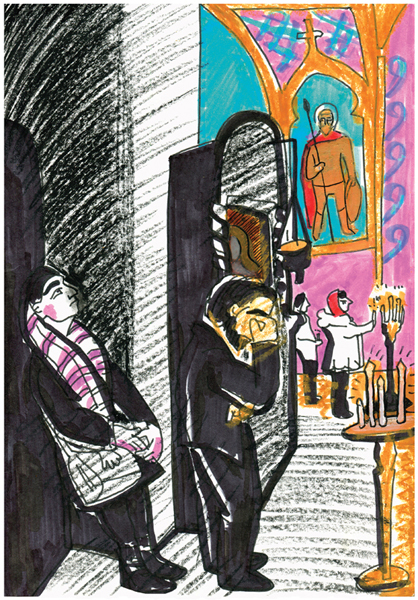
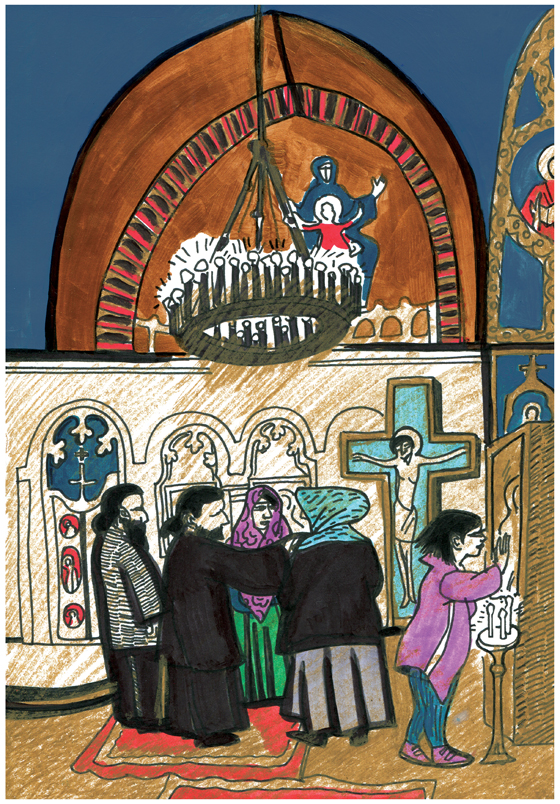
Tbilisi churches are not as much as Moscow temples, similar to state institutions with priests-officials. Throughout the perimeter of the churches, there are benches, during the service everyone who wants, not only sick and old are sitting. I was not forbidden to draw. I noticed that some women were in jeans and without scarves. Before and after service, parishioners actively turned to priests.
 © Victoria Lomasco
In Soviet times, Georgia did not cease to be religious. Most of the elderly people with whom I talked, including ideological communists, said that in the days of the USSR they were believers and went to church.
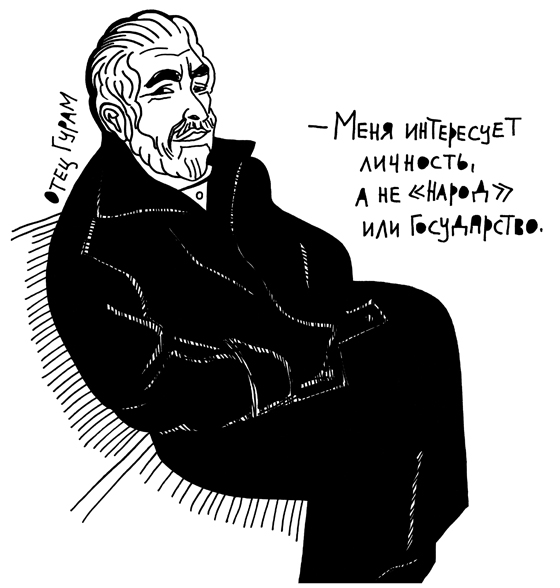
Tbilisi friends advised me to talk with Father Guram, known for their more liberal ones than most Georgian priests. Here is a fragment of our conversation:
- Does the church help in Georgia by homeless, poor and low -income?
- The Orthodox Church, unlike Catholic, is more mysticism and preaching than a charitable organization.
-What can you say about the defeat under the leadership of the priests of the 2013 LGBT Minging?
-Georgians-hot people, could kill someone. But we had the right to express our protest without violence. Is the traditional country ready to accept this? This is even difficult for Europe.
 © Victoria Lomasco
I told Father Guram how in 2008 I painted the trial of the exhibition “Forbidden Art”, started by the Orthodox Moscow activists, about threats and insults on their part and that after this trial I have a disgust for the church. When I finished, he suddenly hugged me and kissed me, anointed the world, asked to wait and returned with a bouquet of violets.
Not for tourists
In the center of Tbilisi at every step they ask for alms. These are gypsies with children, pensioners, homeless people. In addition to refugees from Abkhazia and the Tskhinvalsky region (now partially recognized the Republic of South Ossetia), some of which still live in former hostels and barracks, in Tbilisi there are many internal migrants who have moved to the capital due to hard life in the province. Among the homeless and poor there are people who have not managed to pay off loans or deceived when buying apartments.
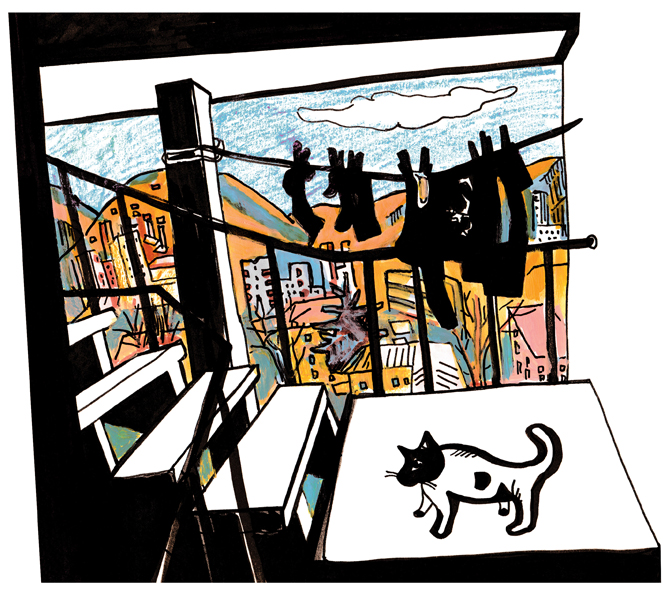 © Victoria Lomasco
The homeless captures the old houses that have been desolate since the collapse of the USSR. There are about 400 squat in the city. The government puts the residents of the squat before the choice - either to move out or to refuse a social benefit. There are cases when captured buildings are officially recognized as legal housing.
An employee-sociologist from the human rights organization EMC , engaged in field research, took me with him in one of the largest squat. In the dilapidated buildings, where there were once a hospital and a cardiological institute, people settled in 2012.
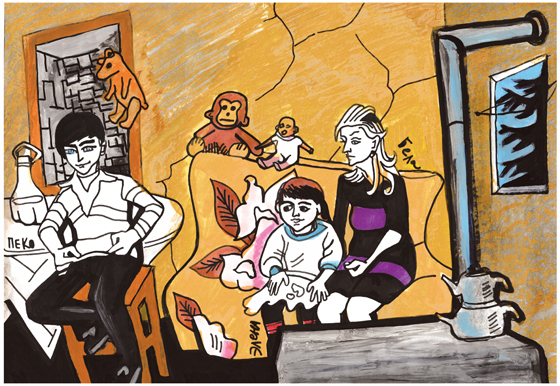 © Victoria Lomasco
Women did not speak Russian, the sociologist translated me that some of them escaped from home due to family violence.
Homeless people are limited in their capabilities and contacts, basically they make marriages among themselves. I saw many young children born already in squat.
Among the inhabitants of the squat there are people with education who used to work in their specialty and rented housing. At some point, they lost their jobs and ended up on the street. According to official statistics, the unemployment rate in the country is about 12%, according to the survey of the American Institute of The National Democratic Institute (NDI) - more than 50%.
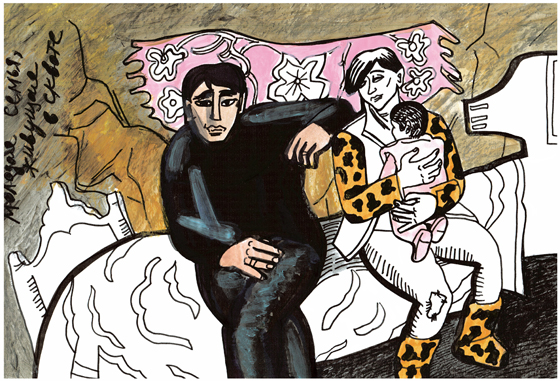 © Victoria Lomasco
It turned out to talk in Russian only with one young man, he lived for several years in St. Petersburg and even managed to sit in a Russian prison: "Many walked - girls, heroin ..."
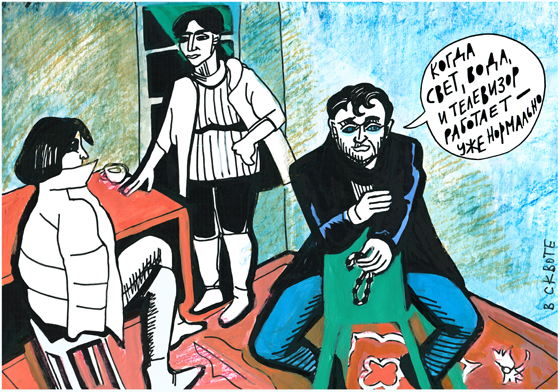 © Victoria Lomasco
Water is brought in buckets, in the courtyard of the squat there is a crane with free water. Electricity is stealing - they are connected to the street lighting network, the police regularly cuts wires. The sewage system goes to the basement of the house. They are heated by bourgeois.
In Georgia, heating problems not only in squat - central heating was disconnected in 1991, during the civil war. In those years, due to poverty, people dug pipes and sold like non-ferrous metal. Now new houses are being built with a separate heating system, and inhabitants of old houses in winter are saved by heaters.
For tourists
In the old Tbilisi, entire quarters are in disrepair. Under Saakashvili, only part of the facades was restored.
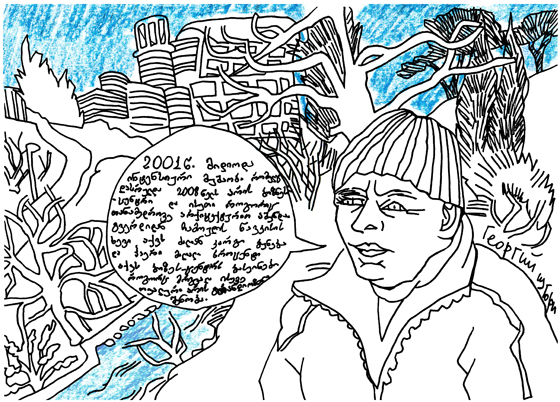
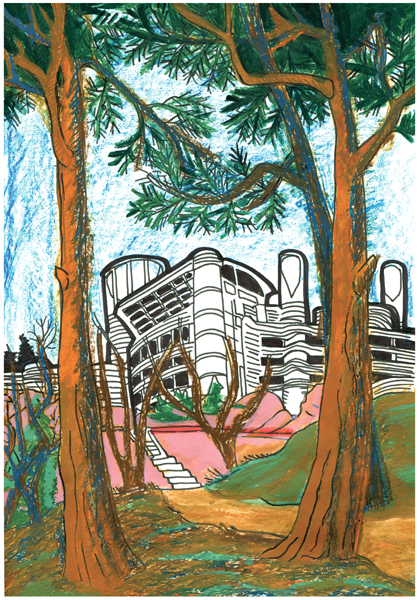
A strange building made of glass and metal rises above the old, dilapidated houses, built on the Sololac Hill. This is the residence (business center) of the former prime minister, billionaire Bidzina Ivanishvili. When I tried to come closer to the residence through the Botanical Garden, a guard came out from behind the bushes and said that private possessions begin further.
The guard introduced himself to George. He said that he came from Gori, because there was no work there, he first worked at the construction of the residence, and then he was left in the guard.
 © Victoria Lomasco
“In 2001, intensive construction was underway, since 2008 there is a business center with modern architecture. Nearby, the gorge of Tsavkisi, very good nature and air. The business center has a gorge and an oval grandiose space. ”
While we were talking, a large waterfall scored from the cliff. It turned out that both the rock and the waterfall are artificial, the waterfall can be included at the request of the owner.
 © Victoria Lomasco
In the coming years, Bidzina Ivanishvili is going to build a giant tourist complex in the high -style style on the same Sololac Hill. Three more complexes from hotels and business centers are planned in other historical parts of the city. The project is called "Panorama Tbilisi", according to Ivanishvili, it will attract more tourists to the city.
 © Victoria Lomasco
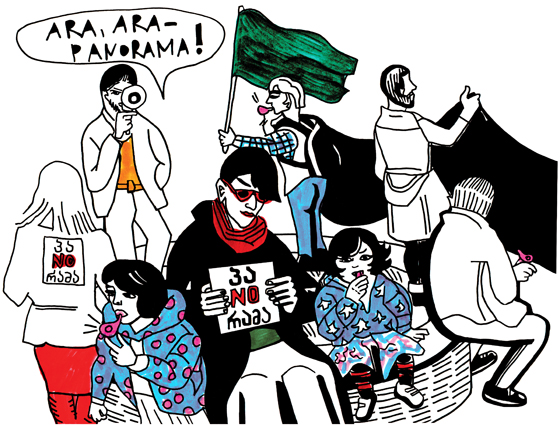
Opponents of the project are sure that Panorama is mutilating the city.
On February 27, I visited the next rally against construction. It was attended by several non-governmental organizations, architects and defenders of cultural heritage, activists of eco-moves, feminists, zoo defenders, a community of cyclists and representatives of other civilian initiatives. Young people of the "generation of Saakashvili" looked stylish and confident, many came with young children.
Despite the mass of the rally, the government ignored it. In several places, construction work has already begun.
Soviet past
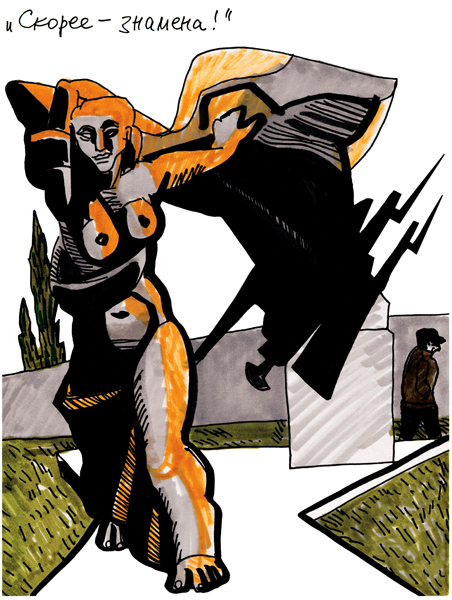
Almost all Soviet symbolism in Tbilisi is dismantled. Therefore, I was surprised to find a warlike Soviet monument a stone's throw from Rustaveli Avenue, in the park, which is now called the park on April 9.
 © Victoria Lomasco
The name of the monument "Rather - banners!" refers to the poem of the famous Georgian poet Galaktion Tabidze:
Light! And the fire ball
The red-hot rises from behind the sea ...
Rather - banners!
The soul was eager ...
One of the Tbilisi acquaintances explained to me that Tabidze wrote "Rather - banners!" In 1918, when Georgia declared itself an independent country, but in Soviet times the date of the poem was changed to 1921 - "the year in which the Bolsheviks occupied Georgia."
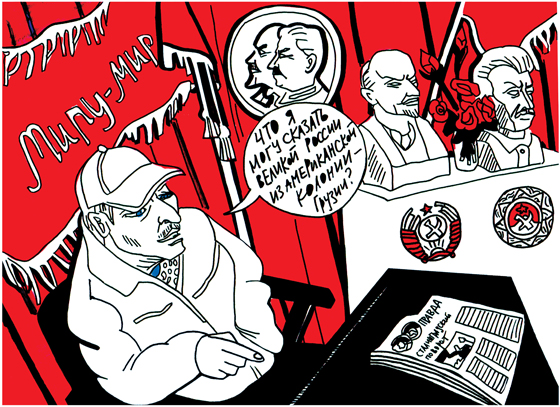
In Tbilisi, the Museum of the Avlabar illegal printing house named after Stalin, on the red gate of which are shining with gold sickle-fellows and stars. The printing house worked from 1903 to 1906. Georgian Social Democrats, among whom was the young Joseph Dzhugashvili, went down into the underground room through the tunnel in the well. Here on German machines they printed revolutionary newspapers and leaflets.
 © Victoria Lomasco
Now the museum has neither a cashier, a schedule, nor employees. Excursions are conducted by an elderly Georgian named Soso. He introduced himself as a former colonel of the KGB. Soso says that, having returned after the collapse of the USSR from Moscow to Tbilisi, he could not get a pension or an apartment, so he settled in the museum and survives tourists. "Sometimes there are no tourists for two weeks!" He complains.
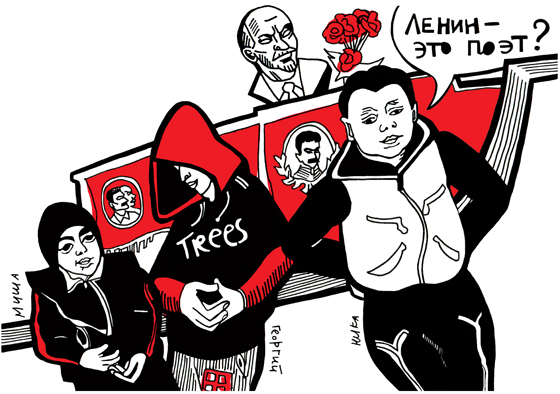
While I was talking with Soso, children from neighboring houses ran into the museum. They said that the first time they found the gates of the museum open and they wanted to see what's inside. Children began to consider in the lobby numerous portraits and busts of Stalin and Lenin. "Do you know who it is?" I asked, pointing to Lenin's bust. The children did not know.
 © Victoria Lomasco
In parting, Sosu advised to go to the Stalin garden, created by the former taxi driver in the courtyard of an apartment building.
 © Victoria Lomasco
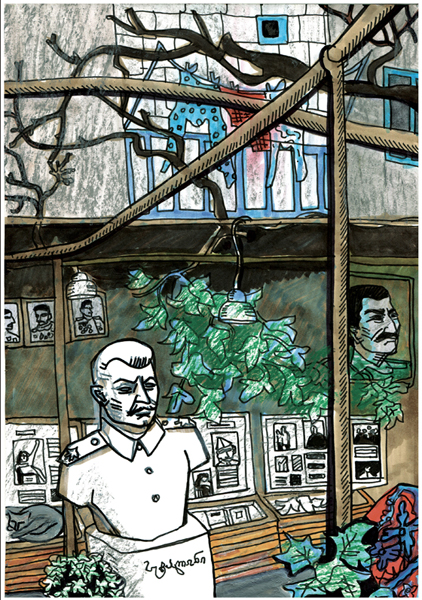
Ushangi Davidovich, the owner of the garden-museum, 86 years old. For my questions about the Stalin time, he began to recall annual decrease in products for food and show shop windows in his garden with prints of Stalin's prices for all types of goods.
Ushangi Davidovich created a museum alone: gradually bought historical photographs, portraits and busts, made a model of Stalin’s house in Gori with his own hands, brought Soviet helmets and fragments of grenades from Stalingrad. In the same garden-museum there is a stele in memory of his deceased son, the old photo card of parents is adjacent to the front portrait of Stalin, the walls are decorated with ligaments of garlic, dried flowers and fruits.
On the wall with which the museum exposition begins, black and white photo portraits in the frames hang. Faces in the photo are young and attractive. These are the executed participants in the 1956 rally.
After the XX Congress of the Communist Party, at which Khrushchev criticized Stalin, unrest began in Tbilisi. Ushangi Davidovich recalls: “Every day there were rallies at the monument to Stalin. We demanded an explanation. On March 9, Khrushchev ordered to open fire on us, shot without warning. I went away at this time to eat, so I survived. 27 people were killed, the youngest was 15 years old. There is nothing about this in history textbooks. ” Immediately after these events, Ushangi Davidovich began to create a Stalin Museum.
 © Victoria Lomasco
He invited his home chacha to his home and showed one of the eighteen books of reviews about his museum with the reviews of the daughter of Stalin and tourists from all Soviet republics. Когда я пришла в сад-музей второй раз, то не застала Ушанги Давидовича дома — он был на заседании новой коммунистической партии «Россия — наш друг».
Очень часто мое обращение на русском становилось поводом для пожилых грузин поговорить об отношениях с Россией. В Тбилиси много таксистов-пенсионеров, и почти каждый из них затевал во время дороги такой разговор:
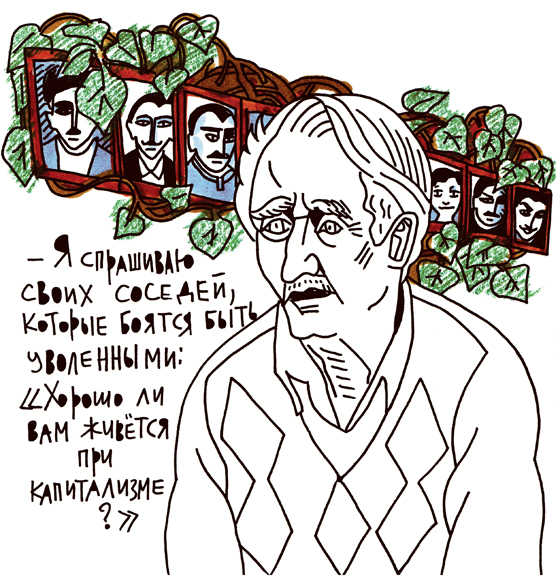
«70 процентов грузин считают, что с Россией лучше жить, чем с Европой или Америкой. С Запада идут дотации, но все достается правящей верхушке, а не простому народу. В Тбилиси нечего делать из-за безработицы, почти все предприятия стоят. В советское время была работа и больше считались с людьми. Пенсия 160 лари, разве на это можно жить?»
Мои замечания об экономическом кризисе и политических репрессиях в современной России таксисты игнорировали: «Нам бы такого президента, как Путин!»
В автобусе со мной заговорил пенсионер, беженец из Сухуми: «В советское время я не был коммунистом, критиковал власть. Сейчас, оглядываясь назад, понимаю, что было лучше. Бесплатные образование и медицина для всех. Мой сын воевал, был контужен, государство его не вылечило. Я очень обижен на власть».
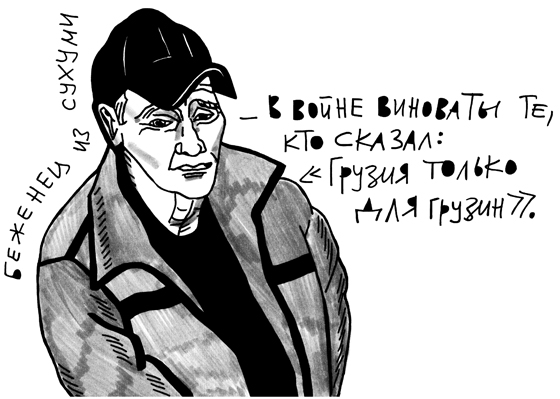 © Victoria Lomasco
В одной из европейских организаций в Тбилиси со мной захотел поговорить охранник. Он попросил, чтобы я не указывала его имя и не рисовала в форме — работой в охране тяготится, а другой нет.
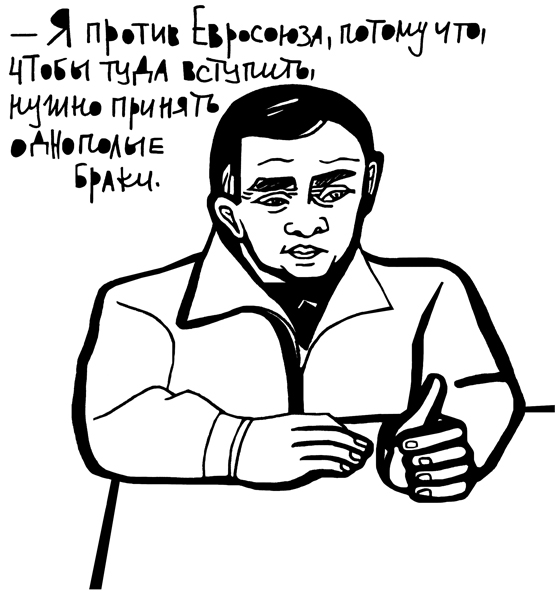 © Victoria Lomasco
«Мне не нужен безвизовый режим с Евросоюзом, мне нужен безвизовый режим с Россией», — говорит он. В советское время ему не нравилось, что все решения по Грузии принимались в Москве, он мечтает, чтобы у Грузии были хорошие отношения с Россией, но на равных.
Если люди старшего поколения хотели общаться, что-нибудь дарили или угощали, то молодые грузины, услышав мой русский или плохой английский с русским акцентом, часто, наоборот, вели себя подчеркнуто холодно.
Нино, директор тбилисского Фонда Генриха Белля, прокомментировала мой рассказ об общении с грузинами так: «К нам в России такое же неровное отношение — или обнимают (“Помните, как мы дружили?”), или обвиняют (“Зачем вы с нами поссорились?”). До сих пор присутствует постколониальный комплекс — мы вас просветили, а вы нас не цените».
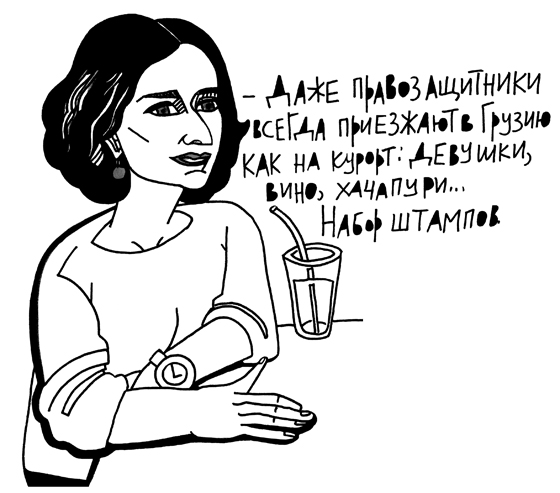 © Victoria Lomasco
Армяне в Тбилиси
Грузины и армяне разные в общении. Во время поездки в Ереван я заметила, что армяне склонны к анализу любого явления, отсутствие логики или несовпадение фактов они замечают сразу. В Тбилиси главное — увлекать и увлекаться, быть живым и артистичным. Моя новая знакомая армянка Лус, недавно переехавшая из Еревана в Тбилиси, согласилась с таким впечатлением.
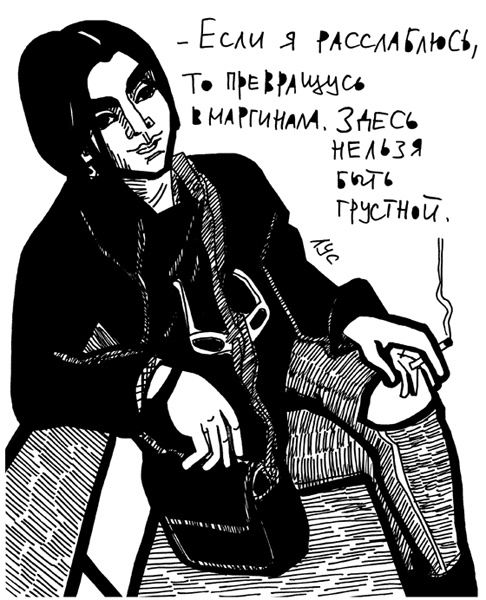 © Victoria Lomasco
Я показала портрет Лус грузинским знакомым. Вот их комментарии:
— Да, в Грузии нельзя быть грустным. Из негативных реакций более-менее приемлема агрессия. Мы не научились справляться с грустью — если углубляться в свои эмоции, можно столкнуться с еще более страшными вещами.
— Веселье — это часть социального статуса. У тебя все хорошо, ты не ноешь и не плачешь.
— Грузины не любят слабых. Это часть культуры.
В Грузии армяне являются вторым по численности национальным меньшинством (6% — азербайджанцы, 5% — армяне).
Предки многих местных армян — беженцы времен геноцида. У армянки Яны, родившейся в Тбилиси, в Грузию во времена геноцида перебрались прадедушка с прабабушкой. Яна росла в русскоязычной семье, армянский и грузинский выучила, уже будучи студенткой.
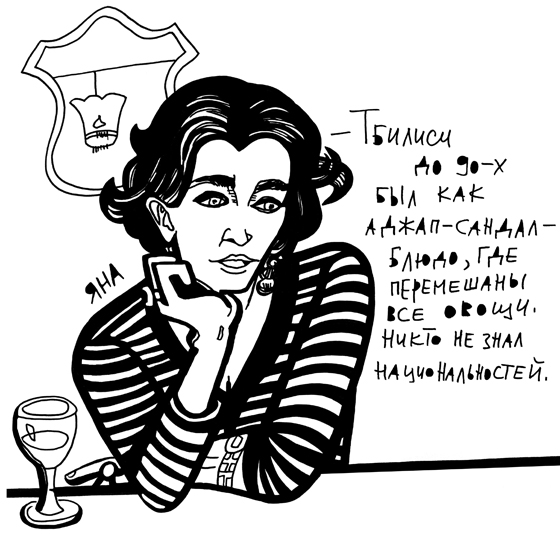 © Victoria Lomasco
В современной Грузии отношение к армянам прохладное. В разговорах с грузинами наиболее распространенные объяснения этому звучали так:
— До революции в Тбилиси было больше армян, чем грузин. Они держали торговлю, а грузины приезжали из деревень как гастарбайтеры и работали на них.
— Грузины не живут в Армении, но множество армян живут в Грузии, владеют недвижимостью и бизнесом. Большая диаспора армян — потенциальная угроза.
Почти все активисты и художники, с которыми я познакомилась в Ереване, ездят в Грузию несколько раз в год — в Грузии гораздо больше западных фондов и соответственно перспектив. Многие из тбилисских молодых знакомых ни разу не были в Армении. На мои вопросы об отношении к «ЭлектроЕревану» 2015 года и к другим армянским протестам они отвечали: «Я больше читаю про Турцию», «Мы следили за протестами в Греции».
В Тбилиси я участвовала в проекте Working agenda of Amirani/Mher , одной из целей которого было укрепление культурных связей между Грузией и Арменией. Грузинские участники говорили о том, что нельзя отделяться от Европы: «Мы должны ценить european experience , у нас global future ».
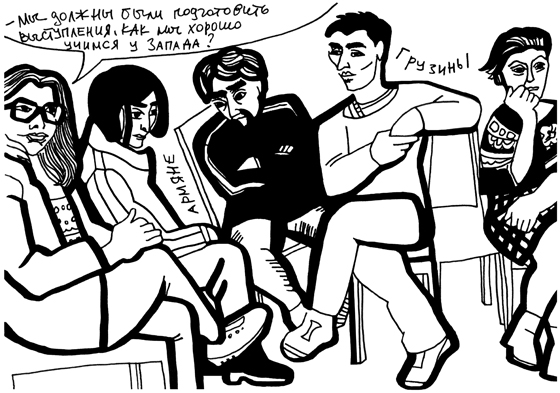 © Victoria Lomasco
«Во всех дискуссиях армяне должны признавать, как правильно идти европейским путем и как плохо находиться под Россией», — сказала после обсуждений Зара, активистка из Армении. Молодые прогрессивные армяне негативно относятся к российскому влиянию в Армении, но и зависимость Грузии от Европы не идеализируют.
Азербайджанцы в Тбилиси
На застолье, завершающее проект, армяне пригласили своих азербайджанских друзей. В Тбилиси я неоднократно слышала от армянских знакомых: «Несмотря на все конфликты, армяне и азербайджанцы лучше понимают друг друга, чем грузин» — и от азербайджанских: «Нет народа ближе нам, чем армяне».
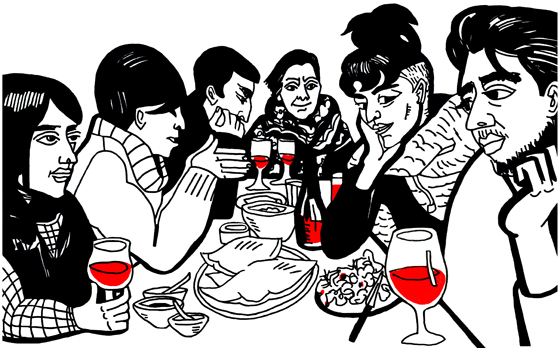 © Victoria Lomasco
Среди присоединившихся к нам азербайджанцев был писатель Сеймур Байджан. Он подарил мне свою книгу «Гугарк» о Карабахской войне. В «Гугарке» Сеймур вспоминает первые перестрелки между армянами и азербайджанцами в родном городе Физули, начало военных действий, превращение города в руины, переезд семьи в Баку. Тяжелее было читать не про военное, а про домашнее насилие — настолько буднично описаны избиения жен и детей в азербайджанских семьях.
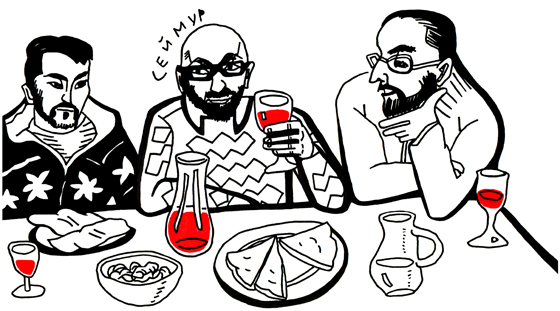 © Victoria Lomasco
Сеймур принадлежал к бакинской культурной среде 2000-х годов. Начиная с 2009 года власть начала выдавливать активную творческую интеллигенцию из Азербайджана.
Позже я познакомилась с друзьями Сеймура, семейной парой, вынужденной покинуть Баку из-за давления со стороны властей. Это журналистка, переводчица и поэтесса Гюнель Молвуд и врач Хаджи Хажиев.
Гюнель начинала как блогерша. После серии критических текстов о проблемах азербайджанского общества она стала одним из самых читаемых авторов у себя в стране. Сейчас Гюнель работает редактором на интернет-портале Meydan TV , созданном азербайджанскими диссидентами в Берлине.
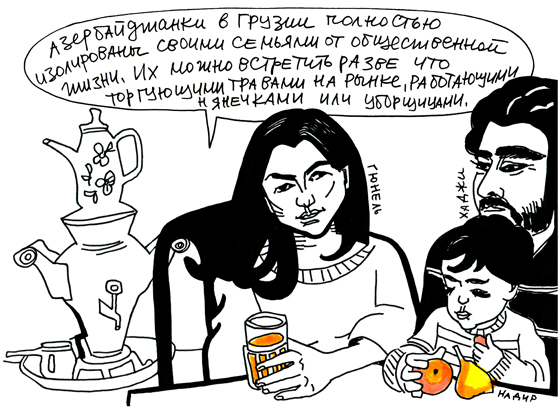 © Victoria Lomasco
Большинство репортажей Гюнель посвящено правам женщин на Южном Кавказе. «Жизнь азербайджанок, проживающих в Тбилиси, иная, нежели у грузинок, — рассказывает она, — азербайджанских девочек семьи забирают из школы в 9-м классе, отдают замуж с 14 лет. Сопротивление азербайджанских девушек — это суицид. Нянечка нашего ребенка стала бабушкой в 32 года. Поговори с ней».
Нянечка Ренка согласилась позировать для портрета и немножко рассказала о себе. В 13 лет она вышла замуж, а в 14 родила дочь.
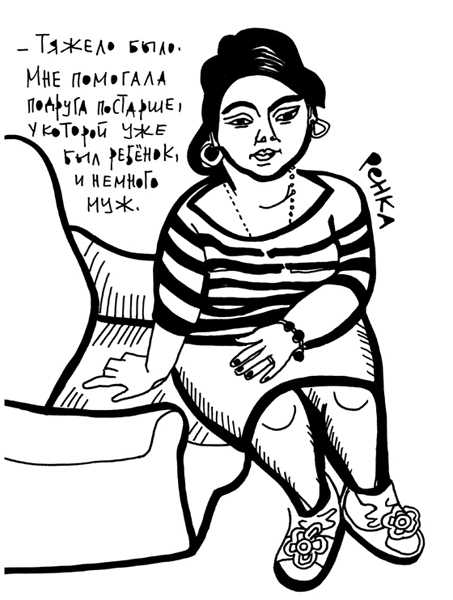 © Victoria Lomasco
В 19 лет родила второго ребенка, мальчика. Долгое время Ренка занималась домом и детьми, в город выходила только вместе с мужем. Работать нянечкой начала недавно, Ренке очень нравится ее работа. Про незамужних женщин, зарабатывающих самостоятельно, Ренка сказала так: «Есть деньги, и живет как хочет. По-моему, это лучше».
На Кавказе есть термин, обозначающий правильное поведение человека в обществе: на азербайджанском и на армянском — «намус», на грузинском — «намуси». Для мужчины намус значит честь, совесть. Для женщины намус связан исключительно с сексуальным поведением, с ее недоступностью. На Северном Кавказе считается, что мужчина, чья родственница «гуляет», может очистить свой намус только ее убийством.
Сеймур говорит, что в азербайджанском обществе намус можно купить. Если женщина, актриса или певица, приносит много денег в семью, она может возвращаться домой поздно ночью и каждый раз с новым мужчиной.
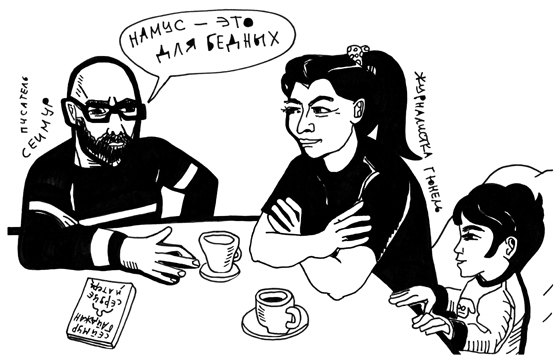 © Victoria Lomasco
Гюнель рассказала историю своей подруги, незамужней студентки. Парни на районе контролировали ее внешний вид и угрожали расправой, если она не будет соблюдать намус. Однажды, когда девушку проводил до дома знакомый, их обоих избили. Эти же парни в упор не видели других соседок в мини-юбках и с силиконовыми грудями — содержанок богатых мужчин.
Не все молодые азербайджанцы готовы вести навязываемый обществом образ жизни. Четыре единомышленника — Руслан, Лала, Эмин из Баку и Эльвин из Тбилиси — организовали активистский проект «Мыслящий гражданин». Они арендуют в Тбилиси помещение и проводят два раза в неделю образовательные лекции. Их интересуют гражданские инициативы и развитие культуры на Южном Кавказе, а также такие табуированные темы, как роль азербайджанской женщины в обществе и домашнее насилие.
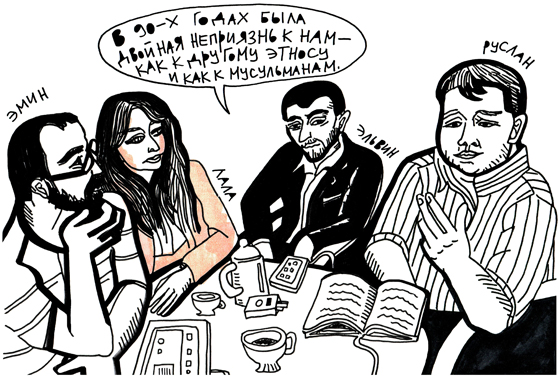 © Victoria Lomasco
Эльвин говорит, что даже для грузинских журналистов проблематично делать материалы об азербайджанцах Грузии — настолько это закрытое общество.
Русские в Тбилиси
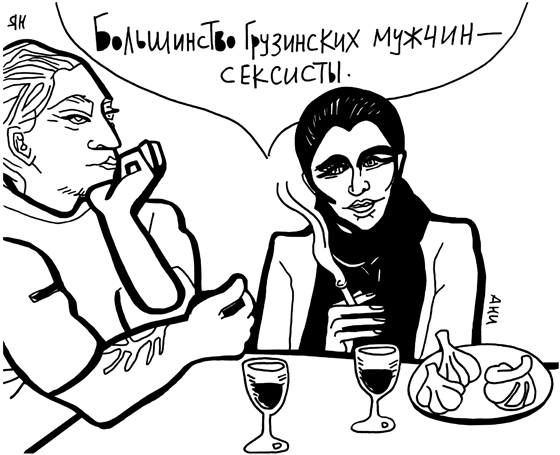 © Victoria Lomasco
Знакомые тбилисцы замечают, что в последние годы в городе начали оседать молодые люди из России, разочарованные и недовольные происходящим на родине. Пока их немного. Те, с кем я общалась, выбрали Грузию, «потому что не нужна виза, тепло, дешево и близко, многие знают русский, много общего в культуре». Они не уверены, что смогут обосноваться в Грузии, но и возвращаться в Россию не готовы. Ян, бывший московский активист, — один из таких полумигрантов. «Вся Грузия — как одно большое село: нравы патриархальнее, отношения людей душевнее, чем в России. Меньше агрессии, но раздражает безответственность грузин», — рассказывает Ян.
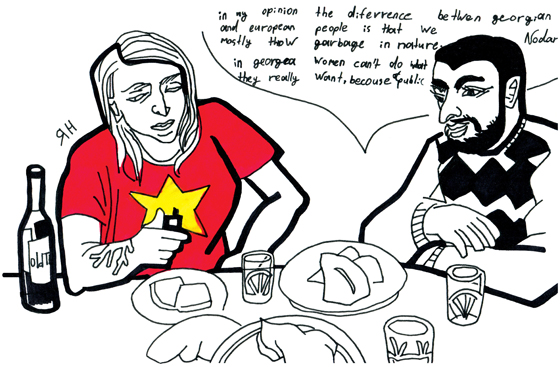 © Victoria Lomasco
Ян снимает квартиру со своей девушкой Ани, с которой познакомился в Тбилиси, и ее братом Нодаром. Как и многие молодые грузины, Нодар не знает русского, а на плохом английском наше общение не клеилось. Я попросила Нодара написать на рисунке, что он думает про особенности грузинского общества.
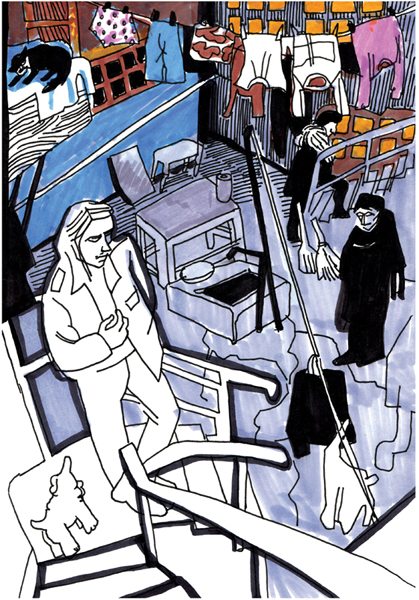 © Victoria Lomasco
Ян все реже читает новости о происходящем в России, а когда читает, радуется, что ему удалось сбежать от «тотального безумия».
Русских всегда можно встретить в Kiwi- Cafe в центре города. Это первое веганское кафе в Грузии, открытое в 2015 году интернациональной компанией: грузины, русские, иранец, шведка. Изначальной идеей было готовить самую простую и дешевую еду, но постепенно кафе превратилось в модное туристическое место. Активисты из России, зависающие на неопределенный срок в Тбилиси, подрабатывают здесь на кухне.
В Kiwi- Cafe регулярно проводятся показы и обсуждения фильмов, дискуссии и лекции на социально-политические темы. Я побывала на лекции о борьбе курдов за свои права, которую подготовил Алексей, активист из Екатеринбурга.
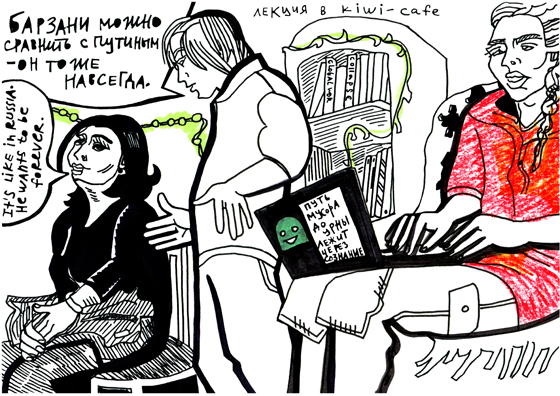 © Victoria Lomasco
Алексей приехал в Тбилиси с компанией друзей: «Живем тут уже два месяца — ни разу не наталкивались ни на полицейского, ни на чиновника. В России ощущение, что они повсюду, а ты — лишний».
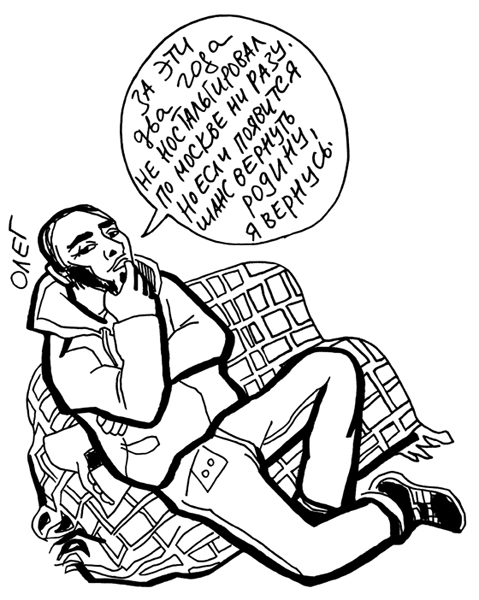
Олег, бывший московский журналист, — один из организаторов Kiwi- Cafe .
Он рассказал про две свои последние поездки из Грузии в Россию. Первый раз Олег пересекал наземную границу через контрольно-пропускной пункт в селе Верхний Ларс: «Меня увели с вещами — спецпроверка ФСБ. Подозревали, что боец ИГИЛ (организация запрещена в РФ. — Ред. )». Второй раз он прилетел в Москву на самолете вместе с другом-украинцем. Украинский паспорт, регистрация в Закарпатье и татуированное тело друга оказались достаточными причинами для его задержания и депортации.
«Ты еще и въехать не успеваешь в Россию, как уже понимаешь, куда возвращаешься!»
 © Victoria Lomasco