
Translated material
Pokarting | Colta.ru
When Alexander Rodnyansky is blamed for the quality of the competition, he recalls that the festival does not create, but only reflects the current situation. There is cunning: in the past, Kinotavr, a powerful engine of author’s cinema, created a lot of things, but this year, indeed, reflects mostly. The authors, a little less than a decade ago, made up the Golden Kinotavrov generation - Khlebnikov, Popogrebsky, Voloshin, Khomeriki - went into TV shows strangled by today's screen prohibitions and mining financial policy. In their absence, the festival turned into a large beautiful TV - largely because the country's population from potential moviegoers transformed into a television audience. The roots of the best and worst in the cinema shown in these three days in the program - there, in a box that has become the most important of the arts in the country with well -developed propaganda. As one of the main domestic film experts angrily noted on the sidelines, "they completely stopped seeing the difference between the film and the TNT channel show." Almost a compliment: some TNT show like the school series “Fizruk” is quite drawn to the fact of art.
The painting “A good boy” that opened the “Kinopodavr” - a teenage comedy that immerses us in an amazing world inhabited by intelligent teenagers and school principals in fashion sneakers could also be a back of the armor -piercing series. The middle Moscow apartment, where the family of a ninth -grader of Kolya lives (Semen Treskunov from the Ghost), the optics of director Oksana Karas transforms into the southern veranda, Moscow to the city by the sea, and puberty to dance. The heroes of the film every now and then pose against the background of the corps de ballet, which twists chirried pins or twists the lower break. Here, a “good boy” inherits not American mass cinema, but Soviet children's films from perestroika, first of all, “above the rainbow”, where the progressive black dance was revealed for the first time for the audience of the USSR. The great tape of George Jungwald-Khilkevich is quoted literally in pieces-to take at least a scene in the gym, where boys practice a phizra against the backdrop of dancing girls. In the finale, we will be pleased with the collective choreographic scene, the main person involved in the Alexander Pal - a computer science teacher, as if who came here from the clip for the song of Musi Totibadze Radio. The conditional world of the “good boy” was built extremely deftly, and risky jokes (the main McGaffin is a maniac pissing for a random street sacrifice), plot courage (the hero is in love with his teacher, who is everybody’s house in his underwear), a hallucinogenic intra -gas humor (a scene where the hero jumps on the pepper in the eyes The director, and then his wife and launching a cheerful Basterkiton turmatic) do the honor to the director who worked on the TV reporter, and then taken up for the series. Karas is a real author who built his acid universe and is happy to rule it. The desire to blossom the viewer turns into an attempt to surprise him - sometimes rather impudent; So before our eyes, television becomes a nursery of the libertins, which will still make the censors wash their bloody tears.
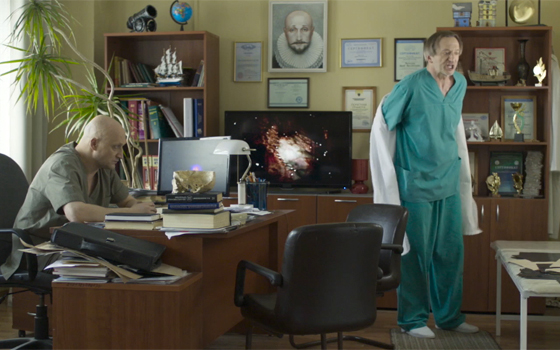 © Artlin LLC Frame from the movie "Doctor"
Now, as they say in information issues, we will move on to other news. Speaking of the rest of the competitive paintings shown during the reporting period, you also have to recall the television format. The directorial debut of Goshi Kutsenko “Doctor”, the drama of neurosurgeons with the director in the title role, is the production of “Interns” (about which there are even a couple of jokes), spoiled by claims for realism. Kutsenko is a completely good, sincere person who is sincerely trying to entertain the audience with tears (the third planning characters die unrest), then jokes (at some point, the title hero who lost the phone, with all the necessary scalpels and tampons, takes on to operate the SIM card to turn it from mini into micro). Most of the hero is surrounded by women in the area of forty, the image of which is thrown into the genre acting avant -garde from Alena Khmelnitskaya to Olesya Zheleznyak. The majority in the script, and with them, is obviously proposed to be identified by most of the public. It turns out that Kutsenko shoots for the audience of the series of the Russia 24 channel - housewives from forty and above. "After you" with Sergey Bezrukov in the title role - a spiritual project dedicated to a high culture. Bezrukov plays a soloist of ballet, as a result of a drunken brawl (it was in the dashing nineties, and not in Russia in general, but in America) and now an injury and now earnings of dancing and a network of pharmacies. The hero does everything as it should be - he walks by swallowing arshin, license to stutter, knocking a lid from a garbage bucket in a rhythm of classics pouring from the musical center. At some point, the hero is imposed on an unrecognized daughter, which he drags to performances in large, warning in advance that all the dancers on the stage (presumably his classmates) are still fagots. The dancer has a declarative unpleasant character, but homophobic jokes rather serve as a paint to the image of a normal, our boyfriend. Telemainstream norm - we have no place for perverts in stupid boots here.
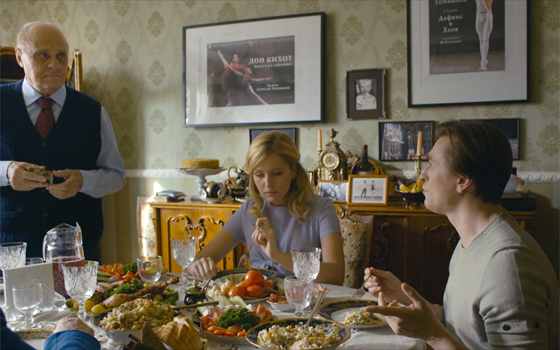 © Production Value, film company Sergei Bezrukova Frame from the movie "After You"
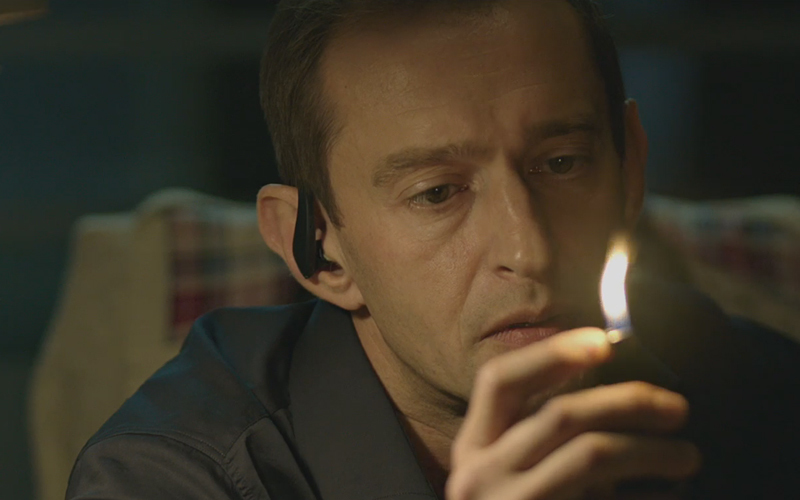
Well, the last telekino-the “collector” of the debutant Alexei Krasovsky, called up to be something like “Loka” with Tom Hardy, only about the debt collector, in the apartment and with Konstantin Khabensky. One place, night for everything about everything - the only actor in the frame is added to classic unity. Place a person with a mysterious but clearly luxurious profession in a studio apartment with giant windows full of evening Moscow lights is also a television fork to create a canvas about local rich people who also cry. The creative, looking for new forms in the art of knocking out debts by the collector, which seems to the victims of different names, like the Renaissance plow, and hears in response: “Why are you kidding people? What do you need? ” - the hero of the era is as vital as the rebellious, well -educated State Duma deputy or twenty -four hours a day thinking about the homeland. Despite the talent of the Khabensky, quite comparable in charisma with Tom Hardy, the “collector” remains not the most stupid and not the cheapest television, whose artistic merits would be simply ridiculous. As for a short meter contest - here the parallel with television is monitored especially clearly. The installers of information services have terminological jargonism “to the point”. This is what is done with the news to which the video was taken out. That is how, not trying to look for visual solutions, they mostly come with their own - sometimes not the most dreary - stories authors presented on the Kinotavra of short cinema. Random pictures illustrating not bad text-a movie shot in 2016 looks strong. In order to understand this, it is enough to imagine any of these plots in the design of Boris Khlebnikov or Igor Voloshin. But the mentioned authors, who have never rolled into television asthetics, alas, have been working on television for a long time.