
Translated material
Drawings of investment machines
All May was filled with the expectations of the Plenum of Economics* - a meeting of the Presidium of the Economic Council with the president, which, experts believed, will adopt the country's development strategy in conditions of sanctions and low oil prices. Observers awaited the battle of two fundamentally different approaches - liberal and conducting. The most amazing thing is that nothing happened at all. The New Times read the reports and realized why
Investments in fixed assets slow down in 2012
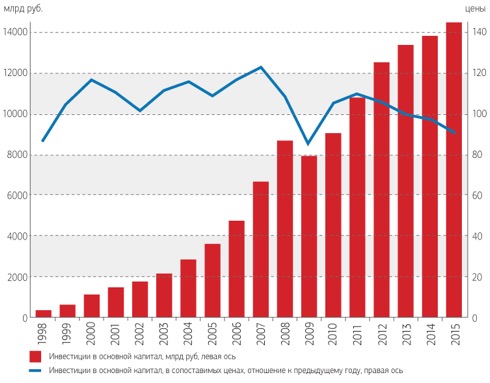
Source: Rosstat. From the report of the CSR at the Presidium of the Economic Council, May 25, 2016
There is an answer, and it is amazing: as follows from the materials of the meeting, not only Alexei Kudrin, but also the Minister of Economics, Alexei Ulyukaev, and the National Patriots from the Stolypin club called for Vladimir Putin to the same-urgent reform of the executive branch, dismantle the remnants of the social machine and reconciliation with the West. The president promised to think for about a year. Meanwhile, in the depths of power structures, another project ripens: to make the government itself unnecessary and bring large state business from its management.
The dispute about the obvious
The meeting of the Presidium of the Presidential Economic Council, we remind, took place on May 25. But already a week before him, Alexei Kudrin formally won the battle that had not yet begun: by order of Vladimir Putin he was appointed head of the working group of the Economic Council, which should prepare proposals for structural reforms in the economy. Since the discussion of structural reforms was precisely assumed on May 25, Kudrin’s opponents, in general, could speak at a meeting of the presidium anything - the new head of the CSR in the future should still bring their ideas in the future. The alleged rivals to argue with each other and did not, preferring to almost jointly argue with the invisible fourth opponent, in the hall represented by the social deputy prime minister Olga Golodets. This was just predictable: both Kudrin and Ulyukaev, and even more so Boris Titov do not hide that they are interested in the reform of the current social system and in raising the retirement age. In any case, the “Social Democrats” in the social block of government remains the main opposition force for any structural reforms-as we have already written, no structural reforms in Russia can be meaningful without refusing a complete employment policy, and all Russian governments adhered to this policy, starting with Viktor Chernomyrdin. It was not for long to argue with the Golodets, especially since the extremely experienced and skilled political player of Golodets is not a supporter at all publicly express his economic views. And finally, following the meeting, Vladimir Putin said that by the summer of 2017, or even a year and a half, joint developments of all three parties may be in demand.
In other words, the president simply refused to discuss not only the ideas proposed in the programs of the CSR (Alexei Kudrin), and the Stolypinsky club (Boris Titov), but also the ideas of ministers of the White House economical block, patronized by the first deputy prime minister Igor Shuvalov. There is no doubt that Vladimir Putin read all the programs in advance. And what he saw there could not but be alert and even, perhaps, fright, they were surprisingly found in a surprisingly many common places, and unpleasant common places.
Three verse of songs about the main
Three reports presented for the meeting on May 25 are at the disposal of NT , and they make an oppressive impression. Despite the fact that Alexei Kudrin is a semi-opposition politician (in any case, the initiative and views of his committee of civil initiatives are not strongly impossible to call the current course of the authorities), Alexei Ulyukaev is a senior official, and Sergei Glazyev is an Orthodox-communist views, it would be simple to find a consensus.
When the three groups of economists, whose ideological views are very different, offer the president to change the principles of the government’s work, here Vladimir Putin has to think
But first about the differences. The main idea of the CSR: Until 2019, no measures can lead to an increase in GDP 4% per year or higher, it is necessary to invest in long -term development for the future until 2025. One of the main problems, according to Kudrin, is low investments of the Russian private business in R&D: if the state in Russia invests in innovative development “at the level of leading countries of the world”, then private business is three times less. At the same time, Aleksey Kudrin states, in fact, the private business has money: on deposits of private companies now lies about the annual volume of investments in the Russian economy. Actually, the task of reforms is to make these savings become investments.
** Use on deposits of enterprises and organizations, we will compare with the annual investment hiring ** 
Source: Rosstat. From the report of the CSR at the Presidium of the Economic Council, May 25, 2016
The main idea of the Ministry of Economy is similar - there is capital in the country, and in the near future it is necessary that it does not eat, but transforms into investments. Capital can ride both by the population and state monopolies. If they do not let them do it now, but to provide money to average non -resource exporters, you can increase the potential GDP growth from the current maximum 2% per year to 4%. 1.2–1.5% of GDP growth will only give restrictions on the appetites of Gazprom, Rosneft and the population. And then-you need to develop an export support system in every possible way (in fact, copying the South Korean experience of the 1990s and 2000s) and wait until the next technological revolution in the world occurs. And it was not long to wait!
Finally, the idea of a fixed club has remained the same - this is a low ruble exchange rate and a small (at the level of 1.5 trillion rubles per year) the target emission of the Central Bank in favor of industry. In addition, the current item is a decrease in taxes, the return of the coveted investment benefits for captive (liquidated by Alexei Kudrin in 2005), the underestimation of the key rate of the Central Bank (with the desired immediate replacement of the head of the Central Bank Elvira Nabiullina - this is not written in the program, but even so clearly).
And then the patriots, liberals and government economists suddenly converge in their ideas. First of all, the legal state (with subtext - instead of arbitrariness and power “manual management”) and a decrease in administrative pressure on business - this is the slogan of all three programs. In addition, all three programs require the President to refuse to protect the interests of the main state monopolies - that is, to reduce the investment programs Gazprom, Transneft, Russian Railways, RusHydro due to restricting their tariffs. Another common point is the development of an export support system. Note, not at all the program of the CSR, but in the presentation of the Stolypin club contains a seditious call - the “restart” of political and economic relations with the West.
All three programs require the reduction of the public sector in the economy and privatization. All three programs require the refusal of a policy of complete employment and restraining unemployment, and everyone somehow involves an increase in the retirement age to 63–65 years and the liberalization of the Labor Code with the removal of excess guarantees for employees in favor of the employer.
And finally, it is precisely the program of Titov - Glazyeva that the “reform of public administration” is said, while in the presentation of Alexei Kudrin this is called “deep institutional reform of public administration”, with Alexei Ulyukaev - “the creation of a system for managing reforms”.
When the three groups of economists, whose ideological views are very different, suggest the president to change the principles of the government’s work, here Vladimir Putin has to think. After all, they say one and the same thing: in the country there is a power that prevents the restoration of economic prosperity for which everything is. Oh well?
Oprichnina as a business model
The magnificent picture of trillion rubles of potential investments in the economy of Russia, waiting for the moment of resignation of the government Dmitry Medvedev or at least deep reform of the executive branch, of course, cannot but inspire. In fact, of course, everything that happens is rather joyless. In many ways, these trillions are waiting not so much by the new government (or, as the Stolypinsky club offers, the growth administration under the President of the Russian Federation, coordinating all reforms, is a quote) and not so much to increase the retirement age as solving the problem of confrontation between the opposition part of society and the Kremlin. The report of the CSR is quite accurately reported by the date when real investments in the Russian Federation began to fall - this is 2012, that is, after the acceleration of swamp and the adoption by the State Duma of the whole package of repressive laws, well, after the Crimea, Donbass, sanctions and counter -sanctions, investments were completely reduced to zero.
If this is so, then all three programs are equally meaningless - if an obstacle to investment is a domestic policy, then it is useless to expect from Vladimir Putin for the prosperity of the Russian economy. He is anyone, but not Danko.
Obviously, this is exactly why the president’s reactions to the advice of the speakers at the meeting of the Economic Council did not follow.
However, it was after May 25 that a new, previously not declared idea appeared in the Kremlin and the White House. Namely: if the executive branch in Russia does not cope well with the regulation of private business, which is poorly investing, and is not inimal, and is generally tortured by relations with the authorities, then why would the state not become to some extent this very private business? There are enough assets: the state has gas (Gazprom), oil (Rosneft and Transneft), transport (Russian Railways, Avtodor and Aeroflot), Energy (RusHydro and Ros-Atom), Banks (Sberbank, VTB and VEB), Communications (Rostelecom), VPK and Engineering (Rostec). Why will the government manage all this at all? No, and it is not necessary to sell these assets either. There is a better idea.
The idea of creating a “Russian Temasek”, the State Investment Fund, as in Singapore, is developed in power from several sides
Recall that one of the inaccessible landmarks of the Russian authorities is Singapore, built by Kuan Yu. The head of Sberbank German Gref, who had died for many years, spent many years that the idea of authoritarian modernization in Singaporely mastered the minds in the Kremlin. And now, apparently, this is happening. The idea of creating a “Russian Temasek”, the State Investment Fund, which in Singapore combined the most significant state-made state instead of privatization and created a state-owned one, but on market principles, the economy of the city-state is developed at once from several parties: the new leadership of Ros-
property ”, and the structures of the Central Bank and the Ministry of Finance. The main idea is that the executive branch needs to leave games with medium and small business and non -human markets, and finally engage in the unified economic state of Gosigrok to integrate the entire economic force accumulated since 2001, capable of fighting competitors on the world arena. To some extent, this repetition of Kazakh experience
It with his state investment fund “Samruk-Kazyna” (he did not produce an economic miracle in Kazakhstan, but he improved the investment climate for major transactions), the experience of Malaysia and the Persian Gulf countries (the economy of Qatar and the developed Emirates of the UAE is arranged that way).
At the same time, there is nothing particularly new for the Kremlin in this. In fact, this is legalization and bringing to a more civilized form of that practice of managing the Kremlin by the largest state -owned companies, which began to develop in 2006. In the form of developing, Lee Kuan Yu, who appointed members of his family in Temasek, will also be useful to the current government. In the end, why don't this project do, say, Kirill Shamalov?
Well, who else will you order to trust? After all, when the communist, liberal and official, without saying a word, tell you that the problem with GDP growth-you yourself, then willy-nilly will have to become this GDP and grow under his own control. It turned out in Singapore - it will turn out here in the new oprichnin.
And let Zemstvo live as he wants: at least according to Kudrin, at least according to Glazyev. It's not about it.
* NT wrote in detail about this in the article "Economic Paralympiad", No. 16 of May 16, 2016