
Translated material
A girl on an orange
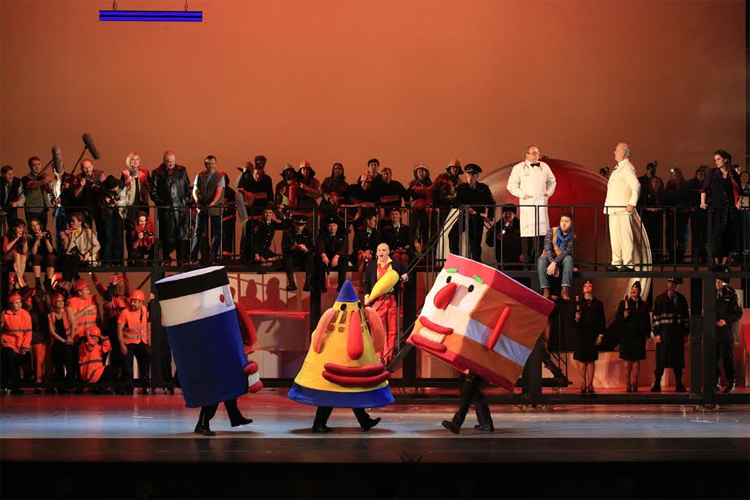
The 125th anniversary of Prokofiev, the music theater named after Stanislavsky and Nemirovich-Danchenko celebrated the staging of “love for three oranges”, which is a repetition of the products of the artistic director of the theater Alexander Titel and his permanent scenographer Vladimir Arefyev in the Latvian National opera of the three-year ago. It turned out a nice performance with a large amount of orange, but still noticeably grazing in front of the wit of a young composer (aka a librettist), supported by the same brilliance and zeal of the orchestra under the direction of Alexander Lazarev.
This cheerful game of the Tale of Carlo Gozzi, inspired by Meyerhold, was written by Prokofiev in the most seemingly inappropriate for the fun of 1918-1919. From the Russian revolution, the composer for several months stubbornly moved to the other side of the globe. For the first time, the opera was staged in Chicago in 1921 in French. But already in 1926-1927, the “oranges” with great enthusiasm were met in the country of the victorious socialism - like their author himself. The exhibition in the theater’s atrium is timed to the current premiere, in particular, representing the unique sketches of the scenery and costumes of Boris Anisfeld from the Chicago production, as well as materials on the first Soviet performances.
The era of the first avant-garde (widely understood) is marked in a new performance by quotes from the classics: Malevich’s Black Square scatters into pieces, the thrombonist leaves the orchestra pit, reminding the Rodchenkovsky pioneer pipe, a girl from the “pink” period of Picasso ballasts at a huge round object hinting at citrus. Heroes of the opera. But by the second half of the performance, this art history somehow comes to naught.
But another visual topic is amplified - funny exhibits of mobile technology from the Soviet period: from a tachanka with a machine gun that representatives of the Central Asian Soviet republics, and a field kitchen from a smoking stiff to the asphalt rink and a rusty broken car, are looking through the windows of which three orange balls look out. From the shock of the ax, they alternately burst, finding three girls, for some reason wrapped in orange bath towels.
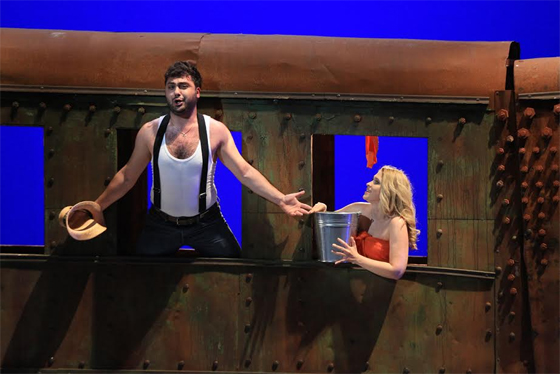 © Oleg Chernous / Moscow Academic Musical Theater named after K.S. Stanislavsky and V.I. Nemirovich-Danchenko Liparit Avetisyan (Prince) and Daria Terekhova (Ninetta) in the play "Love for three oranges"
The rest of the miracles and tricks are equipped with approximately the same posteriorly and innocently. Geometrically spraceic dancing figures on their legs, which are unsuccessfully trying to make a prince suffering from a hypochondria, are really not too funny. The win -win, terrible cook that Prokofiev gave in a man’s voice - and she does not put the hall on the shoulder blades. Princess Ninetta turns into a radio-controlled rat and vice versa is completely childish.
The action revives an ablose blessing (for example, “What is happening here?”, “And who is the artist?”), Highly highlighted in the depths of the stage. Of the many gags, among which there are even carnival white bear with a tiger, the most convincing are striped tight pants of brave Natalia Muradimova, a beautiful singer of serious shapes lying on the floor with her feet in Morgana. From the side of the stronger sex, the performance is decorated with Liparit Avetisyan (funny and charming prince), looking for his love in a T-shirt and suspenders, and Valery Mikitsky (Truffaldin-Podlobilist), to whom the director, among other things, instructed to get to a bit of fear in a specially built-in scene of the Kosobok institution.
Of course, great hopes are entrusted to the Khora party, which is written by Prokofiev for the main plot and funnyly arguing about the ways of modern theatrical art of tragiks, comedians, lyrics, empty -headed and eccentrics. They turn out to be our well -recognized contemporaries here: workers in orange overalls, firefighters with hoses, traffic controllers, orderlies, journalists with video cameras, microphones on a stick and smartphones for a selfie. Appearing in the prologue, they look promising and fun, stomping this day the tired symbols of the last century, but they act monotonously and already by the time of the main opera hit - the famous march - are annoying. The performance hangs in the confusion of times, where it is grabbing a little from each era, but it has not been completely agreed upon anywhere.