
Translated material
Cheerful spleen
“In your own words. A. Pushkin "Evgeny Onegin" at the School of Dramatic Art: Dmitry Krymov's experiments in the memory laboratory
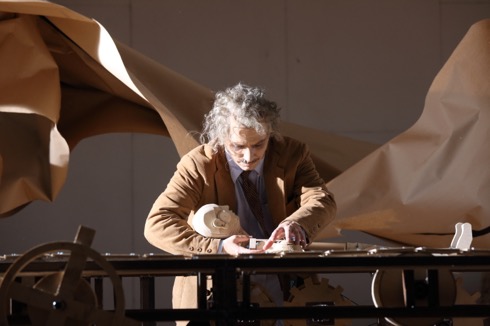
“My friends, you are sorry for the poet ...” Farewell to Lensky (from the author - actor Sergei Molkonyan)
Dmitry Krymova was very fond of Valery Novodvorskaya. She called him the “heir to the subtle energies of the Silver Age”, appreciated for the courage and nature of the new theater language, felt his native soul - vulnerable, ironic and conscientious. The artist and politics were united by romanticism, and faith in humanity, and the excellent memory of the past, from which our fears, despair and future mistakes stretch behind us. The Krymov conducts experiments with the collective unconscious in almost every work, step by step and a layer by a layer liberating our memory from persistent genetic myths, imposed stereotypes and tragic delusions. He does it elegant, easily, playfully. To be an experimental rabbit in the laboratory of Dmitry Krymov is a pure pleasure. And the result of treatment is visible immediately: it can be read on happy audience faces.
There is a theater
The Laboratory of Krymov is one third of the theater School of Dramatic Art (there are also laboratories Igor Yatsko and Konstantin Mishin), but, of course, determining the style and handwriting of the entire Sretenka Theater. The theater of Krymov has long been closely in the framework of the laboratory. This is a formed professional creative association with its face, with a magnificent troupe, with a powerful repertoire. And Krymov, to put it mildly, is not a boy, not “Dima” - he was equal by age with his great father (Anatoly Efros passed away at 61), he was already in sixty: he has long been a whole professor, not a laboratory assistant. However, at the whim of fate, you have to live in a communal apartment and stand in line in the "common use" - that is, on the stage, and no merits to the Fatherland have any merits. And the merits are considerable. The performances of Krymov are indispensable participants in the most prestigious international theater festivals, they have repeatedly performed in Avignon, Edinburgh, London, New York. They just returned from the Vienna Theater Forum, where they played their last premiere “in their own words. A. Pushkin "Evgeny Onegin."
Krymov himself works quickly and a lot, every year releasing several premieres, which become events. Over the years, not a single passing performance, not a single failure. And the performances - with all the lightness and jumping - multi -layer, multi -stage, complicated in dramaturgy and technical equipment.
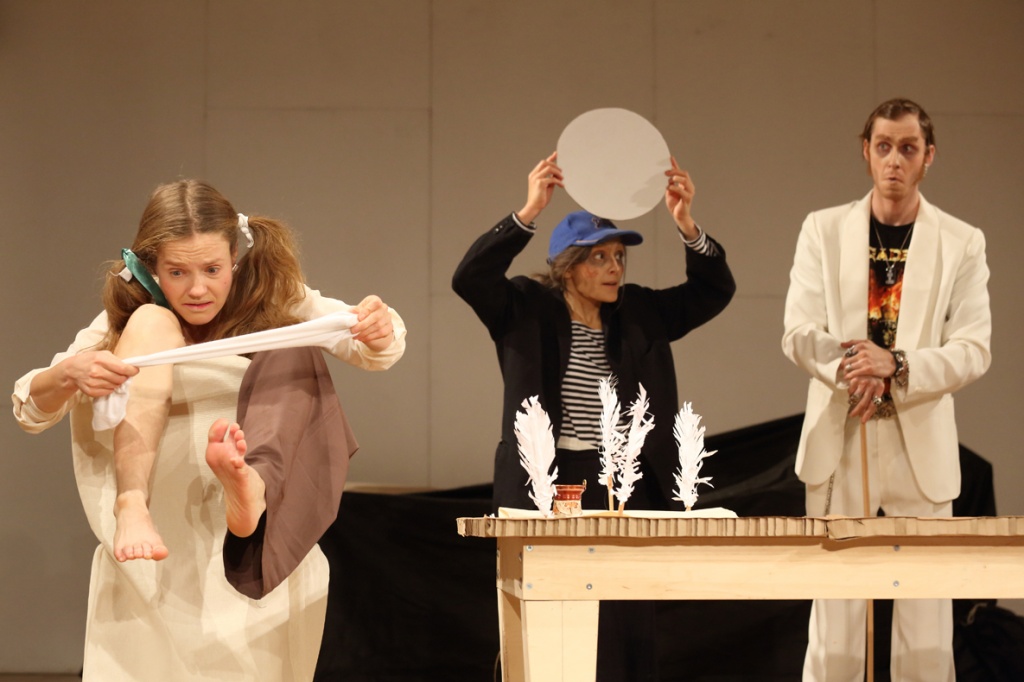
"And everything was dozing in silence at the inspirational moon." Tatyana is preparing to write a letter to Onegin (actors Anna Sinyakina, Natalia Gorchakova and Maxim Maminov)
The mentioned Eugene Onegin is the beginning of the cycle “In your own words”, conceived as an educational gaming project for children. The task is to retell the cult works of the world classics in a fervent game form in order to attract young spectators into the space of great literature and great thoughts. Pushkin will be followed by Chekhov with Sakhalin Island, Gogol with Dead Souls and the unexpected Karl Marx with his “capital”.
Live pictures
“Onegin” “in your own words” is retold four characters, according to the type of comedy del arte: Russian (Anna Sinyakina), Frenchwoman (Natalya Gorchakova), Czech (Sergey Molkonyan) and Finn (Maxim Maminov). Why exactly Czech and Finn - do not ask, science is unknown. However, it is obvious that the actors play precisely those who are planned - the impeccable accent of each foreigner refers to the indicated nationality and gives the Russian word unprecedented grandeur and multifaceted. Four characters in the course of action play the play not by roles, but by meanings - as if answering the usual and most nasty “school” question: what did the author want to say?
This is a formed professional creative association with its face, with a magnificent troupe, with a powerful repertoire. Yes, and Krymov, to put it mildly, is not a boy, not Dima - he was equal by age with his great father
Reflections on topics raised in the “Onegin” make up the main dramatic intrigue, turning a banal retelling into a fascinating journey through familiar lines, into a quest, and a game in the association. Did you put out the light in the hall? You will not even remember now. But they distributed black butterflies (men) and hairpins with a paper flower (girls). And the children (there are a lot of them in the hall), and adults with great pleasure are included in this game, show initiative and even require well -deserved applause. The young man from the first row is appointed Onegin and invited to the name day to Tatyana: on his head he has a carnival cap, on his neck - a garland. In the hands of a paper painted package with a “gift”. Onegin, along with the rest of the guests, dancing, laughs, blows onto the feather that is spinning in the air, and when it comes to give a “gift”, then a huge toy revolver gets from the package, which immediately shoots a deafening jack. One of the guests - Lensky - falls dead. “Thank you,” the actor will significantly tell Onegin. “You helped us a lot.” And coldly brings his hand.
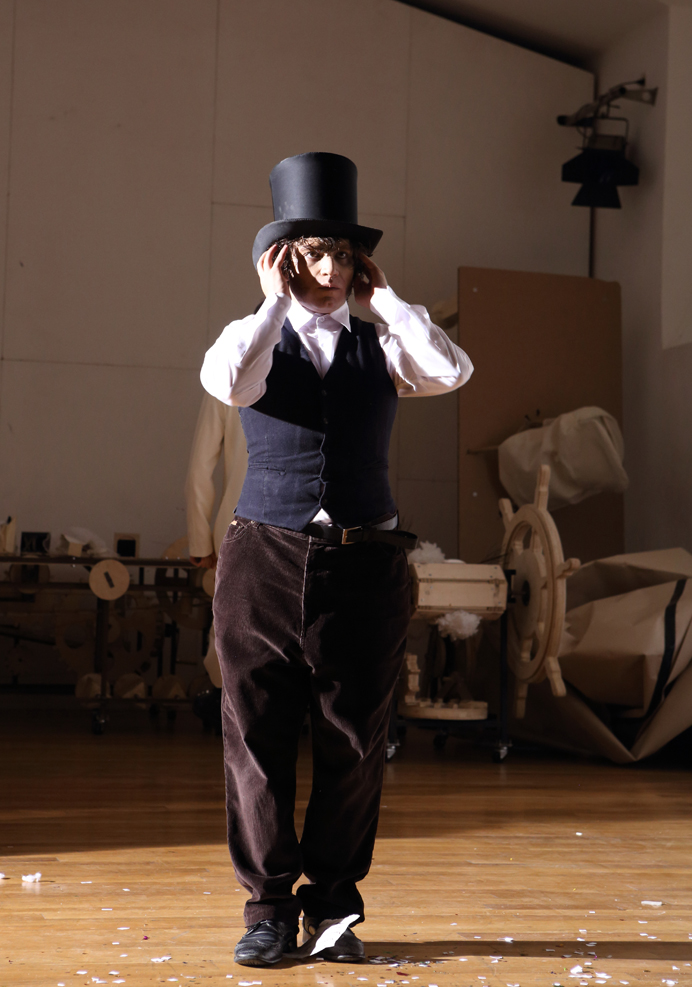
And here is Pushkin himself (Sergey Molkonyan)!
Children from the audience participate in a “lyrical retreat” about the winter, about a boy with a frostbitten finger, who “hurts and funny, and the mother threatens his window,” threatens with the same bandaged finger. A visit to Onegin Theater turns into a whole lecture on the nature and purpose of the theater using visual aids: the layout of the stage and ballerinas in the form of thin matches scattered along the stage. For greater reliability, at the end of the theater episode, a “real” ballerina of two -meter growth in a long bundle, opening powerful male legs in heavy boots, will come out onto the stage. The crafty youngster Tatyana - an angular awkward teenager with two protruding children's tails - writes a letter to Onegin with all the limbs: with his hands and legs, holding the furry goose feathers between the fingers. Tatyana leads huge Karakuli on a huge table, which the “nanny” (or rather, “nanny”) will drag on the back from the far corner of the stage. Onegin receives a love message already in a packed form - with glued shiny hearts and buds, sprinkled with sparkles and New Year's tinsel. Butterflies fly out, golden pollen is spilled out, and in the finale of this almost circus reprise the letter completely explodes in the hands of the annoyed Onegin. It turns out that it turns out that the hero is sick with the mysterious Russian disease “Spleen”. This is when nothing pleases and does not want anything, and that which brought joy yesterday, was pulled by a muddy swamp duckweed and causes nausea. “A disease that the reason would have been found for a long time, similar to an English splin, in short: the Russian spleen ...” Onegin opens the suitcase and shows us the symptoms of “spell”: all the twigs, brushes, notes, books and postcards are covered with trembling gray slide. The view is really creepy.
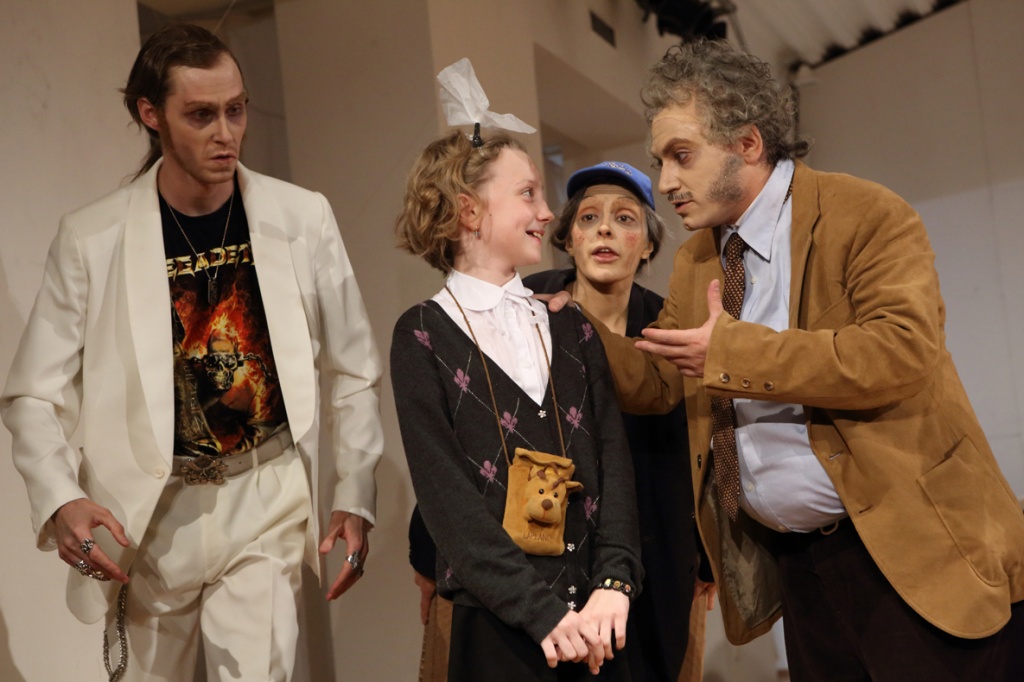
The characters of the performance (Maxim Maminov, Natalya Gorchakova and Sergey Melkonyan) distribute roles for the audience
The Pushkin text itself arises only in the final monologue of Tatyana: “Onegin, I am then younger, I seem to be better”, where actress Anna Sinyakina holds a brilliant transformation session - turning from a girl into an old woman before her eyes.
Author!
The poet’s thoughts about old age and youth, about death and death, about the past and present, on flowering and decay in school classes inspired incredible boredom, we were more interested in the plot of love, "And happiness was so close." Krymov restores the integrity of the perception of the novel and for the sake of this involves in “lyrical digressions” a whole factory for the production of meanings. The factory consists of the most difficult mechanisms-transporters on manual control: they float under the creak of a heavy wooden wheel along a long workbench, replacing each other, then snowdrifts from cotton wool and a tree with green leaves, then a doll with a head turned back, then a lechure in a cylinder, then a grave of Tatyana's parents, then a washed. Snow-wound wooden body of the deceased Lensky. "Or not rejoicing in the return of the sheets dead in the fall, we remember the bitter loss, listening to the new noise of the forests ..."
Onegin receives a love message already in a packed form - with glued brilliant hearts and buds. Butterflies fly out, golden pollen is spilled out, and in the finale of this almost circus reprise the letter is completely exploded
The children became quiet, look carefully how the trees and figures fall into a huge black plastic bag, the wheel creaks, new trees and new snowdrifts stand in the place of the disappeared ... "I will go ahead, I will go back?"
Between crazy, funny and tragic, doomed there is absolutely no gap. The performance is addressed to feeling, to the heart, it does not suppress the scale of the genius, but brings the genius closer to us: we already hear his laughter, his ease, his jealousy and annoyance. A wonderful epilogue unexpectedly leads us to the death of the poet himself: so he lies defeated with a bewildered smile and asks him to bring him cloudberries, and under his body the pink gurgling puddle creeps down the floor. The poet has a heap with “bears” sweets on his chest, he holds out to the audience leaving the hall. Children are afraid to approach: a puddle scares them away. The actress laughs: “Do not be afraid! This is a jelly! " Pushkin nods: "This is Kisel!" There is no death.
Photo: Natalia Cheban