
Translated material
Sing me, a jack
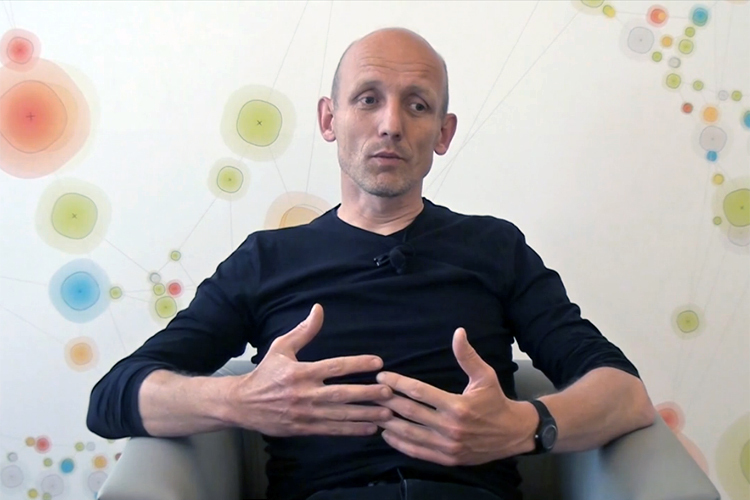
On June 15, in the Museum of the Pushkin Museum of Economics, namely in the estate of the Golitsyn princes, the Swiss duet Codact performed - media artists Andre and Michelles . They gave a lecture, showed the video performance “on the border of art and sound”, as well as their most famous work - the video installation “Pendulum Choir”, invented five years ago. In 2013, she became the owner of the main prize of the prestigious festival of interactive art of Prix Ars Electronica in the Austrian Lynze. On the screen there are 9 opera singers standing on inclined platforms, and 18 hydraulic jacks. Both people and cars together, as it were, perform a choral chant. Parties are superimposed on each other, lost in the general sound stream. In theory of decorators, the voices and bodies of singers, swaying like pendulums, confront gravity.
The performance of the Swiss in Moscow became part of the educational program for the exhibition “House of Impressions. Classics and modern media art. ” It takes place in the space of the museum town and is a collection of nineteen works of video and media artists of the XX-XXI centuries, from classics to representatives of young Russian art.
Andre and Michelle decorates create their sound installations and performances that study the interaction of movement and sounds, since 1999. Each work in one form or another transforms the physical movement into a sound phenomenon. Decorates show how the music in an encrypted form is stored inside the mechanical devices, whether it be a giant metal tripod or a pendulum of rotating pipes. Decorates call their objects an industrial universe.
One of the participants in the duet Michelle decorates told Colta.ru that the space ballet is and how the architecture of Konstantin Melnikov expands consciousness.
- Your cooperation with the glow to them. A.S. Pushkin does not end at the lecture and video presented by you as part of the exhibition "House of Impressions ..." as I understand it, another project is being prepared.
- Yes, we are preparing another media exhibition, which is supposedly opened in the museum next year. The exact date has not yet been defined. This will depend on the nature of our project, the choice of a place for its implementation, as well as on the reconstruction of the Museum of Museum of Museum of Sciences, on the territory of which the exhibition will be held. However, we will introduce our ideas to the museum’s leadership this year.
- And what will it be?
- Sound sculpture in the empty space of the museum town under construction. My brother has been engaged in music all my life, creates the sound support of our works, and I, by education, are an architect and sculptor - I create sculptures, robots or engineering structures with which we extract our music. We will try to combine it once again, but in a new context. I would like to do something that, on the one hand, will emphasize the classical architecture of the museum itself and its rich collection, and on the other, it will resonate with this background. What exactly we will come up with is still difficult to say.
“But you have already worked with museum spaces.” The glow is not the first and not the only one. Where else did you manage to show your sound installations?
-Still, the majority of our works we ourselves belong to the art of performance. And museums, as a rule, are less involved in this process than mediaart-festivals or galleries. But you are right, and we have experience in the Brussels Center for Fine Arts, the Tokyo National Center for Arts, the Museum of Contemporary Art in Montreal, the Korean Museum of Arts in Seoul and a number of other large museums, where we showed our installations.
- Which of them seem to you the most successful?
- One of the most important - “ Cyclo ï D - E ” , invented by us in 2009 and shown in many museums. It is a design made of horizontally installed metal pipes, which are equipped with sound sources and measuring instruments. They rotate against the direction of sound waves. As a result, a harmonic combination of movement and sound arises. The transformation of chaos into harmony. This refers us to the “space ballet”, which Johann Kepler wrote about in his work “Harmony of the World” in 1619. My brother and I have been studying the physical connection between the mechanical movement and the music itself from the age of 17. Not just the sounds that make cars, namely music, something that can be considered a work of art. Our sound and mechanical devices live an autonomous life, like living creatures; Just as living creatures, they produce certain sounds. It is important that we can never predict them to the end. This is always an experiment.
-And yet what is primary in your work-the sound component or the space that it fills?
- Music always determines the space: our instruments should fit into its context in both the technical and conceptual senses.
Our sound and mechanical devices live an autonomous life, like living creatures; Just as living creatures, they produce certain sounds.
- What other Russian museums would you like to work?
- Definitely with polytechnic. We managed to go there on the eve of the lecture - an impressive sight. It would be great to work with these funds, especially since the historical building of the museum on the New Square, which is interesting in itself, will open soon. But the main thing is that the exposition of the Polytechnic is very close to our artistic experiments, almost any exhibit there can easily become part of our sound installation or performance. In this sense, cooperation with the Polytechnic Museum does not seem to be something exceptional, unlike our performance in Pushkin's Pushkin MiMia.
Another interesting site for us is Laboratoria . We have already come up with one joint story and begin to work on it. This will be a project at the junction of science and art - in fact, what Laboratoria usually does. In addition, my brother and I were lucky to visit the Melnikov’s house, which recently became one of the units of the Shchusev Museum of Architecture. This is an absolutely incredible space that has not left us for several days. So far, I can’t imagine what exactly we could come up with a place for this, but it is very inspired and, in a sense, expands the boundaries of consciousness. Although, perhaps, the whole point is that I am an architect myself and with space I have a special relationship.