
Translated material
Under the Germans
In the first year of the Great Patriotic War, which began 75 years ago, a huge territory was captured, on which at least 70 million Soviet citizens lived. What was life for people in occupation - this issue for historians is still not closed

They did not ceremony with the local population. Announcement posted by the occupation forces, April 1942
It would be more correct to raise the question as follows: how they lived and survived in the occupied territories those who escaped death. Who did not die under the bombing at the Nazi offensive; Who was not put to the wall and did not hang, as “commissars”, Soviet chiefs, underground, partisans and their accomplices; Who was not buried in Babi Yar and did not send him to the concentration camp; who was not burned alive in Khatyn; Who was not stolen to Germany as slave power. In Soviet times, staying in the occupied territories was not equated with a captivity, for which after the war they paid the camps. Nevertheless, forty years after the victory, the fact of living relatives “under the German” was recorded: in July 1985, upon admission to the institute, the author personally answered such a question of a four -page questionnaire. Rich military literature was not too interested in how ordinary people lived for more than two years, who did not have time, and more often had the opportunity to evacuate. Where did they work, how did they get food? What was the notorious “German order”, who also replaced the not too affectionate Soviet power? Everything that was connected with this topic was not welcomed: it was not discussed, not investigated, silent.
Trudomes and loans
The main goal of the occupation regime was the maximum economic operation of the captured Soviet territories and their labor resources. Therefore, in addition to the confiscation of everything that was of interest to Germany (primarily food), the rear German authorities sought to establish at least a minimum producing economy. The famous Soviet aircraft designer Vasily Nebaba, who lived with his mother in the Zaporizhzhya region (at the beginning of the war he was 11 years old), recalled: “The Germans retained collective farms, it was easier to take everything out of them” * . Former Wehrmacht Officer Werner Haupt in his book “The battles of the Army Group North” writes that the collective farms were preserved in Estonia, and only after the Stalingrad defeat were partially disbanded, and large farms were preserved. In Belarus, and in the Smolensk and Bryansk regions - everywhere the German authorities prevented the collapse of collective farms created at one time by the Soviet government with similar purposes. Even the system of remuneration - workdays - in many of them have not undergone serious changes. In others, “loans” were practiced by the collective farmers: “In the spring there was no seed grain in the collective farm. It was proposed about leasing grain for sowing with the condition of returning fifty percent of the future crop. It was difficult to believe, but we gave one centner. Fourteen centner from hectare and our family brought seven centners of barley ”(V. Nebaba) were prayed.
Another source of livelihood was to work in the occupation administration and the institutions created by it, as well as the maintenance of the German military. Vera Pirozhkova, who lived in Pskov and worked as a translator, and then a journalist in the newspaper “For the Motherland” published by the Germans, wrote in his memoirs: “We lived all the years of occupation by the peasant market and products issued by the German army to those who worked for them ... The German military units gave work to many Russians: there were women who stolen and stroked laundry, tailors. And the tailors who have changed their forms, shoemakers and other workers. As a translator, I had to help in contacts with the peasants. ” **
Crafts and trade were allowed.
Many people who knew how to sew, repair equipment, photograph, jokes, engaged in minor entrepreneurship; All this resembled the mid-1920s, the heyday of the Soviet NEP.
The speculators revived that exchanged scarce goods from German intensity: kerosene, salt, matches, soap and realized all this on the widespread bazaars and pushing. The German police looked at it through her fingers.
However, in the cities there was a rather large layer of people who had no capabilities of earnings. Understanding that the mass hunger would not turn out to them in anything good, the Germans introduced food cards for the unemployed and dependents, but only for bread; They were cooked irregularly, and the issuance was meager. The townspeople changed their things for food. The Nebaba writes: “Winter and spring were hard. People went from Donetsk and other cities, changed their clothes and everything they had for bread (flour, potatoes, cereals) and other products. Our family had no extra food. Tobacco was very appreciated, but it was kept for men, if it is necessary to do something, for example, to fix the shoes, or treat a friend who already has “ears”, so I want to smoke ... ”
The Polyakova Olympiad, who lived in 1941-1943 in Pavlovsk near Leningrad, recalls: “We collect the acorns. But they must be able to handle them. I learned to bake beautiful gingerbread cookies from acorns with glycerin and cinnamon. The acorns must be cleaned and boiled, changing the water all the time, until the water becomes completely white and transparent. Thus, they are freed from Tanin ... The artist Clover, the son of the famous landscape painter Clever, ate poorly prepared porridge from acorns, was poisoned by Tanin, and his legs were taken away. Milk was needed. In the courtyard where they live, a woman with a cow lives. Clover’s sister begged her woman to sell her milk, but Baba refused, since the Germans could (in exchange for milk) get food, and she doesn’t need money ... ” * ** **
Count to five hundred
At first, most schools were closed, but in the second year of the war the occupation authorities began to implement the “historical instruction” of the SS Reichsführer Gimmler that the forced population is enough to be able to read and write: “There should be no higher schools for the Nenemian population of the eastern schools. It is enough for him to have a four -class people's school. The purpose of learning ... It should only be: a simple account, at most up to 500, the ability to sign, suggestion that the Divine Commandment is to obey the Germans. ” ** ** ** In 1942, under pain of punishment (fine and deprivation of bread cards), parents were obliged to give children who did not have primary education to four-year schools. Compared to the pre -war time, the number of schools decreased sharply: for example, in the Porkhovsky district of the Pskov region from 100 to 21, in Taganrog from 31 (of which 18 decades) to 12 (all - initial). In schools, bodily punishments were introduced, and since 1943, training fees.
However, schools did not exist everywhere. The People’s Teacher of Russia Yuri Velsky, who began his pedagogical activity in 1950 near Kharkov, said: “I started working in Ukraine in a rural school. Children studied there who, for four years of the war, did not go to school at all. ”
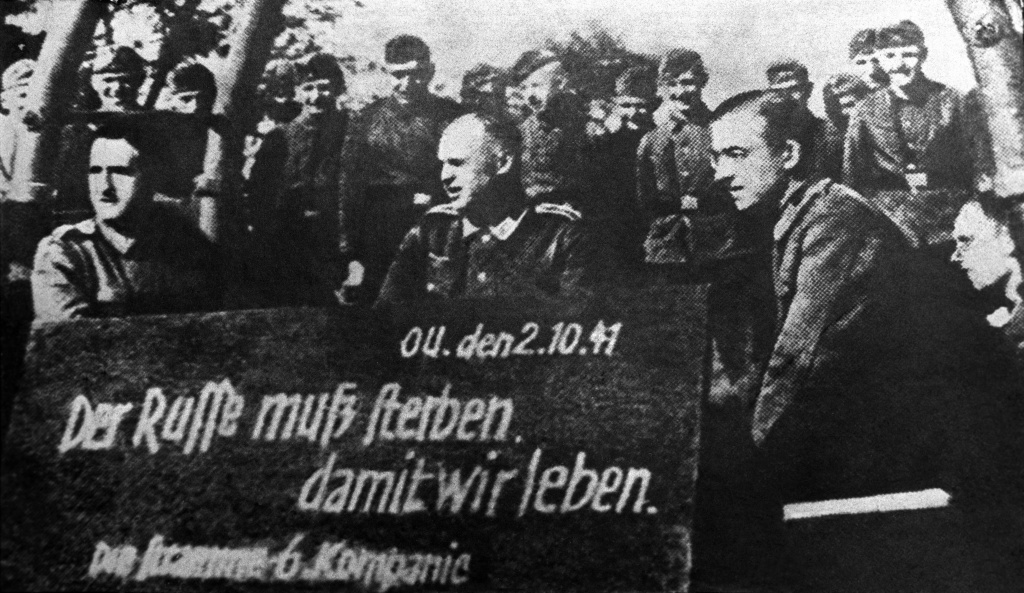
The Nazis hold the poster with the inscription: “The Russian must die so that we live”, Minsk, October 20, 1941
The German authorities understood the importance of propaganda perfectly, therefore, in addition to regularly issued orders, residents of the occupied territories read newspapers in the local language. The historian Igor Krasilnikov notes: “All occupation newspapers were compiled according to the same model. The front strips were devoted to official reports of the German authorities and position at the front. Further, as a rule, stories about the “new life” were held, articles and essays criticizing the Soviet system. The last pages were assigned to the placement of advertising, reports of cultural life. It can be noted that in various newspapers the same articles and messages were printed. The material for most newspapers supplied a special press bureae created in Berlin. ” *** ** **
The scale of this propaganda activity was quite impressive: according to the historian Alexander Korokov, some newspapers (and there are about 200 historians today), such as the Pskov “for the Motherland”, the Smolensk “Bell” and “New Way”, Kiev “Latest News”, separate numbers printed 100 thousand copies.
In turn, partisans and underground also published newspapers. The Minsk Zvyazda, the partisan newspaper for Leningrad, was relatively regularly published. The newspapers published “on the Great Land” penetrated the occupied territory, especially since 1943, when a relatively stable aviation connection with large partisan detachments was established.
Spectacles for local
As the organized resistance to the invaders unfolded, the German administration tried to diversify propaganda. If at the beginning of the occupation most cinemas worked only “for their own”, then in the second year of the war cinemas with German films for the local population appear, and the sessions began watching the German chronicle about the situation in Germany, on the Eastern Front and the Liberated Regions. Here is how the Smolensk newspaper “New Way” described the next “cultural event”: “Near the Avtovagon, which houses the mobile exhibition“ Help the revival of the homeland ”is noisily and fun. Despite its impressive size (22 meters in length), AvtoVagon cannot accommodate everyone at once to visit the exhibition. Near the front doors lined up. Plays radio.
Powerful Rupors spread the words of a new Russian song about the unlucky Soviet marshal of Budyonny:
Eh-ma, sat on a horse,
Come on God's legs!
Your poor people
Throwing the road!
At the box office, each visitor to the exhibition receives a fresh magazine, still smelling of a printing paint, or a brochure, telling a simple and clear language about the life of workers in Germany ... ” **** ** ** ** ** ** ** ** ** **
In August 1943, the same newspaper, a month before the liberation of Smolensk by the Red Army, reports: “The revival of the cultural life of the city, despite all the hardships of the war, proves: always a crowded folk theater, cinema, far from satisfying everyone who wants to get into it, as a result of which the discovery of the second cinema is supposed; Two orchestras, choir, music studio ... "
In the occupied territories there were two types of professional theatrical troupes - with German propaganda authorities and created by the Russian administration "Folkaters", as well as various amateur troupe. According to the memoirs of Vera Pirozhkova, concerts were arranged at the Pskov Theater or the performances “for all” were given, there were amateur evenings, the German Variet and the Russian Variet from Riga, and other gastrolers came. Her words are confirmed by the newspaper Speech on September 16, 1942: “The artist of the Mariinsky Opera House Nikolai Konstantinovich Pechkovsky recently gave three concerts in Pskov ... Pechkovsky did not want to follow with the Red Horde, whose leaders undoubtedly wanted to have such a major artist of art. “I am glad to serve my people and his liberators - German soldiers,” says Nikolai Konstantinovich.
According to legend, one Frenchman was asked: “What did you do while Robespierre chopped heads, Foucher arranged pogroms, and Mirabeau made speeches?” He allegedly answered: "And I lived."
So, people, for the most part, who found themselves in the occupied territory against their will - they lived. Although they lived hard, mostly hungry and scary, like their compatriots on the other side of the front line.
Today, around the war and the greatest victory, the efforts of state propagandists are again created by legends, and they are trying to turn popular tragedy into a means of dividing into “their own” and “strangers”. It is important not to succumb to propaganda and hear the voice of people who saw the war with their own eyes and survived it. Today we have such an opportunity, there would be a desire.
* Nebaba V.V. 45 years in the ANTK named after Antonova. Personal site: http://nebaba.yasinskiy.net/?cat=2.
* * Pirozhkova Vera. Lost generation: memories of childhood and youth. SPb, 1998.
* ** ** Lidia Osipova (Polyakova O.G.). The diary of the collaborators. M., 2002.
* ** ** * Cit. According to Krinko E.F. The Soviet school in the conditions of the Nazi occupation (1941–1944). "Domestic and foreign pedagogy", No. 2, 2015.
* ** * ** * Krasilnikov I.B. The state of educational and cultural and educational institutions of the Smolensk region during the period of German occupation. Izvestia of Smolensk State University, No. 1 (5), 2009.
* ** * ** * * Cit. According to Kovalev B.H. The daily life of the population of Russia during the Nazi occupation. M., 2011.
Photo: ITAR-TASS