
Translated material
Spies of the inner empire
The Ministry of Justice is now checking the Museum of Nikolai Roerich for the presence of extremism and financial fraud in his activities. Vice-President of the International Center of Roerichs Alexander Stetsenko says that this is just an attempt to take the Lopukhins estate from the museum. How can a harmless museum-archin-retrospective matter be related to extremism?
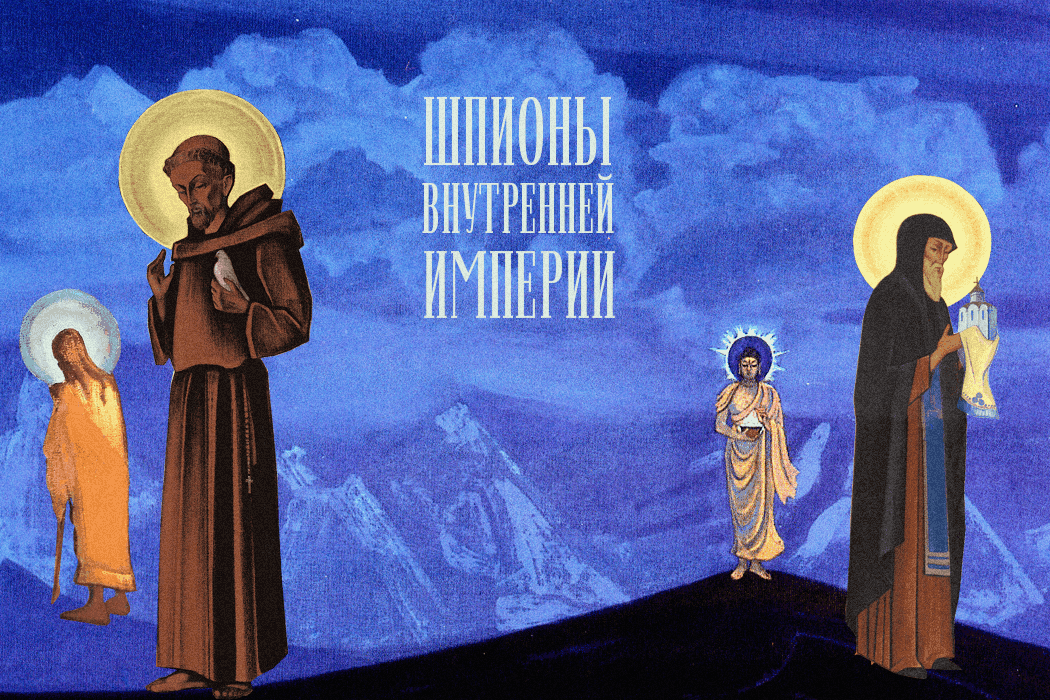
At the turn of the XIX - XX centuries, public consciousness began to excite the idea of the imminent onset of a new era, which will lead to the fact that a person will radically change the way of his existence, discover true knowledge about the nature of the world and reveal the purpose and meaning of human life. The movement in the new era of Aquarius as a whole was called New Age: the basis of the new Aeon, according to the followers of the movement, should be the spiritual development of man, the disclosure of his etheric essence, gaining higher knowledge and superpowers. This idea was promoted and promoted by many thinkers, including Elena Blavatsky and Alistair Crowley , which we have already written about. They proposed ways to improve a person on the basis of the synthesis of many esoteric (that is, relating not to the external, but the inner life of a person) knowledge. Nikolai and Elena Roerich were one of those who believed in the coming of a new era and wanted to take part in her implementation. Acquaintance in the 20s with the Theosophical teaching of Madame Blavatsky became the starting point not only for the development of the Roerikhovsky religious and philosophical course of Agni Yoga (or living ethics), but also largely determined the direction of the philosophy of Russian cosmism. Its representatives believed that the time is not far off when a person will change the way of existence and become closer to his true essence.
By the way, William Burrose also believed that the purpose of man is space, and the main problem in his development is not underdeveloped technologies, but the physical body itself. Roerichs wanted to help humanity overcome the physical barrier and, having cleansed their spirit, master cosmic infinities. In a sense, today a person begins to exist in a fundamentally new form thanks to the development of technology, including the Internet and virtual reality: our civilization slowly crawls from an analogue to a digital form of being. Perhaps these are the signs of the advance of a new era who dreamed of seeing both Vernadsky, who imagined a single incorporeal noosphere, and Nikolai Roerich, who was waiting for the arrival from the distant country of Shambhala of the Hindu Messiah named Kalka. Roerichs and similar thinkers of the twentieth century wanted to complement the rapid development of modern technologies by no less active development of spiritual technologies. And if in the technological sense humanity is now at its peak, then in the spiritual and psychological aspects we need to turn into the past, in which these areas have reached their peak: the cultures of the East - which, in fact, did the Lord Roerichs regularly and we were begun. It is significant that Nikolai Roerich, who never left our mother-land in the material shell, however, who owns ancient spiritual practices, painted his paintings and saw the earth as Yuri Gagarin described from space, using the most advanced technologies of that time. Gagarin wrote: “The rays shone through the earthly atmosphere, the horizon became bright orange, gradually turning into all colors of the rainbow: to blue, blue, purple, black. INSUCTIONAL FIGHTS! As on the canvases of the artist Nikolai Roerich. " In addition to self -improvement, a new era implied the creation of new states on fundamentally different grounds close to either utopian communism, then the Pythagorean idea of the rule of philosophers.
Some Russian sociologists call Roerichs with their living ethics on a par with the Church of Scientology, the Unification Church, “White Brotherhood”, transcendental meditation (beloved by David Lynch ) and the Satanic cult of “Black Brotherhood”, as well as the whole movement of New Age (to which Roerichs are also ranked), and destructive cults. Among the main signs of destructive cults are: “flushing of the brain”, sexual practices, drugs, group ecstatic prayers, deprivation of free time, restriction of external contacts and an apocalyptic attitude from the expectation of the end of the world and the Last Judgment. The main opponent of the Roerichs in Russia was, of course, the Russian Orthodox Church, which in our time threatens the anathema with all Agni Yoga fans. Is it possible to consider group meditations with “ecstatic prayers”, a secluded life in the mountains - imprisonment of free time and limiting external contacts, and hopes for a breakthrough in the spiritual evolution of a person - the expectation of the end of the world, a big question, but in Russia they are asked with impressive perseverance. Mr. Andrei Kuraev, who meticulously dismantled the teachings of Agni Yoga and denied all his main theses with the help of Orthodox theology, became the main persecutor and the exposer of the ROC-ROC.
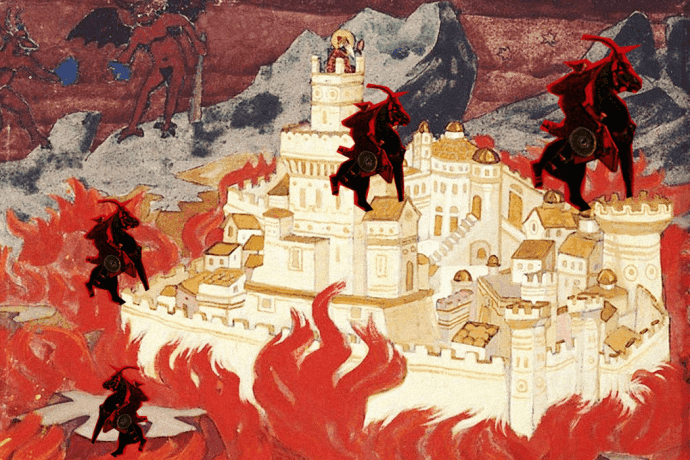
In 1917, Roerich went to Finland for treatment and after closing the borders in connection with the revolution in Russia turned out to be cut off from his homeland, after which he set off on traveling in near and distant countries. In the 20s in London, Roerichs established a connection with the Theosophical Society of Elena Petrovna Blavatsky. Acquaintance with Theosophical teaching had a huge impact on their lives, for some time they even conducted spiritual sessions, from which they subsequently rejected from unnecessary pampering. Then, in London, their acquaintance with the mysterious Mahatma Moriah, who helped to write books by Elena Petrovna Blavatsky, and later “dictated” Elena Ivanovna Roerich, who at the same time began to write the fundamental work of the Roerich Spiritual Heritage-“Agni Yogo”. England of the second half of the 19th and early 20th centuries gave the world not only honed scientific ideas like Darwin theories of evolution and natural selection, but also became a kind of esoteric center and in a powerful way contributed to the synthesis and spread of spiritual practices collected from all over the world. The Egyptian, Chinese, Indian and Jewish traditions brought from the British colonies became the property of advanced minds flowing into foggy albion from all over Europe. Russian emigrants like Blavatsky and Roerichs in a sense successfully picked up and spread this religious and philosophical synthesis around the world. The Masonic tradition, which in England, along with France, has also deserves special mention of the most strong roots and since the 17th century contributed to the collection, understanding and synthesis of scientific data with the most exalted and mystical concepts: the members of the Masonic societies were scientists, entrepreneurs, and philosophers, and poets.
You can trace a certain similarity between the theory of the evolution of Darwin and the spiritual hierarchy from the teachings of the Roerichs. Only Darwin developed a purely material plan on which a person due to evolution and thousands of years of gradual development becomes a higher link in an animal chain and theoretically capable of evolving even further. The Roerichs developed a purely spiritual theory, in which a person is a starting point, something like a Darwin monkey, and spiritual entities like Mahatm are the crown of human development, creatures that overcome the rude matter and existing in the thinnest areas.
One of Agni Yoga’s most important ideas is the belief that a person’s internal life affects not only himself, but also other, more subtle and less tangible energy worlds. It is on faith in the responsibility of the individual to the subtle matters participating in the formation of causality in the world, that the need for unceasing self -improvement is based. Conversely, the processes occurring in the thin "fiery" worlds directly affect the rough material world. Creatures who have reached such a level of development in order to move into subtle forms of being are trying to help people, sending them secret teachers, Mahatm. Mahatma ennoble physical reality and help humanity understand the ideas revolutionary for consciousness, causing fundamental changes in the course of history and a change of eras. People who are not growing over themselves, following their passions, vices, momentary desires and emotions, pollute the ether in which the highest creatures in relation to humanity live. In order to restore balance and contribute to the harmonization of the world, a person must take care of himself, listen to the instructions of Mahatm and not to consider his inner world (thoughts, emotions and motives) hermetically separated from the rest of the world, and to carry out responsibly and consciously to transform the world for the better. The figures of Mahatm (or great teachers), the inhabitants of the White Lodge, are present in all the branches of Theosophical teaching. It is funny that Mohandas Gandhi, who also joined the Theosophy in London, later wore the title of Mahatma.
For eighty years, disputes about who Elena and Nikolai Roerichs have not been fading away: charlatans or dedicated, dreamers or spies - and if spies, then whose (American, Soviet, British or Indian?). These contradictions deny one another: a simple charlatan will never be seriously connected with the special services, and the spiritual dedicated can be neither ordinary, albeit a prolific, artist, nor, moreover, dreamy simpletons. Nikolai Roerich drew seven thousand paintings-but in fact he was never an artist in the narrow sense of the word: the main components of his personality were philosophical and religious and social activity. In 1895, Nikolai entered the studio for the famous artist A. I. Kuindzhi, and two years later he graduated from the St. Petersburg Academy of Arts and with his diploma painting “Merchant” was among the advanced Russian artists. Lev Tolstoy praised him, everyone paid him a successful career, and he diligently wrote the canvas behind the canvas - however, he thought and saw wider the canvas. Very early, he understood what a powerful role the painting in his activities could play: the role of social glue and a reason for financial transactions, solemn discoveries, good gifts and strengthening international cooperation. In the youth, Roerich was interested in Russian culture, which he throughout his life tried to find and revive. The past is necessary in the present only for the future - approximately so Roerich treated the discovery and creation of Russian cultural heritage. He made numerous expeditions in Russia, led excavations, made sketches of architecture, patterns and murals, collected folklore material. From Russian culture, he subsequently moved to the research and discovery of the cultural heritage of other countries for the public and in the second half of his life he devoted many efforts to the awareness and protection of the cultural heritage of all mankind.
In the 1920s, impressed by the destruction of arts and culture monuments during the First World War and the Bolshevik Revolution, Roerich consistently addressed the figures of all countries with a call to the worldwide dialogue on the preservation and protection of the cultural heritage of mankind. The peak of such efforts was the creation of a Covenant Roerich in 1935, or otherwise an agreement on the protection of art and scientific institutions and historical monuments . The first International Culture Protection Treaty was also called the Washington Pact and was adopted with the direct participation of President Roosevelt, however, after a break between the relationship between the US government and the Roerichs, the Pact was recognized as non -viable and weak and continued its existence in the form of an idea rather than a legal document. From national art, Roerich moved to the international and ended with world art that does not know the time frame and political borders. The top or foundation of any culture can rightfully be considered religion - and from visual art, the interests of Roerich spread to the spiritual teachings of different countries and peoples. Who knows one religion and does not know the rest, in fact does not know a single religion, because the true religion is known through a comparison.
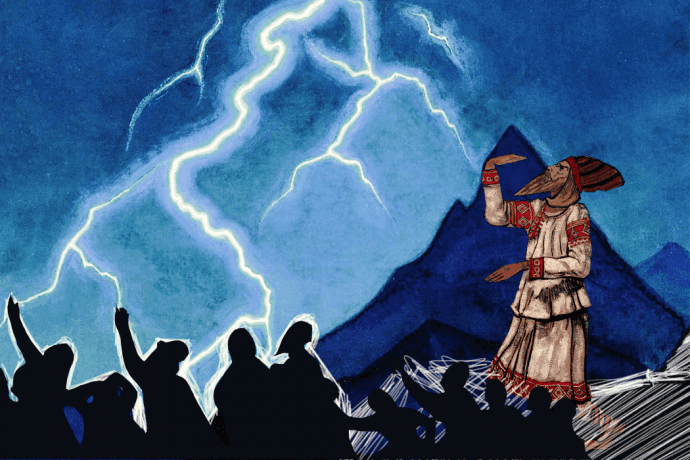
Cooperation with the American businessman Louis Horschet is extremely important for compiling the right portrait of Nikolai Roerich: it shows that this person was also a major businessman-countryman and co-owner of the corporation. But, unlike many colleagues, he applied his abilities not to gain the benefits and increase wealth, but to disseminate spiritual ideas on political and business channels. At first, Nikolai Roerich gave lectures in America, held numerous exhibitions and in 1921 in New York opened the “Master-Institute of the United Arts”, which put the convergence of the peoples of the world on the basis of culture and art. For the same purpose, Nikolai Konstantinovich founded the Alatas Publishing House (modified anagram of the word “Atlas”), and then a couple with his student and follower of Horsche - commercial enterprises “World Service. Pancosmos Corporation (the name emphasizes the scale) and “Beluha Corporation” (the name refers to the highest grief of the Altai mountains), and also built a master book (or the house of the teacher),-twenty-generated skyscrapers, on the first floors of which the Museum of Roerich was located. In the process of all this cultural and business activity, Elena and Nikolai Roerichs were acquired by followers and students from a variety of layers of society.
Spiritual mentoring and secular guardianship were the skate of Roerich from the very beginning of his social activity. In tsarist Russia, Roerich for many years in a row headed the imperial society for the promotion of arts and took an active and patronizing part in the cultural life of the country. When Russia was in the fire of the revolution, the Roerichs were horrified by the inhumanity of the Bolsheviks and supported the whites. In general, a rather typical reaction of noble people to similar historical events in which a cultural and spiritual heritage is often melted with kirs. Pretty soon, however, their views changed: the Roerichs saw a relationship between Buddhist and communist ideals, or simply decided not to swim against the current and tried to deal with what became a reality for Russia. At some stage, in their works, Lenin began to be called, like the highest beings, Mahatma, and they fell in love with the idea of uniting the Buddhist and communist worlds into a new state, in which people reject property and money-grubbing and work for the benefit of general karma. However, such love did not last long, and in the later editions of the Roerich Book “Community” Mahatma Lenin was no longer mentioned.
At the same time, Senator Henry Wallace, Minister of Agriculture of the United States, successor to Franklin Roosevelt and the successor of his “new course” fell under the charm of the Roerichs. Wallace himself had a tendency to study esoteric works and, at least, they like to tell Oliver Stone and a significant part of the democratic party, in general was a real altruist and the embodiment of enlightened democracy. Therefore, when in 1930 he met a spiritual mentor who had ideas about the realization of some spiritual truths in a particular state, became his student. It was with the money of the US Department of Agriculture, led by Wallace, Roerichs went to the Manchu expedition in 1934 (as they said, in order to collect useful seeds). While the scientific part of the expedition studied vegetation, Roerich himself actively engaged in public speeches and lectures in the Asian territories, advocating for the unification of Asia into a new single state, continuing the rhetoric that brought him closer to the Bolshevik faith in universal communism. At the same time, he contacted the emigrant Russian organizations like the Military Monarchical Union, tried to unite them and even acquired some publications as a Ruper. It seems that in fact the strategy of the couple of the Roerichs was not completely clear any interested special service. Patience eventually burst at once for everyone. The White Guard counterintelligence began to blacken the activity of the expedition in the press, Japanese newspapers - to blame the Roerichs of trying to unite the White Guard emigration, the Japanese removed their book from the printing house and set up the Bolsheviks against them. As a result, Roerich, whom American newspapers convicted of the preparation of a military uprising in Mongolia, also refused Wallace, and recognized the results of his expedition with no value.
However, before the Manchu expedition and quarrels with all the official authorities, the superpower of that time Nikolai Konstantinovich, having secured the financial support of American like-minded people, organized a Central Asian expedition, which passed through India, China, Siberia, Altai (Hello, Beluha), Mongolia and Tibet. This long -term scientific expedition attracted the attention of Soviet, English, German and who knows what other intelligence agencies (later many special services about the Roerich travels were declassified). Частью Центрально-Азиатской экспедиции стала мини-экспедиция в Тибет, носившая название Миссии Западных буддистов в Лхасу — во время экспедиции спутники и местные жители называли Николая Константиновича западным Далай-ламой . Экспедиция так и не попала в священный город Лхасу, так как под давлением английской разведки была задержана на одном из высокогорных перевалов, продолжительное время содержалась под стражей при минусовой температуре и в конце концов была развёрнута назад и отпущена без каких-либо сатисфакций или извинений. По некоторым данным, английскую разведку сильно смутило, что над Миссией Западных буддистов в Лхасу в определённый момент совершенно неожиданно воспрянул американский флаг. Тут ещё раз необходимо подчеркнуть, что относительно истинных политических мотивов Рерихов никогда и ничто не было известно наверняка — и истории про двойную, тройную и четырёхуровневую вербовку спецслужбами, хоть и не доказаны, берутся всё-таки не из воздуха. В целом Центрально-Азиатская экспедиция продлилась около пяти лет, и существует множество теорий о её истинных целях и основных задачах. Одна из самых романтических трактовок гласит, что Рерихи (в экспедиции участвовала чета Рерихов и один из их сыновей) искали мистическое царство Шамбалу.
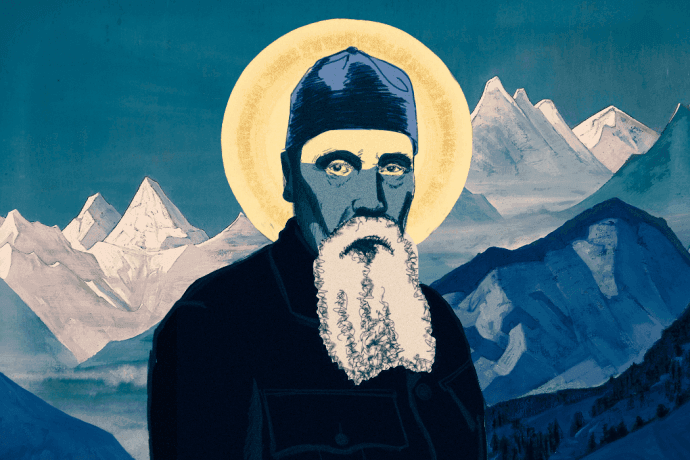
Главный герой культового сериала «Твин Пикс», агент ФБР Дейл Купер, прежде чем показать своим захолустным копам-протеже, как правильно вести расследование с помощью метания камней по пустым бутылкам, решает поделиться с ними сокровенным. Тогда он рассказывает им о далёкой горной стране Тибете, которая будоражит его во сне и наяву. Тот же чудаковатый линчевский агент медитирует, подвешивает себя за ноги к потолку, стоит на голове, общается с духами и собирает улики в своих снах. В конце сериала он попадает в таинственные Чёрную и Белую ложи, вход в которые открывается в определённое время просто посреди леса. Его простодушный помощник, местный шериф, тоже пытается войти в это странное место — но у него ничего не получается. Перед медитирующим агентом Купером в лесу появляется красный занавес и открывается вход в параллельную реальность, а для профана-полицейского в волшебном лесу есть только обычные деревья.
Всякий поклонник «Твин Пикса» на самом деле хорошо знаком с идеей поиска мистического мира Шамбалы — города мудрецов, способных управлять миром одной мыслью, сокрытого из физического измерения. По древней легенде, попасть в Шамбалу может только чистый сердцем стремящийся к знанию, и именно оттуда придёт Мессия, который именит мир. Поисками этого царства, хранящего ключи управления миром, занимались не только теософы и супруги Рерихи, но и жаждавшие мистической власти над миром нацистские спецслужбы. Кажется однако, что лучший способ найти Шамбалу — не путешествие, а самосовершенствование. Достигшему звенящей чистоты ученику Махатмы могут явиться сами — и даже надиктовать объёмный философский труд, как это произошло с мадам Блаватской и Еленой Рерих. По сей день никто не может сказать точно, существовали ли учителя на самом деле или были плодом фантазии склонных к мистификациям русских эмигрантов — но что если?..