
Translated material
Like a beast in a corral
The first premiere from the poetic cycle “Star” was released in the Gogol Center-the play “Pasternak. My sister is life ”in the production of Maxim Didenko
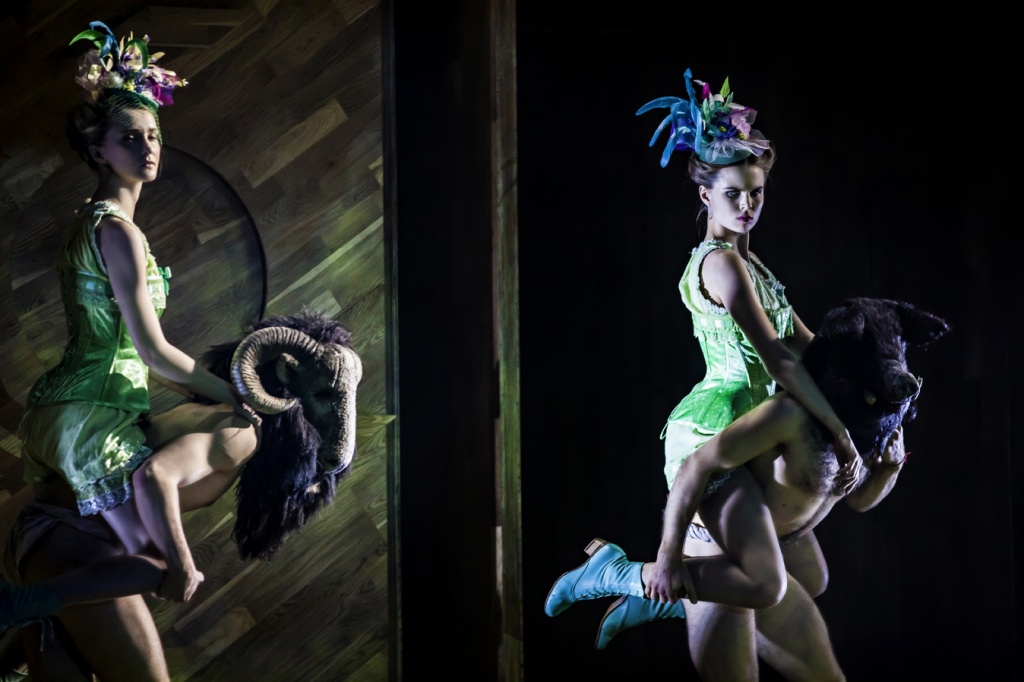
There are no heroes in the play - surreal images are born in the imagination of the poet
The dramatic Pentalogy “Zvezda” was conceived by Kirill Serebrennikov as an educational project: to introduce the audience (and in the “Gogol Center” these are the most part young people) with the poets of the Silver Age, with five of its brightest representatives. To feel the breath of the time in which Russian romantics-symbolists were born and spoke, to hear their mystical and terrible omens, to plunge into their tragic fates, from which there was only a dash between the dates of birth and death, to bring the bloody twentieth century closer to themselves.
"Parsnip. My sister is life ” - the first performance of the cycle. The Mandelstam will follow him. The century of the wolfhound ”in the production of Anton Adasinsky with Chulpan Khamatova in the title role,“ Akhmatova. A poem without a hero ”Serebrennikov himself with the participation of Alla Demidova,“ Mayakovsky. I love ”(again Serebrennikov) and“ Kuzmin. The trout breaks the ice ”in the production of Vladislav Menvashev.
The symbol of the cycle is a five -pointed star, the image of how heavenly and shining, so sinister when it is painted with a flickering bloody color and turns into a ruby dormitory eye of the Kremlin God.
The poet and the king
The artist and power are the main theme of the composition of Didenko. It seems that it will become through for all five performances. This is obvious by the convexity, graphics of the central plot, in which the fragile crystal world of the poet is opposed to the cunning and ruthless world of the courtiers.
The epigraph to the cycle “when it is walking around” (it is he who forms the poetic basis of the performance) Pasternak took from Proust: “The book is a large cemetery, where on many plates it is impossible to read the erased names.” Didenko mixes myths with reality, extracts out of non -existence the past tense and disappeared people, creates his “historical reconstruction” - live, pulsating, filled with surging memories and images that are piled around like outlandish fish in a huge aquarium of subconscious.
Director, artist (Galya Solodovnikova), composer (Ivan Kushnir) and the entire staged group virtuoso managed to translate the surrealist movement of a nightmarish nonsense into the stage language, in which reality and sleep are interrupted with each other and are tightened into a temporary loop. Didenko is one of the few Russian artists who, with the help of expressive means of the theater, are trying to comprehend, reflect Soviet history, free it from disgusting templates: this is read in Konarmia (Brusnikin's workshop) and Harms. Myr ”(“ Gogol Center ”), and in“ Earth ”(Alexandrinsky Theater).
Faces of fear
In Pasternak, as in the previous performances of the director, fear is one of the main subjects of creative research. Yes, fear with a capital letter is a separate hero, a separately acting face that does not appear on the stage, but the whole atmosphere, all the air of the performance, is saturated with its creature. Sticky fear, which is cold later on pale foreheads; panic fear, turning a person into a continuous screech; physical fear that drives you like a hare on a hunt; Closing fear of a closed space, against a brick wall under the muzzle of a revolver; Finally, the horror on the edge of the black abyss, after which there will be nothing but deafening silence and impenetrable endless darkness.
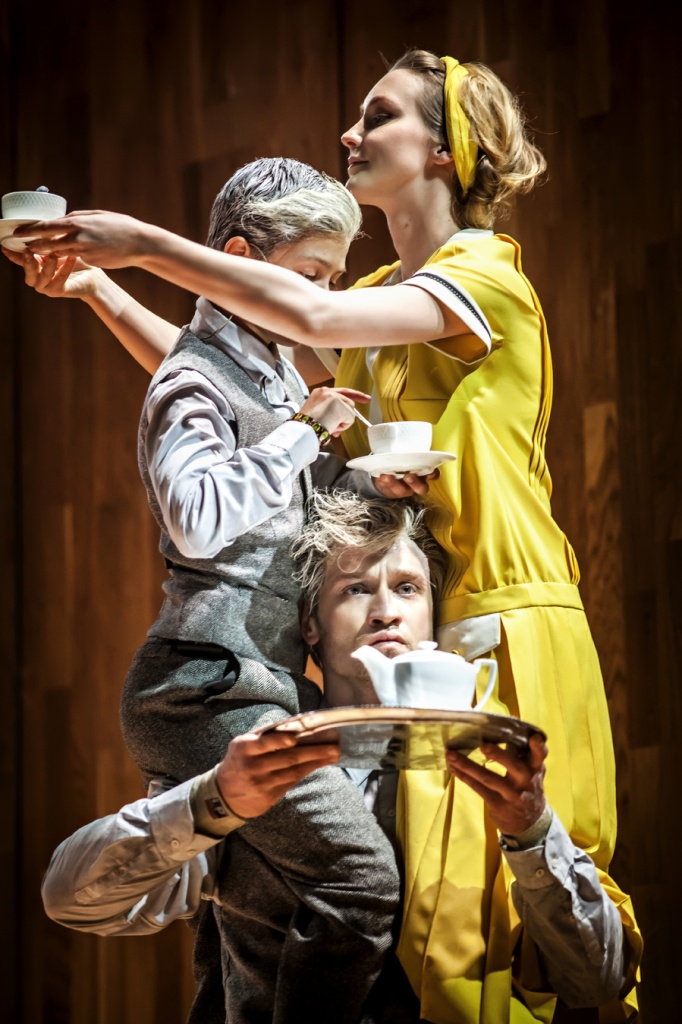
The poet's family is his cross, his death and his salvation (Mikhail Troika, Nikita Shchetinin, Maria Selezneva)
This genetic fear is transmitted from generation to generation, as an incurable disease, sits in us from birth-and Pasternak-boy was born with gray hair. Yes, three age of the poets - a child (Nikita Shchetinin), a man (Mikhail Troika) and an old man (Vyacheslav Gilinov and Benjamin Smekhov) - are united by verses, women, appearance and gray hair. Next to the boy, the mother (Svetlana Bragarnik), who reads him “do not cry, do not face the swollen lips,” and in her intonations the love lyrics sounds like a cradle song to the baby, like a talisman from the future blows of fate. Next to the man is a woman (Alexandra Revenko), who keeps him on the very edge of the abyss and falls into her, carrying him behind him all the poet loved and will love. Next to the old man is a voice from the reproduct, the voice of the poet himself, thinking about what a word is, freely tearing from the heart.
Shepherd and shepherds
If Mandelstam “power is disgusting like the hands of a branded”, then the power represented in Pasternak is a continuous charm of evil, a continuous complacency. In a snow -white tunic and white pants, a flexible athlete with an unchanged pipe in his hand and an innocent red squirrel on his shoulder (Nikita Kukushkin and Rinal Muhametov), he reads lines from Shakespeare and from Hamlet Zhivago, kisses Pasternak’s boy, collects mushrooms in a basket, cadches around. A metal pole with a ruby star at the top and smiles slyly in a lush mustache. He is not called Stalin, but a characteristic Caucasian accent, with whom he pronounces “the rumble, I dragged on the backdrop”, leaves no doubt. He is omnipotent and inspired, he does not get old, does not decrepit, he is always young, flexible and beautiful, like an elf, like a forest king - surrounded by satires and nymphs, bringing him sacrificial animals, cups of wine and heads of enemies.
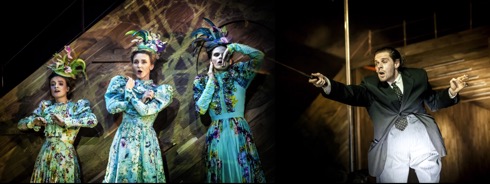
Fars and the tragedy of the Soviet intelligentsia are displayed in the image of the chairman (Philip Avdeev)
In his retinue there is a sophisticated thick -capacity hunchback in a costume of the Soviet employee (chairman - Philip Avdeev, the best role of the performance), who does not release papyros from the crooked mouth - in the permanent clubs of smelly smoke, he will circle around the host until he is bored. The collective image of the Kholuyan Soviet intelligentsia, in which, from the effort to please the smoke from the ass, the unrecognizable Avdeev creates very accurately - a sense of disgust in relation to this character does not leave even in the tragic scene of suicide, committed by him from cowardice and fear. Fadeev? Maybe he, who was leaning from drunkenness and insomnia, sedimented with fear and shame ... “It is difficult to live with bloodied hands,” he admitted shortly before his death.
Pasternak did not shoot himself like Fadeev. He was not arrested and not tortured, they did not put a black bag on his head, they did not beat with whips and iron rods, and did not pull him onto the detective. Two Encavedeshnik trainers in leather Galife with shouts “Hop-hop” drove the poet under the very dome of their bloody circus only in nightmares, from which he woke up in cold sweat.

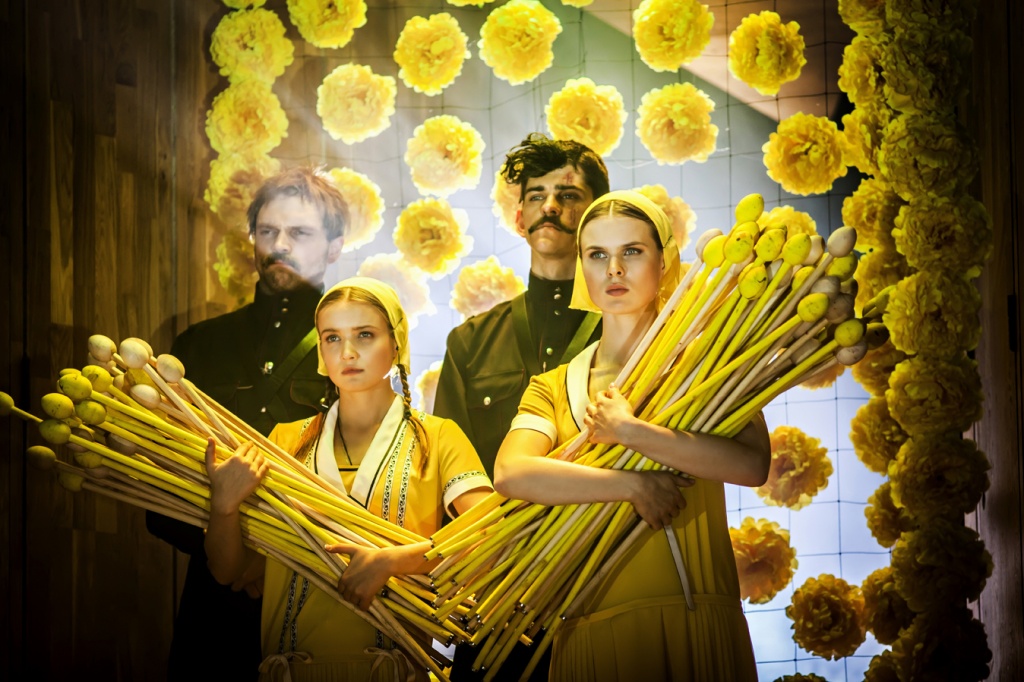
But still driven-into the corner where they allowed them to live. Here it is, the space of life: corner, mowed floor, walls and ceiling, compressing from all sides. There are behind the walls - paradise, beautiful women, juicy fruits, chirping of birds and the murmur of streams, there is a yellow rye, the blue sky rings with purity and beautiful shepherds take out with crystal voices “and the bird believes, as in its rudder and does not let anyone out by the threshold”. And here in this cramped pencil case everything turns into a decay, into a dust - and you, and your lines, and your manuscripts, and your love, and your purpose. “What did I do for the dirty trick, am I a killer and a villain? I made the whole world cry over the beauty of my land. ”
The performance does not pass the sentence to anyone, does not blame, does not judge, does not call to judge. He only offers options for fate, revealing a fork in front of a person, for which there is always the opportunity to choose, reminding him of responsibility. In front of you, in front of your gift, in front of the children, before what will happen after you. After all, “to die in your bed” - this does not mean not to be killed long before.
Photo: Ira Polar