
Translated material
Why people fly
Six days have passed after the premiere shows of the completely radical “thunderstorm” by Andrei Mogeliy, but criticism does not swear! What is this - temporary summer remission in the struggle for traditional values or an important event - a type of living vegetation that activists will not climb?
I will express a hypothesis. The interpretation of Ostrovsky’s play is absolutely innovative, it has nothing to do with a banal expectation of philosophy and forms, the theatrical language is complex, even very complex, but artistic fabric is so cool, thought out, spelled out, fulfilled, which has the power of influence - even contrary to the logical beliefs of the conservatives. An ideological rational assessment is defeated by the theatrical sensual beginning.
The “thunderstorm” in the BDT is a miracles-performance, a metaphysical work. “Thunderstorm” is the phenomenon of the mythology of Russian consciousness both in the religious-mystical and in the comic genre. The fabric of the play of Ostrovsky is freed from the realities of a particular life and put on avant -garde music. The play became in sound, by subject, rhythm, imagery, by visual embodiment of sound - a musical form, oratorio. Micst of the Middle Ages and postmodern. The sound that forgot everything that was between the XVI and XXI centuries.
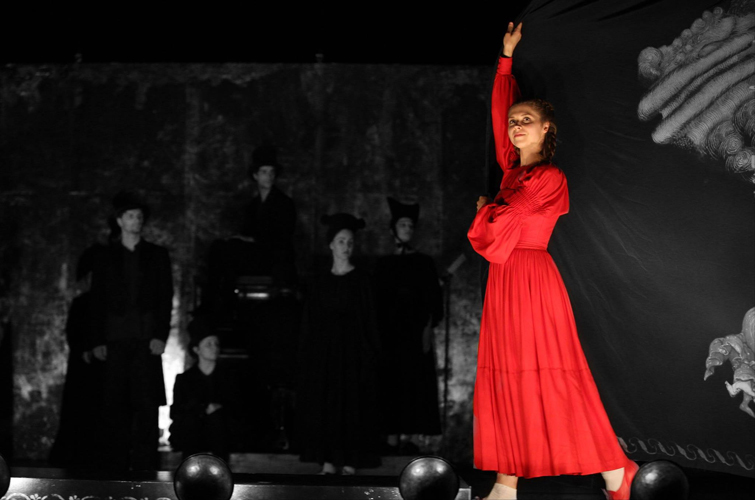
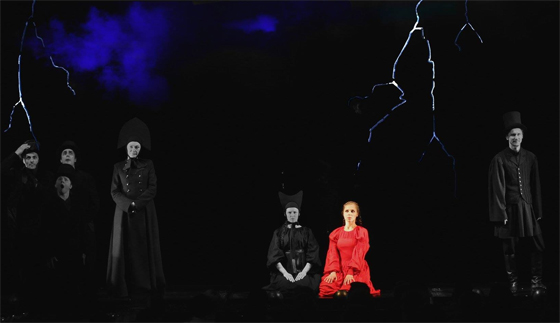
Special simplicity. Monochrome. Flatness. Frontality. Badness. Mystical. The characters leave, like wooden motionless figures, from the darkness, after a tangible pause, they begin to act terribly and funny, then they freeze in static poses and float deep into mythical emptiness, in the Yungg underground of archetypes-along direct trajectories, back and forth. The sites on which they exist are controlled by the same servants of the scenes as in the old Japanese theater but invisible in black costumes on a black background. Curtains in the style of the Palekh miniature are replaced: festive-loving, the other with a fantastic city, then an ominous, with monsters hanging upside down by beasts and red clouds, at the end-plain-black. In the dreams of Boris Katerina, it is illuminated under a red cloud in a medieval cloud.
The image of the director of the mighty who is rooted in the minds of critics, an avant -garde playing with abstract forms, is completely false.
Speech is transformed from prose to rap, into a rhythmized recitative, into half -sailing and singing. As in the Eastern Theater: the more dramatic the action, the more musical in the melodic and rhythmic organization of speech. A huge drum emphasizes the peaks of drama. The first note of the song “Kalinka” begins to sound several times and does not continue, the accumulated voltage is not allowed.
... The description of the design can create the impression of a boring and rationalistically made concept. One who should avert everyone except concept lovers. But not avert! Firstly, the performance is unusually beautiful and lives in non-banal beauty dynamically. All action - metamorphoses of Palekh painting: black, red, fantastic, executed with exquisite graphics; This is in the curtains, and in the mise -en -scenes, and in how the characters look and move. Secondly, the wonderful music of Alexander Manotskov, spoke and blessed by the voices of the artists, overcomes schematic, it is sensual and creates a choir of sincere human voices. And most importantly, the acting game fills the form of a lively, passionate, diverse life. This clearly began in the “drunk”: the BDT artists dived into a non-life-like philosophical text, clashed in a performive space and suddenly healed in this anti-realest fiction, heart-thoroughly, sketchy-symptom.
In fact, even earlier in the most intricate productions of the mighty (“between the dog and the wolf”, “Petersburg”, “Ivanes”, “ Pro Turandot”), artists triumphed, taught to be alive at all costs. And they were alive. So here. Outwardly, flat (medieval, in the drawing of a casket primitive) fictional figures, remaining fantastic, bright theater, are filled with a vasomeline human passion, and all different. For example, Wild Dmitry Vorobyov-some Old Testament mythological old man from painting on biblical topics, with lively rage. The Feklusha Maria Lavrova is a womb, who is convulsed in a trance, which exists, as it were, in addition to her will, by the will of the demon, with a tough cunning-plain look. Kuligin Anatoly Petrova - science fiction, romantic, liberal, non -conformist, Protestant. Dowager Queen, Iron Lady - Kabanova Marina Ignatova.
They are all in black. Black people. Characters of medieval myth. Only Boris is from another opera, precisely from the opera, another myth of Russian culture: a baritone lover in a gold cylinder from Pushkin’s plots. And, in contrast in Krasnoye, Katerina, also a different, image, popular in appearance and speech, ends the role with a long folk joyful cry, the transition to the bright world. All are brought to some mythological integrity, the world is divided into very evil and very kind. Everyone has an inner life, although not in the forms of realistic characters.
 © BDT named after G. Tovstonogov
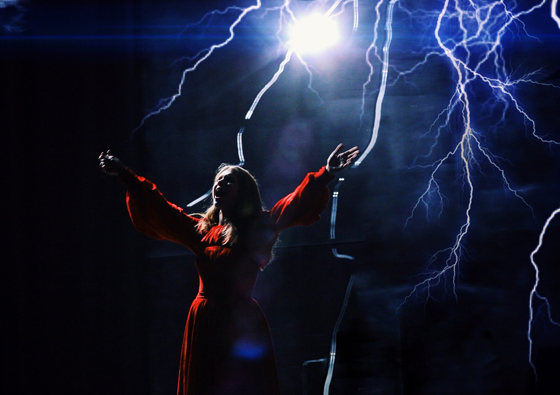
Understanding the “thunderstorms” as a miracle is laid in the play. Religiosity passes through the entire text of Ostrovsky and defines the compositional foundations: Boris saw and fell in love with Katerina praying in the church, she talks about the former benevolent life, the catastrophe occurs against the background of the destroyed church with the frescoes of the Last Judgment, she refuses life with sin, the dead heroine appears before the “judge” who lives more than the contradictions of the drama is much higher than life relations much higher than life relations. And habits. The question that Katerina is tormented (in the performance of the BDT then he repeats Kabanova), “Why do people do not fly?”, The question of Kuligin and the wild “What is a thunderstorm?” They have a much more direct meaning than it seems with a realistic reading of the play. Questions - about the essence of man. The answer is about his unearthly essence.
The wonderful dialect of the characters, their extremely naive reactions are strong means to bring down pathos, academic correctness from the text. By the way, Ostrovsky’s text lies well with music - not without reason the theatricality of speech in his plays Meyerhold compared with Spanish classics. Three artists whose palms tremble like wings, and their heads tremble and turn like birds, with jerks intersect the scene, anxiously monitor the events, the curtains are rapidly separating the episodes and create a tense game atmosphere of the play. Clown agents create a nervous, sad stress. The background to the recitative of characters is almost constantly going on a musical background, the farther, the more alarming and desperate.
An artificial issue of interpretation of the classical text could not be raised. Any performance of rights with your own reality, which comes from different sources. But in this case, we can just talk about direct relations of directing and drama. The mighty acts as a traditionalist. He is worried about the philosophical volume laid down by Ostrovsky. Directory opens in the depths of the play a mythological idea of the world, later the Middle Ages, the world of Bosch, a terrible bast. That “terrible”, which was then the main thing for romanticism, “secret mysticism”, which Apollo Grigoriev saw in this play. The style of the performance does not repeat nothing specific, consists of heterogeneous components: myth, lubok, miracles, buzzing fairy tale, life, representation of the eastern theater. The performance begins with the words of Kuligin, gathered in a monologue, about a good-beautiful, ideal world: “What beauty is spilled in nature ...” In this world-happy, intangible-Katerina will go away at the end, rejoicing, swinging, dancing (under the Russian tuning, movements of Russian dance, although Krishnaites are also happy). The director frees the text from the household surface and sees in it the dramatic motives for Ostrovsky: national myth, love, violence, sin, fear, weakness, sense of will. All these stages, as in the brands of life icons, passes the heroine. The Russian drama is interpreted as an archaic-a-a-a-a-aid-term.
 © BDT named after G. Tovstonogov
The execution of this archaic theater is today's, complex in musical texture, in mixed style of speech and a popular-psychological method of acting. The genre is especially complicated. Starting with a buffoon, without losing the stunt details, with access to suffering and redeeming, the action acquires the most complicated intonation of the funny tragic (namely without dividing signs, without a connecting union “and”): a funny state is terrible and tragic. As a monster of Feklush, like the personified dead tradition of Kabanov, as unusual in the evil screams of wild. This is characteristic of myth and folk culture, a platform game, the mask theater. The love of the opera Boris and the popular Katerina with his roulads and her dialect, the Masichnaya Tikhon (comic simpleton), the naive Kuligin is also ridiculous and dying. "All this is ours - Russian, dear!" - Boris sings pathetically.
Andrei Mighty is not the first to use the mythological language. So it was in the play “Between the Dog and the Wolf” according to the novel by Sasha Sokolov, where there were myths of Soviet reality, and Duel Pushkin, and in the second version of “Petersburg” by Andrei Bely (in the courtyard of the Mikhailovsky castle, with the repeated return of the topic of political murder), and in the play “School for Fools”, also according to Sokolov, where history seemed to be seen with a large distance and seemed to be seen with a large distance and As if preserved in memory or created memory. And even earlier there was the epic "Orlando Furiozo" according to Ludovico Ariosto; Hamlet Machine and Non-Gamlet on Hainer Müller and Vladimir Sorokin were also beaten by Shakespearean cultural emblems. The performance “Play of Konstantin Treplev“ People, Lions, Eagles and partridges ”” was built on recognizable “integrated” Chekhov motives from all his big plays at once ...
The image of the director of the mighty who is rooted in the minds of critics, an avant -garde playing with abstract forms, is completely false. Almost all of his performances are staged in classical literature. In addition to the listed authors, he put Gogol, Hoffmann, Gozzi, Cervantes, Turgenev, Meterlink, Kafka, Carroll, Ionesko. Modern texts are also included in real literature: Ivan Vyrypaev, Mikhail Durnenkov, Alexey Shipenko. Directory, which breaks the literary structure and replaces it theatrical, using the original created texture of action, radically updates the artistic language in every new performance, is more needed more than “sensitive to classics” of an illustrative theater, which has ready -made artistic models, filled with plots and characters. Experience with Ostrovsky shows that the mighty is ready to talk about the meaning of the interpretation of the classics is much more than authorized institutions of cultural heritage.