Date
Author
Записала Анастасия Палихова; Фото Глеба Пайкачёва

Preserved copy
Translated material
Why do not be afraid of artificial intelligence. Lecture of the lecture of the expert Sergei Markov at the Festival "City of Rights"
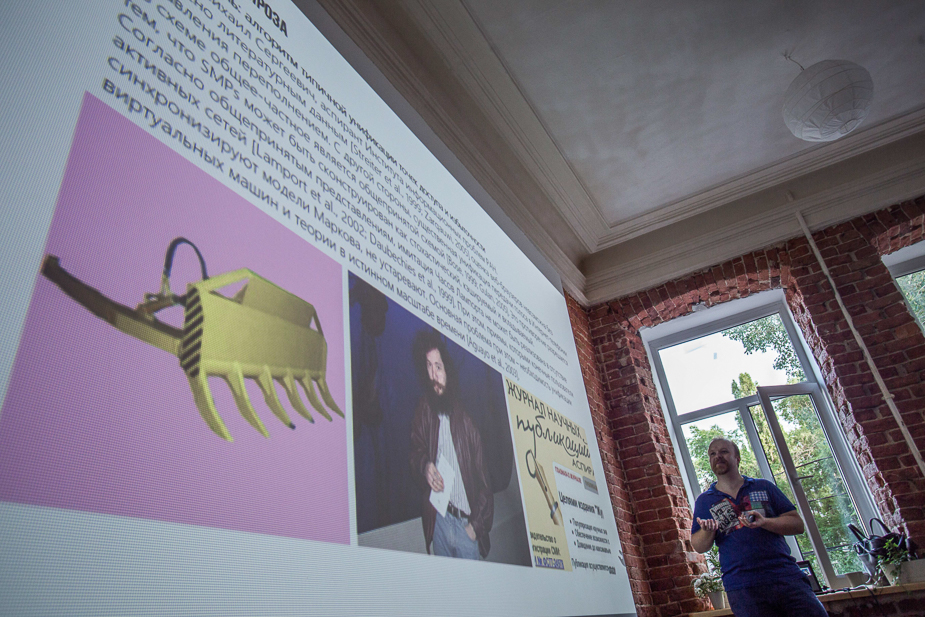
Sergey Markov is the author of one of the strongest chess programs in Russia Smarthink, a specialist in machine learning methods - at the Voronezh festival “City of Right” talked about what successes in the field of artificial intelligence we have already achieved and what to expect from modern technologies in the future. “ 7x7 ” publishes a scope of popular science lecture.
What is artificial intelligence
With the concept of artificial intelligence, as well as with many concepts that initially appeared in the scientific environment, peculiar transformations occurred when this topic was on the media environment. And if today you ask a person on the street about what AI is [artificial intelligence], then about how many people you will see - you will hear so many versions. And the versions will depend on what last film a person watched on this topic, which was the last time he was scared ... before talking about AI, we will determine what it is.
If you take this term most widely, then it is determined as follows. There is some kind of intellectual task. If we automate the solution of this problem, then we thus create artificial intelligence. But this is "weak", applied intelligence. Its goal is to solve any one problem, and a wide set of algorithms is suitable for this definition.
And there is such a thing as Agi (Artificial General Intelligence), or “strong” AI. This is a universal intelligence designed to solve a very wide range of intellectual problems. The evil irony lies in the fact that the real types of systems in this area are, of course, applied intelligence, and we are only conducting certain work over universal AI.
How to determine if we created a system that actually has universal AI? This question was asked by people from computer sciences, in particular, Alan Turing, and people from a philosophical camp, for example, Alfred Ayer.
The procedure, which was invented in 1950, was called the Turing test. The fact is that Turing was a rather cheerful man, loved good companies, loved intellectual pastime, and in his years there was such a game at the parties, which was called the “Playing INMICATION”. What were her rules? There were two rooms, they locked themselves with a key. A girl was planted in one room, a guy, and participants in this game could stick notes under the door with any questions and notes, and the person who was sitting in this room had the opportunity to write answers. The task of this game was to guess where the girl is and where the guy is. Thuring took as a basis this protocol and developed the so -called Turing test.
A girl was planted in one room, a guy, and participants in this game could stick notes under the door with any questions and notes, and the person who was sitting in this room had the opportunity to write answers. The task of this game was to guess where the girl is and where is the guy
Test Test
We have an expert person who, with the help of a certain note of the same note, a computer terminal, for example, communicates with the machine. The purpose of the machine is to pretend to be a person and ensure that in this experiment the expert could not distinguish artificial intelligence from the intelligence of the natural. The basis of this approach is what Ayer said previously: if something looks like a sheep, shines like a sheep, jumps like a sheep, and looks like a sheep, then, probably, before us is a sheep. That is, if something in any experiment is manifested as intelligence, then, probably, this is intelligence.
The first experiments, primitive systems for “playing imitation” appeared very early. In particular, in 1966, the Eliza program appeared. According to modern concepts, it was a chat boot, that is, a system with which you could correspond. The creators decided to joke a little: it seemed to them that it would be easier to portray a psychotherapist than an ordinary person, because the therapist asks about the same thing for people, reacts in a similar way to what they say, so Eliza played just such a role in this experiment.
It is clear that the system worked very simple: it was a large-large set of rules compiled by people. She could find some keywords in the text that a person wrote, and on their basis could choose a rule and transform the input data into a certain answer. I must say, this program in some situations could already emergency people. Of course, it was impossible to believe that it was already a full -fledged Turing test, but nevertheless, some private successes were achieved.
Well, for example, the 1972 Parry program. This is a more complicated system, it played, on the contrary, the patient. “Parry” - from the word “paranoid”. Parry played a patient with a paranoid syndrome, and he was pretty good for psychiatrists. In 48% of cases, psychiatrists could not guess that they were dealing with the machine. But this is also a special case, because the nonsense of paranoid can resemble some kind of mechanical behavior, so we also cannot take the successes of this experiment seriously.
Shrdlu
The program was written in 1970, it produced a certain splash in the field of AI. Its author is Terry Grapes - one of the classics of the so -called School "Gryaznul". He was quite dismissive to this experiment ...
This program has a small world in which there is a small set of objects: a box, several pyramids, several parallelepipeds, and, most interestingly, the program could communicate with a person in a natural language. You could write some judgments to the program, give it some teams, and a rather natural dialogue took place about what was happening inside this small world. What exists outside this environment, the system did not know.
If you look at the source of this program, you can see that there are a lot of rules. That is, Terry Grapes actually experimented with different people for several years, watched what things they can say, and for every option he wrote a whole set of rules.
What is the secret? Why does Shrdlu make an impression on us, despite the fact that this was done more than forty years ago? Because the world there is very simple. 50 adjectives, nouns and verbs - this is all that will be required to describe what is happening in this world. Under such conditions, the machine could remember a sufficient number of rules in order to impress intellectual behavior.
Turing expectations
Turing said: “I think that in 2000, machines with a memory of 109 bits (about 125 MB) will be able to deceive a person in Turing's test in 30% of cases.”
There was such an Eugene Goostman program, she portrayed a boy from Odessa. The University of Reading conducted tests for two years in a row. In 2014, the program was able to deceive judges in 33% of cases.
But not all AI experts agree with the Turing procedure. In particular, John Surl, objecting, proposed an experiment that he called the Chinese room.
Chinese room
Imagine that there is a room that is connected as a terminal, to the outside world, has a “entrance” and “output”. And inside a person who does not know the Chinese language, and he has a thick set of rules in the book. What if such hieroglyphs have come to him, then in response you need to send these, and so on. An external observer may give the impression that the person who sits in the room says in Chinese. But, says Surn, in fact, a person does not understand the Chinese language by definition.
The main objections that other experts present are such: yes, a person sitting in the room does not understand Chinese, but if you take the whole system as a whole, then a person equipped with such a cunning and large set of rules has an understanding of the Chinese language.
And then the question arises. Very often, when the capabilities of the machine and people are compared, they consider how cars beat a person in chess, in the th, the main judgment that you hear from a person who does not deal with AI questions: the car is simply very fast, it has a lot of memory, and it presses a person with rough power. It will be interesting to compare these two computing devices: the human brain and the most powerful processor that we have at the beginning of 2016.
Very often, when they compare the capabilities of the machine and people, consider how cars beat a person in chess, in the th, the main judgment that you hear from a person who does not deal with AI questions: the car is simply very fast, it has a lot of memory, and it crushes a person with rough force
Brute Force
We know that the nerve tissue consists of nerve cells (neurons), and in nerve cells there are processes. Incoming processes are dendrites, and outgoing - axons. And then the location of the axon of one cell with the dendritus of the next is called the synapse.
In the middle brain, 86 billion neurons and 150 trillion synapses - connections and contacts between neurons. Each synapse has 1,000 molecular triggers. Neural networks are built on a simple formalism.
Thus, the rough equivalent of the brain in transistors is 150 KVDRLN. And the most powerful processor-SPARC-M7-has 10 billion transistors. The largest user programmable, the valve matrix has 20 billion transistors.
The difference is very large. In addition, each neuron in the brain is a separate computing device, a “core”. The electronic machine has a lot of memory, but even the most powerful computers have about 50 thousand cores.
School "Gryazval" and the school "Clean"
I mentioned a little earlier that Terry Vinograms wrote by Shrdlu was a representative of the Gryazval school. When the science of artificial intelligence was only born, there were two fundamental approaches.
"Cleaning" used, so to speak, a mathematical approach. This school was formed mainly at the Stanford, Edinburgh University and at the University of Carnegie - Mellon. They focused on an analytical, logically reasonable solution to problems. Before creating the AI system, you need to conduct a lot of mathematical research, then create a scheme close to optimal, and implement it.
And “dirty” used any method that solves the problem. And it doesn’t matter that it is not formally justified. They used a term such as Hacking, that is, they “broke” the task. Despite the fact that AI “Gryaznul” had much less technical capabilities than the real human brain, they achieved an effective solution to the problem with these limited means.
Modern AI systems are, of course, the synthesis of these two approaches. If we take chess programs, then in many ways they began, like ordinary “Gryazval” systems: they came up with some kind of cunning algorithm, and it seems to work. They made some change to the program, and it began to work better, but why-we do not know. Then gradually, many methods that the impatient “dirty” came up with, were already studied by “cleanlies”, and more strictly reasonable methods came to replace the approximate tricks, which, of course, were more effective.
Machine translation
One of the first tasks of processing a natural language by artificial intelligence was the task of machine translation. I must say that the first electromechanical systems for an automated translation appeared in the late 20s. When computer equipment began to develop, more serious programs appeared. In the 60s, large military American projects appeared. They were dedicated to automated translation from Russian into English. These were Mark, Gat and Systran Alpac Report. In the 70s, such work began in the Soviet Union. Raimund Piotrovsky led the Group "Statistics of Speech", and these Soviet achievements are the basis of the Promt program.
In the 90s, a new direction in a machine translation was born. The Internet appears, and with it huge cases of texts written in different languages. Previously, I had to work with scanned books, and the Internet immediately increased the volume of the buildings by several orders of magnitude and created the hope that you can build a translation, without delving into a particularly natural language. An example of this approach is Google Translate. In this program, there are very few programmed intelligence, it is built on the basis of corps analysis. However, so far the quality of the Google Translate translation is inferior to the previous generation of programs.
A classic example: “Sosysk in the test” was translated as Sausage in Father-In-Law. That is, the translation does not mean “dough”, but “father -in -law”. This funny mistake helps us to understand how deep the problem is. To translate the text well, you need to understand it. And in order to understand the text, you need to understand the features of human culture. And to know that, most likely, the practice of wrapping sausages in the dough is more common than the practice of placing sausages in the father -in -law. This does not mean that the second practice does not exist, but the car needs to know a lot about human culture in order to prevent mistakes.
To translate the text well, you need to understand it. And in order to understand the text, you need to understand the features of human culture. And to know that, most likely, the practice of wrapping sausages in the dough is more common than the practice of placing sausages in the father -in -law
Poems of AI
Another funny task in the framework of processing a natural language is the composition of poems. From a technical point of view, take some text and stick it into a poetic size, having a large dictionary with stresses, is a trivial task. This was already clear in the 70s, and therefore, when the first such toy programs began to appear, of course, they already tried to achieve meaningfulness from this system.
Raimund Piotrovsky used the poetry of scalds. Scandinavian poetry is noteworthy by fairly simple poetic sizes and the so -called kennings, of which the poem consisted. These are such stable images with a clearly expressed semantic color: “good”, “bad”, “scary” and so on. The program was given the task: to compose a abusive poem about a raven. Here's what happened:
Ned Vorona
VRI, lies
The thief of the RAS,
Griff thunderstorm,
Goose of tears.
Sokhl, bad,
Trukhl, Rukhl,
Impedized, chahl,
Short, rotten,
Black, weak,
Zhrun toads
Rubbish lies.
Dryann, bo!
Scientific nonsense of artificial intelligence
There are other tasks in the processing of a natural language. Mikhail Sergeyevich Gelfand - a well -known Russian bioinformatic - decided to put a rather evil experiment. We have several scientific publications that specialize in the publications of people preparing to defend the dissertation. A certain business has grown around this. There is a magazine, you send money and an article there, in theory, this text reads the reviewer and says whether this text is suitable for publication or not. What did Gelfand do? He used the Scigen program, which generates science -like delirium, and translated its text into Russian using an automatic translator. Thus, a second -order nonsense turned out. He was minimally edited so that all words were agreed, and this text was sent to the publications of this kind. And there was such a “journal of scientific publications of graduate students and doctoral students”, which published this article. It was called "The Rodantea: an algorithm of typical unification of access points and redundancy." It was written there was complete nonsense.
Can we assume that in this way we advanced to pass the Turing test? After all, qualified experts who worked in a scientific publication missed this text.
AI and literature
There are more serious experiments, attempts to create a program that would write literary works of serious genres. In 2013, under the leadership of Darius Kazimi, the Nanogenmo project (“National Month of the Creation of Romanes”) was launched. The program wrote the novel "Teenagers walk around the house." Interestingly, the text was not generated, but special codes were taken, the characters were guided by their logic. That is, there was such a virtual world in which teenage robots walked around the house, met with each other, discussing some events taking place in this world, and expressing some judgments. And then, on the basis of dialogues of these bots, a novel was published.
At the beginning of 2016, at the Japanese University of Hakodat, a program was developed that wrote the work “The Day when the Computer writes Roman”. The work went to the final of the literary competition, bypassing 1,450 writers.
Well, specifically now, while we are sitting here, Google Corporation makes another system that will write novels. It is planned that she will be given to read 2,865 novels in English, it will be a large, large neural network, and then the program will write its own work.
Forecasts
Our technological power is growing, and in terms of our intellectual and moral progress, we develop quite slowly. Genetically, we have changed little over the past 100 years, and technologically greatly advanced forward. Of course, this creates a serious threat - at a certain moment we can be unable to dispose of the technology that will be in our hands. But it is unlikely that this scenario will be associated with artificial intelligence.
One of the pessimistic forecasts is this - the mind inevitably destroys itself. Once bacterial mats lived on Earth, who only knew how to effectively consume elements that were part of the primary composition of the Earth’s atmosphere and multiply quickly. Эти бактерии выработали кислород, который их самих же и убил в конечном счете. Оказалось, что они как бы доминировали на планете гораздо более эффективно, чем люди, контролировали чуть ли не всю биосферу, и они себя сгубили. В чем проблема бактериальных матов? Каждый из них в отдельности мог сократить свое потребление каких-то веществ и выработку кислорода, но это не изменило бы картину, потому что они не могли координировать свои действия друг с другом. Потенциально у людей проблема может быть похожей. Мы можем не оказаться достаточно разумными, чтобы построить рациональную стратегию нашего существования в биосфере. Это плохой сценарий, и я лично не очень в него верю.
Нельзя остановить развитие технологий. К тому же технология сама дает инструменты для борьбы с теми угрозами, которые она приносит. Есть хороший сценарий.
Нельзя остановить развитие технологий. К тому же технология сама дает инструменты для борьбы с теми угрозами, которые она приносит
В какой-то момент мы создаем ИИ, который нас превосходит, и наши дороги с этим ИИ расходятся. Люди продолжают жить, занятые своими людскими проблемами, технология продолжает их обеспечивать едой и развлечениями. А ИИ с этого момента как бы принимает эстафетную палочку развития разума, и дальше разумная жизнь развивается в наших «детях», а мы — тупиковая ветвь эволюции в этом плане.
Честно говоря, я думаю, что и этот сценарий спекулятивный. Мне кажется, произойдет нечто другое. В какой-то момент уровень технологии начнет превышать уровень устройства нашего тела. И с этого момента границы между естественным и искусственным начнут стираться еще быстрее, чем это происходит сейчас. Уже сейчас, несмотря на то, что мы разделяем технологию и биологию, в этом есть какое-то лукавство. Когда мы изобрели огонь, первые рубила и так далее, мы стали активно изменять среду, в которой живем. Как биологический вид, мы приспосабливаемся уже к измененной среде, которую сами во многом сформировали благодаря технологии.
Мы не замечаем, что биологическое строение современного человека — уже результат технологии, что мы уже несколько десятков тысяч лет вмешиваемся в его естественное устройство. В том числе и непосредственно — мы активно используем хирургию, бионические протезы рук и ног, мы создали искусственную трахею и искусственный глаз. Пусть это и примитивно, это первые грубые шаги, но в целом вектор намечен. В какой-то момент синтеза биологии и технологии вы не сможете определить, где в человеке будущего модификация, а где что-то врожденное. Этот вариант кажется мне более вероятным.