
Translated material
Speech to the Polish -Lithuanian
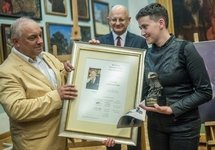
The deputy of the Verkhovna Rada of Ukraine Nadezhda Savchenko received the Polish award named after Jan Kara - the Orl statuette. It is reported by Polske Radio.
The ceremony was held on Saturday in Lublin. As the jury indicated, Savchenko’s reward was awarded "for the fortitude in the struggle for human dignity and honor."
The laureate thanked for the support that Poland provided to both her personally and the whole of Ukraine. “I am ready to ask for forgiveness and forgive,” she emphasized. “I apologize to the Polish people, from the Poles for those insults that were inflicted by Ukrainians during our difficult long history. I do not hold evil and will not remember anything that was made by the Poles to the Ukrainians.”
“I believe that at one time Poland and Ukraine could have a close and friendly story,” Savchenko continued. “But at one time, because of just such insults and disagreements, Bogdan Khmelnitsky turned towards Russia. I would really like me to go in the same direction.”
Recently, in Polish society, the theme of the Volyn massacre of 1943 has been updated, during which about 50-60 thousand Polish civilian populations cut out certain detachments of the Ukrainian rebel army. In 2013, the Polish Parliament adopted a resolution in which he recognized ethnic purges with signs of genocide. In the fall in Poland, the feature film of Wojciech of the Sublings "Volyn" is released - the first tape about the events of 1943. In Ukrainian society, they fear that the release of the film will worsen relations between the two nations.
On June 2, a group of Ukrainian politicians, clergy and intellectuals turned to a Polish society with an open letter, in which, on behalf of her nation, she asked for forgiveness for insults. The document was signed, in particular, the ex-presidents Leonid Kravchuk and Viktor Yushchenko, the Patriarch of Kiev and all Rus'-Ukrainian Filaret, the Primate of the Ukrainian Greek Catholic Church, the Svyatoslav Shevchuk, a publicist, former Soviet dissident Ivan Dzyuba, who became famous for the pamphlet, "Internationalism or Russification?" (1965), poet Dmitry Pavlychko. On June 4, a letter entitled “We forgive and ask for forgiveness” published in the Polish translation Gazeta Wyborcza.
The meaning of Savchenko’s speech as a whole coincides with the idea of this letter.
Jan Karsky (initial surname Kozelevsky; 1914-2000) - participant in resistance during the Second World War. After the start of the war in 1939, he was wounded in a battle with the Germans, and then was captured by the Soviets; After the exchange of prisoners, he was in German captivity, from where he fled. In 1940, the Gestapo was arrested in Slovakia, but liberated his associates. He carried out the tasks of the Polish government in exile both in occupied Poland and in the USA. He played an important role in the information of the Western society about the Holocaust, for which in 1982 he received the title of the Righteous of the Peoples of the world from the Jerusalem Institute "Yad Va-shhem", and in 1994 from the state of Israel-honorary citizenship. Years after World War II and Kara spoke in the United States until the end of his life.
The Karsky reward has been awarded annually since 2000. In accordance with the testament of the deceased, it is awarded to those who "are able to take care of Poland with dignity," and those who "are not Poles, but wish Poland good." In different years, the ex-president of the country Lech Valens, one of the leaders of the anti-communist movement, Yatsek Kuron; Last year, she was posthumously awarded to the co-chair of the RPR-Parnas Boris Nemtsov.