
Translated material
In Perm they are pursuing human rights activists for a textbook on Stalinist repressions
In Perm they are pursuing human rights activists for a textbook on Stalinist repressions
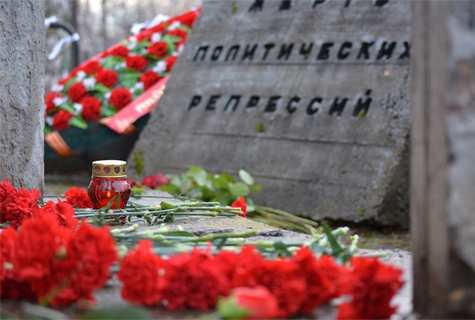 © PMem.ru
Today, June 27, the Free Historical Society and the International Society of Memorial made a statement on the persecution of the Perm Center for Civil Education and Human Rights in connection with the publication of the methodological manual for teachers “Studying at the School of the History of Stalinist repressions”.
Colta.ru gives the application completely:
We consider our civilian and professional debt to express the attitude to the persecution of the Perm Center for Civil Education and Human Rights, which is led by the Doctor of Historical Sciences, Professor Andrei Borisovich Suslov. The reason for the campaign against the center for several months was the publication in 2015 of the methodological manual for teachers “Studying at the School of the History of Stalinist repressions” (authors-compiled AB Suslov and MV Cheremny, circulation of 150 copies).
Accredited experts of the Federal Service for Service for Communications, Information Technologies and Mass Communications, attracted by Roskomnadzor to assess the content of the manual, - psychologist Zhanna Tachmamedova and teacher Irina Myasnikova, concluded about the inadmissibility of the use of this manual in the educational process.
J.K. Tachmamedova accuses the authors of discrediting children's readiness for self -sacrifice (examination, p. 9), and concludes from this that the manual contains “propaganda of the priority of personal interests over public and state”. Such propaganda, the expert believes, “forms immoral personalities, and subject to the massive distribution of such curricula, the country's security threatens” (examination, p. 10; here and further in the quotes from the examination, grammatical and stylistic features of the original are preserved).
In fact, the priority of the individual over the “state interests” is primarily asserted by the Constitution of the Russian Federation: “Man, his rights and freedoms are the highest value. Recognition, compliance and protection of the rights and freedoms of man and citizen is the obligation of the state ”(Article 2, section one -“ main provisions ”, chap. 1 -“ Fundamentals of the constitutional system ”). As a private person J.K. Tachmamedova, of course, has the right to criticize the Russian Constitution and believe that its foundations “form immoral personalities” and “threaten the security of the state”; But as an accredited expert of a state institution, she should not have done so clearly with anti -constitutional statements. And even more so, a state institution should not make decisions based on the anti -constitutional position of the expert.
However, the text of the manual that the expert refers to prove his statements refers - “Today we often hear that the end justifies the means, that in the name of a high goal, one can neglect such values as the life and freedom of an individual or even entire groups” (guide, p. 24), does not confirm the accusations of “discrediting readiness for self -sacrifice”. Obviously, this is not about self -sacrifice at all, but about violation of the rights of other people, social groups or even entire nations. Thus, the whole chain of expert reasoning is devoid of any basis and has nothing to do with the manual.
The expert claims that when using such words as “nightmare”, “terror”, “universal crazy scale” “in the lessons, a frightening oppressive atmosphere is created, which is harmful to the psyche of schoolchildren, which provokes.” Visiting places of memory or reading letters repressed (examination, p. 10–11) is equally harmful. Thus, under the pretext of taking care of the children's psyche, the expert actually proposes to deprive students of the opportunity to empathize with the victims of repression; close access to information about the heavy pages of the history of our country. Meanwhile, it is empathy, sympathy unjustly victims of playing a tremendous role in the formation of the personality of the teenager, his growing up. From the point of view of age -related psychology and pedagogy, the expert’s conclusion is not just incompetent, but frankly illiterate. Note that the formation of a sense of empathy, in particular, during a visit to Nazi concentration camps and other places of memory as an obligatory part of the educational process, is based on teaching the history of the Second World War in all countries of Western and Central Europe.
The conclusion of the second expert-I.F. is just as tendentious and incompetent from a psychological and pedagogical point of view Myasnikova, who objects to the study of the places of memory on the basis that they are able to “cause horror” (examination, p. 35). But such studies should cause horror. This horror is a cleansing, giving a chance that this will not happen again in the history of our country. On the social maladaptation of adolescents, which the expert scares, this feeling has nothing to do, on the contrary, confronts her, raising civil liability in them.
It is impossible not to add that the desire of both experts to protect schoolchildren from severe emotional experiences is included in a frank contradiction with the inclusion of the book “Archipelago Gulag” A.I. Solzhenitsyn, which was the result of the initiative of the President of the Russian Federation.
Accusing the authors of the manual of subjectivity, I.F. Myasnikova allows himself to decide what amount of knowledge about Stalinist repressions is sufficient: “In the textbook of the history of Russia for the 9th grade, the authors A.A. Danilov, L.G. Kosulin, M.Yu. Brandt, telling about the pre -war years, is quite clearly illuminated by the different aspects of the country's life, not silent to its negative pages. The impassive scientific language is also reported about the number of repressed, data on the Gulag, etc. ”are given (Expertise, p. 23). The question of whether it is necessary to talk with adolescents about historical tragedies “impassive” or, on the contrary, with an emotional language, at least argued. Recall that the exact opposite opinion is also widespread: many believe that the history of repression in modern textbooks is not illuminated enough. The methodological manual of Suslov and Cheremny provides the opportunity for those teachers who adhere to this opinion, fill out existing gaps.
The expert opinion ends with the peremptory verdict: “The manual shows the world around the world to complete distrust and fear. The manual uses inaccurate statistics ... Explored guide, using manipulation techniques and the information of the worldview of schoolchildren, form an inaccurate picture of the world, directing the purpose of the teenager towards the formation of an aggressive attitude to the state ”; “The content of the manual does not comply with the Law“ On Education ”and the requirements of the Federal State Educational Standard (Federal State Educational Standard) regarding the formation of Russian civil identity, respect for the history of the state, the education of a sense of responsibility and duty to the Motherland”.
Leaving such negative assessments of the labor of Perm historians and human rights activists on experts conscience, we note the following fundamental aspects of the problem.
The first aspect is formal: the examination is built as if we are talking about a textbook or a teaching aid, although the methodological recommendations are addressed to teachers, not to schoolchildren.
The second aspect is legal. The authors of the examination ignore a number of state legal acts. As you know, the Russian Federation has officially established the day of memory of political repression (October 30) and at the state level adopted the implementation of the “concept of state policy to perpetuate the memory of victims of political repression”, which includes “the development of educational and educational programs on this topic with their subsequent inclusion in the general educational programs of the basic general and secondary general education”.
The third aspect is substantial. In the “Perm case” we again see the clash of two approaches to the interpretation of our historical past. One announces the highest value, the other sees the foundations of a strong and sovereign state in the development of personality and civil society. In the first case, a paternalistic and, in fact, a deadly, protective model of education and socialization is reproduced. In the second case, the goal of education is the formation of just those qualities that are mentioned in educational acts - civil identity, respect for domestic history. We believe that it is the second path that is not only declared, but also actually realized in the educational practice of A.B. Suslov and his Perm colleagues gives a chance that the ideal of citizenship is formed in the country, and not the cult of citizenship.
So, an expert opinion written for Roskomnadzor under the pretext of protecting children from negative emotions is aimed at depriving students of a deep understanding of the history of the Fatherland, and hide from them the most complex, weighing episodes. Moreover, this conclusion frankly serves the rehabilitation of the Stalinist terror and is actually a call for the introduction of censorship prohibited by the Constitution of the Russian Federation, creates a precedent that may have the most sad consequences.
June 27, 2016