
Translated material
Symptom - but what?
The Russian authorities have recently seemed to offer riddles to critics and interpreters. It is discussed what the Sobyaninsky shock and unceremonious improvement of the Moscow Center, then the meanings of the Russian pavilion at the Venetian Biennale, entitled "VDNH: Urbanistic phenomenon." Everyone converges in one thing: cultural and urbanist initiatives of power-a symptom of something, but what exactly-turns out to be the subject of disagreements. After all, all decisions descend from above and are commented on by the performers only evasively ,ritory.
The representative of VDNH on Biennal creates a fractal effect that causes dizziness: the Soviet exhibition with its republican pavilions is structurally identical to international exhibitions with pavilions of different countries. The Stalin VDNH proposed to see in the USSR a full -fledged world within the big world, and today Russia claims to be such a closed, isolated integrity. And in recent years, officials began to see in VDNH a convenient and intelligible package for the new model of Russian cultural unity: an example of this is the video made by the Russia TV channel Today . VDNH has become a platform for many fashion events, one of the territories for the implementation of a program to increase the attractiveness of city parks for a young creative class. The exhibition is now exhibited there, in which the new state ideology of history was crystallized - “My story” .
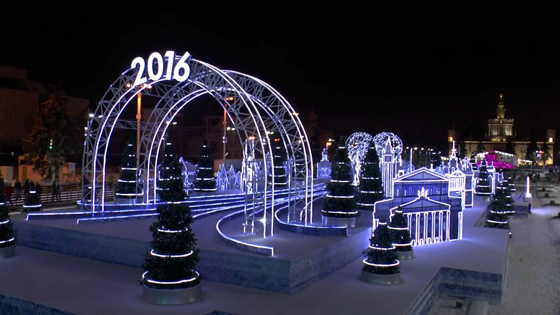 © VDNH-REASHE.rf Installation "Winter Heart of Moscow" at VDNH, 2015
The pavilion in Venice presents a detailed history of the construction of VDNH and the path to the decision of the modern authorities about its "revitalization". But the most interesting is still omitted; What exactly - Maria Silina recalled in her article on the gloomy background of the creation of the then VSHV: o collectivization, on the repressions of millions of peasants, about the Holodomor, as well as about Lysenkovsky pseudoscientific experiments in biology . International Biennale did not become a platform for the Russians discussing their own history, but only by the landfill of its triumphal representation.
In the Western press, our pavilion is mentioned as Enfant Terrible Biennale. Some are surprised at such an open reflection of the expansive policy of Russia , others see in it an absurd joke about the revival of the Stalinist style . The Rchinect publication called the exposition "an amazingly strange reminder of the history and consequences of the merger of ideology, culture and architecture or suppression of one another." Their perplexity caused, first of all, the choice of the topic.
The exhibition really looks so inappropriately among the modest social projects of neighbors adequate to the Alejandro Alejandro Avrandro theme “Reporting from the front” that the Russian organizers themselves at the opening ceremony, realizing that they were overdoing, even began to make excuses - they say, “not everyone on the topic”. Although the topic was not so demonstratively ignored, perhaps no one.
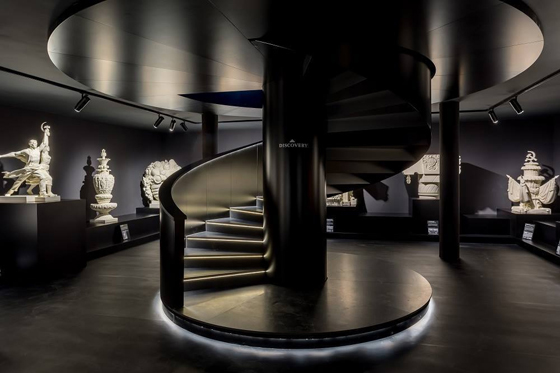 © VDNH Urban Phenomenon Hall “The Crypt” of the VDNH Urban Phenomenon project on the 15th Venetian Architectural Biennale, 2016
The curator himself Sergei Kuznetsov himself takes a neutral-shealing position in the exhibiting of the material-emphasizing that he exhibits masterpieces. His stiffness is understandable if we take into account that the curator is a major official who makes an exhibition about the concepts of his bosses. Before the opening of the exhibition, the key role in the comments of Kuznetsov was played by the injury of the spectacular power of the pavilion, as it were, the congenial VDNH: “There will be a very serious multimedia component of the exposition made by the latest technology. There will be most of the work dedicated to the uniqueness and authenticity of the masterpieces, of which VDNH consists. We attract a large team of artists, sculptors, architects to work on the project. ” Approximately in the same spirit, the Pavilion and CEO of VDNH, the souvenist of the exhibition Ekaterina Pronicheva, commented on. Both Kuznetsov and Pronichev speak of a dialogue with consumers, an example of which supposedly is the modernization of VDNH: for example, Pronicheva claims that "the exposition in the Biennal is a forum for dialogue." What exactly this dialogue consists of, the exhibition remains not quite clarified - but there is really plenty of entertainment. It is precisely this entertainment that, apparently, is offered to think as architecture - Kuznetsov throws Aradea a reproach, which does not understand, "why there is so little architecture on the architectural Biennale." At the same time, Kuznetsov believes that the appeal to Stalinist architecture is not problematic, referring to VDNH again and again: “We cannot abandon the great architecture, masterpieces of sculpture, art and park design.”
Architectural critic Nikolai Andropov sees here the formalism characteristic of the domestic architectural school:
In the Russian pavilion there is no concern to the public - there is only a dialogue of strong formal decisions of the past and present.
“The pavilion turned out to be very Russian in the sense that the dream of a domestic architect is presented there. The interior is extremely monumental thanks to the set of strong, spectacular spatial solutions. The visitor is invited to go through the crypt and go up to the panoramic cinema! From the dungeon to the pantheon! The idea of architecture as a set of dominant and spatial composition is a view typical of a Russian school. Vadim Bass wrote that this view is formed by the specific training of architects-for example, according to the textbook of VKhUTEMAS “Elements of the Architectural and Spatrows” by Vladimir Krinsky, Ivan Lamtsov and Mikhail Turkus. The textbook may be good, but he offers a view of the profession of an architect in which there is no place, for example, social sensitivity. So in the Russian pavilion there is no concern to the public - there is only a dialogue of strong formal decisions of the past and the present. There is not even a nod towards the Biennale topic: behind the exposition of our pavilion, the question of expediency and price does not arise, it seems to exist on its own. ” (Comment is given specifically for this article.)
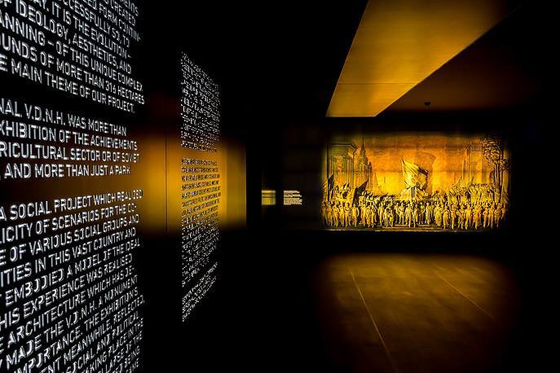 © VDNH Urban Phenomenon Hall "Intro" of the VDNH Urban Phenomenon project on the 15th Venice Architectural Biennale, 2016
The fact that the revitalization of VDNH works as a way to forget the real economic and social problems, the art critic Andrei Erofeev agrees. The non -critical renewal of VDNH, in his opinion, is a characteristic manifestation of the cultural and ideological policy of modern Putin Russia, which simultaneously calls for proud of the past and relieves responsibility for the present:
The ancestors fought for the empire. And he had a sweet share to rest on his laurels.
“For VDNH, a model of“ colonial gardens ”of the British and French empires of the XIX century was borrowed. In Paris, in the Vincennes forest, such a garden with huts, pagodas and crocodiles still accepts visitors. Around the main, state, axis, national pavilions of vassal peoples are planted. Although the former republics of the USSR gained independence, their pavilions in the territory of VDNH indicate the involvement of these regions in the “sphere of interests” of the imaginary superpower - Russia. Walking in white canvas pants by the arm with his wife and daughter, the citizen examines the owner of the owner. The ancestors fought for the empire. And he had a sweet share to rest on his laurels. Forever celebrate the victory “for yourself and for that guy”. VDNH evokes its adherents a state of euphoric relaxation and, as it were, honored by the grandfathers of the festival. From the current generation, neither feats nor shock labor are required. He is offered to relax and plunge into a nostalgic comforting dream, which not only has a therapeutic effect, helps to forget about the loss of territories and cities, about the loss of the status of superpower, about the economic crisis, but also helps to form a new proud of self -identification. This is also facilitated by the ideological turn of the authorities from the ideas of raising a “new person” to the tasks of returning to a “old man”, immersed in the past of his family, his countrymen, his ethnic group. ” (The full version of the commentary will be published in the journal "Art", No. 2 (597), 2016)
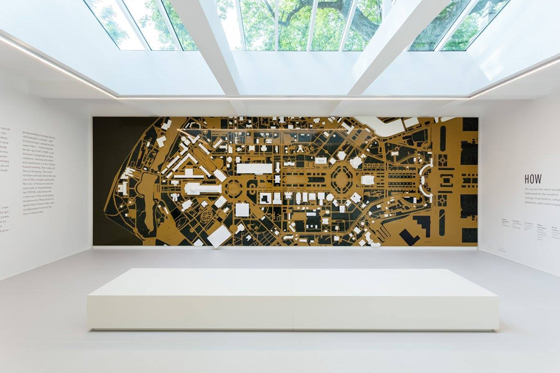 © VDNH Urban Phenomenon Hall "Future" of the project "VDNH Urban Phenomenon" on the 15th Venetian Architectural Biennale, 2016
Architecture historian Elena Kosovskaya also draws attention to the toy and hedonism of modern Russian patriotism in the form in which it is served in the pavilion:
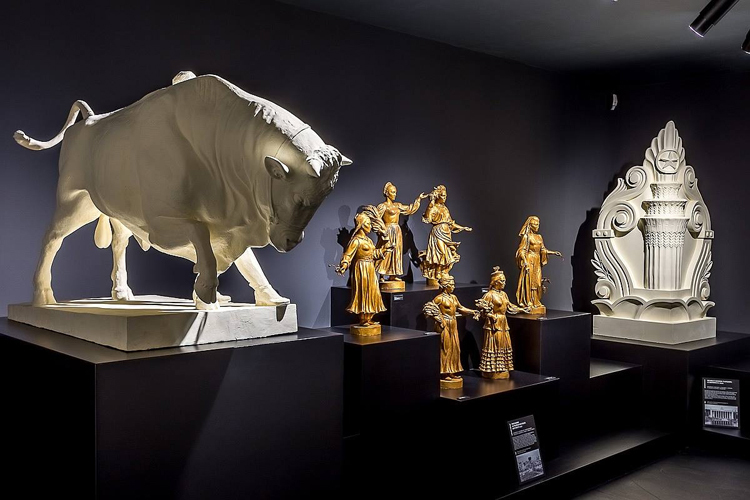
“The first sensation from the pavilion is terrible: you enter and hear brave music, you see an incredible pile of objects and the deliberate rudeness of installation. Next, the viewer is waiting for an even more terrible children's black room with a bull and other creepy mythical characters, picked up in the darkness of point illumination. When from the darkness of this room you climb the spiral staircase up, physical dizziness occurs - legs are directly swinging. Upstairs, a panoramic image turns so quickly in a circle, which seems to be going on the floor underfoot. The viewer is not clear which space is motionless because there is no landmark. But the most interesting object in the pavilion is a children's kaleidoscope at the top, where the same symbols of VDNH are spinning that were presented below with incredible pathos. It becomes clear here that all these Stalinist symbols are now only small pebbles from a kaleidoscope, in which there is no sense today. And the whole ideological pathos of the pavilion, in fact, about the meaninglessness of these symbols. About the same and a terrible black small room below. After all, only copies of VDNH sculptures are exhibited there, and reduced, which everyone who saw the originals understands. All this is just a room of toys, ideologized children's toys. They were given by the system, of course, repressive, but not as terrible as the Stalinism with which it flirts. So the exhibition, itself not wanting it and greatly overdoing with pathos, shows that we have such a room of toys in Russia. In this regard, the Russian pavilion is not so bad, because it very accurately reflects the ideological mood, now common in Russia. ” (Comment is given specifically for this article.)
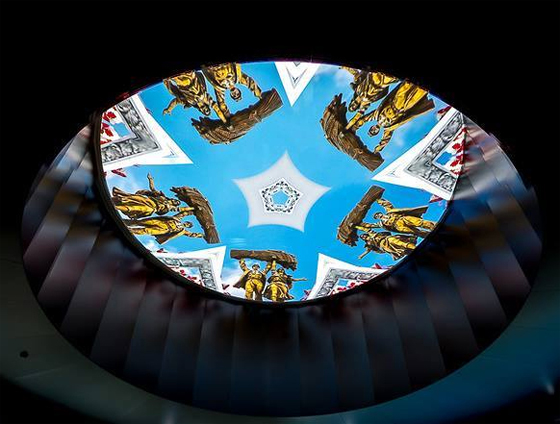 © VDNH Urban Phenomenon Hall "Discovery" of the VDNH Urban Phenomenon project on the 15th Venice Architectural Biennale, 2016
In domestic publications, the pavilion is mostly praised - especially in the official censorship publications: Izvestia newspaper reports that the Pavilion allegedly "struck Venice." But even in the relatively independent journal "Kommersant Weekend ", the architectural critic Grigory Revzin noted the veracity of the Russian pavilion as its main dignity. Moreover, he assures that it would be impossible to come up with the best and more symptomatic statement for the exhibition of Araven in our conditions:
“We made a wonderful pavilion. Here Alejandro Araven calls for every country to find where she has a front. Denmark found him in boredom of everyday life, and Germany - in millions of migrants. And where is the front? But this is obvious - our front passes through Stalinism, it has split the country in two, the fighting moves with varying success. VDNH is the main temple of Stalinism. And you seriously think that this is not related to the topic of the Biennale called “News from the front”? Yes, we have never answered the topic of Biennale more precisely. "
Revzin acts as an employee of the EE Center, lusting the interlocutor.
And further, ridicurating those who talk about the intricacy of this approach to Stalinism:
“Curators, chief architect of Moscow Sergey Kuznetsov, Director of VDNH Ekaterina Pronichev, and the commissioner of Pavilion, the rector of the Academy of Arts Semen Mikhailovsky, should finally say that state policy is rubbish, and we should fight for the rights of migrants because Germany does this. Realistic script, huh? "
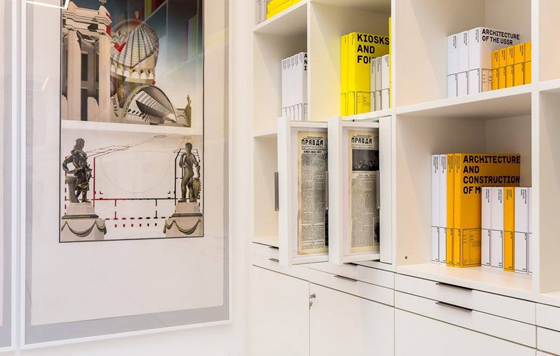 © VDNH Urban Phenomenon Hall "Researcher's Study" of the VDNH Urban Phenomenon project on the 15th Venice Architectural Biennale, 2016
 But Stop! Is it time to stop and think: how, having plunged in the interpretation, we can come to an excuse that it was originally seen by a painful symptom, the result of crowding out serious social and political problems? Grigory Revzin is a master of virtuoso justification of the state of the state, whether it be antisocial medical reform or brutal ennolation of Moscow, which is not considered the opinion of its inhabitants . Revzin acts as an employee of the EE Center, lusting the interlocutor criticizing power, and forcing him to feel that he himself is to blame for everything and that any of his arguments are absurd. But this is only an imitation of dialogue, which oven the feeling of our incompetence and ultimately only serves the refusal of the authorities to explain their decisions.
Also about the architectural Biennale in Venice in 2016, read other materials from Nikolai Erofeev:
Download the entire issue of the magazine "Disagreements" (No. 5) "On a business trip. Abroad. On the Biennale ": PDF , MOBI , EPUB